Greywater System Installation cost at a glance
- Typical range: $2,200 – $5,500
- Most homeowners pay: around $4,000
Cross-checked against seven published sources for this project. Sources used for this page: Angi, How Much Does a Grey Water System Cost? [2026 Data] (https://www.angi.com/articles/grey-water-system-cost.htm — updated Oct 29, 2026; page notes it was created with automation technology and fact-checked/edited by an Angi editor; national average $4,000; most homeowners $2,200–$5,500; advanced automated systems up to $20,000; by size 25–50 gpd $500–$2,500, 50–150 gpd $2,000–$5,000, 150–300 gpd $4,000–$9,000, 300+ gpd $8,000–$20,000+; by type simple diverter $500–$2,500, branched drain $1,000–$4,000, pumped $4,000–$10,000, automated filtration $8,000–$20,000; labour $50–$150/hr licensed plumber, NO total labour hours published; permits $50–$1,000; maintenance $100–$800/yr, filters and UV bulbs $20–$200/yr, repairs $150–$1,000, extended warranty $100–$500; DIY materials + permits $500–$1,500; water-bill savings 20–40%, payback 5–10 years; warranties 1–10 years), Modernize, Greywater Systems: Guide to Costs, Benefits, and Installation (https://modernize.com/plumbing/systems/greywater — published 2025-06-12, updated Aug 12, 2026; basic laundry-to-landscape / no-tank $800–$2,000, advanced automated $5,000–$20,000, both citing greywateraction.org; average installation $2,500–$4,500; greywater = shower, bath, bathroom sink, laundry rinse water, excludes toilets AND kitchen sinks; reuse 30–40% of indoor water, up to 40,000 gallons per year, citing waterwisegroup.com; laundry-to-landscape gravity, branched drain gravity, pumped/filtered incl. toilet flushing; permits required where plumbing is modified or pumps/filtration are included; clean filters monthly, check clogs/leaks every 3–6 months, flush tanks every 6–12 months, test soil and pH annually; DIY possible for simple laundry-to-landscape, pro advised for whole-house or pressurised systems), GreenCitizen, How To Implement A Greywater System At Home (https://greencitizen.com/blog/greywater-system/ — no publication or update date visible; DIY laundry-to-landscape $150–$700, basic branched drain $300–$1,500, pumped/filtered installed to code $1,500–$6,000+; laundry-to-landscape DIY 2–8 hours, branched drain 1–3 days, pumped/filtered pro 2–5 days; subsurface irrigation / mulch basins / subsurface drip only, never spray; California Plumbing Code Chapter 16A exempts laundry-to-landscape from construction permits if it does not alter drain/waste/vent plumbing, discharges below the mulch surface, includes a diverter valve and keeps water on the property; complex systems that cut into drainage pipes almost always require a permit and inspection; clean/replace lint filter monthly, mulch basins checked annually, flush lines to remove sediment; storage limited/discouraged, turns odorous quickly), Greywater Action / Ecology Center, Greywater Reuse fact sheet (https://ecologycenter.org/wp-content/uploads/2026/04/greywater-sheet-2.pdf — no publication date visible; the specialist nonprofit source Modernize cites for its type figures; laundry-to-landscape materials ~$200, pro $700–$2,000, no permit in CA if basic guidelines followed; branched drain materials ~$300, pro $1,000–$4,000 excluding permitting fees, usually requires a permit, best for trees and bushes, landscape must be lower than the plumbing; pumped systems materials ~$600, pro typically “in the thousands of dollars” — NO numeric band published, so none is quoted from this source; indoor non-potable reuse (toilet flushing) “more costly and complicated”, best for commercial scale or new construction, NO price published; always use plant-friendly salt/boron-free products; never store greywater more than 24 hours; water must soak in, never pool or run off), Editorial GE, Greywater System for Homes: How It Works, Cost & Safety (https://editorialge.com/greywater-system-for-homes/ — figures labelled “2024–2025 Estimates”; corroboration only, never the anchor; DIY laundry-to-landscape $500–$1,000 parts only; simple pumped pro $2,500–$5,000; whole-house automated $10,000–$20,000+ incl. dual-plumbing retrofit; greywater must be used within 24 hours; pumped-system electricity approx. $5–$20/yr; payback 3–7 years where water is expensive, 10+ years where it is cheap; California, Arizona and Texas greywater-friendly; its “family of four saves 30,000–50,000 gallons a year” carries no source and is NOT printed), University of Washington, Green Technology Research: Grey Water Systems (Cost page) (https://depts.washington.edu/dislc/GreyWaterSystems/Cost.htm — academic page, no date visible; corroboration only; initial cost approx. $1,600–$6,000). NOT used: ams11.org greywater pages (many near-identical pages with conflicting averages $4,300 / $4,800 / $5,600 / $5,800 and percentile tables with no methodology or visible authorship — appears to be an AI-content farm; its figures were NOT verified by reading and are NOT in this brief, including its 15–25 year lifespan claim and its “design and permits 10–15%, plumbing/installation ~50%, treatment ~20%” split — do not use), HomeFortifyROI water-systems calculator (single-point estimates), The Quote Yard NSW (Australian dollars, NSW regulation), SepticTankHub greywater guide (search snippets only). No Fixr, HomeGuide, Bob Vila, Forbes Home or This Old House / Homewyse dedicated greywater cost page was found in search — none exists to cite. NO source read publishes a line-item breakdown with % shares or total labour hours for greywater installation, so this page carries NO worked example and NO percentage shares.. Sources last checked: October 2026 — This Old House, Forbes Home, HomeGuide, Modernize, Fixr, Angi, Homewyse. How we calculate these costs
Cost by scope
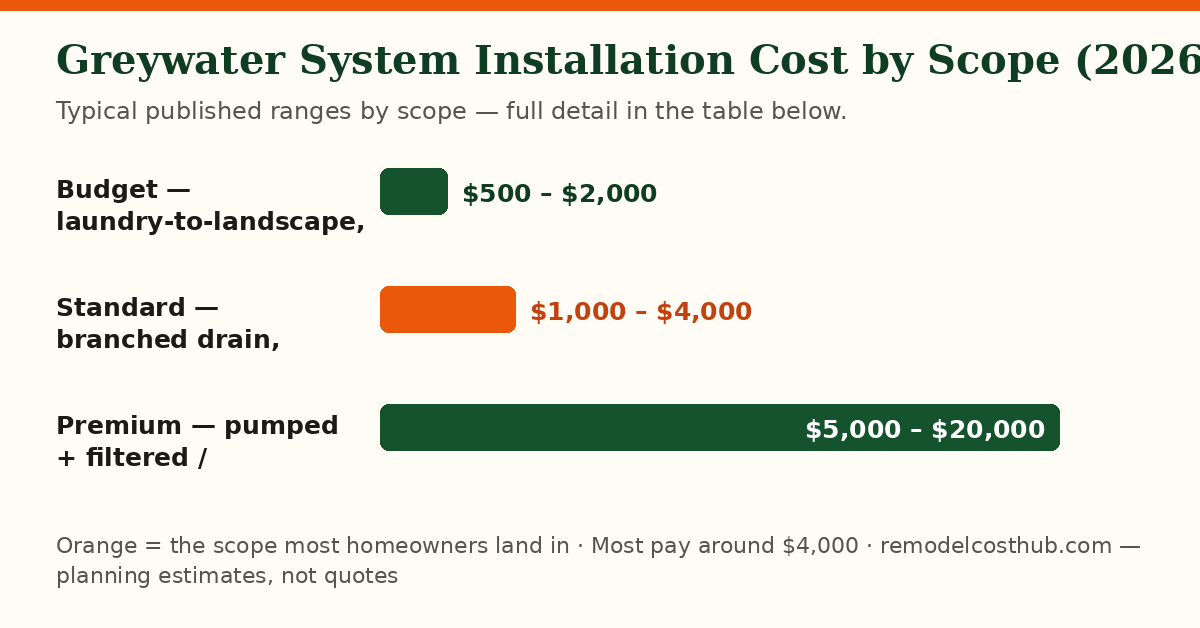
| Scope | Typical cost | What it includes |
|---|---|---|
| Budget — laundry-to-landscape, professionally installed | $500 – $2,000 | Washing-machine water only: a 3-way diverter valve, lint filter and 1-inch HDPE tubing to mulch basins — no tank, no pump, gravity only. The entry system and the only one often permit-exempt. (Angi diverter $500–$2,500; Greywater Action pro $700–$2,000; Modernize $800–$2,000; honest overlap $800–$2,000.) |
| Standard — branched drain, showers/baths + laundry, gravity | $1,000 – $4,000 | Multiple fixtures diverted through branching pipes to several subsurface irrigation outlets; a permit is usually required; the band most family-home systems land in. Filtration here is a mesh/lint filter, not disinfection. (Angi $1,000–$4,000 AND Greywater Action pro $1,000–$4,000 — the two sources agree exactly.) |
| Premium — pumped + filtered / automated whole-house system | $5,000 – $20,000 | Pump, surge tank, multi-stage filtration and disinfection (UV / chlorine), smart controls, irrigation plus toilet-flush reuse. Needs electricity, permits, backflow protection and regular professional maintenance. (Modernize advanced automated $5,000–$20,000; Angi automated filtration $8,000–$20,000; Editorial GE whole-house automated $10,000–$20,000+; honest overlap $10,000–$20,000.) |
Where the money goes
| Part of the job | Share | Note |
|---|---|---|
| Materials by system type (materials only) | No published share | Greywater Action: laundry-to-landscape ~$200; branched drain ~$300; pumped ~$600. These are MATERIALS ONLY — the professional installed totals above are several times higher because labour, routing and permits dominate. |
| Labour — licensed plumber | No published share | Angi: $50–$150 per hour for a licensed plumber; complex systems may also need a general contractor or irrigation specialist. NO source publishes total labour hours for a greywater install, so no labour total can be derived — do not multiply the hourly rate by an invented number of hours. |
| Permits | No published share | $50–$1,000 (Angi). No single national permit price exists — rules, fees and inspections vary by state, county and municipality. Simple laundry-to-landscape systems are often permit-exempt (see below); branched-drain pro totals in Greywater Action EXCLUDE permitting fees. |
| DIY materials + permits (basic DIY system, note only) | No published share | $500–$1,500 (Angi). A note only — never present a DIY parts figure as an installed price, and never present the Budget tier as DIY: the Budget tier is a pro-installed laundry-to-landscape system ($500–$2,000). |
| Running costs (not install cost) | No published share | Maintenance $100–$800 per year; filters and UV bulbs $20–$200 per year; repairs $150–$1,000 (Angi); pumped-system electricity approx. $5–$20 per year (Editorial GE). |
What moves the price most
How the figures were built — read this before the numbers: no source publishes a line-item breakdown with percentage shares for greywater installation, and no source publishes total labour hours — so there is NO worked example summing to the $4,000 pin and NO percentage shares anywhere on this page; the breakdown above is dollar ranges only, each with its source. The $4,000 most-pay figure is Angi's published national average (2026), not a derived midpoint. Per system type, professionally installed: simple diverter / laundry-to-landscape $500–$2,000 (overlap $800–$2,000); branched drain $1,000–$4,000 (Angi and Greywater Action agree exactly); pumped $4,000–$10,000 (Angi — simpler pump-only jobs $1,500–$6,000+, GreenCitizen; Editorial GE simple pumped pro $2,500–$5,000; honest overlap $4,000–$5,000, the spread is scope, not error); automated filtration / whole-house $5,000–$20,000 (overlap $10,000–$20,000). Per size, daily capacity (Angi — the only source publishing capacity bands): 25–50 gallons/day (one appliance or room) $500–$2,500; 50–150 gallons/day (small homes) $2,000–$5,000; 150–300 gallons/day (larger families/homes) $4,000–$9,000; 300+ gallons/day (extra-large / multi-unit / commercial) $8,000–$20,000+ — do not present this commercial band as a residential typical. Permits: Angi's $50–$1,000 band is for systems that need a permit; the simplest laundry-to-landscape systems may need none at all — under California Plumbing Code Chapter 16A a laundry-to-landscape system is exempt from construction permits provided it does not alter the drain/waste/vent plumbing, discharges below the mulch surface, includes a diverter valve and keeps water on the property (GreenCitizen; Greywater Action). Complex systems that cut into drainage pipes (e.g. shower drains) almost always require a permit and inspection. Skipping a required permit risks fines, forced removal or a system shutdown (Angi). What counts as greywater: showers, baths, bathroom sinks and laundry water. NOT toilet water (blackwater) and NOT kitchen-sink or dishwasher water — Modernize, Editorial GE and GreenCitizen all class kitchen water as blackwater/dark greywater because of fats and food waste; some jurisdictions differ, so check local code. Use only biodegradable, phosphate-free, boron-free detergents, and never divert water used with bleach or harsh chemicals — the 3-way diverter valve sends those loads back to the sewer (GreenCitizen). Use and storage: subsurface irrigation / mulch basins / subsurface drip only — never spray greywater (aerosol risk, disallowed in many codes). Use on ornamentals, trees and shrubs; avoid edible portions; avoid pooling and runoff. Greywater must be used within 24 hours — stored longer it turns smelly and biologically unsafe (Greywater Action; Editorial GE) — so systems use a small surge tank, not long-term storage. Savings: Angi: water-bill savings of 20–40% with a 5–10 year payback. Modernize (citing WaterWise Group): reuse 30–40% of indoor water, up to 40,000 gallons a year. Payback is fastest where water is expensive (Editorial GE: 3–7 years) and slowest where it is cheap (10+ years). Scope — what this page is not: a septic system (blackwater treatment — tank + drain field for ALL wastewater including toilets); rainwater harvesting (roof runoff, seasonal, a different water source); water filtration, softening or reverse osmosis (treatment of INCOMING potable water, not reuse of outgoing wastewater); a plumbing repipe (replacing supply/drain pipes is a different job); spray/sprinkler irrigation with greywater (never spray it); or cistern-style storage over 24 hours. Methodology: figures cross-checked across five independent data families — Angi Inc., Modernize, GreenCitizen, Greywater Action / Ecology Center, Editorial GE — with the University of Washington as academic corroboration; where sources disagree, the page publishes the honest overlap band and names the disagreement. Related costs: septic system installation, septic tank installation, plumbing repipe, water line installation, reverse osmosis installation, water filtration installation, water softener installation, sprinkler system installation, drip irrigation installation and backflow preventer installation.
Costs in your city
Labor is the biggest variable in any remodel, and labor is local — the same bathroom can price very differently in Houston than in Boston. We are adding city editions metro by metro, each with its own labor index, permit notes and climate factors, written for that city rather than copied from this page. Wave 1: Houston, Dallas–Fort Worth, Phoenix, Atlanta, Miami–South Florida, Orlando, Tampa, Charlotte, Austin and San Antonio. Until your city's page is live, use the national range here and weight it the way contractors do: Sun Belt labor often prices near or below the national middle, while coastal California and the Northeast metros often price well above it.
Frequently asked questions
How much does a greywater system cost?
Most homeowners spend $2,200–$5,500 installed, with a national average of $4,000 (Angi, 2026). Modernize's average installation range is $2,500–$4,500. The average covers all residential system types — a simple laundry system costs far less and a whole-house automated system far more, so budget by system type, not by the average alone.
How much does a greywater system cost by type?
Laundry-to-landscape professionally installed: $700–$2,000 (Greywater Action) / $800–$2,000 (Modernize). Branched drain: $1,000–$4,000 (Angi and Greywater Action agree exactly). Pumped system: $4,000–$10,000 (Angi). Automated filtration / whole-house: $8,000–$20,000 (Angi) / $5,000–$20,000 (Modernize). DIY parts only: $150–$700 for laundry-to-landscape (GreenCitizen) — not an installed price.
Do I need a permit to install a greywater system?
It depends on the system and where you live. Simple laundry-to-landscape systems are often permit-exempt — in California, Plumbing Code Chapter 16A exempts them if they do not alter drain/waste/vent plumbing, discharge below the mulch surface, include a diverter valve and keep water on the property (GreenCitizen; Greywater Action). Branched-drain and pumped/filtered systems usually require a permit and inspection. Where a permit is needed, Angi prices fees at $50–$1,000. Skipping a required permit risks fines, forced removal or a system shutdown (Angi). Always check your local building department first (Modernize).
What water counts as greywater?
Showers, baths, bathroom sinks and laundry water. NOT toilet water (blackwater) and NOT kitchen-sink or dishwasher water — Modernize, Editorial GE and GreenCitizen all class kitchen water as blackwater/dark greywater because of fats and food waste. Use only biodegradable, phosphate-free, boron-free detergents (Modernize; GreenCitizen) and never divert water used with bleach or harsh chemicals — the 3-way diverter valve sends those loads back to the sewer (GreenCitizen).
Can a greywater system flush my toilets?
Only a treated system can. Simple laundry-to-landscape and branched-drain systems are for subsurface irrigation only. Toilet flushing needs filtration and disinfection (UV/chlorine) — Angi prices automated filtration systems at $8,000–$20,000, and Greywater Action calls indoor reuse “more costly and complicated”, best suited to new construction or commercial scale. Greywater must also be used within 24 hours — stored longer it turns smelly and biologically unsafe (Greywater Action; Editorial GE) — so systems use a small surge tank, not long-term storage.
How much water and money does a greywater system save, and what does it cost to run?
Angi: water-bill savings of 20–40% with a 5–10 year payback. Modernize (citing WaterWise Group): reuse 30–40% of indoor water, up to 40,000 gallons a year. Payback is fastest where water is expensive (Editorial GE: 3–7 years) and slowest where it is cheap (10+ years). Running costs: maintenance $100–$800 a year, filters and UV bulbs $20–$200 a year, repairs $150–$1,000 (Angi). Install time: laundry-to-landscape DIY 2–8 hours; branched drain 1–3 days; pumped/filtered professionally installed 2–5 days (GreenCitizen).