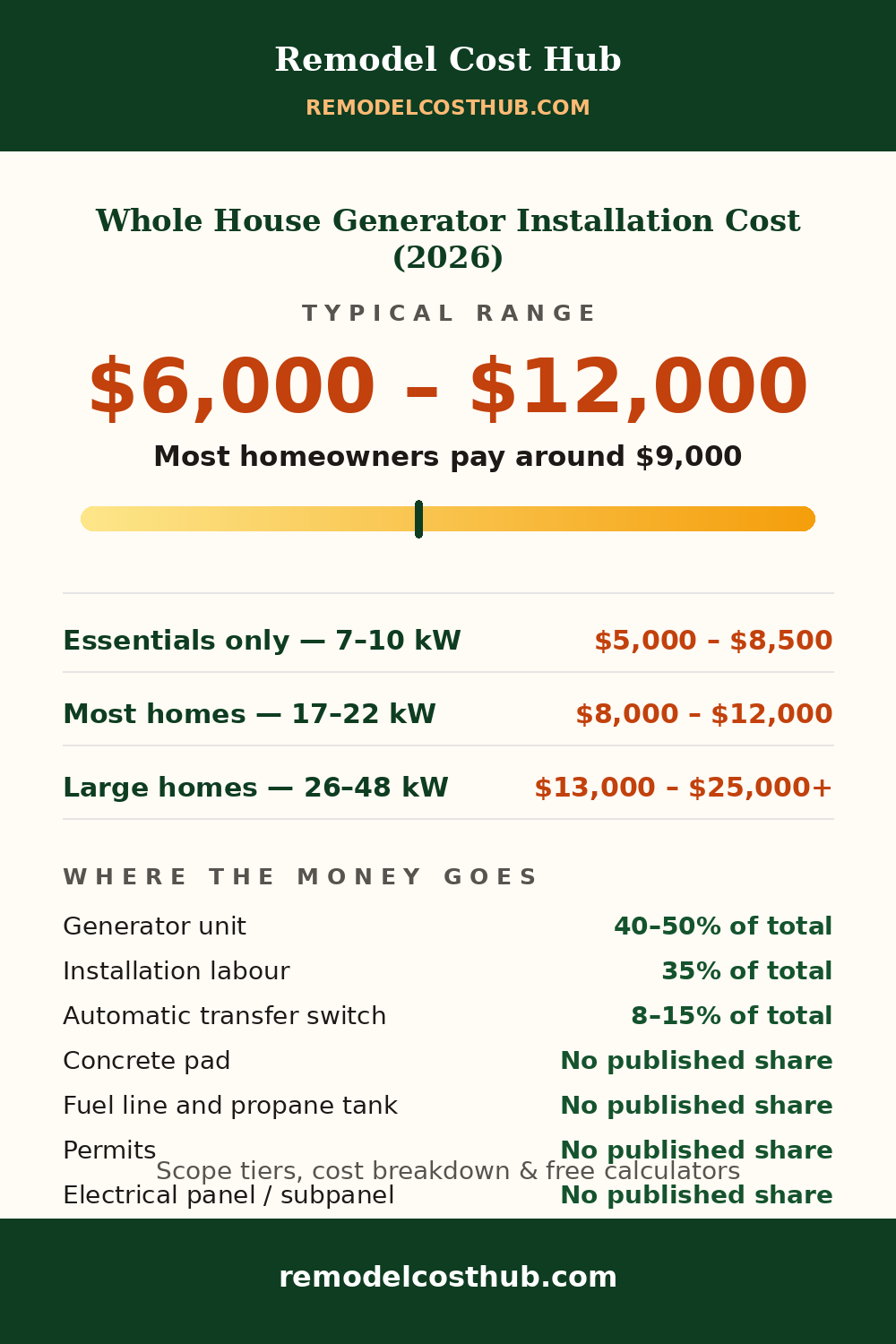
Whole House Generator Installation cost at a glance
- Typical range: $6,000 – $12,000
- Most homeowners pay: around $9,000
- Prices vary most by: Generator unit (40–50% of the budget)
Cross-checked against four published sources for this project. Sources used for this page: Angi, 'Whole House Generator Cost [2026 Data]', updated Sep 1, 2026 (4,364 verified projects; full range $350-$13,500, most pay $1,509-$8,799, national average $5,154 — its dataset mixes partial/essentials-only units with true whole-house standby; standby install average $4,520 incl. permits, assembly, placement and wiring; labour $1,500-$5,000; ATS ~$1,200 of install cost; pad ~$1,000 poured at $50-$75/sq ft; permits $50-$200; subpanel upgrade $500-$2,000; maintenance $80-$300 per visit; Angi's '$17,000 average' on the same page contradicts its own $5,154 and is NOT printed), HomeGuide, 'How Much Does a Whole House Generator Cost (2026)', updated Dec 30, 2025 (typical installed $6,000-$11,000; long distances or >20 kW $9,500-$24,000; labour $3,000-$5,000 typical, $5,000-$12,000+ long runs/>20 kW; ATS installation $600-$2,500; pre-cast pad $150-$400; gas line $12-$25/ft table vs $15-$50+/ft prose; propane tank $400-$1,800; permits $80-$450; by-fuel running costs 20 kW: natural gas $30-$40/day, propane $150-$170/day; maintenance $200-$650/year; lifespan 15-30 years / 10,000-30,000 hours; unit 40-50% of total per its city pages), Forbes Home, generator cost guide ($4,000-$25,000+ installed, average about $9,000 — figures as cited by three agreeing secondary sources, since the direct forbes.com page did not surface in search; labour $1,500-$5,000; ATS $800-$2,000; permits $50-$200), Modernize, 'Home Generator Systems', updated Aug 12, 2026 (whole home/standby installed $6,000-$12,000; worked example 2,500 sq ft North Carolina $9,000-$11,000; transfer switch $500-$1,500) and Generac, home standby solution finder + installation-cost support article (total installed $8,000-$16,000 incl. generator and installation; install-only $5,000-$10,000 average; simple installs from ~$2,000; 22 kW MSRP $6,309 alone / $7,369 with 200A ATS, Sep 2026). Synthesized typical = the $6,000-$12,000 overlap of HomeGuide, Modernize and Generac's lower band; most-pay $9,000 = Forbes Home's published whole-house average, supported by a DERIVED cross-check (midpoints of the three typical bands average $9,833). Installed-by-size figures are DERIVED (unit + $3,000-$5,000 installation) and labelled as estimates. Checked November 2026.. Sources last checked: October 2026 — Forbes Home, HomeGuide, Modernize, Angi. How we calculate these costs
Cost by scope
| Scope | Typical cost | What it includes |
|---|---|---|
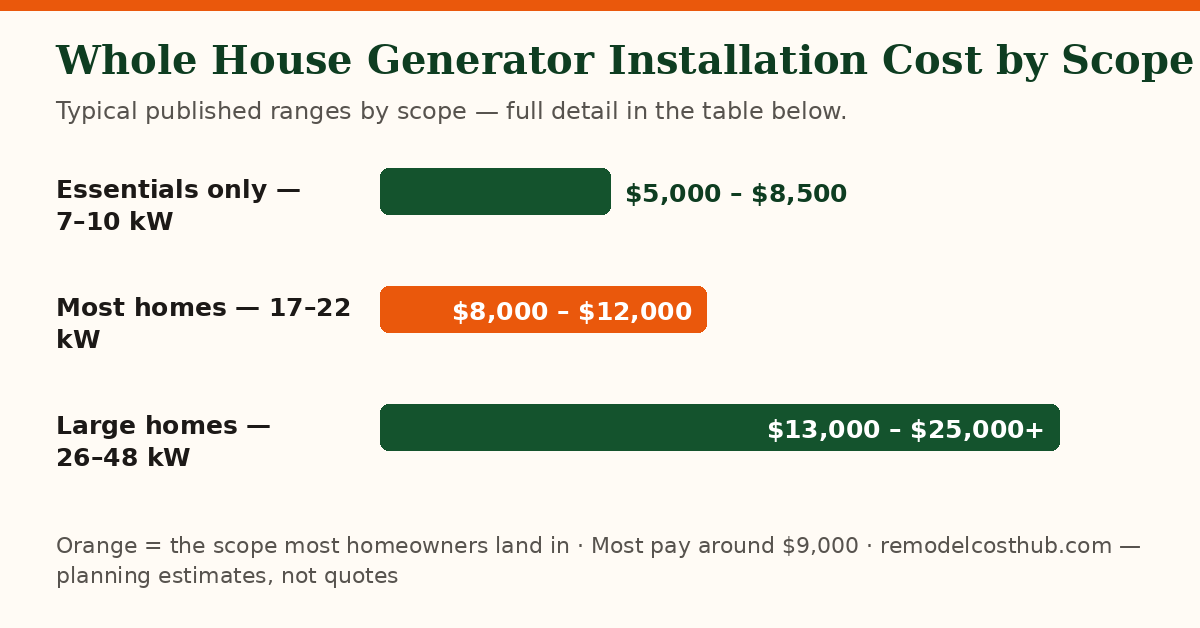
| Essentials only — 7–10 kW | $5,000 – $8,500 | A smaller standby unit covering essential circuits only: fridge, freezer, sump pump, well pump, lights and furnace fan. Unit $2,000–$3,500 (Angi, HomeGuide and Forbes agree closely). The installed total is DERIVED — unit plus $3,000–$5,000 typical installation labour (HomeGuide); no source publishes installed-by-size figures. Generac's 10 kW installed $4,500–$6,500 (secondary dealer data) sits at the low end of the tier. |
| Most homes — 17–22 kW | $8,000 – $12,000 | The standard whole-house job: a 17–22 kW unit covering a 1,500–3,000 sq ft home including one central air conditioner. Unit $4,000–$6,500; 22 kW is the best-selling size. The installed total is DERIVED (unit plus $3,000–$5,000 installation). The $9,000 most-pay sits inside this tier, and Generac's own $8,000–$16,000 total installed range brackets it. |
| Large homes — 26–48 kW | $13,000 – $25,000+ | Large or luxury homes, multiple HVAC units, electric ranges or pool heaters. Unit $10,000–$25,000 (HomeGuide/Forbes; liquid-cooled units cost more). The installed total is DERIVED and runs higher again for long fuel or electrical runs — labour $5,000–$12,000+ (HomeGuide). Forbes tops out at $25,000+ installed. |
Where the money goes
| Part of the job | Share | Note |
|---|---|---|
| Generator unit | 40–50% of total | The unit is usually 40–50% of the total project cost (HomeGuide city pages). A 22 kW Generac lists at $6,309 alone or $7,369 with a 200A automatic transfer switch (Generac MSRP, Sep 2026). HomeGuide's older 'Generac $2,000–$5,000 for 7–24 kW' line is stale against that MSRP and is NOT printed. |
| Installation labour | 35% of total | DERIVED share from the worked example below ($3,500 of a $10,000 job — the unit at 50% plus labour at 35% is the split the brief's arithmetic supports). Published labour bands: $1,500–$5,000 (Angi/Forbes), $3,000–$5,000 typical (HomeGuide), $5,000–$12,000+ for long runs or systems over 20 kW (HomeGuide); Generac's install-only average is $5,000–$10,000 (its dealer turnkey scope). |
| Automatic transfer switch | 8–15% of total | DERIVED share ($800–$1,500 on a $10,000 job). Published: ATS installation $600–$2,500 (HomeGuide), $800–$2,000 (Forbes), $500–$1,500 (Modernize); Angi puts about $1,200 of the install cost toward transfer-switch wiring. A 200A service-rated ATS is standard for whole-house jobs; a smart load manager adds $130–$300. |
| Concrete pad | No published share | A poured pad runs about $1,000 for a standard 3 ft × 6 ft slab at $50–$75 per sq ft (Angi/Forbes); a pre-cast pad is $150–$400 (HomeGuide). Different products — do not average them. |
| Fuel line and propane tank | No published share | Natural gas line $12–$25 per linear foot (HomeGuide table; its prose says up to $50+/ft). A propane tank runs $400–$1,800 installed (HomeGuide); a large new 500–1,000 gallon tank costs more. Natural gas needs no tank; propane needs a tank and refills; diesel needs manual refuelling. |
| Permits | No published share | $50–$450 total (Angi $50–$200; HomeGuide $80–$450; Forbes $50–$200). Most jobs land at $80–$200; separate electrical, plumbing and mechanical permits may apply. |
| Electrical panel / subpanel | No published share | A subpanel upgrade runs $500–$2,000 (Angi); a new circuit $570–$1,000. No source publishes a full 200-amp service-panel replacement figure in the generator context — if the existing panel cannot take the transfer switch, that upgrade is quoted separately (see our electrical panel upgrade guide). |
| Monitoring and accessories | No published share | Wireless monitoring $200–$400, smart load manager $130–$300, cold-weather kit $130–$500, generator battery $70–$300 (Angi/HomeGuide/Forbes agree closely). |
What moves the price most
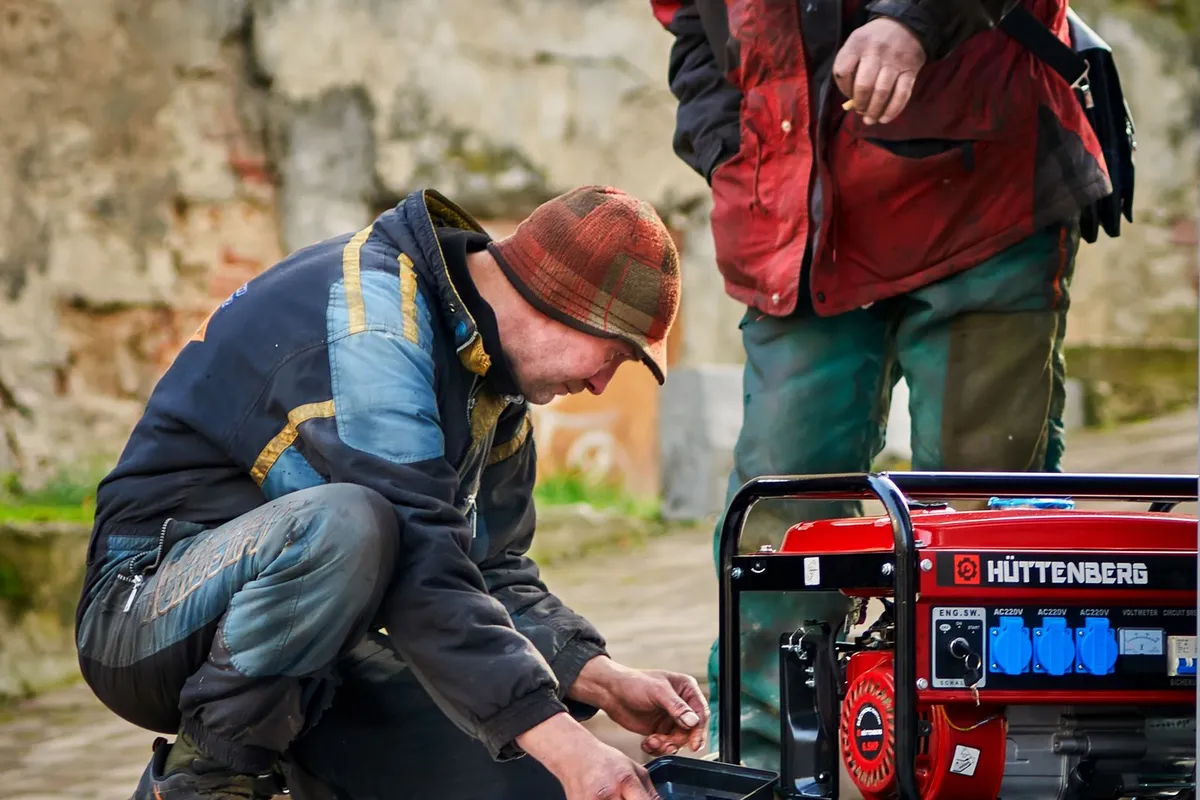
Worked example — illustrative arithmetic from published bands (not a published quote): a 22 kW whole-house job: unit $5,500 + installation labour $2,000 + automatic transfer switch $1,000 + pre-cast pad $400 + permits $100 = $9,000 — exactly the Forbes Home most-pay. Each line sits inside its published band; do NOT present the $9,000 as a contractor quote. Size is the single biggest driver: 7–10 kW units run $2,000–$3,500 (essentials only), 13–16 kW $3,000–$4,800, 17–20 kW $4,000–$6,200, 20–26 kW $4,500–$12,500, 30+ kW $10,000–$25,000 (unit only, all three primary sources agree closely). Size by square footage is only a rough guide — 1,500 sq ft needs about 7–10 kW, 2,000 sq ft 10–14 kW, 3,000 sq ft 16–20 kW+ (Angi) — the accurate method is a load calculation: add up the running plus starting watts of everything you want powered. Fuel choice decides running cost, not size: HomeGuide's by-fuel table puts a 20 kW unit at $30–$40 a day on natural gas but $150–$170 a day on propane running all day — propane costs roughly 4–5× natural gas per day for the same unit. Forbes puts a hard-working 20 kW unit at about $90 a day on gas and about $200 a day on propane or diesel, so treat the HomeGuide table as the detailed view and the Forbes figures as the high-load end. Distance matters: long runs from the electrical panel or gas meter push labour to $5,000–$12,000+ and whole jobs to $9,500–$24,000 (HomeGuide). Maintenance is real money: $80–$300 per service visit (Angi/Forbes), $200–$650 a year all-in (HomeGuide); lifespan 15–30 years or 10,000–30,000 hours with proper maintenance, and manufacturers recommend no more than about 500 hours (~3 weeks) of continuous running. What is NOT printed here: Angi's '$17,000 average whole-house generator' contradicts its own $5,154 average and $1,509–$8,799 most-pay band on the same page; Angi's annual fuel table ($2,000–$21,000 a year) is internally inconsistent with its own $90–$220 a day figure; HomeGuide's 'up to 150% ROI / +5% home value' is an attributed marketing claim with no methodology shown — a generator is resilience spending, not a money-saving device. Methodology: figures cross-checked across Angi (updated Sep 1, 2026; 4,364 verified projects), HomeGuide (updated Dec 30, 2025), Forbes Home (figures as cited by three agreeing secondary sources — the direct forbes.com page did not surface in search), Modernize (updated Aug 12, 2026) and Generac's own installation guidance. Where sources disagreed, the page publishes the honest overlap band; installed-by-size figures are derived from unit prices plus typical installation labour and are labelled as estimates. Related costs: electrical panel upgrade, solar battery installation, HVAC replacement, electrical subpanel installation, water heater replacement and home inspection.
Costs in your city
Labor is the biggest variable in any remodel, and labor is local — the same bathroom can price very differently in Houston than in Boston. We are adding city editions metro by metro, each with its own labor index, permit notes and climate factors, written for that city rather than copied from this page. Wave 1: Houston, Dallas–Fort Worth, Phoenix, Atlanta, Miami–South Florida, Orlando, Tampa, Charlotte, Austin and San Antonio. Until your city's page is live, use the national range here and weight it the way contractors do: Sun Belt labor often prices near or below the national middle, while coastal California and the Northeast metros often price well above it.
Frequently asked questions
How much does it cost to install a whole-house generator?
$6,000–$11,000 installed for a typical job (HomeGuide); $4,000–$25,000+ overall with most homeowners paying around $9,000 (Forbes Home); Generac's own range is $8,000–$16,000 including the unit. Size and site work move the final number most.
What size generator do I need for my house?
A home up to 3,000 sq ft typically needs 13–20 kW (HomeGuide); by square footage Angi suggests 1,500 sq ft 7–10 kW, 2,000 sq ft 10–14 kW, 3,000 sq ft 16–20 kW+. The accurate method is a load calculation — add up the running plus starting watts of everything you want powered. A 22 kW unit is the most common whole-house choice.
How much does a whole-house generator cost to run?
HomeGuide's by-fuel table: a 20 kW unit costs $30–$40 a day on natural gas but $150–$170 a day on propane running all day. Forbes puts a hard-working 20 kW unit at about $90 a day on gas and about $200 a day on propane or diesel. Propane costs roughly 4–5× natural gas per day — fuel choice dominates running cost.
Do I need a permit to install a whole-house generator?
Yes, in most areas — permanently installed standby units typically require permits (Angi/HomeGuide). Expect $50–$450 total (Angi $50–$200; HomeGuide $80–$450; Forbes $50–$200); separate electrical, plumbing and mechanical permits may apply. Check with the local municipality and HOA first.
How long does a whole-house generator last?
15–30 years or 10,000–30,000 hours with proper maintenance (HomeGuide); reputable brands offer 5–10 year limited warranties. Manufacturers recommend a maximum of about 500 hours (roughly 3 weeks) of continuous running. Annual professional maintenance runs $200–$650 a year (HomeGuide); per-visit servicing $80–$300 (Angi/Forbes).
Is a whole-house generator worth it — does it add home value?
It provides automatic backup during outages with no manual start and is most valuable where outages are frequent or medical and heating loads are critical. HomeGuide cites Consumer Reports and Remodeling magazine for 'up to 150% ROI / +5% value' — treat that as an attributed claim, not a measured fact. Running costs are real: budget $200–$650 a year in maintenance plus fuel. A partial generator at $3,000–$12,000 covers essentials only if the full whole-house price is too much.