Drip Irrigation Installation cost at a glance
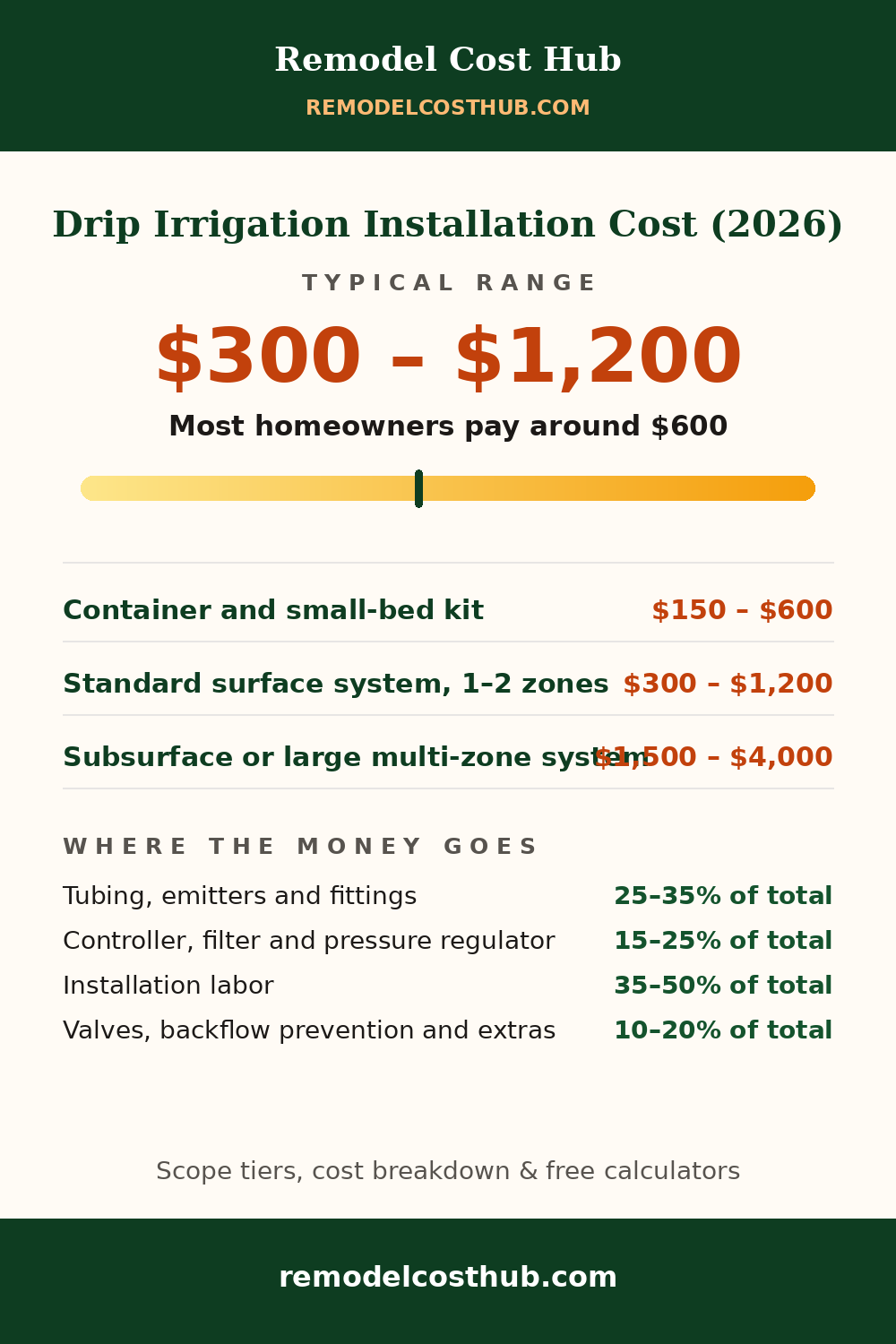
- Typical range: $300 – $1,200
- Most homeowners pay: around $600
- Prices vary most by: Installation labor (35–50% of the budget)
Cross-checked against three published sources for this project. Sources used for this page: Angi's drip irrigation system cost guide, updated October 23, 2026 (national average $350, most $310–$850; surface systems $500–$1,200, subsurface $1,500–$4,000, container/planter $150–$600; $0.50–$5 per square foot; professional labor $40–$100 per hour; permit fees $50–$200 where local codes require approval), HomeGuide's drip irrigation system cost guide ($300–$1,200 per zone or $1.50–$4.50 per square foot for above-ground lines; subsurface $1,000–$4,000 per acre; adding drip to an existing sprinkler system $300–$1,200 per zone) and LawnStarter's 2026 drip irrigation cost guide (average $520, typical range $310–$815, $1.70–$4.80 per square foot including labor and materials). Synthesized typical = the HomeGuide per-zone band overlapped with Angi's most-pay band; $600 most-pay sits inside all three bands. Checked November 2026.. Sources last checked: October 2026 — HomeGuide, Angi, LawnStarter. How we calculate these costs
Cost by scope
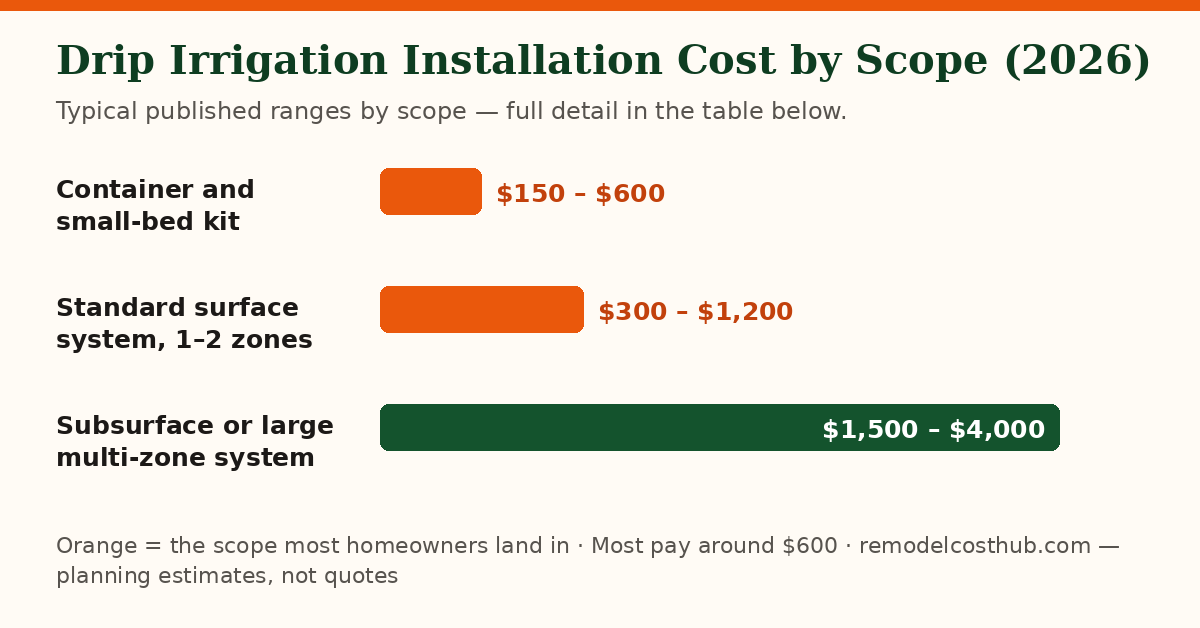
| Scope | Typical cost | What it includes |
|---|---|---|
| Container and small-bed kit | $150 – $600 | Angi's container/planter band — pots, raised beds and small spaces, often assembled as a DIY kit. |
| Standard surface system, 1–2 zones | $300 – $1,200 | The typical project on this page: HomeGuide prices above-ground drip at $300–$1,200 per zone, and Angi's 2026 data puts most residential systems at $310–$850. |
| Subsurface or large multi-zone system | $1,500 – $4,000 | Angi's subsurface band — buried lines for lawns and root-zone watering across a larger yard. |
Where the money goes
| Part of the job | Share | Note |
|---|---|---|
| Tubing, emitters and fittings | 25–35% of total | Drip line, emitters, stakes and connectors — the parts that scale with bed length |
| Controller, filter and pressure regulator | 15–25% of total | The head assembly every system needs: timer/controller, filter and regulator |
| Installation labor | 35–50% of total | Angi prices professional drip labor at $40–$100 per hour |
| Valves, backflow prevention and extras | 10–20% of total | Zone valves, a backflow device where code requires it, and permit fees of $50–$200 in Angi's data where local codes require approval |
What moves the price most
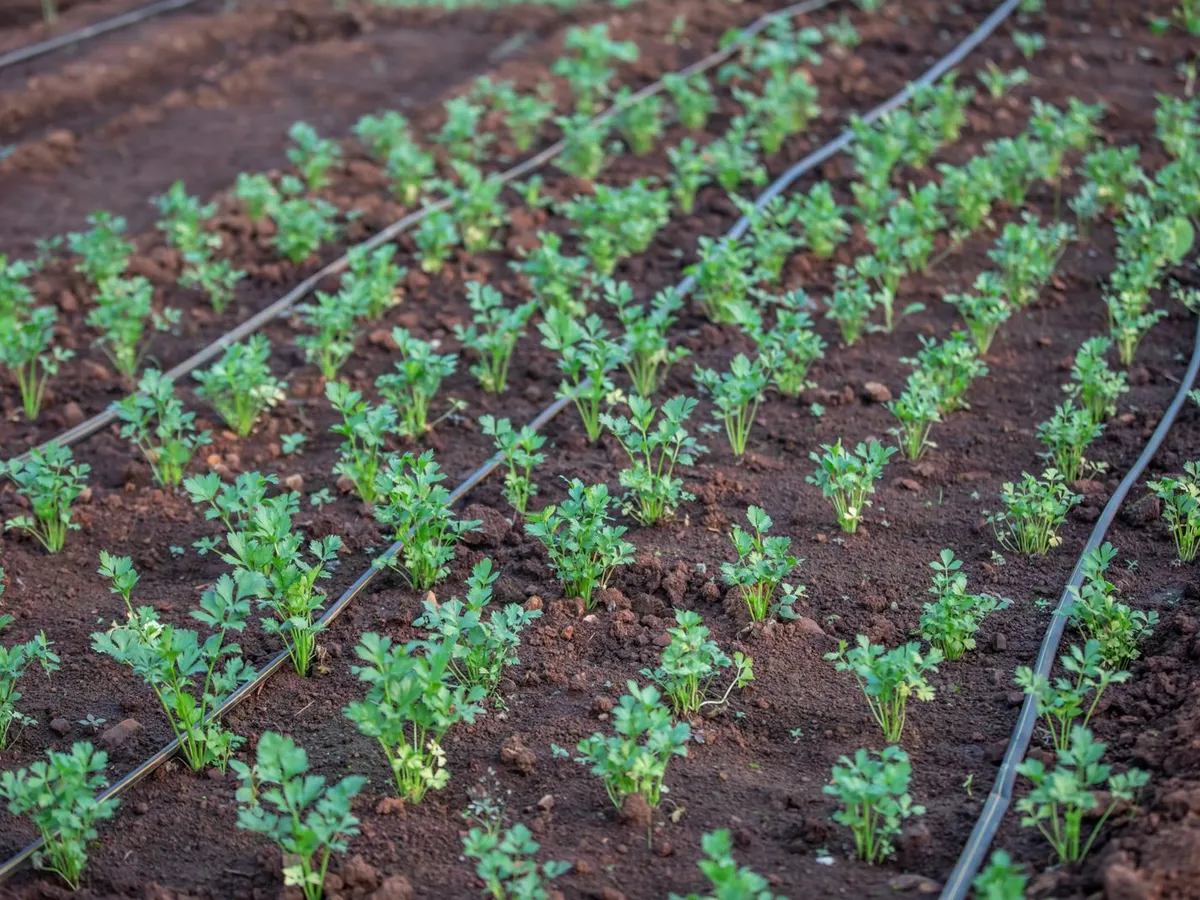
Zone count and area are the first lever: HomeGuide prices drip at $300–$1,200 per zone and $1.50–$4.50 per square foot, so a one-zone bed garden and a five-zone yard are different jobs even with the same parts. Surface versus subsurface is second: Angi prices surface systems at $500–$1,200 against $1,500–$4,000 for buried subsurface lines — burying the line is trenching work, not just parts. Water source and pressure are third: drip emitters run at low pressure and clog without filtration, so every pro install includes a filter and pressure regulator in the head assembly, and a conversion from an existing sprinkler system runs $300–$1,200 per zone in HomeGuide's pricing. DIY versus pro is fourth: Angi prices above-ground DIY kits from around $20 per 100 linear feet, against $40–$100 per hour for professional installation. Worked example at the most-pay figure: tubing and emitters $200 + controller, filter and regulator $150 + installation labor $250 = $600. Against a full sprinkler system, drip is the cheaper bed-watering choice: Angi prices professional lawn sprinkler installation at $1,636–$3,595. For that alternative, see our sprinkler system installation guide, for the water source at the house wall, see our outdoor faucet installation guide, and for the beds the system waters, see our mulch installation guide.
Costs in your city
Labor is the biggest variable in any remodel, and labor is local — the same bathroom can price very differently in Houston than in Boston. We are adding city editions metro by metro, each with its own labor index, permit notes and climate factors, written for that city rather than copied from this page. Wave 1: Houston, Dallas–Fort Worth, Phoenix, Atlanta, Miami–South Florida, Orlando, Tampa, Charlotte, Austin and San Antonio. Until your city's page is live, use the national range here and weight it the way contractors do: Sun Belt labor often prices near or below the national middle, while coastal California and the Northeast metros often price well above it.
Frequently asked questions
How much does drip irrigation installation cost?
Typically $300–$1,200 for a standard one-to-two-zone garden system, with $600 the middle of that band — HomeGuide's per-zone band, overlapped with Angi's 2026 most-pay band of $310–$850 and LawnStarter's $310–$815 typical range.
How much does drip irrigation cost per zone?
HomeGuide prices above-ground drip at $300–$1,200 per zone, or $1.50–$4.50 per square foot installed. Adding drip to an existing sprinkler system costs the same $300–$1,200 per zone, depending on whether the drip uses existing zones or needs new ones.
Is drip irrigation cheaper than a sprinkler system?
For garden beds, usually: Angi prices drip at $450–$650 per quarter acre in its sprinkler-system guide, against $1,636–$3,595 for a professionally installed lawn sprinkler system. Drip also wastes less water, since it delivers at the root instead of spraying the whole bed.
Can I add drip irrigation to an existing sprinkler system?
Yes — HomeGuide prices a sprinkler-to-drip conversion at $300–$1,200 per zone. The usual route is a conversion kit on an existing zone: filter, pressure regulator and drip tubing off the sprinkler valve, with the spray heads capped or removed.
Does drip irrigation need a filter and pressure regulator?
Yes, both: emitters run at low pressure and clog on grit, so the filter and regulator are part of every professional install, not an upgrade. Angi also notes permit fees of $50–$200 where local codes require approval, usually where a backflow device is involved.