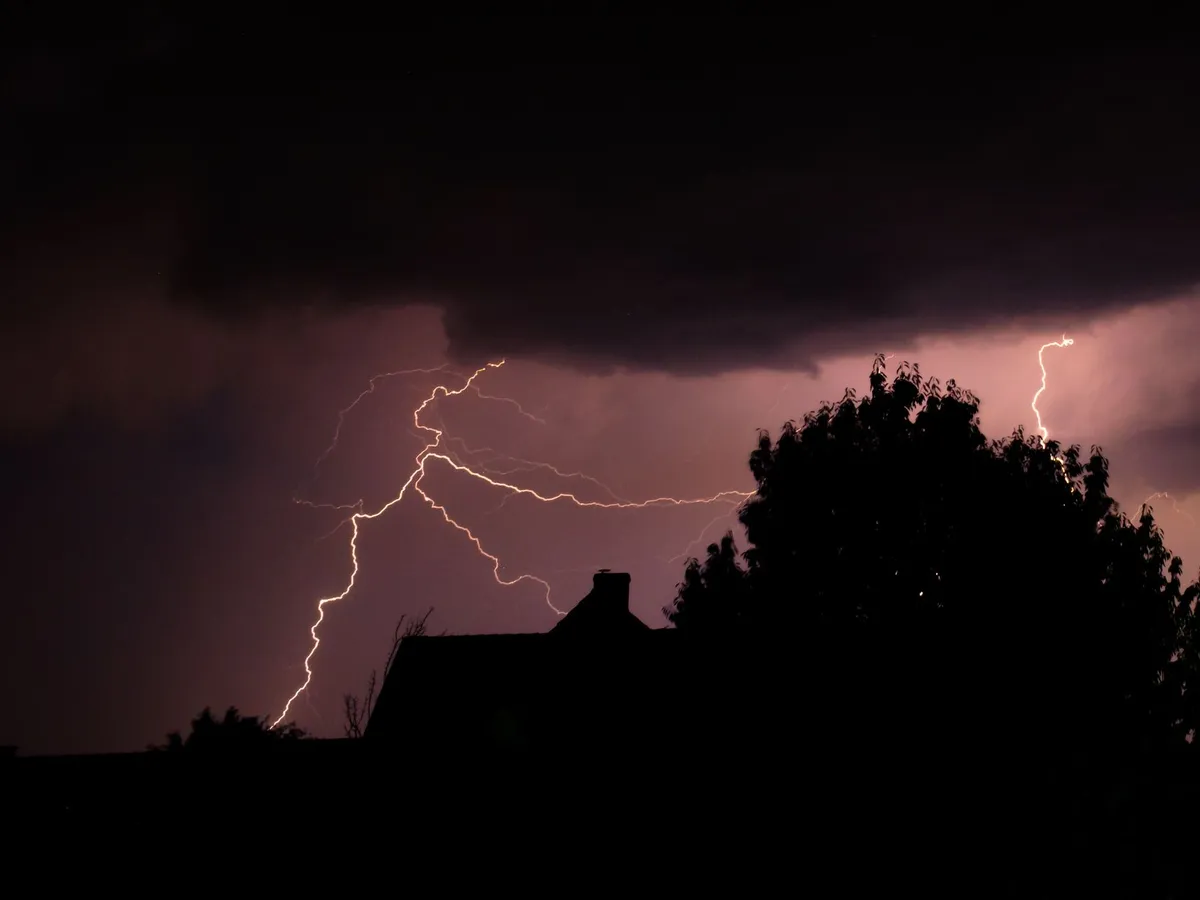
Lightning Rod Installation cost at a glance
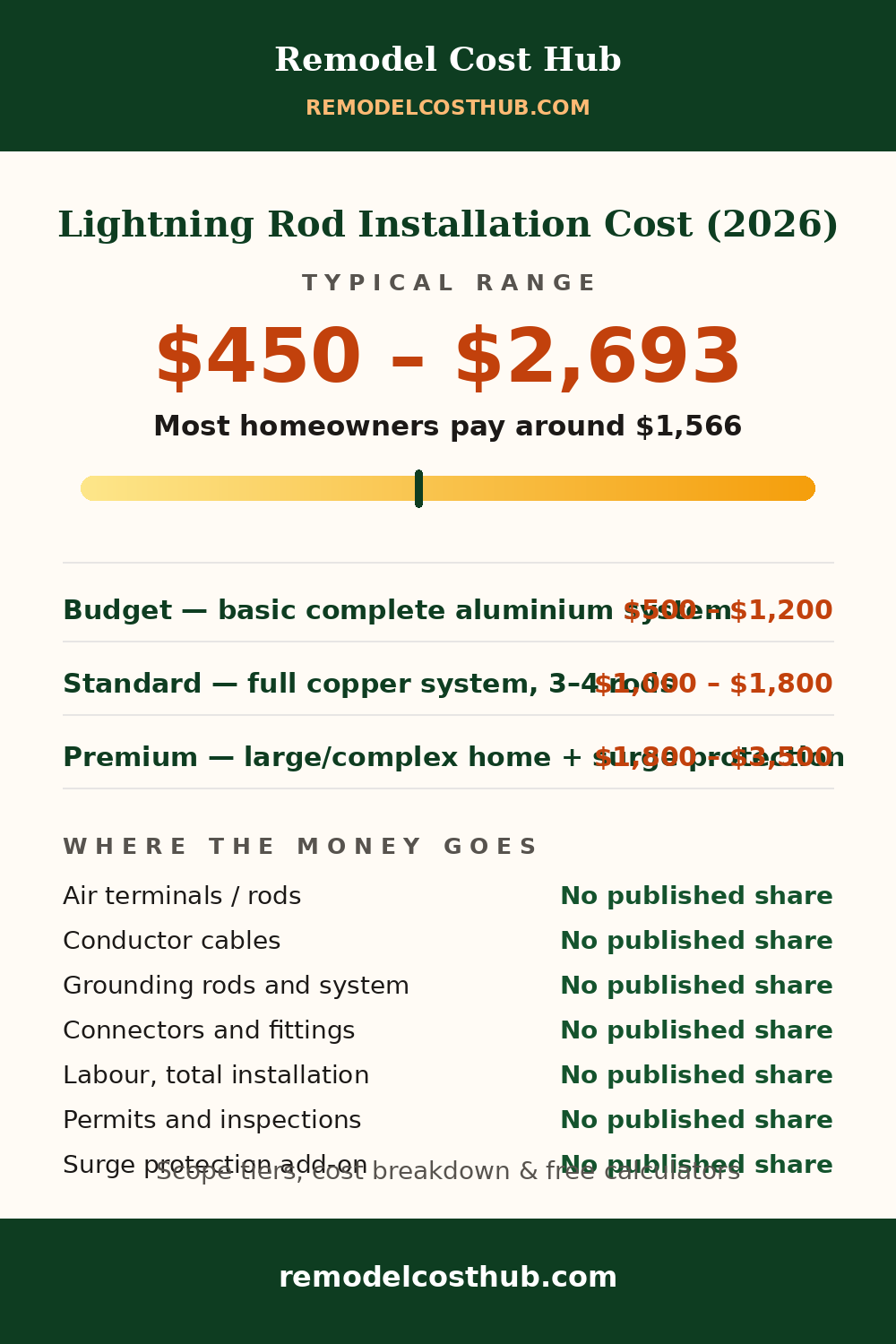
- Typical range: $450 – $2,693
- Most homeowners pay: around $1,566
Cross-checked against five published sources for this project. Sources used for this page: Angi, How Much Does Lightning Rod Installation Cost? (updated Sep 2026; national average $1,566 based on 895 verified projects; most homeowners $450–$2,693; per-rod installed prices INCLUDE installation — Franklin rod $60–$175 either metal, aluminium $50–$90, copper $125–$150, ESE air terminal $2,000–$2,500 each fully installed, usually ONE covers a whole home; materials 30–50% of total, on a $1,500 job $500–$750; labour electrician $35–$50/hr, total labour $100 to $1,000+, 1–2 copper rods $100–$200 labour, six copper rods ~$600 labour alone, ESE install labour $400–$800; overages budget a 10–20% buffer, roof repairs / wildlife removal / surge protectors $150–$700 extra; whole-house surge protectors $70–$700 average $300, outlet protectors $10–$30, lightning arresters $440–$2,300; DIY kits $1,000–$3,000 for a complete setup — savings over a pro “often smaller than homeowners expect”, not recommended; install by UL-certified professionals only, NOT a DIY project, UL-listed materials, Lightning Protection Institute standards; Angi's OTHER lightning pages, same family, same data, not separate sources: $1,555 average / $450–$2,680 hire-a-pro page and rounded $1,600 average / $450–$2,700 guides — print $1,566 / $450–$2,693 only, never the $1,555 or $1,600 variants; Angi LOCAL averages are wildly volatile and must NOT be published: Detroit $699 average ($316–$1,272), Indianapolis $3,092 ($2,162–$4,023), Los Angeles $245 ($150–$387); state table Florida $130–$350, Texas $800–$3,650, Kansas $270–$4,550 — thin local samples), HomeGuide, How Much Does Lightning Rod Installation Cost? (2026) (https://homeguide.com/costs/lightning-rod-cost — updated 2026-04-29, same data family as Angi; most homeowners $500–$2,500; full lightning protection system $700–$3,500; by home size small under 1,500 sq ft 2–3 rods $500–$1,200, MEDIUM 1,500–2,500 sq ft 3–4 rods $1,000–$1,800, large 2,500–4,000 sq ft 4–6 rods $1,500–$2,500, very large over 4,000 sq ft 6–10 rods $2,500–$4,000+; component table rods $100–$1,200, conductor cables $100–$400, grounding rods and system $100–$500, connectors and fittings $50–$150, surge protection devices $300–$1,000, labour total installation $400–$1,200; per rod aluminium $30–$100, copper $70–$150 materials, extended-length $100–$200, decorative with ornamental finial $100–$300 +$50–$100 per rod for aesthetics; basic small-home install materials $100–$600, labour $400–$700; complex rooflines labour +20–30%; steep roofs add 30–50% to labour; copper costs 40–100% more than aluminium; permits $50–$200; rocky soil adds $100–$300; by roof type added labour flat/low-pitch $0 baseline, standard-pitch shingle $100–$300, steep pitch $200–$800, slate or tile $300–$800, metal $100–$400; surge add-on basic whole-house $300–$500, advanced $500–$1,000, point-of-use $20–$80 each; savings off-season scheduling 10–20% off labour, aluminium over copper $20–$100 per rod, bulk 5+ rods 10–20% off materials, complete system package $1,000–$1,500 for a medium home; strike damage $10,000–$100,000+; most homes need 2–6 rods spaced ~20–25 ft along ridgelines; NOT DIY (NFPA 780); system lasts 30–50+ years; insurance discounts “typically 1%–5%” of annual premium; annual visual inspection recommended), EngineerFix, How Much Do Lightning Rods Cost to Install? (https://engineerfix.com/how-much-do-lightning-rods-cost-to-install/ — single-author guide, Liam, founder; NO publication or update date visible, search index last-updated ~324 days before 2026-11-11; corroboration with a specialist tilt, never the anchor; residential LPS for a standard single-family home $2,000–$4,000 complete system; labour = 50–75% of total, materials = 25–50% of total; materials typically $500–$1,500; copper air terminals $50–$200 each, grounding systems $150–$500; whole-house surge protection add-on $300–$1,000; complex roofline labour +20–30% vs a simple roof; copper systems cost ~30% more than aluminium systems; permits and inspection $50–$200; rocky/poor soil “hundreds of dollars” extra for deeper/more ground rods; maintenance professional inspection every 3–5 years $50–$200, minor repairs corroded ground rod, loose connection +$50–$100; companion page “Do I Need a Lightning Rod for My Home?”: certified complete system $1,500–$3,000 INCLUDING whole-house surge protection, insurance discounts “typically 5%–15%” — CONFLICTS with HomeGuide's 1–5%, do not resolve, print no single % figure), Fixr, Storm Damage Recovery | Cost to Repair Hail Damage (https://www.fixr.com/costs/storm-damage-recovery — updated 2025-01-31; a storm-damage guide, NOT a dedicated lightning-rod survey — its lightning-rod figure is ONE line in the “Enhancement and Improvement Costs” section; corroboration only, never the anchor; “Lightning rods cost on average between $1,000 and $2,000 to have installed”), StormHero North Texas, Lightning Rod & Storm Shelter FAQs (https://www.mystormhero.com/faqs — LPI-approved contractor, North Texas only; contractor cross-check, single-market pricing, NOT a national survey; “Most residential lightning protection systems we install in North Texas cost between $3,200 and $4,500”, driven by copper quantity and roof complexity; rods do NOT attract lightning, they intercept a strike that was going to hit anyway; surge protection alone is NOT enough — a grounding network is required; not a DIY project; LPI-approved contractor, NFPA 780 / UL 96A, UL-listed materials). NOT used: LegalClarity Lightning Rod Installation Cost (a secondary synthesis quoting HomeGuide, HomeAdvisor/Angi and All South Lightning Protection — its $2,000–$4,000 “specialty installer” figure is the same band EngineerFix publishes, not a new survey), ThePricer whole-home lightning protection guide (explicitly synthesizes Angi's $1,566 / $450–$2,693 — NOT independent), ProMatcher ($1,296 fixed-fee benchmark, as quoted in ThePricer), Farmers Insurance $0.50–$3/sq ft (quoted second-hand), Vika Construction Tanzania (non-US pricing, IEC 62305 market). Worked example ($1,550) is illustrative arithmetic from published HomeGuide component bands, NOT a published quote; aggregate shares materials 30–50% (Angi) / labour 50–75% (EngineerFix) are the only published % shares.. Sources last checked: October 2026 — HomeAdvisor, HomeGuide, Fixr, Angi, ThePricer. How we calculate these costs
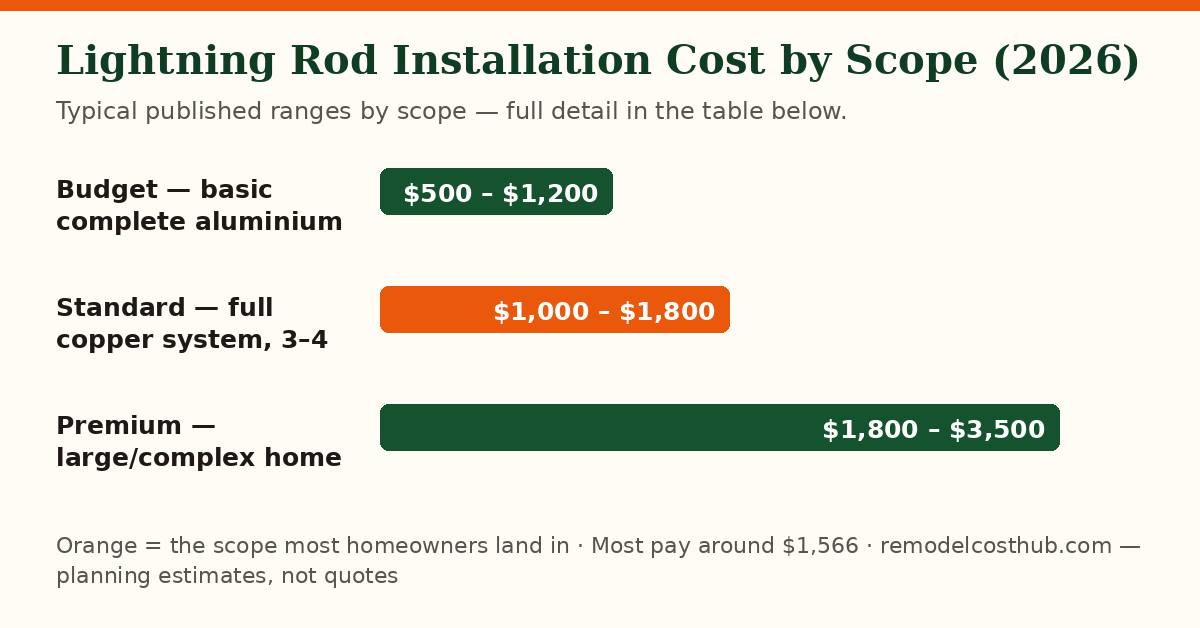
Cost by scope
| Scope | Typical cost | What it includes |
|---|---|---|
| Budget — basic complete aluminium system | $500 – $1,200 | A basic complete system for a small-to-medium home: 2–3 aluminium Franklin rods, standard conductor runs, single grounding point, basic connectors. Aluminium keeps material cost down; simple gable roof, easy access. (HomeGuide small-home band; Angi's $450 low end sits just below it.) NOTE: “rods-only” is not a real tier — a rod without grounding and conductors is not a system and no source prices one. |
| Standard — full copper system, 3–4 rods | $1,000 – $1,800 | The most-pay tier — a full copper system for the standard 2,000 sq ft home: 3–4 copper Franklin rods, copper conductors, grounding network, connectors, permit and inspection. The band most homes land in; the $1,566 published average sits inside it. (HomeGuide medium-home band.) |
| Premium — large/complex home + surge protection | $1,800 – $3,500 | A full copper system for a large/complex home PLUS whole-house surge protection ($300–$1,000 add-on) and UL/LPI inspection and certification. Steep or multi-level roof, 4–6+ rods, multiple grounding points. (HomeGuide full-system top $3,500; large-home band $1,500–$2,500 plus surge add-on.) Premium alternative, same tier, different technology: a single ESE air terminal at $2,000–$2,500 fully installed (Angi) instead of multiple Franklin rods — one terminal covers the whole home. |
Where the money goes
| Part of the job | Share | Note |
|---|---|---|
| Air terminals / rods | No published share | $100–$1,200 (HomeGuide component table). Per-rod installed prices from Angi INCLUDE installation — do not add labour on top of them: Franklin rod $60–$175 either metal; aluminium $50–$90; copper $125–$150; extended-length $100–$200; decorative with ornamental finial $100–$300 (HomeGuide). ESE air terminal $2,000–$2,500 each fully installed (Angi) — usually ONE covers a whole home, it is not a per-rod price for Franklin rods. |
| Conductor cables | No published share | $100–$400 (HomeGuide). |
| Grounding rods and system | No published share | $100–$500 (HomeGuide) / $150–$500 (EngineerFix). |
| Connectors and fittings | No published share | $50–$150 (HomeGuide). |
| Labour, total installation | No published share | $400–$1,200 (HomeGuide) / $100–$1,000+ (Angi; electrician $35–$50/hr; 1–2 copper rods $100–$200 labour; six copper rods ~$600 labour alone; ESE install labour $400–$800). Basic small-home install: materials $100–$600, labour $400–$700 (HomeGuide). Complex rooflines: labour +20–30% (EngineerFix) / steep roofs add 30–50% to labour (HomeGuide) — publish 20–50% with both sources named. |
| Permits and inspections | No published share | $50–$200 (HomeGuide AND EngineerFix agree); Angi's wider $50–$500 covers complex or multi-permit jobs — publish $50–$200 and note complex jobs can run higher. |
| Surge protection add-on | No published share | $300–$1,000 (HomeGuide AND EngineerFix agree) as an add-on inside a lightning job with extra wiring/bonding. Angi's $70–$700 (average $300) is a bare Type 2 device installed at the panel — the live surge-protector page prices that standalone device job at $200–$450 typical / $300 most; do not re-price the device here. |
What moves the price most
Worked example — illustrative arithmetic from published bands (not a published quote): medium 2,000 sq ft home, 4 copper rods, standard system: rods $400 + conductors $250 + grounding $300 + connectors $100 + labour $500 = $1,550. Each line is picked INSIDE its published HomeGuide component band; the arithmetic lands within 1% of Angi's published $1,566 national average, which is why the example is credible. Add a permit of $50–$200 on top where required. Do NOT present the $1,550 as a quote — it is a worked illustration. No percentage shares are printed on the component rows above — but the published AGGREGATE shares are: materials 30–50% of total (Angi; on a $1,500 job, $500–$750) and labour 50–75% (EngineerFix) / materials 25–50% (EngineerFix) — publishable synthesis: materials ~30–50%, labour ~50–70%. The two shares are consistent with each other. The worked example's labour line sits at the low end of the published $400–$1,200 labour band, so its materials share runs higher — component mixes vary by roof and materials choice. Per home size (HomeGuide published totals): small, under 1,500 sq ft, 2–3 rods, $500–$1,200; medium, 1,500–2,500 sq ft, 3–4 rods, $1,000–$1,800 (this page's standard spec); large, 2,500–4,000 sq ft, 4–6 rods, $1,500–$2,500; very large, over 4,000 sq ft, 6–10 rods, $2,500–$4,000+; full system (all sizes) $700–$3,500. Most homes need 2–6 rods, spaced ~20–25 ft along ridgelines, at each peak and gable end (HomeGuide). Where sources disagree: the total range is the real split — Angi $450–$2,693 and HomeGuide $500–$2,500 (most-pay bands, survey/aggregator data) vs EngineerFix $2,000–$4,000 and StormHero $3,200–$4,500 (specialist/contractor pricing). The specialist figures are NOT wrong — they describe certified, copper-heavy, full-system jobs quoted by LPI specialists, while Angi's 895-project survey includes smaller jobs and electrician-installed systems. The page publishes the Angi/HomeGuide band as typical and carries the specialist range as “certified-specialist quotes run $2,000–$4,500” — never blended into a single $450–$4,500 band. Fixr's $1,000–$2,000 sits inside the Angi/HomeGuide overlap ($1,000–$2,000) and corroborates the low-middle of the typical band; it is a single line in a storm-damage guide, not a survey. Surge add-on: Angi $70–$700 vs HomeGuide and EngineerFix $300–$1,000 — the gap is scope (see the breakdown). Permits: Angi $50–$500 vs HomeGuide $50–$200 and EngineerFix $50–$200. Copper premium: HomeGuide says copper costs 40–100% more than aluminium; EngineerFix says copper systems cost ~30% more — publish “roughly 30–100% more” with both figures named. Roof complexity: HomeGuide steep roofs add 30–50% to labour; EngineerFix complex rooflines add 20–30% — publish 20–50% with both sources named. Insurance discounts are a DIRECT CONFLICT, not resolved: HomeGuide says discounts “typically 1%–5%” of annual premium; EngineerFix's companion page says “typically 5%–15%” — the page says only that some insurers offer a discount for a UL-certified system and to ask the provider, NEVER a single % figure. Angi internal rounding variance (same data, three wordings): national average $1,566 (895 projects) vs $1,555 (hire-a-pro page) vs $1,600 rounded (guide pages); range $450–$2,693 vs $450–$2,680 vs $450–$2,700 — print $1,566 / $450–$2,693 (the 895-project figures) and never the $1,555 or $1,600 variants. Angi LOCAL averages are wildly volatile and are NOT published: Detroit $699 average ($316–$1,272), Indianapolis $3,092 average ($2,162–$4,023), Los Angeles $245 average ($150–$387); same for the state table (Florida $130–$350 vs Texas $800–$3,650 vs Kansas $270–$4,550) — thin local samples; the national figures are the only stable ones. What moves the price: home size and rod count first, then roof type and pitch (added labour: flat/low-pitch $0 baseline; standard-pitch shingle $100–$300; steep pitch $200–$800; slate or tile $300–$800; metal $100–$400 — HomeGuide), then material (copper ~30–100% more than aluminium), then soil (rocky soil adds $100–$300 for chemical ground enhancement / deeper rods — HomeGuide; EngineerFix: “hundreds of dollars” extra), then the surge add-on and certification. Budget a 10–20% overage buffer (Angi) for roof repairs, wildlife removal or surge add-ons ($150–$700). Off-season scheduling saves 10–20% off labour; aluminium over copper saves $20–$100 per rod; bulk 5+ rods saves 10–20% off materials (HomeGuide). Installation and lifespan: install by UL-certified professionals only, using UL-listed materials to Lightning Protection Institute standards (Angi) — NOT a DIY project; HomeGuide: improper installation can create a fire hazard or leave the system ineffective. EngineerFix and StormHero agree: it is outside the expertise of homeowners, general electricians, roofers and general contractors. DIY kits exist ($1,000–$3,000, Angi) but the savings are small and the risk is real. Rods do NOT attract lightning — they intercept a strike that was going to hit anyway (StormHero). A system lasts 30–50+ years with minimal maintenance (HomeGuide); copper rods last longer than aluminium (corrosion resistance). Get a professional inspection every 3–5 years at $50–$200 (EngineerFix), plus an annual visual check of connections and cables (HomeGuide), and a professional inspection after any known strike. Scope — what this page is not: a whole-house surge protector as a standalone device job ($200–$450 typical / $300 most on the live surge page — on this page surge appears only as a $300–$1,000 add-on line); an electrical panel upgrade (a separate job, a separate live page); a roof replacement (priced separately from any roof work); lightning arresters ($440–$2,300, Angi — a different device class for power/telecom lines, not part of a residential rod system); outlet / point-of-use protectors ($10–$30 each, Angi; $20–$80 each, HomeGuide — plug-in strips, not structural protection); an ESE air terminal priced per rod ($2,000–$2,500 buys ONE terminal covering a whole home — a Premium-tier alternative, never a per-rod figure); a DIY kit as a tier ($1,000–$3,000 — no source recommends DIY); decorative / ornamental rods ($100–$300 per rod — an aesthetic upgrade for historic/custom homes, a note only); or trees as protection (trees do NOT protect a house — lightning can travel through a tree and its roots into the home, StormHero). Inspection / maintenance after install ($50–$200 every 3–5 years; minor repairs +$50–$100) are running costs, not install cost. Methodology: figures cross-checked across three independent data families — Angi Inc. (Angi + HomeGuide), EngineerFix, Fixr — with the LPI-approved contractor StormHero (North Texas) as a cross-check; where sources disagree, the page publishes the honest overlap band and names the disagreement. Related costs: whole-house surge protector installation, electrical panel upgrade, electrical inspection, generator installation, roof inspection, home inspection and security system installation.
Costs in your city
Labor is the biggest variable in any remodel, and labor is local — the same bathroom can price very differently in Houston than in Boston. We are adding city editions metro by metro, each with its own labor index, permit notes and climate factors, written for that city rather than copied from this page. Wave 1: Houston, Dallas–Fort Worth, Phoenix, Atlanta, Miami–South Florida, Orlando, Tampa, Charlotte, Austin and San Antonio. Until your city's page is live, use the national range here and weight it the way contractors do: Sun Belt labor often prices near or below the national middle, while coastal California and the Northeast metros often price well above it.
Frequently asked questions
How much does lightning rod installation cost?
$450–$2,693 for most homeowners, with a national average of $1,566 (Angi, 895 verified projects, Sep 2026). HomeGuide puts most homeowners at $500–$2,500, and a standard 2,000 sq ft home at $1,000–$1,800. Certified-specialist quotes run higher, $2,000–$4,000 (EngineerFix) and up to $4,500 in North Texas (StormHero).
How many lightning rods does a house need?
Most homes need 2–6 rods (HomeGuide): 2–3 for a small home under 1,500 sq ft, 3–4 for a medium 1,500–2,500 sq ft home, 4–6 for a large home, 6–10 for a very large home. Rods sit at each peak and gable end, spaced about 20–25 ft along ridgelines (HomeGuide). A licensed installer assesses the roof and sets the count.
Can I install lightning rods myself?
No — not recommended by any source read. Angi: install by UL-certified professionals only, using UL-listed materials to Lightning Protection Institute standards. HomeGuide: improper installation can create a fire hazard or leave the system ineffective; professional install ensures NFPA 780 compliance. EngineerFix and StormHero agree: it is outside the expertise of homeowners, general electricians, roofers and general contractors. DIY kits exist ($1,000–$3,000, Angi) but the savings are small and the risk is real.
Do lightning rods protect my electronics from a strike?
Only partly. Rods protect the STRUCTURE by carrying a direct strike to ground; the electromagnetic pulse from a nearby strike can still send surges through your wiring (HomeGuide). Pair the rod system with a whole-house surge protector ($300–$1,000 add-on; HomeGuide, EngineerFix) — see our whole-house surge protector guide. And the reverse is true too: a surge protector alone will NOT stop a direct strike (live surge page FAQ).
How long does a lightning protection system last?
30–50+ years with minimal maintenance (HomeGuide). Copper rods last longer than aluminium (corrosion resistance). Get a professional inspection every 3–5 years at $50–$200 (EngineerFix), plus an annual visual check of connections and cables (HomeGuide), and a professional inspection after any known strike to the property.
Do lightning rods lower my home insurance premium?
Some insurers offer a discount for a UL-certified system — but the published figures disagree (HomeGuide 1–5% vs EngineerFix 5–15%), so no single percentage can be printed. Ask your own provider what discount it offers and what documentation it needs; most require certified professional installation (HomeGuide; EngineerFix).