Septic System Installation cost at a glance
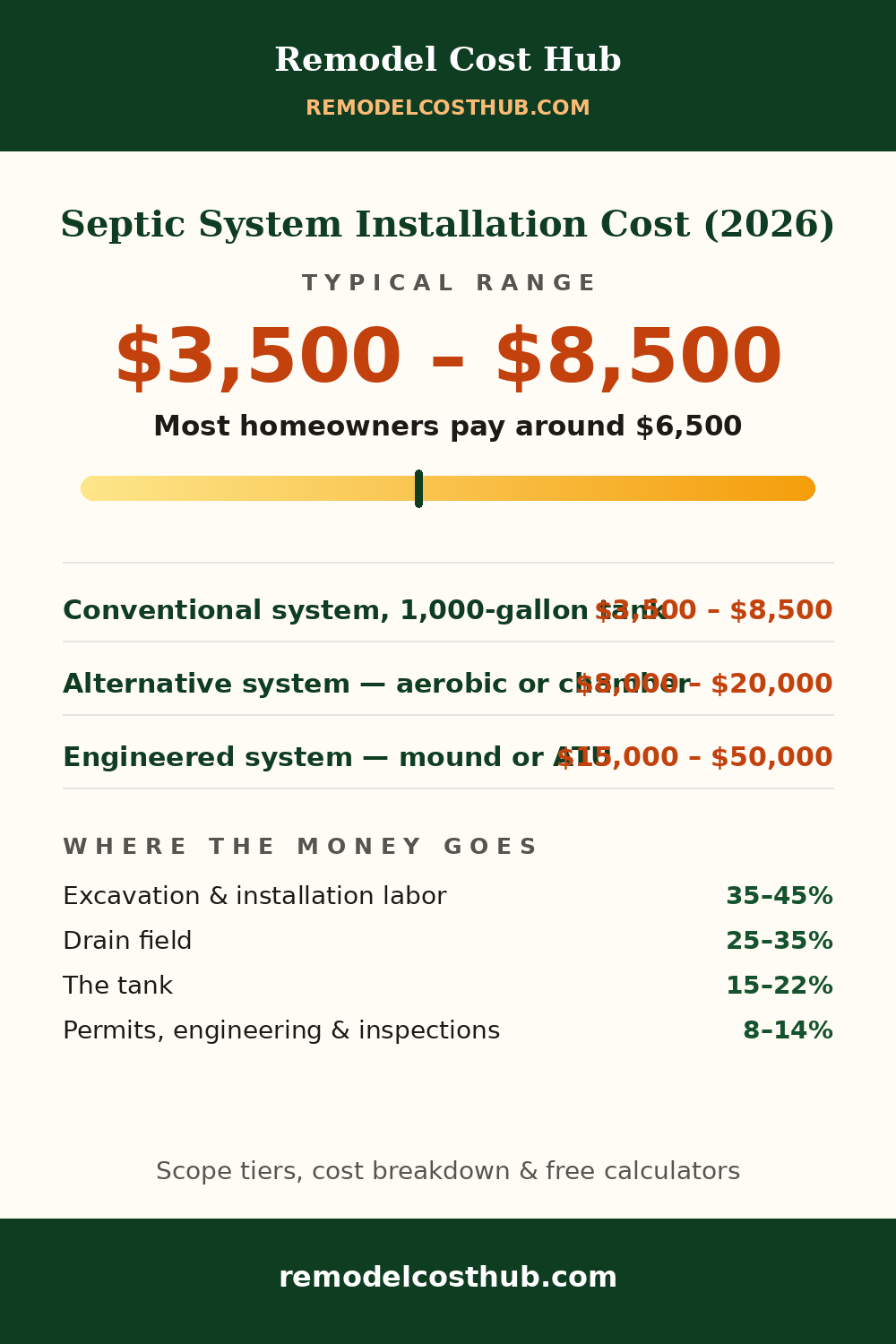
- Typical range: $3,500 – $8,500
- Most homeowners pay: around $6,500
- Prices vary most by: Excavation & installation labor (35–45% of the budget)
Cross-checked against three published sources for this project. Sources used for this page: Angi's septic system cost data, HomeGuide's septic tank system cost guide and HomeAdvisor's septic system installation cost data. Sources last checked: October 2026 — HomeAdvisor, HomeGuide, Angi. Last updated October 2026 · How we calculate these costs
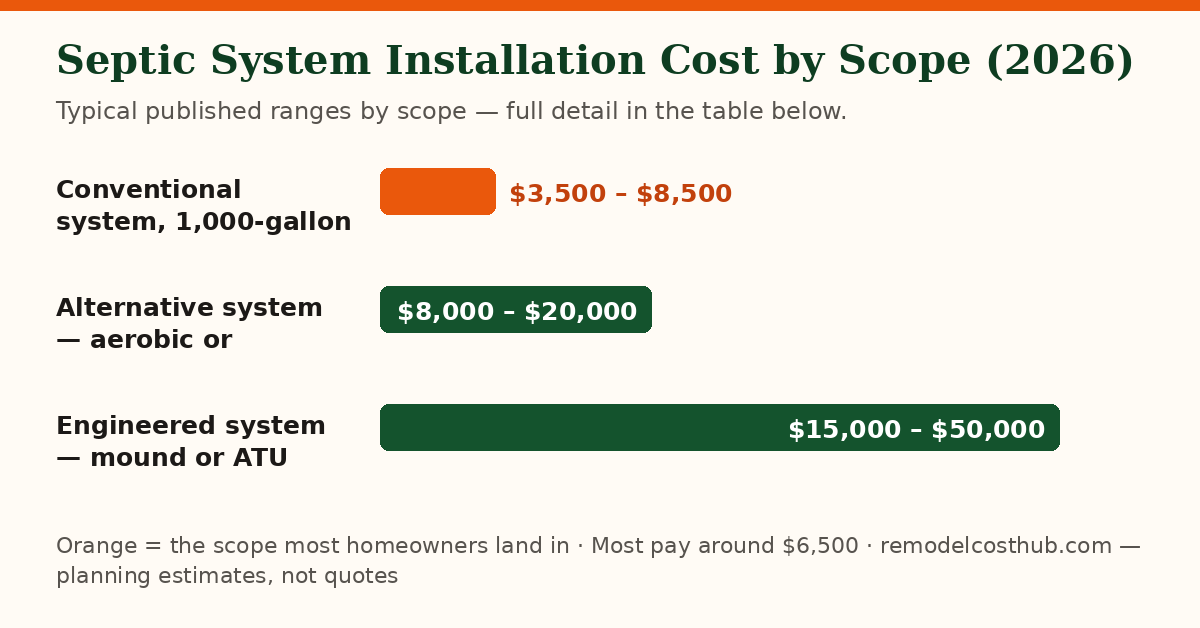
Cost by scope
| Scope | Typical cost | What it includes |
|---|---|---|
| Conventional system, 1,000-gallon tank | $3,500 – $8,500 | The typical project on this page. HomeGuide totals a conventional system at $3,500–$8,500 installed, Angi prices conventional anaerobic systems at $3,000–$8,000, and HomeAdvisor's full installation range of $3,591–$12,463 averages about $8,023 across all system types. |
| Alternative system — aerobic or chamber | $8,000 – $20,000 | For lots where a gravity field will not perc or the water table is high. Angi prices aerobic systems at $10,000–$20,000, and HomeGuide prices alternative systems at $4,000–$15,000 — the overlap is a system with treatment the soil cannot provide on its own. |
| Engineered system — mound or ATU | $15,000 – $50,000 | Designed systems for failed soils, small lots and strict setbacks. HomeGuide prices engineered systems at $15,000–$50,000, with aerobic treatment units at $20,000–$40,000 or more and mound systems at $25,000–$50,000 or more — the design, the sand and the pumps are the project. |
Where the money goes
| Part of the job | Share | Note |
|---|---|---|
| Excavation & installation labor | 35–45% | The digging and setting crew: HomeGuide prices labor and site preparation at $1,000–$4,500 of a conventional system, Angi puts labor at $4,000–$5,600 of an average installation with excavation at $1,500–$6,300 where it is priced separately, and HomeAdvisor puts labor at 50–70% of its totals |
| Drain field | 25–35% | The trenches, pipe or chambers and stone that disperse the effluent — sized by the perc test, not by preference. HomeGuide prices the distribution box alone at $500–$1,000, and a field that fails its soil test is what moves a project out of this tier and into the engineered one |
| The tank | 15–22% | HomeGuide prices a 1,000-gallon concrete tank at $1,000–$1,500, a 1,250-gallon at $1,200–$1,800 and a 1,500-gallon at $1,500–$2,500; tank size is set by bedroom count under most local codes, and concrete tanks are rated at 20 to 30 years of life |
| Permits, engineering & inspections | 8–14% | HomeGuide prices engineering, permits and inspections at $1,000–$1,500 of a conventional system and permitting, inspection and soil testing at $1,000–$2,000 overall; HomeAdvisor prices permits at $450–$2,300 and soil engineers at $700–$2,000 — the perc test result decides the whole design |
What moves the price most
The soil decides the system, and the system decides the price. A lot that percs well takes the conventional system on this page; a failed perc test moves the same house to an alternative or engineered design at two to five times the money — HomeGuide's spread between conventional at $3,500–$8,500 and engineered at $15,000–$50,000 is mostly a soil story. Bedroom count sets the tank: HomeGuide prices tanks from $700–$1,200 at 750 gallons to $1,500–$2,500 at 1,500 gallons, and codes size the system to bedrooms, not bathrooms. Excavation is the swing line: Angi prices it at $1,500–$6,300 where it is not inside the quote, and rock, a high water table or a long run from the house all dig slower. Access matters: the tank arrives on a truck and is set by machine, so a tight or fenced lot adds handling time. And the old system's exit is a line too — decommissioning or removing a failed tank is priced separately from the new install in most bids.
Worked example: how a typical septic system installation budget breaks down
A typical job: a conventional system for a 3-bedroom home — perc test passed, 1,000-gallon concrete tank set by crane truck, distribution box and three gravity drain-field trenches dug and piped, the whole system inspected before a single trench is backfilled. The budget below totals $6,500 — the "most homeowners pay around" figure from the top of this page — split using this page's own cost breakdown. It shows how a real quote at that level is usually composed; every line is built from the ranges on this page, and it is an illustration, not a quote for your project.
| Line item | Example budget |
|---|---|
| Excavation & installation labor | $2,600 |
| Drain field (trenches, pipe & stone) | $1,950 |
| 1,000-gallon concrete tank | $1,250 |
| Permits, engineering & inspections | $700 |
| Total | $6,500 |
What most people get wrong
- Getting quotes before the perc test — the soil result chooses the system, and HomeGuide's spread from $3,500–$8,500 conventional to $15,000–$50,000 engineered means a pre-test quote is a guess wearing a number.
- Comparing a tank-only price with a full-system price — HomeGuide prices the 1,000-gallon tank at $1,000–$1,500, which is under a fifth of the typical installed total on this page.
- Accepting a bid with excavation buried in a lump sum — Angi prices excavation at $1,500–$6,300 where it is separate, and rock or a high water table is discovered by the bucket, not by the brochure.
- Skipping pumping to save $300–$700 — HomeGuide prices pumping every 3 to 5 years at that figure, and the failure it prevents is a drain field replacement priced like a new system.
Costs in your city
Septic pricing is set by your county health department and your soil more than by your market. Permits, inspection and soil testing run $1,000–$2,000 in HomeGuide and permits alone run $450–$2,300 in HomeAdvisor, with the fee schedule and the setback rules — distance from wells, water lines and property lines — written locally. Labor follows the same pattern: HomeGuide prices labor and site preparation at $1,000–$4,500 on a conventional system, and rocky, wet or tight lots dig at the top of it everywhere. The tank itself is the closest thing to a national price, at $1,000–$1,500 for 1,000 gallons in HomeGuide. Ask each bidder whether the perc test, the design, excavation and the final inspection are inside the number — on a septic quote, the exclusions are where the money hides.
Frequently asked questions
How much does it cost to install a septic system?
Most homeowners pay $3,500–$8,500 for a conventional septic system installed, with $6,500 typical for a 1,000-gallon tank and a gravity drain field. HomeGuide totals conventional systems at $3,500–$8,500, Angi prices conventional anaerobic systems at $3,000–$8,000, and HomeAdvisor averages about $8,023 across all system types.
How much does a septic system cost by type?
Conventional systems run $3,500–$8,500 in HomeGuide and $3,000–$8,000 in Angi. Aerobic systems run $10,000–$20,000 in Angi, alternative systems $4,000–$15,000 in HomeGuide, and engineered systems — mound and advanced treatment designs — $15,000–$50,000 in HomeGuide. The type is chosen by your soil test, not by preference.
How long does a septic system last?
HomeGuide rates a concrete tank at 20 to 30 years of life. The drain field is the shorter-lived half of the system, and its life is set by water use and maintenance — which is why the pumping interval below matters more than the tank material.
How much does septic tank pumping cost?
HomeGuide prices pumping at $300–$700 every 3 to 5 years. It is the cheapest maintenance in this entire guide: a neglected tank sends solids into the drain field, and a failed field is a replacement project priced like the engineered tier, not a service call.
Do I need a permit to install a septic system?
Yes — every source's breakdown carries the line. HomeGuide prices engineering, permits and inspections at $1,000–$1,500 of a conventional system, with soil testing inside its $1,000–$2,000 permitting total, and HomeAdvisor prices permits at $450–$2,300 with soil engineers at $700–$2,000. The perc test comes first: its result is what the permit, and the design, are built on.