Plumbing Repipe cost at a glance
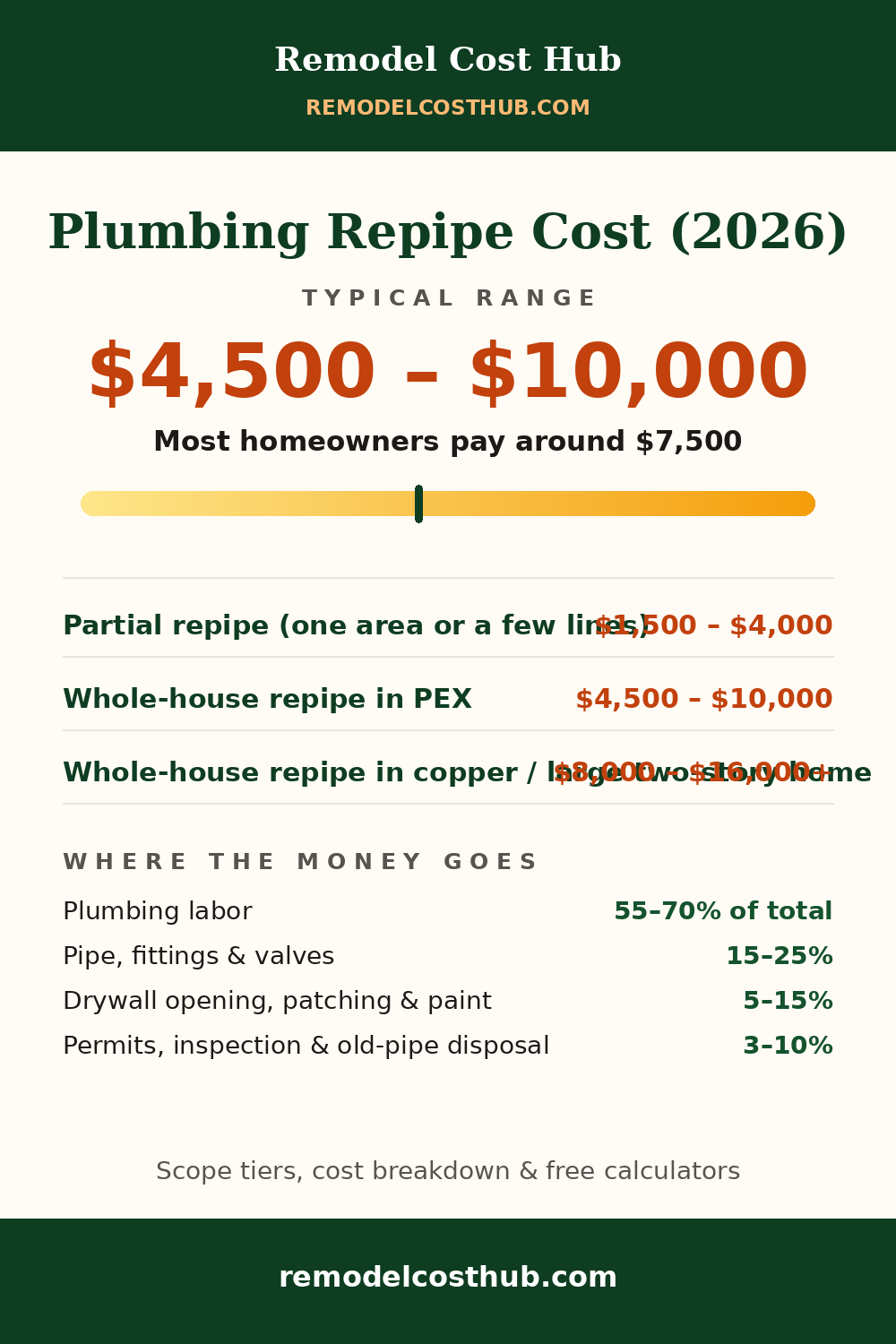
- Typical range: $4,500 – $10,000
- Most homeowners pay: around $7,500
- Prices vary most by: Plumbing labor (55–70% of the budget)
Cross-checked against three published sources for this project. Sources used for this page: the Angi repipe and pipe replacement cost guides, HomeGuide's repipe cost data and the Benjamin Franklin Plumbing repiping cost guide. Sources last checked: October 2026 — Benjamin Franklin Plumbing, HomeGuide, Angi. Last updated October 2026 · How we calculate these costs
Cost by scope
| Scope | Typical cost | What it includes |
|---|---|---|
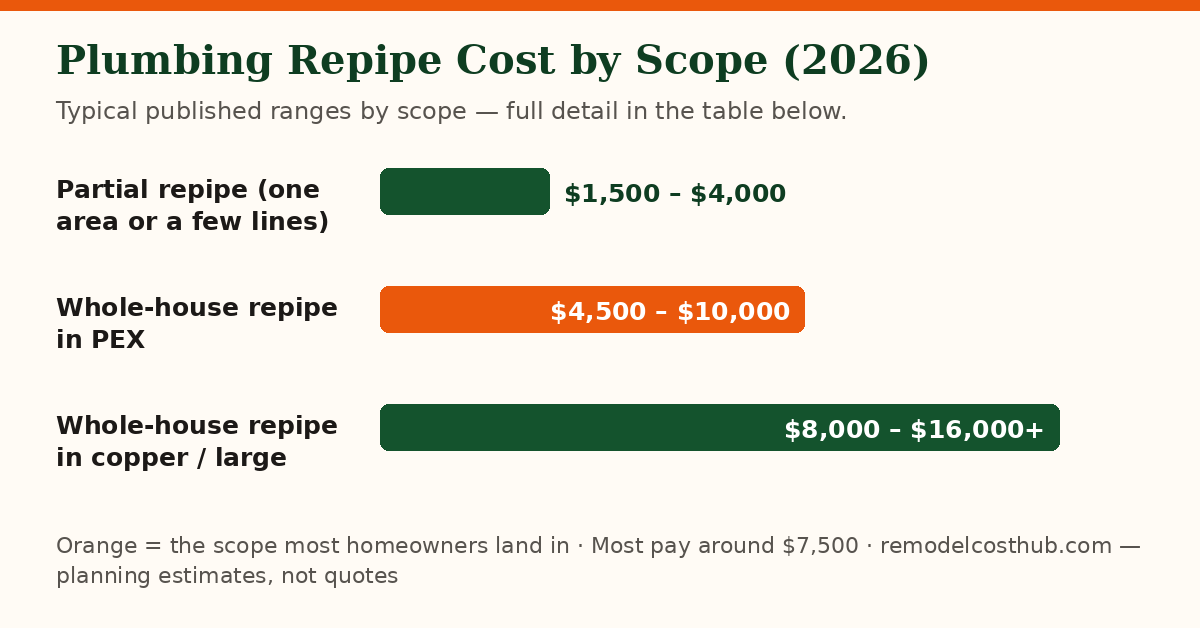
| Partial repipe (one area or a few lines) | $1,500 – $4,000 | Replacing the failing section only — one bathroom's supply lines, a corroded run in the basement, or the lines to one floor — while the rest of the system stays |
| Whole-house repipe in PEX | $4,500 – $10,000 | All supply lines replaced in PEX, fixtures reconnected, permit and inspection included — where most full repipes land; drywall patching is sometimes quoted separately, so confirm it in writing |
| Whole-house repipe in copper / large two-story home | $8,000 – $16,000+ | Copper throughout (HomeGuide prices a 2,000 sq ft copper repipe at $8,000–$16,000), or a large or two-story home in any material — more footage, more fixtures, more wall access |
Where the money goes
| Part of the job | Share | Note |
|---|---|---|
| Plumbing labor | 55–70% of total | The largest share in every published guide — Angi puts labor at about 70% of a repipe bill, because routing new lines through a finished house is slow, skilled work |
| Pipe, fittings & valves | 15–25% | PEX tubing itself is cheap per foot ($0.40–$2 in Angi's data); copper at $2–$8 per foot is what pushes this line up |
| Drywall opening, patching & paint | 5–15% | Modern repipes use targeted access holes rather than removing whole walls, but every hole still has to be patched, textured and painted — sometimes by a separate trade |
| Permits, inspection & old-pipe disposal | 3–10% | Permit fees commonly run a few hundred dollars; hauling out the old galvanized or copper is usually bundled but worth confirming |
What moves the price most
Pipe material is the first and biggest lever. Angi prices PEX at $0.40–$2 per linear foot against copper at $2–$8, and the gap is not just material: flexible PEX snakes through wall cavities with far fewer joints and far fewer access holes, so it installs faster as well. HomeGuide's totals show the result — a 2,000 sq ft home at roughly $2,000–$4,000 in PEX against $8,000–$16,000 in copper. Access is the second cliff. A home with an unfinished basement, crawl space or accessible attic lets the crew run lines from below or above; a slab foundation forces overhead rerouting or slab work, and finished walls, tile and plaster each add careful cutting and repair. Fixture count comes third — every bathroom, kitchen, laundry and hose bib is a branch with its own connections, which is why a three-bath two-story prices nothing like a one-bath ranch of the same square footage. Finally, what 'repipe' includes in the quote: plumbing-only and all-in (drywall patched and painted) can differ by thousands on the same house, so get the finish level in writing before comparing bids.
Worked example: how a typical plumbing repipe budget breaks down
A typical job: a whole-house repipe in PEX of an average single-story home, old supply lines abandoned or removed, walls opened and patched ready for paint. The budget below totals $7,500 — the "most homeowners pay around" figure from the top of this page — split using this page's own cost breakdown. It shows how a real quote at that level is usually composed; every line is built from the ranges on this page, and it is an illustration, not a quote for your project.
| Line item | Example budget |
|---|---|
| Licensed plumbing labor | $4,650 |
| PEX pipe, fittings and valves | $1,500 |
| Drywall opening, patching and making good | $825 |
| Permit, inspection and old-pipe disposal | $525 |
| Total | $7,500 |
What most people get wrong
- Accepting a low bid that ends at the pipe — opening, patching and repainting walls is part of the real job, and a quote that omits it is a quote for two-thirds of a repipe.
- Repiping only the lines that have failed so far — in a system failing from age and corrosion, the untouched lines are next season's leak, priced at emergency rates.
- Not planning the water-off days — a whole-house repipe means living without water on a schedule, and households that plan it (and those that do not) have very different weeks.
- Choosing pipe material on price alone — water chemistry argues for or against copper in different places, and the local plumber's reasoning is worth hearing before deciding.
Costs in your city
Repipes follow the age and construction of the local housing stock. Pre-war and post-war neighborhoods with galvanized pipe are the heartland of this job; slab-on-grade Sun Belt homes often need lines rerouted overhead through the attic, which changes the labor picture entirely; and regions with aggressive or acidic water watch copper develop pinhole leaks that other regions never see. Two-story homes cost more everywhere, and permit practice for repipes ranges from routine to rigorous by city.
Frequently asked questions
How much does it cost to repipe a whole house?
Most whole-house repipes land between $1,500 and $15,000 across all home sizes and materials in Angi's data, with an average around $7,500. A standard PEX repipe of an average home sits in the $4,500–$10,000 band on this page; copper and large two-story homes run higher.
How long does a whole-house repipe take?
A small one-bath home commonly takes about 2–3 days; larger homes with several bathrooms typically run 3 days to a week. Water is usually shut off during working hours and restored each evening, so most owners stay in the house.
Is PEX or copper better for a repipe?
PEX is the value choice for most homes: cheaper material, faster installation, no corrosion and good freeze tolerance. Copper costs considerably more installed but has the longest proven track record and suits exposed runs or owners who simply prefer metal. Both are code-approved in most areas — ask what your local code and your plumber recommend for your water chemistry.
Do I need a permit to repipe a house?
In most jurisdictions, yes — repiping is permitted, inspected work, and published guides put permit fees at roughly $150–$600. Unpermitted plumbing tends to surface at resale and can complicate insurance claims, so a quote that suggests skipping the permit is a warning sign.
Can I repipe my house myself?
PEX is the most DIY-friendly pipe material, and some owners do tackle partial runs. A whole-house repipe adds permit and inspection requirements, correct sizing for pressure and flow, and real liability if a concealed joint fails behind a wall. Most homeowners hire a licensed plumber for the full job and keep DIY to fixture-level work.