Backflow Preventer Installation cost at a glance
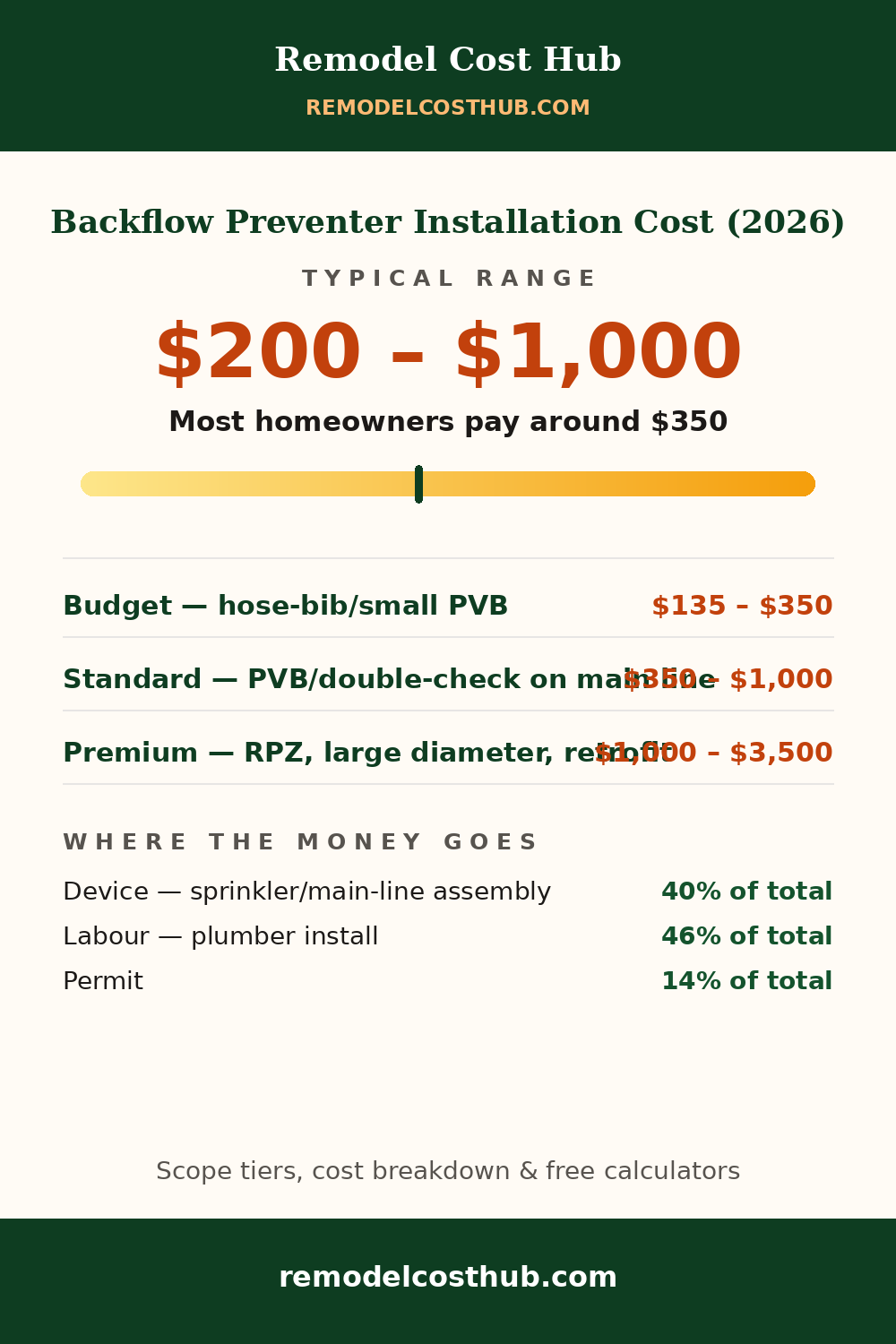
- Typical range: $200 – $1,000
- Most homeowners pay: around $350
Cross-checked against two published sources for this project. Sources used for this page: Angi, 'Backflow Preventer Installation Cost [2026 Data]', updated Sep 23, 2026 — total $135–$1,100; national average $350 (parts + labour); most pay $150–$450; device bands hose-bib AVB $3–$35, appliance $10–$100, sprinkler/sewer $100–$600, basement drain $150–$1,000 (sewer-side, not this page's device); by size 1/2 in. $35–$55, 1 in. $50–$100, 2 in. $75–$200, 6 in. $100–$300; labour $35–$200 (a partial figure — see the factors note); permits from $50; annual testing $70–$90; freeze relief valve about $100; anti-theft device $200–$300; repairs $50–$100. HomeGuide, 'How Much Does a Backflow Preventer Cost? (2026)', last updated about Sep 2024 (stale) — device + installation $200–$1,000; materials $40–$600; labour $160–$400; plumber $75–$150 an hour; annual testing $30–$300 a year; device bands hose-bib $5–$40, appliance $40–$100, sprinkler/sewer $100–$600, basement drain $150–$1,000 (sewer-side). Plumbing Supply and More, 'Hidden Costs: What to Consider When Installing a Watts Backflow Preventer', updated Jul 3, 2026 (Watts retailer) — total $300–$3,500; residential $300–$1,000; device $280–$1,550 (Watts brand, incl. large/commercial); installation $160–$400; annual testing $30–$350 a year; freeze protection $100–$300; pressure drop 3–5 psi; booster pump $500–$1,200 if needed. Plumbing Local Service Pro, 'Backflow Preventer Guide: Types, Testing & Costs', published Oct 19, 2026 — residential installation $150–$500; PVB device $75–$200; RPZ $200–$500+ installed; hose-bib AVB $5–$15; annual testing $50–$150 residential; test takes 20–30 minutes; insulated cover $20–$40; rebuild kits $75–$200 parts plus labour. Breakdown shares are derived from the worked example below. Checked November 2026.. Sources last checked: October 2026 — HomeGuide, Angi. How we calculate these costs
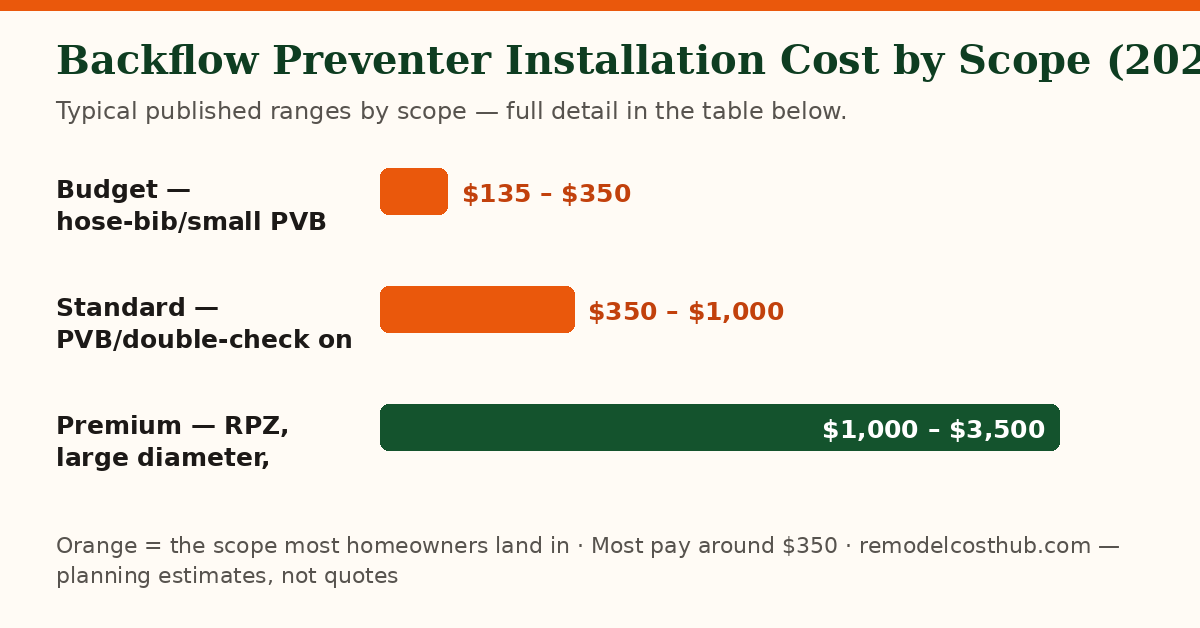
Cost by scope
| Scope | Typical cost | What it includes |
|---|---|---|
| Budget — hose-bib/small PVB | $135 – $350 | A hose-bib/appliance vacuum breaker or a small PVB on an easily accessible line; small-diameter device ($5–$100), minimal labour, no permit complications, no old-pipe retrofit. Anchors: Angi low end $135 and average $350; PLSP replacement low $150; HomeGuide hose/appliance device $5–$100. |
| Standard — PVB/double-check on main line | $350 – $1,000 | The typical residential job — the worked example below: a PVB or double-check assembly on an irrigation or main water line (device $100–$600), professional labour $160–$400, permit $50–$200, first test/certification included. Anchors: HomeGuide total $200–$1,000; PSAM residential $300–$1,000; Angi most-pay $150–$450. |
| Premium — RPZ, large diameter, retrofit | $1,000 – $3,500 | A high-hazard RPZ assembly, large diameter (2 in.+), old/galvanised-pipe retrofit needing custom fittings, difficult access, or a commercial/high-hazard connection; device alone can reach $1,550 (Watts). Anchors: PSAM total $300–$3,500 and device to $1,550; PLSP prices a residential RPZ at only $200–$500+ installed — the premium tier is driven by PSAM's brand/commercial figures, flagged in the estimator's note. |
Where the money goes
| Part of the job | Share | Note |
|---|---|---|
| Device — sprinkler/main-line assembly | 40% of total | $140 for the device — a sprinkler/main-line PVB or double-check assembly, inside the $100–$600 device band (Angi, HomeGuide agree exactly). Share derived from the worked example below. |
| Labour — plumber install | 46% of total | $160 for installation labour — at the floor of the $160–$400 labour band (HomeGuide; PSAM agrees exactly). Angi lists $35–$200 for hiring a pro — see the factors note. Share derived from the worked example below. |
| Permit | 14% of total | $50 for the permit — at the floor of the $50–$200 permit band (Angi from $50; PSAM $50–$200). Share derived from the worked example below. |
What moves the price most
Worked example — $350 most-pay install (PVB/double-check assembly on an irrigation or main water line, pro installed, permit, first test): device $140 (40%) + labour $160 (46%) + permit $50 (14%) = $350. Every line sits inside a published band. The shares are whole-percent roundings of this example — no source publishes a component percentage split for this job. Annual testing ($30–$350 a year, typically $50–$150 residential) is NOT in this total — it is a recurring cost after install. Where sources disagree: the total top — Angi $1,100 vs HomeGuide $1,000 vs PSAM $3,500 (includes commercial/high-hazard RPZ work) vs PLSP $500 (excludes RPZ/large/commercial jobs); $200–$1,000 is the defensible residential overlap; labour — HomeGuide $160–$400 and PSAM $160–$400 (exact agreement) vs Angi '$35 to $200' for hiring a pro, which reads as a partial/add-on figure, not a full install labour charge, published here as $160–$400 with the Angi footnote; annual testing — Angi $70–$90 vs PLSP $50–$150 vs HomeGuide $30–$300 vs PSAM $30–$350, published as $30–$350 with $50–$150 as the typical residential test; device price — HomeGuide most common devices $40–$600 vs PSAM Watts $280–$1,550 (single brand, includes large/commercial sizes), published as HomeGuide's band typical and PSAM's as the premium/brand end; RPZ — PLSP residential $200–$500+ installed vs PSAM Watts device alone up to $1,550, the commercial/large-diameter end; scope blending — Angi frames its article as 'sewer backflow preventer' and HomeGuide's sprinkler/sewer and basement-drain rows mix potable and sewer devices under one label, so their headline totals blend both device families; this page covers the potable-water assembly only and the basement-drain $150–$1,000 band is never presented as this page's device price; data currency — Angi September 2026 and PLSP October 2026 are freshest, PSAM July 2026, HomeGuide titled 2026 but last updated about September 2024, and where HomeGuide and Angi conflict, Angi is weighted. Methodology: the typical range $200–$1,000 is the honest overlap all four sources agree a standard residential job lands in; most-pay $350 is Angi's published national average; no double-check device-only price is published, so the $100–$600 sprinkler/main-line band covers the DC class; no breakdown % share is published, so the shares are derived from the worked example; a backflow preventer typically reduces water pressure by 3–5 psi (PSAM) — unnoticeable in most homes, but a pressure-boosting pump ($500–$1,200, PSAM, single source) is the fix if pressure is already marginal. Related costs: sprinkler system installation, water line installation, main water line replacement, outdoor faucet installation, water filtration installation, water softener installation and plumbing repipe.
Costs in your city
Labor is the biggest variable in any remodel, and labor is local — the same bathroom can price very differently in Houston than in Boston. We are adding city editions metro by metro, each with its own labor index, permit notes and climate factors, written for that city rather than copied from this page. Wave 1: Houston, Dallas–Fort Worth, Phoenix, Atlanta, Miami–South Florida, Orlando, Tampa, Charlotte, Austin and San Antonio. Until your city's page is live, use the national range here and weight it the way contractors do: Sun Belt labor often prices near or below the national middle, while coastal California and the Northeast metros often price well above it.
Frequently asked questions
How much does it cost to install a backflow preventer?
Typically $200–$1,000 for a standard residential job (HomeGuide), with most homeowners paying around $350 (Angi national average); Angi's full range is $135–$1,100. The device itself is usually $100–$600 for a sprinkler/main-line unit (Angi, HomeGuide); labour adds $160–$400 (HomeGuide, PSAM).
Which type do I need — PVB, double-check or RPZ?
It depends on the hazard level and your local code (PLSP). A PVB ($75–$200 device) is the standard for residential irrigation and handles back-siphonage only; a double-check assembly suits low-to-medium hazard connections and some fire-sprinkler lines; an RPZ ($200–$500+ installed) protects against both back-siphonage and back-pressure and is required for high-hazard connections such as boilers with chemical treatment or fertigation. Your water utility/code is the final word.
Do I need a permit to install a backflow preventer?
Yes, in most areas (Angi, PSAM, PLSP). Permit fees start at $50 (Angi) and typically run $50–$200 (PSAM). Skipping the permit risks fines and reinstallation (PSAM). Your plumber usually handles the paperwork.
How much does annual backflow testing cost?
$30–$350 per device per year (HomeGuide, PSAM), typically $50–$150 for a residential device (PLSP); Angi lists $70–$90 per test. Most cities that require a device also require annual testing by a certified tester, and the results are filed with the water utility (PLSP, HomeGuide).
Can I install or test a backflow preventer myself?
No, for practical purposes. Installation and testing should be done by a licensed plumber or certified backflow tester (PLSP); most jurisdictions only accept tests from certified testers and DIY test results are not accepted by water utilities. Homeowners can handle winterisation (draining and insulating) and visual inspections. DIY installation risks contaminated drinking water and code violations (Angi).
Does a backflow preventer affect my water pressure?
Yes, slightly — a backflow preventer typically reduces water pressure by 3–5 psi (PSAM). In most homes that is unnoticeable, but if pressure is already marginal it can require a pressure-boosting pump ($500–$1,200, PSAM) or, in rare commercial/fire-system cases, far larger upgrades.