Fire Sprinkler System Installation cost at a glance
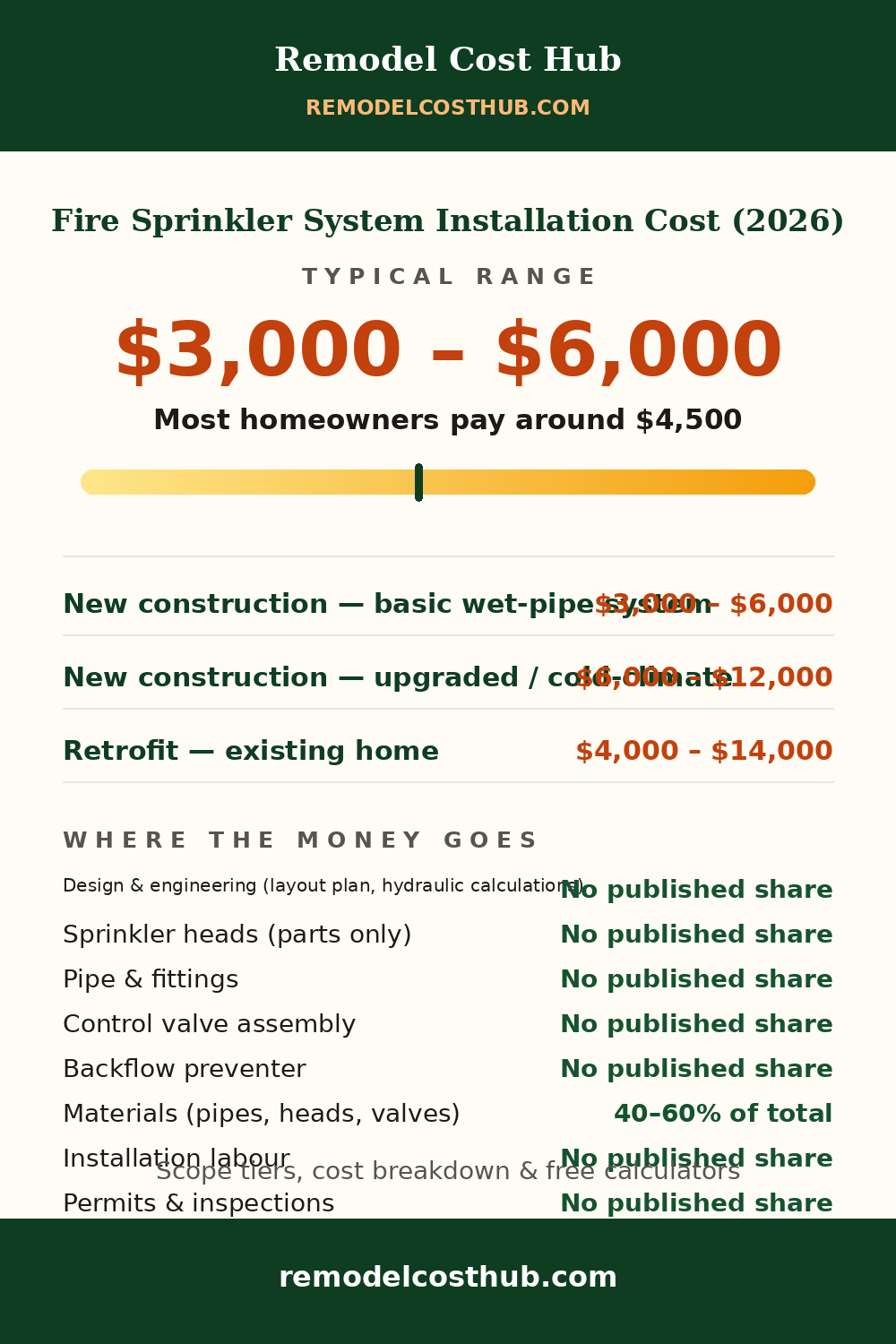
- Typical range: $3,000 – $6,000
- Most homeowners pay: around $4,500
- Per square foot: $2.25 per sq ft
- Prices vary most by: Materials (pipes, heads, valves) (40–60% of the budget)
Cross-checked against two published sources for this project. Sources used for this page: Angi, 'How Much Does a Home Fire Sprinkler System Cost? [2026 Data]', updated Apr 6, 2026 per page body (wet pipe $1.50–$3 per sq ft, dry pipe $2.50–$4.50, pre-action/deluge $4–$7, standalone $2–$4, multipurpose $1.50–$3.50; labour $50–$150/hr, licensed fire-sprinkler contractor required; permits $100–$1,000; annual maintenance $150–$400/yr; insurance 5–15%; head replacement $100–$300, leak/valve repair $200–$800, full replacement $6,000–$20,000; regional totals Northeast $2,000–$5,000, Midwest $900–$2,500, South $800–$1,500, West $2,000–$7,500 — its $766 average / $263–$1,279 most-pay band and its home-size table ($700 for a 1,500 sq ft new build) are NOT printed: they contradict Angi's own per-sq-ft figures and can only reflect partial jobs; the search-snippet variant ($782 avg) is also not used), HomeServe USA, 'How Much Does It Cost to Install a Residential Fire Sprinkler System?', published 2026-05-03 (new construction $1.50–$3.00 per sq ft; retrofit $2.00–$7.00 per sq ft; PEX $0.40–$0.50 per linear foot, copper $3–$8; water storage tank 300–20,000 gal fibreglass $5,000–$9,000; plumbing permit $50–$300; visual inspection $100–$200, camera inspection $300–$1,110; plumber call-out $50–$200 then $45–$150/hr; one head covers ~130 sq ft, ~23 heads per 3,000 sq ft home; insurance 'as high as 35%' as a maximum, never printed as typical) and Total Fire Protection, 'Fire Sprinkler System Installation Cost Guide', published 2026-07-07, updated 2026-10-02 (new construction $1.50–$3.50 per sq ft; retrofit $4.00–$10.00 per sq ft; residential totals 1,500 sq ft $2,250–$15,000, 2,500 $3,750–$25,000, 4,000 $6,000–$40,000; wet pipe $1.50–$3.50, dry pipe $2.50–$4.50 residential; materials typically 40–60% of total, labour the rest; heads $5–$30 each, concealed 2–3x standard; CPVC pipe & fittings $8–$12 per linear foot; control valve $800–$3,000; backflow preventer $800–$2,500; fire pump $8,000–$15,000; water tank $3,000–$8,000; design & engineering $1,500–$3,000; permits & inspections $500–$1,000; labour $2,000–$10,000; alarm integration $1,000–$3,000; 12–20 ft ceilings +$2,000–$5,000, many small rooms +15–30%, long/narrow shape +20–40%; annual inspection $150–$400, five-year flow test $200–$600, five-year internal pipe inspection $800–$2,500, backflow testing $100–$200/yr, monitoring setup $500–$1,500 + $30–$40/month — its commercial columns are never printed as residential). Supporting (not counted toward the 3-source rule): National Fire Sprinkler Association via Precision Fire Protection, 'The True Cost to Install a Residential Fire Sprinkler System' (underlying NFSA report 15 Sep 2020 — its $1.35 per sq ft is NOT printed as a 2026 price); This Old House, 'How To Install a Fire Sprinkler System' (updated 2026-05-27; $2–$7 per sq ft, explicitly sourced from Angi — NOT independent; install time 4–6 days for an average house); LegalClarity, 'Fire Sprinkler System Cost: Residential and Commercial Pricing' (figures cited to HomeServe + NFSA — derivative). Synthesized typical = the $1.50–$3.00 per sq ft new-construction overlap x 2,000 sq ft = $3,000–$6,000, with $4,500 most-pay as a DERIVED midpoint, labelled as such. No worked example sums to the pin, because no source publishes line items that add to it. Checked November 2026.. Sources last checked: October 2026 — This Old House, Angi. How we calculate these costs
Cost by scope
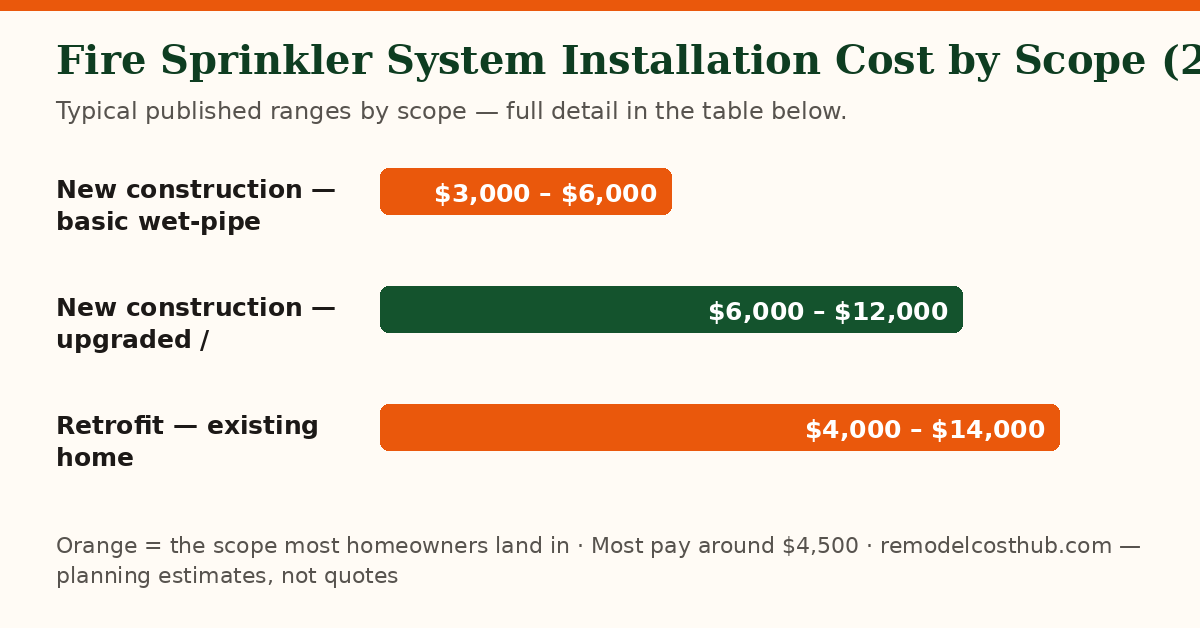
| Scope | Typical cost | What it includes |
|---|---|---|
| New construction — basic wet-pipe system | $3,000 – $6,000 | An NFPA 13D wet-pipe system installed while walls are open: CPVC or PEX piping, standard (non-concealed) sprinkler heads at about one head per 130 sq ft, control valve assembly, connection to the municipal water supply, design/layout plan, permit and final inspection. The cheapest time to install — piping goes in before drywall. (HomeServe $1.50–$3.00 per sq ft; Angi wet pipe $1.50–$3; Total Fire Protection $1.50–$3.50.) |
| New construction — upgraded / cold-climate | $6,000 – $12,000 | Everything in the basic tier, plus a dry-pipe system with a compressed-air valve for unheated spaces (garage, attic, cold climates), concealed sprinkler heads that sit flush behind cover plates, freeze protection, a backflow preventer, and fire-alarm integration / waterflow monitoring. Larger homes (2,500–4,000 sq ft) and multi-zone layouts sit in this tier. (About $2.50–$4.50 per sq ft; a 2,500 sq ft home at dry-pipe rates is $6,250–$11,250 — Angi and Total Fire Protection agree on the rate.) |
| Retrofit — existing home | $4,000 – $14,000 | An NFPA 13D system retrofitted into a finished home: cutting and patching drywall and ceilings and repainting, routing pipe through finished walls, floors and ceilings, control valve and backflow preventer, permit and inspections. Complex or multi-story retrofits can reach $20,000 (Total Fire Protection $4–$10 per sq ft top end). Cheapest when bundled with a major renovation while walls are already open. (HomeServe $2.00–$7.00 per sq ft.) |
Where the money goes
| Part of the job | Share | Note |
|---|---|---|
| Design & engineering (layout plan, hydraulic calculations) | No published share | $1,500–$3,000 (Total Fire Protection). |
| Sprinkler heads (parts only) | No published share | $5–$30 each (Total Fire Protection); about 15 heads for a 2,000 sq ft home at one head per ~130 sq ft (HomeServe) = roughly $75–$450 in parts (derived). Concealed heads cost 2–3x standard heads (Total Fire Protection). Installed head replacement (a repair, not a new install) is $100–$300 each (Angi). |
| Pipe & fittings | No published share | CPVC $8–$12 per linear foot (Total Fire Protection); PEX piping $0.40–$0.50 per linear foot; copper $3–$8 per linear foot (HomeServe). |
| Control valve assembly | No published share | $800–$3,000 (Total Fire Protection). |
| Backflow preventer | No published share | $800–$2,500 (Total Fire Protection); annual backflow testing $100–$200 per year (Total Fire Protection). |
| Materials (pipes, heads, valves) | 40–60% of total | Materials are typically 40–60% of total project cost, labour the rest (Total Fire Protection) — the ONLY published % share on this page; it drives the estimator's note and the 'Prices vary most by' glance row. |
| Installation labour | No published share | $2,000–$10,000 per project (Total Fire Protection), at $50–$150 per hour (Angi; HomeServe plumbers $45–$150 per hour). A licensed fire-sprinkler contractor is required (Angi; This Old House). Install time is 4–6 days for an average-size house (This Old House). |
| Permits & inspections | No published share | $100–$1,000 all-in (Angi; Total Fire Protection $500–$1,000 for permits + inspections). The plumbing permit fee alone is $50–$300 (HomeServe). Visual inspection $100–$200; camera inspection $300–$1,110 (HomeServe). |
| Fire alarm / monitoring integration | No published share | $1,000–$3,000 (Total Fire Protection); central-station monitoring setup $500–$1,500 plus $30–$40 per month (Total Fire Protection). |
| Water storage tank (only if pressure is inadequate) | No published share | $3,000–$9,000 overlap band (Total Fire Protection $3,000–$8,000; HomeServe $5,000–$9,000 for 300–20,000 gal fibreglass). Needed only where municipal pressure is low or the home is on a well. |
| Fire pump (only if pressure is inadequate) | No published share | $8,000–$15,000 (Total Fire Protection, residential). |
| Annual inspection & maintenance (not install cost) | No published share | $150–$400 per year (Angi and Total Fire Protection agree exactly). Five-year flow test $200–$600; five-year internal pipe inspection $800–$2,500 (Total Fire Protection). Full system replacement, if ever needed, is $6,000–$20,000 (Angi) — a replacement figure, never an install cost. |
What moves the price most
How the figures were built — read this before the numbers: no source publishes a line-item breakdown that sums to a whole-house total, so there is NO worked example summing to the $4,500 pin and NO percentage shares except the materials 40–60% line above; the breakdown is dollar ranges only, each with its source. The $4,500 most-pay figure is a DERIVED midpoint (2,000 sq ft x $2.25 per sq ft), labelled as such in the anchor — no source publishes a national-average total. Angi's $766 'average' and its $263–$1,279 'most pay' band are NOT printed: they contradict Angi's own per-sq-ft figures ($3,000–$6,000 for a 2,000 sq ft home) and its own home-size table, and can only reflect partial or small jobs in its 207-project sample. New build vs retrofit is the single biggest driver: installing while walls are open costs $1.50–$3.00 per sq ft; retrofitting finished walls costs $2–$7 per sq ft, roughly two to four times as much, because contractors must cut, patch and repaint. The cheapest retrofit is one bundled with a major renovation. Home size and layout: cost scales with square footage and head count (about one head per 130 sq ft). Many small rooms cost 15–30% more than an open plan of the same size because every room needs its own coverage; long, narrow shapes add 20–40% (Total Fire Protection). System type: wet-pipe is the cheapest and most common ($1.50–$3 per sq ft); dry-pipe for unheated areas runs $2.50–$4.50 per sq ft; pre-action and deluge systems are commercial-grade, rarely used in homes, and cost far more. Pipe material: PEX/CPVC is the budget choice (PEX $0.40–$0.50 per linear foot); copper costs $3–$8 per linear foot and some jurisdictions require metal pipe in garages or unfinished basements. Water supply: adequate municipal pressure keeps costs low; low pressure or a low-yield well can force a storage tank ($3,000–$9,000) and/or a fire pump ($8,000–$15,000). Climate and freeze protection: cold regions need dry-pipe systems, insulation or heat tracing; Angi's regional totals run $2,000–$5,000 in the Northeast vs $800–$1,500 in the South. Local codes and permits: NFPA 13D is the residential standard and the International Residential Code has included a sprinkler mandate since 2009, but only California and Maryland enforce it statewide — most states leave it to local jurisdictions, so permit fees ($100–$1,000) and requirements vary. Ceiling height and extras: 12–20 ft ceilings add $2,000–$5,000 (Total Fire Protection); concealed heads cost 2–3x standard heads; alarm monitoring adds $30–$40 per month. Labour market: $50–$150 per hour, higher in metro areas; rural jobs can be cheaper but may carry travel fees and fewer qualified installers. Methodology: figures cross-checked across three independent data families — Angi (updated Apr 6, 2026, page body), HomeServe (published May 3, 2026) and Total Fire Protection (published Jul 7, 2026, updated Oct 2, 2026) — read in full on 2026-11-11. NFSA figures ($1.35 per sq ft) come from a September 2020 report and are NOT printed as 2026 prices. This Old House's $2–$7 per sq ft is explicitly sourced from Angi and is not counted as an independent source. No single activation temperature is printed — This Old House says 135–165°F, HomeServe says 175–225°F; heads trigger at their rated temperature. Related costs: lawn sprinkler system installation (a different system — irrigation, not fire protection), backflow preventer installation, smoke detector installation, water line installation, plumbing repipe, drywall repair, kitchen remodel and home inspection.
Costs in your city
Labor is the biggest variable in any remodel, and labor is local — the same bathroom can price very differently in Houston than in Boston. We are adding city editions metro by metro, each with its own labor index, permit notes and climate factors, written for that city rather than copied from this page. Wave 1: Houston, Dallas–Fort Worth, Phoenix, Atlanta, Miami–South Florida, Orlando, Tampa, Charlotte, Austin and San Antonio. Until your city's page is live, use the national range here and weight it the way contractors do: Sun Belt labor often prices near or below the national middle, while coastal California and the Northeast metros often price well above it.
Frequently asked questions
How much does a residential fire sprinkler system cost?
For new construction, $1.50–$3.00 per square foot — about $3,000–$6,000 for a 2,000 sq ft home, with a derived midpoint of $4,500. Retrofitting an existing home costs $2–$7 per square foot, or roughly $4,000–$14,000 for the same size home. (HomeServe; Angi; Total Fire Protection.)
Is it cheaper to install sprinklers during construction or later?
Much cheaper during construction — roughly half to a quarter of the retrofit price per square foot, because pipes go in before drywall. The best time to retrofit is during a major renovation, when walls and ceilings are already open. (HomeServe; LegalClarity; Total Fire Protection.)
Are home fire sprinklers required by law?
The NFPA 13D standard and the International Residential Code cover sprinklers in new one- and two-family homes, but only California and Maryland enforce a statewide mandate; most states opted out and leave it to local jurisdictions. Check your local building code before you build or remodel. (LegalClarity; NFSA.)
Will all the sprinklers go off at once and flood my house?
No. Each head works independently and only the head or heads nearest the fire activate — usually just one or two. NFSA-cited data puts sprinkler control of home fires at about 96% of the time, with property loss per home fire roughly 55% lower in sprinklered homes. (This Old House; NFSA via Precision Fire Protection; LegalClarity.)
How much maintenance does a home sprinkler system need?
Very little. Budget $150–$400 a year for a professional annual inspection, plus a flow test every five years ($200–$600). Homeowners do monthly visual checks, keep the control valve open, and never paint sprinkler heads or hang anything from them. Multipurpose systems need no separate flow test because water moves through the lines every time you use a tap. (Angi; Total Fire Protection; NFSA.)
Do fire sprinklers lower my homeowners insurance?
Usually, yes — typically by 5–15%, though some insurers offer up to 35%. You will generally need proof of regular inspections and maintenance to keep the discount. Ask your insurer before installing. (Angi; HomeServe; NFSA.)