Water Line Installation cost at a glance
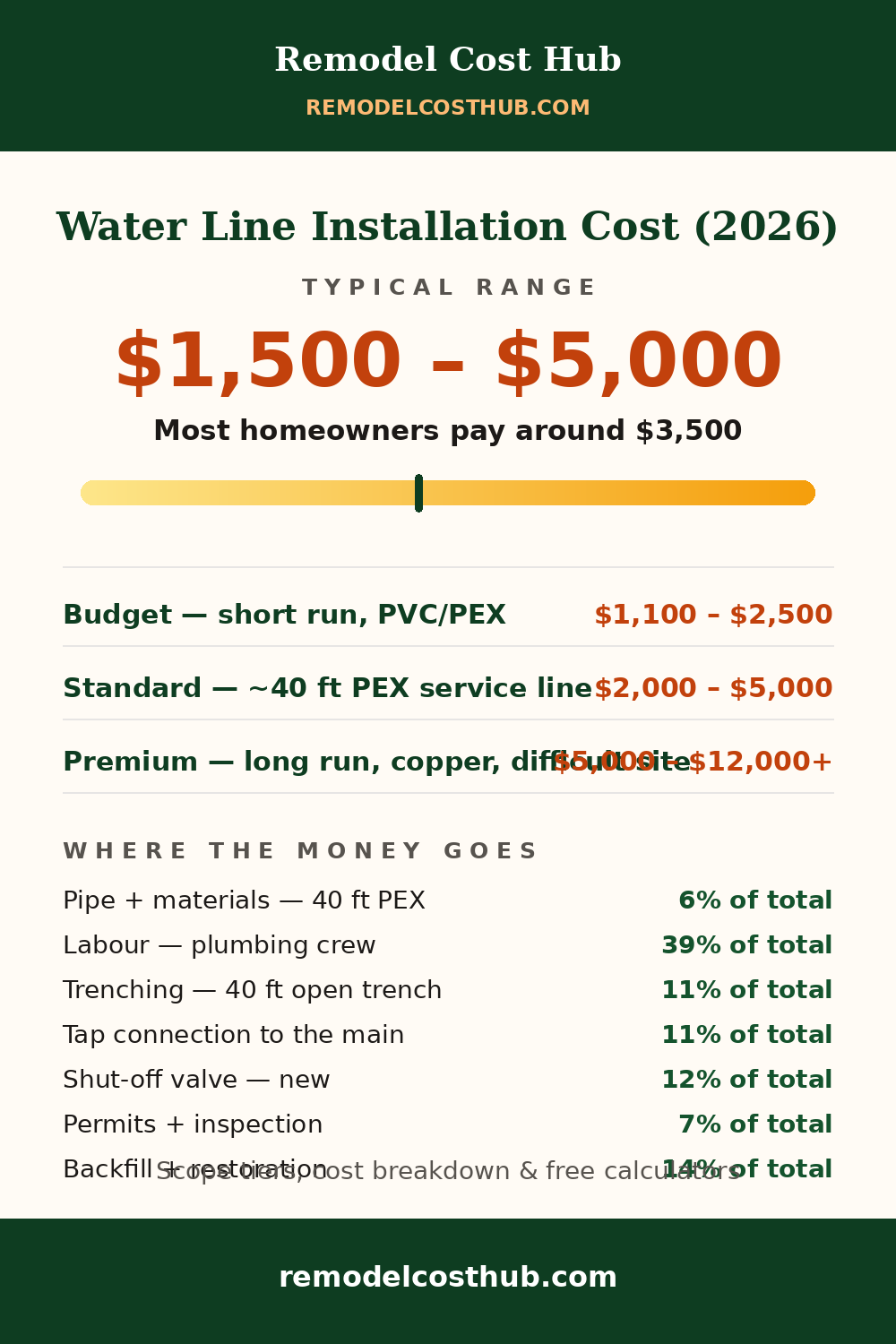
- Typical range: $1,500 – $5,000
- Most homeowners pay: around $3,500
Cross-checked against four published sources for this project. Sources used for this page: HomeGuide, 'How Much Does Water Line Replacement Cost? (2026)', updated about Dec 22, 2025 — national average $3,500, average range $2,000–$5,000, min $620, max $12,500; trenched $50–$200 per linear foot installed, trenchless $70–$250; materials only PVC $0.50–$5, copper $2–$10+, cast iron $2–$10, fibreglass $6–$13; tap connection part + labour $300–$500; permits $30–$500; inspection $100–$500; labour $45–$150 an hour; trenching $5–$12 per linear foot in normal soil; new line takes a few hours to several days; depth typically 1–3 ft, always below the local frost line; whole-house repipe $2,280–$5,120. Fixr, '2023 Main Water Line Installation Cost', updated about Aug 29, 2025 — national average $3,750 (a 25 ft galvanized-steel trenchless job), average range $1,500–$12,000; by length installed 10 ft $750–$2,250, 25 ft $1,875–$5,625, 50 ft $3,750–$11,250, 75 ft $5,625–$16,875, 100 ft $7,500–$22,500; trenched $175–$225 per linear foot (the difficult-site outlier), trenchless $75–$150; materials only PVC $0.50–$5, polyethylene $2–$5, copper $20–$30 (2–3x the other sources — see the factors note), cast iron $2–$10, fibreglass $6–$10, brass $10–$15; tap connection $300–$500; permits $50–$400; labour $75–$150 an hour; shut-off valve $200–$1,000; pressure regulator $250–$400 installed; new installations need a new water meter and valve, and digging-and-backfilling is typically used for new installations rather than replacements. Angi, 'How Much Does Main Water Line Replacement Cost? [2026 Data]', updated Oct 14, 2026 (5,474 verified projects) — national average $1,703, most pay $647–$2,835, up to $5,000 for deep or obstructed lines; $50–$150 per linear foot installed, up to $250; trenched $50–$250, trenchless $75–$150; labour 35–60% of the total (the only published percentage share); materials only PVC $0.50–$5, PEX $0.40–$2, copper $2–$10, cast iron $2–$10, fibreglass $6–$10; permits $100–$500; inspection $100–$500; shut-off valve $400–$800; connecting to city water $1,500–$12,000 (the physical run, not utility fees); digging out and disposing of an old line pushes a replacement total toward the higher end. Engineer Fix, 'How Much Does It Cost to Get City Water Installed?', updated about Dec 18, 2025 — the only source written about NEW installs: $50–$250 per linear foot; trenching $5–$12 per linear foot in normal soil, $20–$30 in hard clay or rock; landscaping repair $500–$2,000 for a typical yard; residential impact/capacity fees $3,700 to over $30,000 in some regions (single source); combined new city tap + meter $4,700–$8,100 in some cities (single source); backflow preventer $130–$1,200, typically $300–$450. No source publishes a CPVC material figure, so none is given. Breakdown shares are derived from the worked example below. Checked November 2026.. Sources last checked: October 2026 — HomeGuide, Fixr, Angi, Engineer Fix. How we calculate these costs
Cost by scope
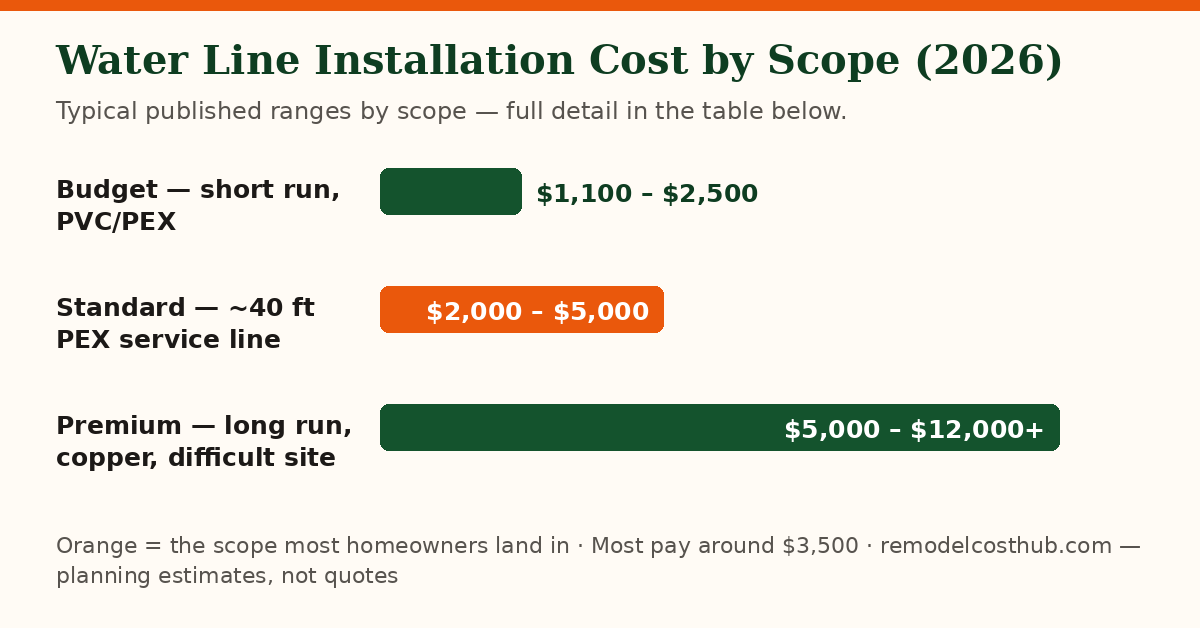
| Scope | Typical cost | What it includes |
|---|---|---|
| Budget — short run, PVC/PEX | $1,100 – $2,500 | A short run (10–25 ft) to a nearby main or outbuilding, PVC or PEX pipe, trenchless or directional-bore install in easy soil, existing meter and valve reused where possible, no driveway or sidewalk crossing. Anchors: Fixr's low end $1,125 (10 ft PVC trenchless); Fixr's 10 ft table $750–$2,250; Angi's low end $647. |
| Standard — ~40 ft PEX service line | $2,000 – $5,000 | The most-pay tier — the worked example below: a typical 25–50 ft service line to a new build or addition, PVC or PEX (1-inch for most homes), open trench or bore, new meter and shut-off valve, permit and inspection, basic backfill and lawn restoration. |
| Premium — long run, copper, difficult site | $5,000 – $12,000+ | A long run (50–100+ ft) or difficult site: copper pipe, deep burial below a deep frost line, rocky or clay soil, driveway or sidewalk crossings, a new tap plus impact/capacity fees, full hardscape restoration. Anchors: Fixr's average-range top $12,000; Fixr's 100 ft copper trenched $22,500. Engineer Fix's impact fees to $30,000+ can push a new-connection job beyond this tier on their own — flagged separately, not folded in silently. |
Where the money goes
| Part of the job | Share | Note |
|---|---|---|
| Pipe + materials — 40 ft PEX | 6% of total | $200 for pipe and materials — 40 ft of PEX at $0.50–$5 per linear foot materials (all three sources agree on PVC/PEX at $0.50–$5). $200 is at the top of that band for 40 ft; materials are the smallest slice of the job. Share derived from the worked example below. |
| Labour — plumbing crew | 39% of total | $1,350 for labour — 39% of the total, inside Angi's published labour share of 35–60% of the total, the only percentage share any source publishes. Labour rates $45–$150 an hour (HomeGuide); $75–$150 an hour (Fixr). Share derived from the worked example below. |
| Trenching — 40 ft open trench | 11% of total | $400 for trenching — 40 ft of open trench at $5–$12 per linear foot in normal soil (Engineer Fix; HomeGuide), which gives $200–$480. Share derived from the worked example below. |
| Tap connection to the main | 11% of total | $400 for the tap connection to the city main, parts and labour — inside the $300–$500 band agreed by HomeGuide and Fixr. The water meter itself is usually supplied by the utility; Engineer Fix reports a combined new city tap + meter charge of $4,700–$8,100 (single source) — see the factors note. Share derived from the worked example below. |
| Shut-off valve — new | 12% of total | $400 for a new main shut-off valve — inside all three published bands (Fixr $200–$1,000; HomeGuide $250–$600; Angi $400–$800). Share derived from the worked example below. |
| Permits + inspection | 7% of total | $250 for permits and inspection — inside the $50–$500 permit overlap (Fixr $50–$400; HomeGuide $30–$500; Angi $100–$500) plus inspection $100–$500 (Angi; HomeGuide). Share derived from the worked example below. |
| Backfill + restoration | 14% of total | $500 for backfill and lawn restoration — at the floor of Engineer Fix's $500–$2,000 landscaping-repair band for a typical yard. Share derived from the worked example below. |
What moves the price most
Worked example — $3,500 most-pay install (standard ~40 ft PEX service line, open trench, tap connection, shut-off valve, permit, backfill and restoration): pipe/materials $200 (6%) + labour $1,350 (39%) + trenching $400 (11%) + tap connection $400 (11%) + shut-off valve $400 (12%) + permits + inspection $250 (7%) + backfill/restoration $500 (14%) = $3,500. The shares are whole-percent roundings of this example — the only published percentage share is labour at 35–60% of the total (Angi), and this example's 39% sits inside it; no source publishes a materials or trenching percentage. The water meter is usually supplied by the utility and is not in this example's lines: Engineer Fix reports a combined new city tap + meter charge of $4,700–$8,100 in some cities (single source) and residential impact/capacity fees of $3,700 to over $30,000 (single source) — check your water utility before budgeting; neither figure is a national typical. Where sources disagree: the most-pay figure — Angi $1,703 (2026, 5,474 verified projects) vs HomeGuide $3,500 vs Fixr $3,750 (defined as a 25 ft galvanized-steel trenchless job); Angi's figure is less than half the others', likely because its sample skews to short/urban and partial jobs, while Fixr and HomeGuide anchor on a full 25 ft service line — the page shows the $1,700–$3,750 span and names the cause, not one number; copper material — Fixr $20–$30 per linear foot vs HomeGuide $2–$10+ and Angi $2–$10, published as $2–$10 with a footnote that one guide (Fixr) lists $20–$30; trenched per-foot — Fixr $175–$225 per linear foot for digging and backfilling vs HomeGuide $50–$200 and Angi $50–$250, treated as the difficult-site end, not the norm; typical total — Angi $647–$2,835 vs HomeGuide $2,000–$5,000 vs Fixr $1,500–$12,000, with the $1,500–$5,000 overlap as the defensible typical band; tap/impact fees — only Engineer Fix publishes impact fees and the combined tap + meter figure, and Angi's $1,500–$12,000 'connect to city water' is a different scope (the physical run, not utility fees). Data currency: Angi is October 2026 (freshest); HomeGuide and Engineer Fix are about December 2025; Fixr's guide is titled 2023 with an August 2025 update — where Fixr and Angi conflict, Angi is weighted. Methodology: the typical range $1,500–$5,000 is the honest overlap of all four sources; per-foot rates are installed rates (labour + materials) unless labelled materials-only; pipe bursting and pipe lining are replacement-only methods and are never presented as new-line options; no CPVC material price is published anywhere, so none is given. Related costs: main water line replacement, plumbing repipe, water well drilling, sewer line replacement and outdoor faucet installation.
Costs in your city
Labor is the biggest variable in any remodel, and labor is local — the same bathroom can price very differently in Houston than in Boston. We are adding city editions metro by metro, each with its own labor index, permit notes and climate factors, written for that city rather than copied from this page. Wave 1: Houston, Dallas–Fort Worth, Phoenix, Atlanta, Miami–South Florida, Orlando, Tampa, Charlotte, Austin and San Antonio. Until your city's page is live, use the national range here and weight it the way contractors do: Sun Belt labor often prices near or below the national middle, while coastal California and the Northeast metros often price well above it.
Frequently asked questions
How much does it cost to install a new water line?
Typically $1,500–$5,000 for a standard residential job, with published averages spanning $1,703 (Angi, 2026) to $3,750 (Fixr); HomeGuide's national average is $3,500. Fixr's full average range runs $1,500–$12,000, but that top end is 100 ft runs. Length is the main driver: about $75–$200 per linear foot installed for a standard job.
How much does a new water line cost per foot?
$50–$250 per linear foot installed depending on method and material (Angi, HomeGuide, Fixr, Engineer Fix all sit inside this band). Trenchless/directional boring runs $75–$150 per linear foot (Angi, Fixr); open trenching $50–$200 (HomeGuide). Pipe alone is $0.50–$5 per linear foot for PVC or PEX and $2–$10 for copper (HomeGuide, Angi).
How deep does a new water line need to be buried?
Typically 1–3 feet deep (Fixr, HomeGuide, Angi agree), and always below the local frost line — in extreme-cold climates that can mean 3+ feet, and HomeGuide notes lines in cold regions are sometimes 8+ feet deep. Your local code sets the exact depth.
Do I need a permit to install a new water line?
Yes — a permit and city approval are required before installing a new water main (Fixr). Permits cost $50–$500 (Fixr $50–$400; HomeGuide $30–$500; Angi $100–$500), plus an inspection at $100–$500 (Angi, HomeGuide). Your plumber usually handles it.
How long does a new water line installation take?
A few hours to several days depending on length, depth and method (HomeGuide). A trenchless/bored line is typically done in under a day; an open-trench job takes several days to a week once excavation, backfill and restoration are included.
Is installing a new water line different from replacing one?
Yes. A new install lays pipe through fresh ground — no old pipe to remove — but it needs a new meter, shut-off valve and a first-time tap into the city main, plus possible impact/capacity fees ($3,700–$30,000+ in some areas, Engineer Fix, single source). Fixr notes labour and total cost end up 'very close' to a replacement, but pipe bursting and pipe lining only work for replacements, not new lines.