Water Softener Installation cost at a glance
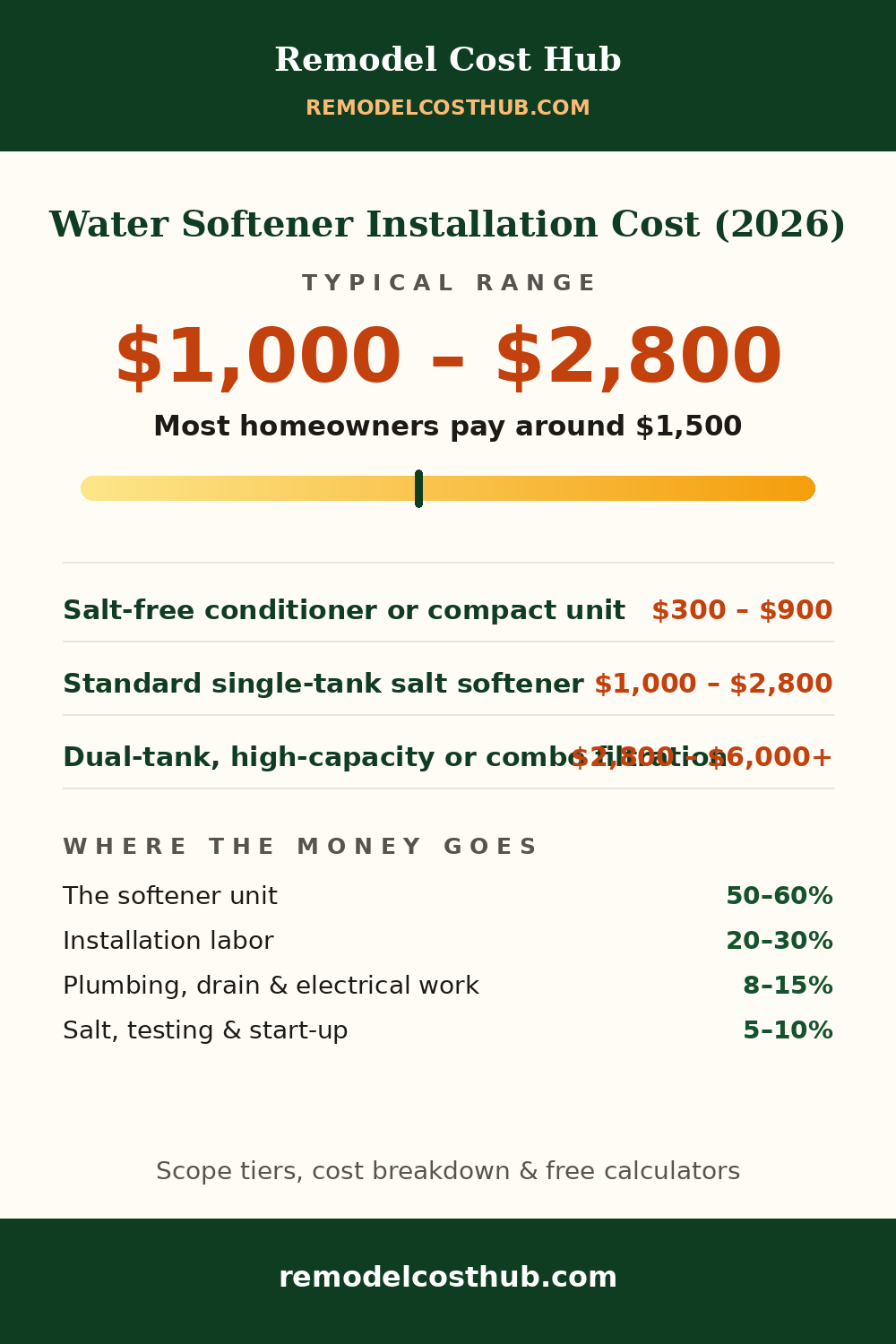
- Typical range: $1,000 – $2,800
- Most homeowners pay: around $1,500
- Prices vary most by: The softener unit (50–60% of the budget)
Cross-checked against three published sources for this project. Sources used for this page: Angi's water softener installation cost guide, HomeGuide's water filtration and softener cost guides and Forbes Home's water softener cost data. Sources last checked: October 2026 — Forbes Home, HomeGuide, Angi. Last updated October 2026 · How we calculate these costs
Cost by scope
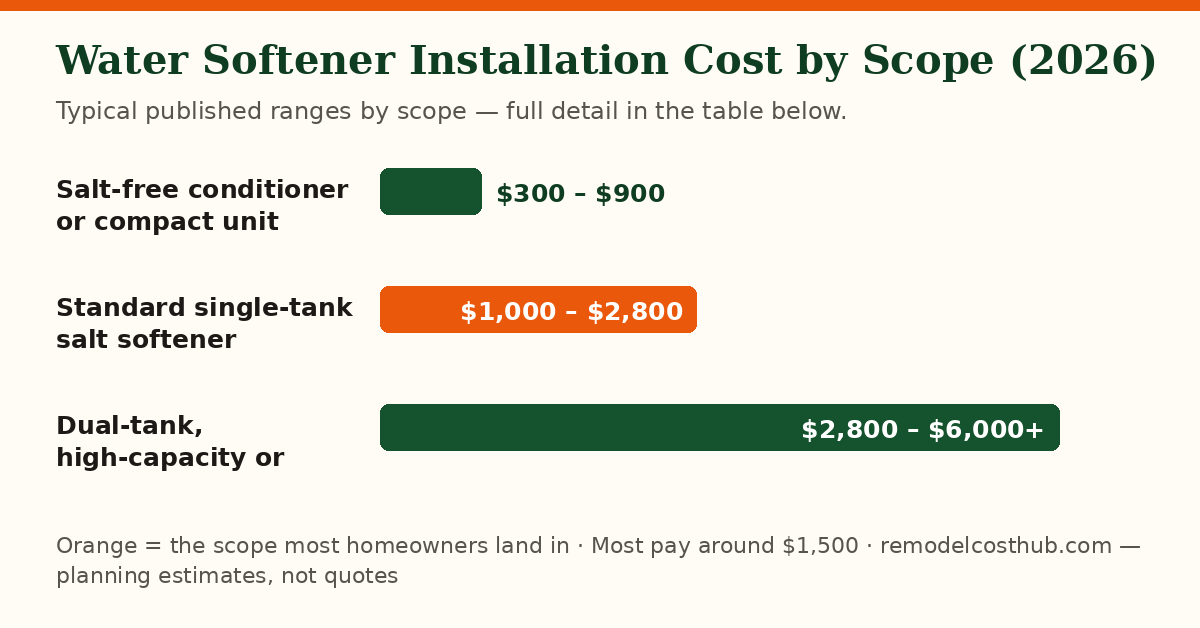
| Scope | Typical cost | What it includes |
|---|---|---|
| Salt-free conditioner or compact unit | $300 – $900 | The light-duty route: a template-assisted (salt-free) conditioner or a compact unit on an existing loop. Forbes prices salt-free systems at $500–$3,000 and magnetic units at $100–$2,000 before installation, and HomeGuide prices chemical injector systems at $500–$1,500 — a basic conditioner professionally fitted lands in this band, and it conditions rather than truly softening. |
| Standard single-tank salt softener | $1,000 – $2,800 | The typical project on this page. Angi prices a single-tank ion-exchange softener at $500–$1,700 installed with an overall average of $1,500, HomeGuide prices a water softener at $1,200–$3,800 installed and at $800–$2,500 as a whole-house system in its treatment table, and Forbes averages $1,500 including labor and materials. |
| Dual-tank, high-capacity or combo filtration | $2,800 – $6,000+ | Where capacity or filtration joins the job. Angi's normal range runs to $6,000 for high-capacity and dual-tank systems, HomeGuide prices a carbon, UV and softener combination at $2,650–$5,400 installed, and Forbes prices advanced ion-exchange systems at $6,000–$7,000. |
Where the money goes
| Part of the job | Share | Note |
|---|---|---|
| The softener unit | 50–60% | The hardware is most of the money: Angi prices single-tank ion-exchange models at $500–$1,700 installed around a $1,500 average, HomeGuide prices the softener itself inside its $1,200–$3,800 installed band, and capacity in grains — not features — is what moves the unit price |
| Installation labor | 20–30% | Cutting the unit into the main line, setting the drain and programming the regeneration cycle: Forbes prices softener labor at $150–$1,000, HomeGuide prices whole-house filtration labor at $200–$600, and a pre-plumbed softener loop is what keeps a job at the bottom of both ranges |
| Plumbing, drain & electrical work | 8–15% | The connections the unit needs to exist: HomeGuide prices a new drain connection at $300–$800, a new outlet at $150–$350 and pipe extensions at $150–$850 where the main enters far from a drain, with permits at $30–$500 where the jurisdiction requires one |
| Salt, testing & start-up | 5–10% | The first fill and the water test that sizes the system: HomeGuide prices water testing at $100–$300 and running salt at $10–$20 per month, and installers commonly include the first bags of salt and the hardness programming in the installation price |
What moves the price most
Capacity is the budget. A softener is sized in grains from your hardness and household size, and every guide's ladder is a capacity ladder: Angi's single-tank band is $500–$1,700 installed while its high-capacity work runs to $6,000, and an oversized unit costs more to buy, regenerates more often and uses more salt for the life of the system. The loop is the second lever: a house pre-plumbed with a softener loop is a cut-and-connect job, while a house without one needs the main cut, a drain run and often an outlet — HomeGuide prices that drain at $300–$800 and the outlet at $150–$350. Salt-based versus salt-free is the third: Forbes prices salt-free systems at $500–$3,000, but a conditioner does not remove hardness minerals, so the comparison is between two different products wearing one name. Finally, well water changes the specification: HomeGuide's well-water filtration runs $800–$4,000 because iron and sediment pre-filters ride in front of the softener — a softener quoted alone on iron-heavy well water is a quote for half a system.
Worked example: how a typical water softener installation budget breaks down
A typical job: a standard 40,000-grain single-tank salt softener cut into the main line on an existing softener loop, bypass valve fitted, drain tied in, first salt fill and hardness programmed. The budget below totals $1,500 — the "most homeowners pay around" figure from the top of this page — split using this page's own cost breakdown. It shows how a real quote at that level is usually composed; every line is built from the ranges on this page, and it is an illustration, not a quote for your project.
| Line item | Example budget |
|---|---|
| The softener unit (40,000-grain, single tank) | $825 |
| Installation labor (cut in, set, program) | $375 |
| Plumbing, drain & electrical work | $180 |
| Salt, testing & start-up | $120 |
| Total | $1,500 |
What most people get wrong
- Buying capacity by bathroom count instead of a water test — HomeGuide prices testing at $100–$300, and an oversized unit regenerates more often and burns salt for 10–15 years to pay for the guess.
- Expecting a salt-free conditioner to soften — Forbes prices conditioners at $500–$3,000, but they do not remove hardness minerals, so the scale test that sold the unit still reads hard afterwards.
- Forgetting the drain until install day — HomeGuide prices a new drain connection at $300–$800, which turns a Saturday install into a plumbing project when nobody priced it.
- Putting a softener alone on iron-heavy well water — HomeGuide prices well-water filtration at $800–$4,000 because iron and sediment pre-filters belong in front of the resin, and raw iron fouls a softener bed fast.
Costs in your city
Softener pricing is plumber pricing around a shipped unit: Forbes prices the labor at $150–$1,000 and HomeGuide prices whole-house labor at $200–$600, so the same system installs near the bottom of the band where trade rates are low and well above it in a coastal metro. The local variable that actually moves the specification is the water itself — hardness varies by city supply and by well, and HomeGuide prices the test that settles it at $100–$300. Permit practice varies too, at $30–$500 in HomeGuide where a permit is pulled at all. Ask each bidder for the grain size they are quoting, whether a loop already exists in your home, and whether the drain run is inside the number.
Frequently asked questions
How much does it cost to install a water softener?
Angi averages $1,500 inside a normal range of $200–$6,000, HomeGuide prices a water softener at $1,200–$3,800 installed, and Forbes averages $1,500 including labor and materials. A standard single-tank salt softener lands around $1,000–$2,800 in most quotes.
How much is labor alone to install a water softener?
Forbes prices the labor at $150–$1,000 depending on system type and plumbing access, and HomeGuide prices whole-house filtration labor at $200–$600. A pre-plumbed softener loop keeps labor at the bottom of both ranges; a new drain run is what pushes it up.
What size water softener do I need?
Size follows hardness multiplied by daily household use: the guides size a typical family home at 32,000–48,000 grains, and Angi and HomeGuide both warn that oversizing raises the purchase price and the lifetime salt and water cost of regeneration. A water test — $100–$300 in HomeGuide — is what turns the size from a guess into a specification.
Is a salt-free water conditioner the same as a softener?
No. Forbes prices salt-free systems at $500–$3,000 and magnetic units at $100–$2,000, but conditioners change how minerals behave rather than removing them, so scale reduces while hardness readings stay the same. Angi and HomeGuide both reserve the word softener for ion-exchange systems that actually remove calcium and magnesium.
How long does a water softener last, and what does it cost to run?
HomeGuide puts a softener's life at 10–15 years and its running salt cost at $10–$20 per month, and prices repair at $100–$500 when a valve or motor fails. Budget the salt as a subscription you haul yourself — it is the one running cost every guide agrees on.