Whole-House Water Filtration System cost at a glance
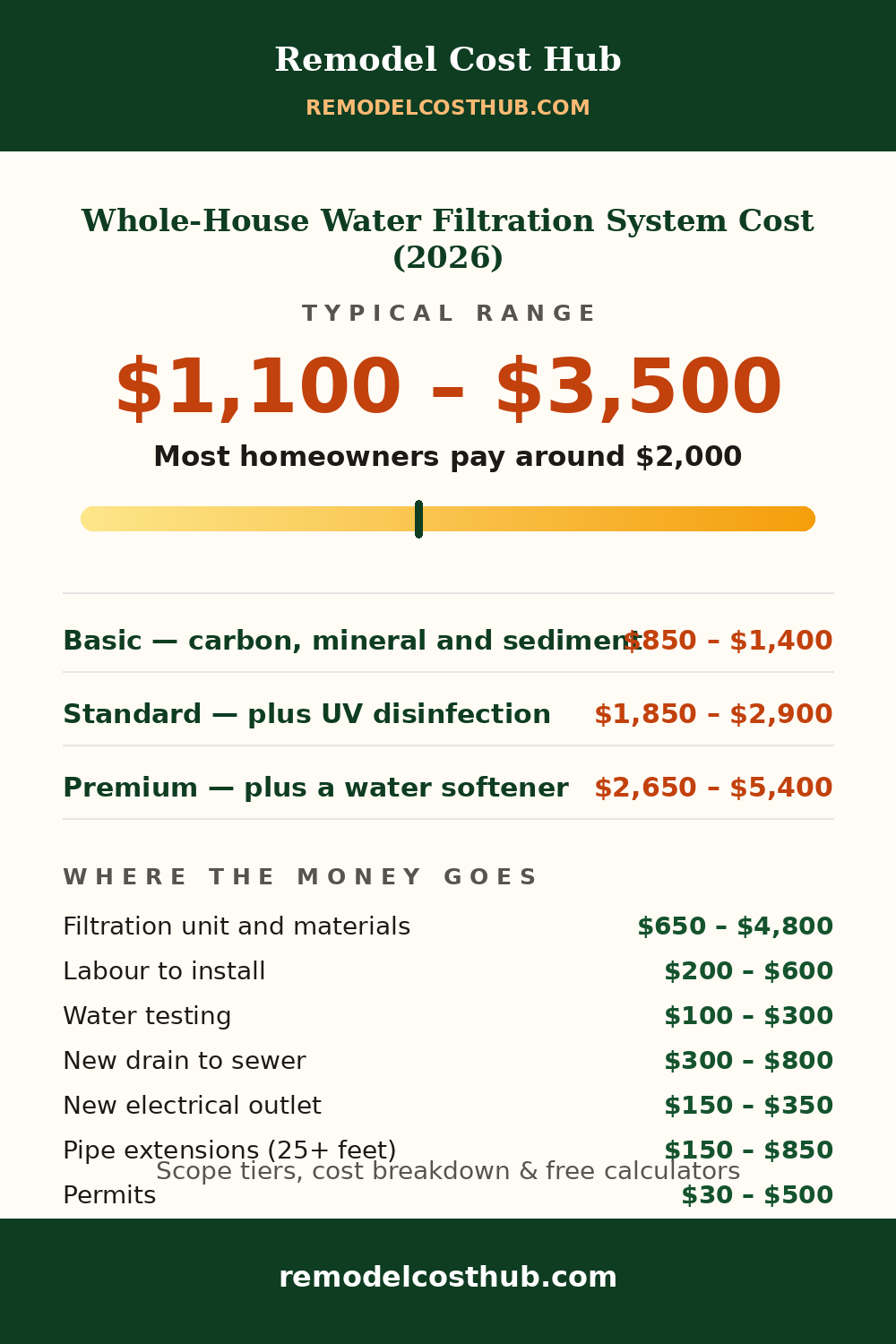
- Typical range: $1,100 – $3,500
- Most homeowners pay: around $2,000
Cross-checked against four published sources for this project. Sources used for this page: Angi's and HomeGuide's home water filtration system cost guides (same Angi family — counted as one source), CostHelper's water filter cost guide, and Dierolf Plumbing's 2026 whole-house water filter installation cost guide. Sources last checked: October 2026 — HomeGuide, Angi, CostHelper, Dierolf Plumbing. How we calculate these costs
Cost by scope
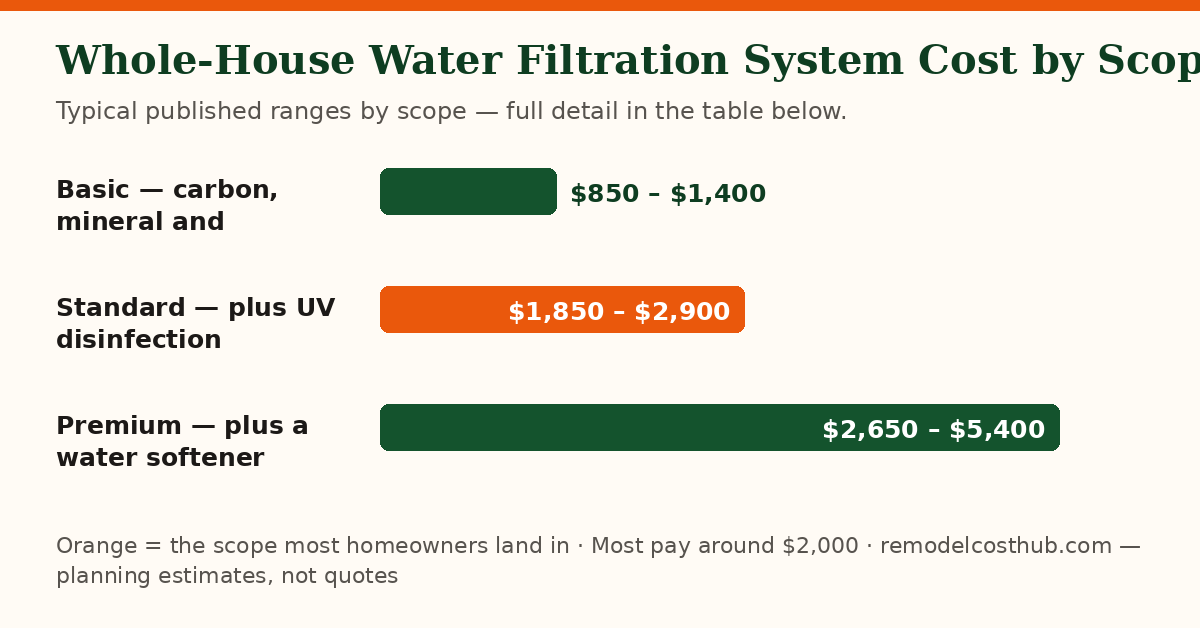
| Scope | Typical cost | What it includes |
|---|---|---|
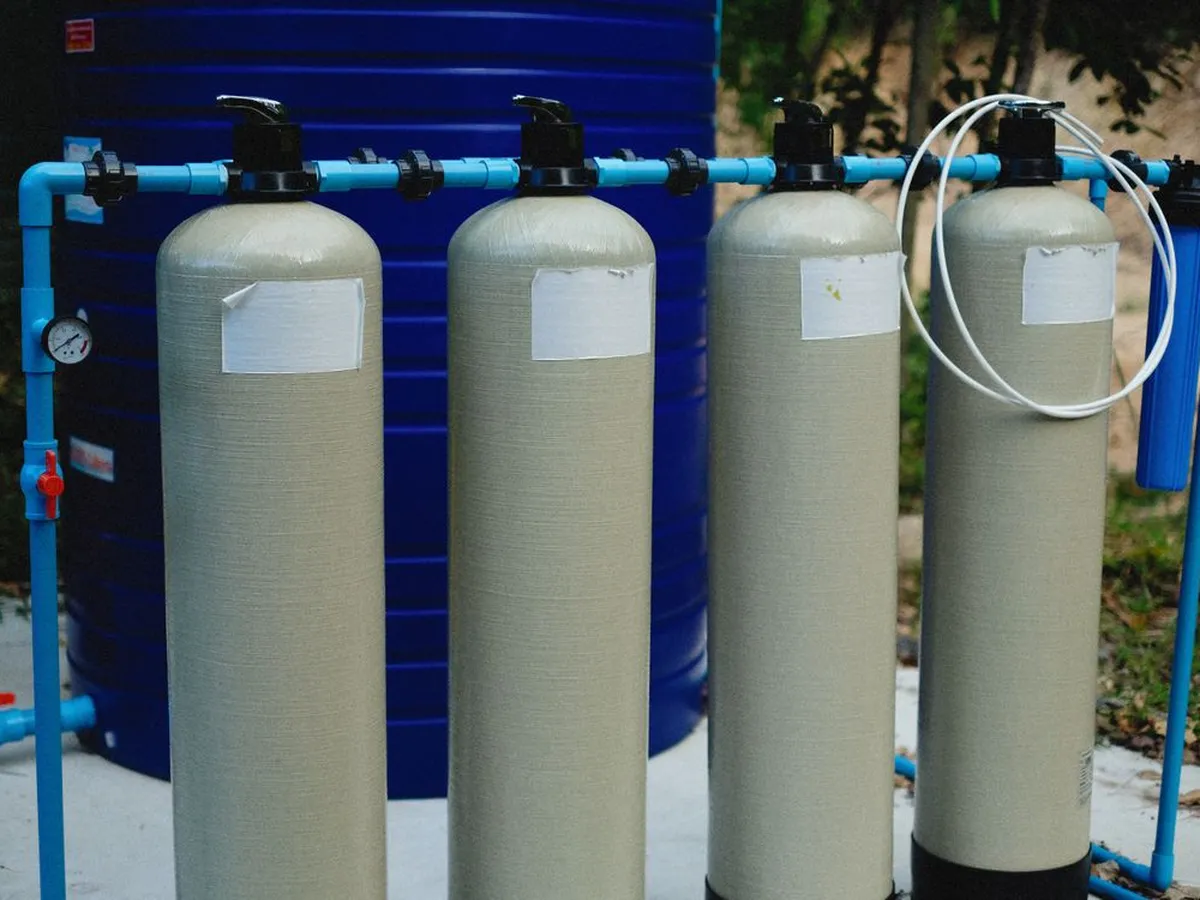
| Basic — carbon, mineral and sediment | $850 – $1,400 | HomeGuide's standard whole-house carbon band: sediment and carbon stages that handle chlorine, taste, odour and sediment for a municipal-water home |
| Standard — plus UV disinfection | $1,850 – $2,900 | HomeGuide's carbon/mineral/sediment plus UV band: the well-water and bacteria-conscious step, with UV alone at $350–$1,500 installed depending on size |
| Premium — plus a water softener | $2,650 – $5,400 | HomeGuide's full-combo band: carbon, mineral, sediment and UV plus a softener for hard water; Dierolf's multi-stage well-water systems land at $2,500–$6,000 in the same territory |
Where the money goes
| Part of the job | Share | Note |
|---|---|---|
| Filtration unit and materials | $650 – $4,800 | HomeGuide's whole-house materials table; Angi puts the system itself at $1,000–$4,000 |
| Labour to install | $200 – $600 | HomeGuide's table; Angi's $300–$3,000 installation band bundles major plumbing modifications, and Dierolf's labour alone runs $500–$2,000 — the wide spread is a scope difference, not an error |
| Water testing | $100 – $300 | HomeGuide's testing band; Dierolf's certified lab testing varies by package |
| New drain to sewer | $300 – $800 | HomeGuide's extra for a new drain connection where the system needs one |
| New electrical outlet | $150 – $350 | HomeGuide's outlet band for a new outlet within 10–15 feet of the tank; Dierolf puts UV electrical work at $200–$500 |
| Pipe extensions (25+ feet) | $150 – $850 | HomeGuide's band for long pipe runs; plumber rates run $45–$150 an hour |
| Permits | $30 – $500 | HomeGuide's plumbing-permit band; Dierolf's local permits run $50–$200 |
| Annual replacement filters | $150 – $250 per year | HomeGuide's whole-house filter table (DIY labour); the wider planning figure across guides is $100–$300 a year, plus $10–$20 a month in salt if a salt softener is included |
What moves the price most
Stage count is the dominant driver: each added stage (UV, softener or conditioner, iron treatment) moves the project up a tier. Well vs municipal water is next — municipal water is usually chlorine/taste-led and carbon suffices, while well water may need sediment, iron, bacteria (UV) and softening, and testing first. Flow-rate sizing decides whether the system works in practice: most family homes need around 10–15 GPM, and an undersized system drops pressure when several fixtures run at once. Plumbing age, access and location escalate labour — tight crawl spaces, attic installs, galvanised or undersized pipe, long runs, and new drains or electrics. Two disagreements are published, not smoothed: whole-house reverse osmosis is $4,800–$8,000 installed in HomeGuide but $1,000–$4,000 unit-led in Bob Vila (HomeGuide's installed band is used here), and softener pricing inside HomeGuide itself is $800–$2,500 in one table vs $1,200–$3,800 in its softener section. Salt-free conditioner has no three-source verification (secondary tables only, roughly $550–$1,700) and is therefore not priced as a standalone tier here.
Costs in your city
Labor is the biggest variable in any remodel, and labor is local — the same bathroom can price very differently in Houston than in Boston. We are adding city editions metro by metro, each with its own labor index, permit notes and climate factors, written for that city rather than copied from this page. Wave 1: Houston, Dallas–Fort Worth, Phoenix, Atlanta, Miami–South Florida, Orlando, Tampa, Charlotte, Austin and San Antonio. Until your city's page is live, use the national range here and weight it the way contractors do: Sun Belt labor often prices near or below the national middle, while coastal California and the Northeast metros often price well above it.
Frequently asked questions
How much does a whole-house water filtration system cost installed?
Typically $1,100–$3,500 for a standard system (Angi's average installed band); the full published spread is $850–$5,400 (HomeGuide), with whole-house reverse osmosis separate at $4,800–$8,000.
What is the average cost?
About $2,000 is the most-cited average (Forbes Home, as reported), and an Angi-derived national average of $2,078 (Bob Vila) lands in the same place. Treat $2,000–$2,100 as the most-pay anchor, not a guaranteed quote.
What do the tiers actually buy?
Basic carbon/mineral/sediment filtration runs $850–$1,400 installed (HomeGuide); adding UV disinfection takes it to $1,850–$2,900; adding a water softener as well takes it to $2,650–$5,400. Each stage answers a different water problem, so the tier follows the water test, not the budget alone.
Do I need whole-house reverse osmosis?
Usually no for the whole house. HomeGuide prices it at $4,800–$8,000 installed, it needs a large storage tank, produces the most wastewater, and is slow. The normal pattern in the sources is whole-house carbon filtration plus, if needed, a small under-sink RO unit ($300–$950 installed, HomeGuide) for drinking water.
How much is maintenance each year?
Budget roughly $100–$300 a year for filters and consumables in most guides; HomeGuide's table narrows whole-house replacement filters to $150–$250 a year DIY, plus $10–$20 a month in salt if a salt softener is included, and UV lamp replacement roughly $20–$100 in parts.
Will it work for well water, and will it lower pressure?
Yes for well water, but expect more stages and a higher price when iron, sulfur or bacteria are present, plus UV for bacteria. Pressure drop is mainly a sizing problem: an undersized system drops pressure when multiple fixtures run, so size by peak flow (around 10–15 GPM for a family home), not by tank size alone.