Generator Installation cost at a glance
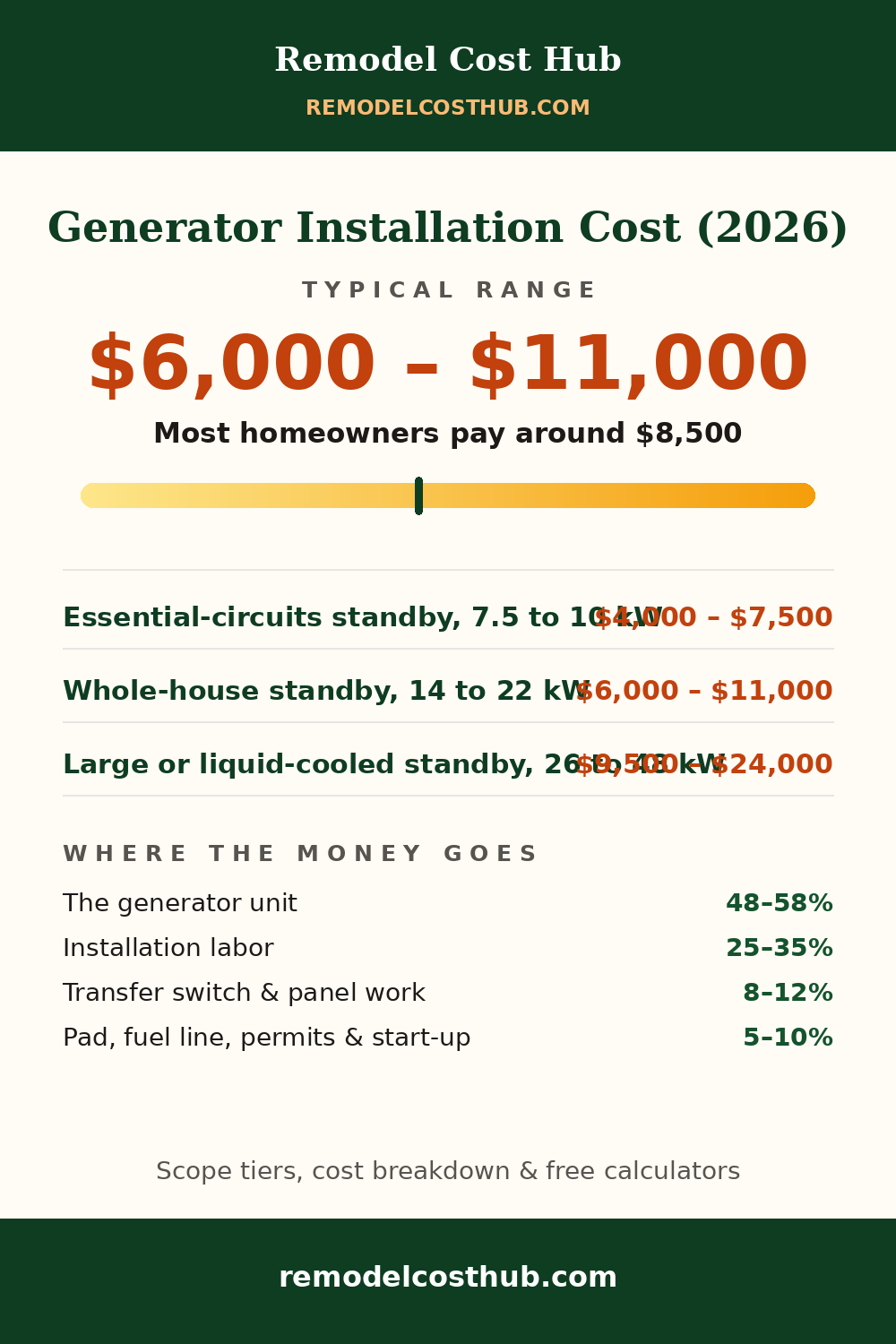
- Typical range: $6,000 – $11,000
- Most homeowners pay: around $8,500
- Prices vary most by: The generator unit (48–58% of the budget)
Cross-checked against three published sources for this project. Sources used for this page: Angi's whole-house generator cost guide, HomeGuide's whole-house generator cost guide and Forbes Home's generator cost data. Sources last checked: October 2026 — Forbes Home, HomeGuide, Angi. Last updated October 2026 · How we calculate these costs
Cost by scope
| Scope | Typical cost | What it includes |
|---|---|---|
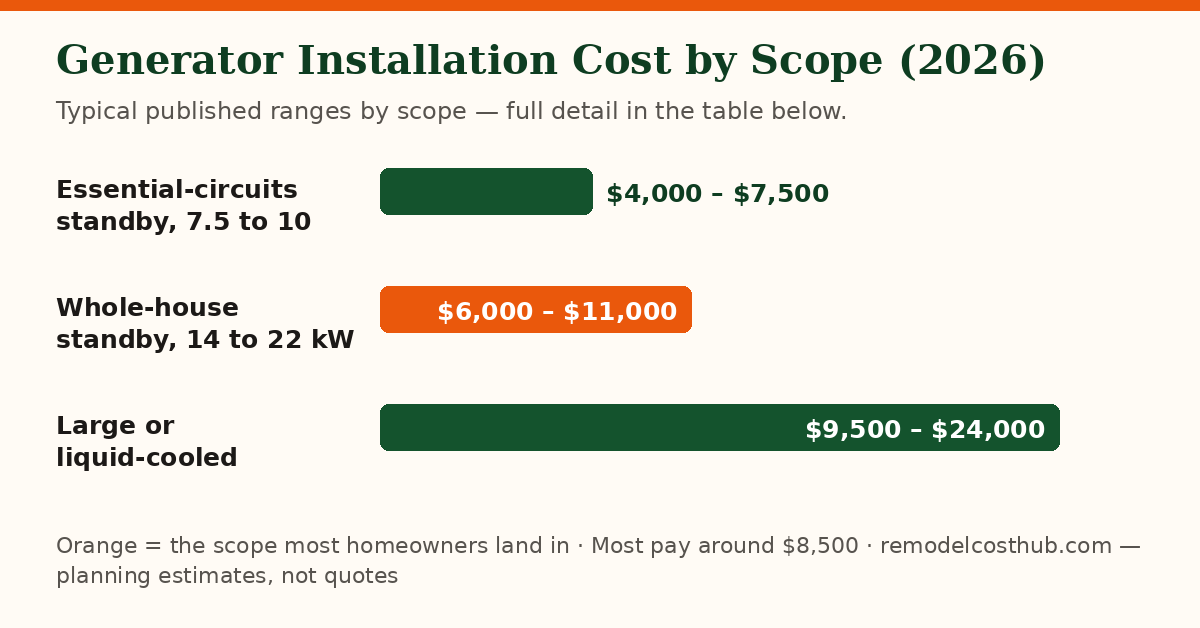
| Essential-circuits standby, 7.5 to 10 kW | $4,000 – $7,500 | Backup for the essentials only — refrigerator, furnace fan, well or sump pump, lights and a few outlets. Angi prices a 7.5–10 kW unit at $2,000–$3,500 before installation, and HomeGuide totals a basic standby installation from about $4,000 once the transfer switch, pad and permits are added. |
| Whole-house standby, 14 to 22 kW | $6,000 – $11,000 | The typical project on this page. HomeGuide totals a whole-house generator installed at $6,000–$11,000, with the unit itself at $3,000–$6,000 and installation labor at $3,000–$5,000 — and Forbes Home's published average lands at about $9,000 installed, inside the same band. |
| Large or liquid-cooled standby, 26 to 48 kW | $9,500 – $24,000 | Where big houses and long fuel runs live. HomeGuide prices units over 20 kW at $9,500–$24,000 installed once longer installation is counted, and Angi prices 26–32 kW units alone at $6,500–$15,000 and 45–48 kW units at $16,200–$21,000 before installation. |
Where the money goes
| Part of the job | Share | Note |
|---|---|---|
| The generator unit | 48–58% | The machine is half the bill: HomeGuide prices the unit at $3,000–$6,000 for a standard whole-house size, and Angi prices units by output — $2,000–$3,500 at 7.5–10 kW, $4,000–$5,500 at 14–18 kW and $5,000–$6,500 at 20–24 kW |
| Installation labor | 25–35% | Two trades on one job — an electrician for the switch and panel work and a plumber or gas fitter for the fuel line. Angi averages standby installation at $4,520 including permits, assembly, placement and wiring, with labor itself at $1,500–$5,000 |
| Transfer switch & panel work | 8–12% | The switch is what makes the system automatic and safe. Angi puts about $1,200 of the installation cost into transfer-switch wiring, and HomeGuide prices a transfer switch installation at $600–$2,500; a subpanel upgrade adds $500–$2,000 in Angi when the existing panel cannot take the load |
| Pad, fuel line, permits & start-up | 5–10% | HomeGuide prices a concrete pad at $150–$400, a gas line run at $12–$25 per foot and permits at $80–$450; Angi prices the pad work at about $1,000 on its standard 3-by-6-foot pour and permits at $50–$200 — small lines that are never zero |
What moves the price most
Size in kilowatts is the price. Every source prices by output: Angi's unit table runs from $2,000–$3,500 at 7.5–10 kW to $16,200–$21,000 at 45–48 kW, so sizing the unit to a real load list — not to the whole panel's theoretical total — is the single biggest saving available. Distance is the second driver: HomeGuide prices installation labor at $3,000–$5,000 as standard and $5,000–$12,000 or more where the unit sits far from the panel or the fuel source, because both the electrical run and the gas line are priced by the foot. Fuel decides the plumbing bill: an existing natural-gas service is the cheap connection, while propane adds a tank at $400–$1,800 in HomeGuide. The panel can add a tier of its own — a subpanel upgrade runs $500–$2,000 in Angi. And the running costs are real money: HomeGuide budgets maintenance at $200–$650 a year, and Angi puts a 20 kW unit's daily fuel burn at roughly $175 on diesel and $220 on propane during an outage.
Worked example: how a typical generator installation budget breaks down
A typical job: an 18 kW air-cooled standby generator on a poured pad beside the house — automatic transfer switch wired at the panel, natural gas line run from the existing meter, permits pulled, and the first start-up and load test run with the installer present. The budget below totals $8,500 — the "most homeowners pay around" figure from the top of this page — split using this page's own cost breakdown. It shows how a real quote at that level is usually composed; every line is built from the ranges on this page, and it is an illustration, not a quote for your project.
| Line item | Example budget |
|---|---|
| The generator unit (18 kW, air-cooled) | $4,500 |
| Installation labor (electrical + gas) | $2,550 |
| Transfer switch & panel wiring | $850 |
| Pad, permits & start-up | $600 |
| Total | $8,500 |
What most people get wrong
- Sizing the unit to the whole panel instead of a load list — Angi prices 20–24 kW units at $5,000–$6,500 and 26–32 kW units at $6,500–$15,000, so every unneeded kilowatt is bought twice, once in the unit and once in fuel.
- Accepting a quote with no transfer switch line — HomeGuide prices the switch installation at $600–$2,500, and a standby system without an automatic switch is neither automatic nor code-safe.
- Placing the unit wherever it fits and pricing the gas run later — HomeGuide prices installation labor at $3,000–$5,000 standard and $5,000–$12,000 or more on long runs, because distance is priced by the foot on both the wire and the pipe.
- Skipping the maintenance budget — HomeGuide puts upkeep at $200–$650 a year, and a standby unit that is never exercised or serviced is a $8,500 ornament on the day the power actually fails.
Costs in your city
Generator pricing is a national unit price wrapped in local labor and local code. The unit itself ships at the same price everywhere — Angi's size table runs $4,000–$5,500 at 14–18 kW and $5,000–$6,500 at 20–24 kW in every market — but permits run $50–$200 in Angi and $80–$450 in HomeGuide depending on the jurisdiction, and outage country pays an urgency premium: hurricane, ice-storm and wildfire-shutoff regions carry longer installer backlogs after every event, which is when quotes stretch. Fuel is the other local variable — an existing natural-gas service is the cheap hookup, while propane adds a tank at $400–$1,800 in HomeGuide where no gas main reaches. Ask each bidder for the unit size in writing, the transfer switch and gas run as separate lines, and who pulls the permits.
Frequently asked questions
How much does it cost to install a whole-house generator?
Most homeowners pay $6,000–$11,000 for a whole-house standby generator fully installed, with $8,500 typical for a 14 to 22 kW unit. HomeGuide totals the installed job at $6,000–$11,000, Forbes Home's published average is about $9,000 installed, and Angi averages a standby installation itself at $4,520 on top of the unit.
How much does generator installation labor cost alone?
Angi averages the installation work at $4,520, including permits, assembly, placement and wiring, with labor at $1,500–$5,000 of it. HomeGuide prices installation labor higher on standard jobs at $3,000–$5,000 and at $5,000–$12,000 or more where the unit sits far from the panel or the fuel line runs long.
What size generator do I need for a whole house?
Most houses run whole-home on 14 to 22 kW: Angi prices 14–18 kW units at $4,000–$5,500 covering essentials plus air conditioning and a water heater, and 20–24 kW units at $5,000–$6,500 covering everything including multiple air conditioners. Smaller 7.5–10 kW units at $2,000–$3,500 cover essentials only.
How much does a transfer switch cost?
HomeGuide prices a transfer switch installation at $600–$2,500, and Angi puts about $1,200 of a typical installation cost into the switch and its wiring. The switch is not optional on a standby system — it is what isolates the house from the grid so the generator cannot back-feed the lines.
How much does it cost to run and maintain a standby generator?
HomeGuide budgets maintenance at $200–$650 a year, and the units are rated for 15 to 30 years of life. Fuel during an outage is the variable cost: Angi puts a 20 kW unit at about $175 a day on diesel and $220 a day on propane, which is why long outages, not the purchase, are where oversized units get expensive.