Whole-House Surge Protector Installation cost at a glance
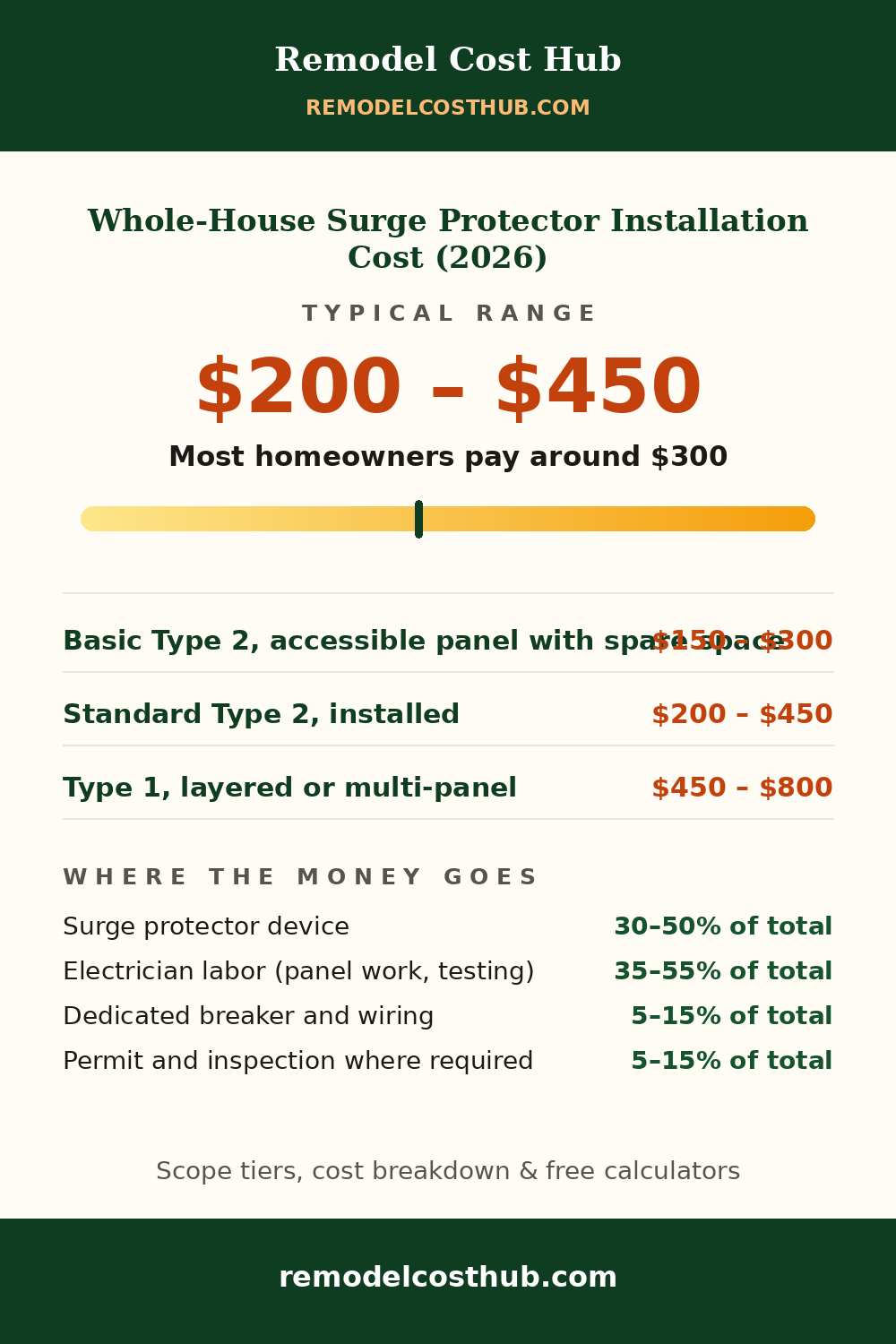
- Typical range: $200 – $450
- Most homeowners pay: around $300
- Prices vary most by: Electrician labor (panel work, testing) (35–55% of the budget)
Cross-checked against two published sources for this project. Sources used for this page: Angi's whole-house surge protector cost guide, updated October 13, 2026 (national average $300, most $70–$700; Type 1 and Type 2 devices $50–$250 before installation, Type 3 plug-in $10–$25; electrician labor $100–$200 for about two hours at $50–$100 an hour), HomeGuide's whole-house surge protector cost data as reported in current published summaries (Type 2 installed $200–$450, Type 1 installed $250–$800, installation labor $140–$300, with the note that connected-equipment warranties often require a licensed-electrician install) and EngineerFix's whole-home surge protector guide (device $70–$350, professional labor $100–$300, standard total $300–$700; look for UL 1449 certification and a 60–80 kA rating as a starting point for a modern home). Synthesized typical = HomeGuide's Type 2 installed band; $300 most-pay is Angi's national average inside that band. Checked November 2026.. Sources last checked: October 2026 — HomeGuide, Angi. How we calculate these costs
Cost by scope
| Scope | Typical cost | What it includes |
|---|---|---|
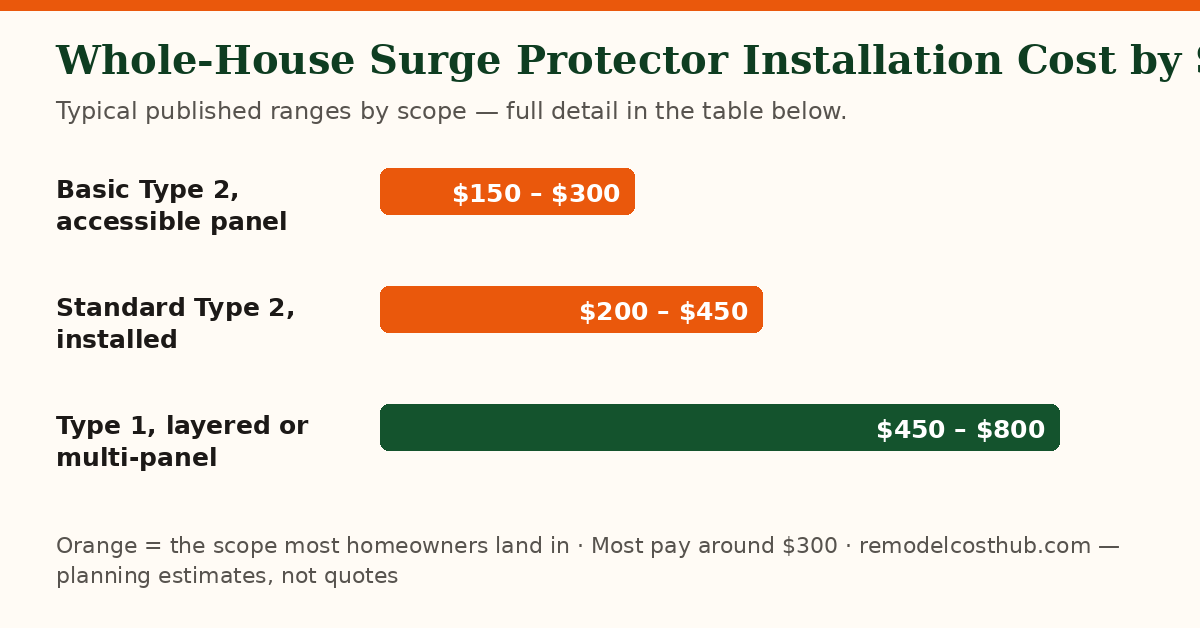
| Basic Type 2, accessible panel with spare space | $150 – $300 | Angi's device band for Type 2 is $50–$250 and its labor band is $100–$200 for about two hours; a straightforward panel with room lands here. |
| Standard Type 2, installed | $200 – $450 | The typical project on this page. HomeGuide puts a Type 2 installed at $200–$450, and Angi's national average for the project is $300 inside a $70–$700 band. |
| Type 1, layered or multi-panel | $450 – $800 | HomeGuide puts Type 1 installed at $250–$800; meter-side work, a second panel, or a crowded panel that needs rework lands here. |
Where the money goes
| Part of the job | Share | Note |
|---|---|---|
| Surge protector device | 30–50% of total | Type 2 devices run $50–$250 in Angi and $70–$350 in EngineerFix; the surge-current rating in kA and the enclosure type move this line |
| Electrician labor (panel work, testing) | 35–55% of total | Angi prices labor at $100–$200 for about two hours at $50–$100 an hour; HomeGuide's labor band is $140–$300 |
| Dedicated breaker and wiring | 5–15% of total | A Type 2 device needs its own dedicated double-pole breaker, about $15–$30, plus short wiring runs inside or beside the panel |
| Permit and inspection where required | 5–15% of total | Some jurisdictions require a permit and inspection for panel work; where that is charged it is a separate line, not part of the device price |
What moves the price most
Type is first: Angi prices Type 1 and Type 2 devices at $50–$250 before installation, while Type 3 plug-in strips run $10–$25 and need no install at all — Type 2, mounted in the main panel, is the common residential choice. Panel condition is second: a panel with spare breaker space takes a two-hour visit, while a crowded or outdated panel needs rework before a device can be added. Amperage is third: Angi names panel amperage as a price driver, and a larger service generally takes a larger-rated device. Layering is fourth: a whole-house device handles surges at the service entrance, but point-of-use strips at sensitive electronics are still the second layer — the panel device is not a substitute for them. For the panel itself, see our electrical panel upgrade guide, for a safety check, see our electrical inspection guide, and for full rewiring, see our whole-house rewiring guide.
Costs in your city
Labor is the biggest variable in any remodel, and labor is local — the same bathroom can price very differently in Houston than in Boston. We are adding city editions metro by metro, each with its own labor index, permit notes and climate factors, written for that city rather than copied from this page. Wave 1: Houston, Dallas–Fort Worth, Phoenix, Atlanta, Miami–South Florida, Orlando, Tampa, Charlotte, Austin and San Antonio. Until your city's page is live, use the national range here and weight it the way contractors do: Sun Belt labor often prices near or below the national middle, while coastal California and the Northeast metros often price well above it.
Frequently asked questions
How much does a whole-house surge protector cost installed?
A standard Type 2 install runs $200–$450 with $300 typical — HomeGuide's Type 2 installed band, with Angi's $300 national average sitting inside it. Angi's broader project band is $70–$700 because it includes the cheapest and the meter-side jobs.
What is the difference between Type 1, Type 2 and Type 3?
Type 1 mounts before the main breaker, at the meter, for the largest external surges. Type 2 mounts inside the main panel and is the standard whole-house choice. Type 3 is a plug-in strip at individual outlets — useful as a second layer, not a whole-house device.
Will a whole-house surge protector stop lightning damage?
It diverts surges at the service entrance, but it will not protect against a direct lightning strike — no panel device is rated for that. Its job is the far more common surges from the grid and from large appliances switching.
Do I need an electrician to install one?
Yes. The device goes inside the main panel, which carries live service conductors, and HomeGuide notes that connected-equipment warranties often only pay out when a licensed electrician installed the device. This is not a DIY panel job.
Is a whole-house surge protector required by code?
Since the 2020 National Electrical Code, section 230.67 requires a Type 1 or Type 2 device at dwelling-unit services — which in practice means new construction and service-equipment replacements include one. An existing older panel is not automatically forced to retrofit, but adding one is the same device at the same price.
How long does installation take, and how long does the device last?
Angi puts the visit at about two hours for a standard panel. The device itself has an indicator light: when it has absorbed a large surge or its indicator changes, it has done its job and needs replacing — check the indicator, do not assume a silent box is still protecting.