Home Inspection cost at a glance
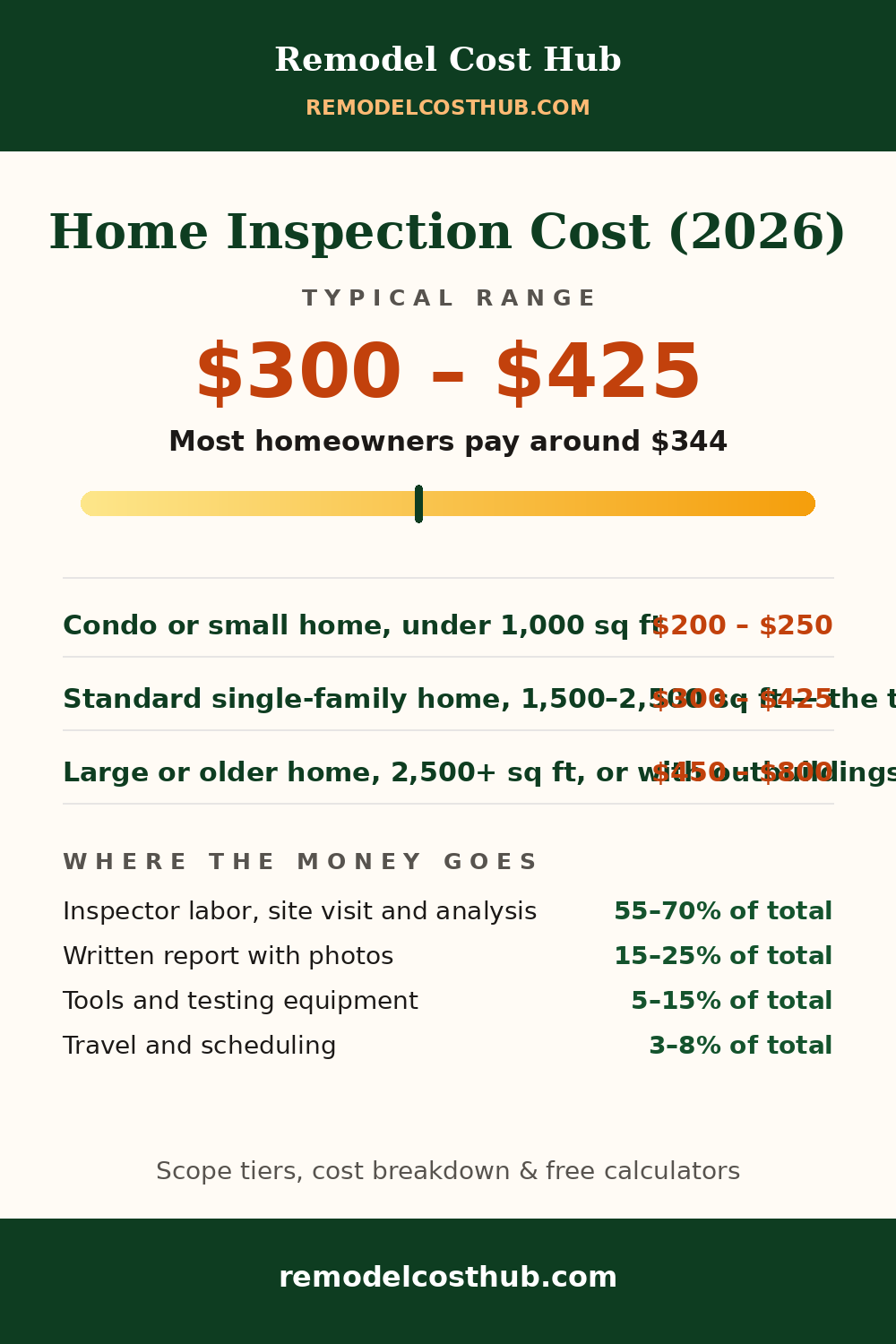
- Typical range: $300 – $425
- Most homeowners pay: around $344
- Prices vary most by: Inspector labor, site visit and analysis (55–70% of the budget)
Cross-checked against three published sources for this project. Sources used for this page: Angi's home inspection cost guide, updated September 25, 2026 (national average $344 across 34,526 verified projects, most $296–$425; under 1,000 sq ft $200–$250, 1,000–1,500 $225–$325, 1,500–2,000 $250–$375, 2,000–2,500 $275–$400, 2,500–3,000 $300–$500; visit two to four hours; specialized inspections $125–$660), HomeGuide's home inspection cost guide (national average $340, average range $200–$500, minimum $200, maximum $800; under 1,000 sq ft $200–$250, 1,501–2,000 $300–$400, 2,501–3,000 $450–$500+; condo $200–$250; 4-point inspection $50–$100; pre-drywall $100–$400; thermal imaging $300–$500; travel $1–$2 per mile beyond 20–60 miles) and Rocket Mortgage's 2026 home inspection cost guide (average about $343, most $296–$424 on HomeAdvisor data, same size table as Angi). The page's typical band is the Angi most-pay band against HomeGuide's average range, and its $344 most-pay figure is Angi's published average. Sources last checked: October 2026 — HomeAdvisor, HomeGuide, Angi. How we calculate these costs
Cost by scope
| Scope | Typical cost | What it includes |
|---|---|---|
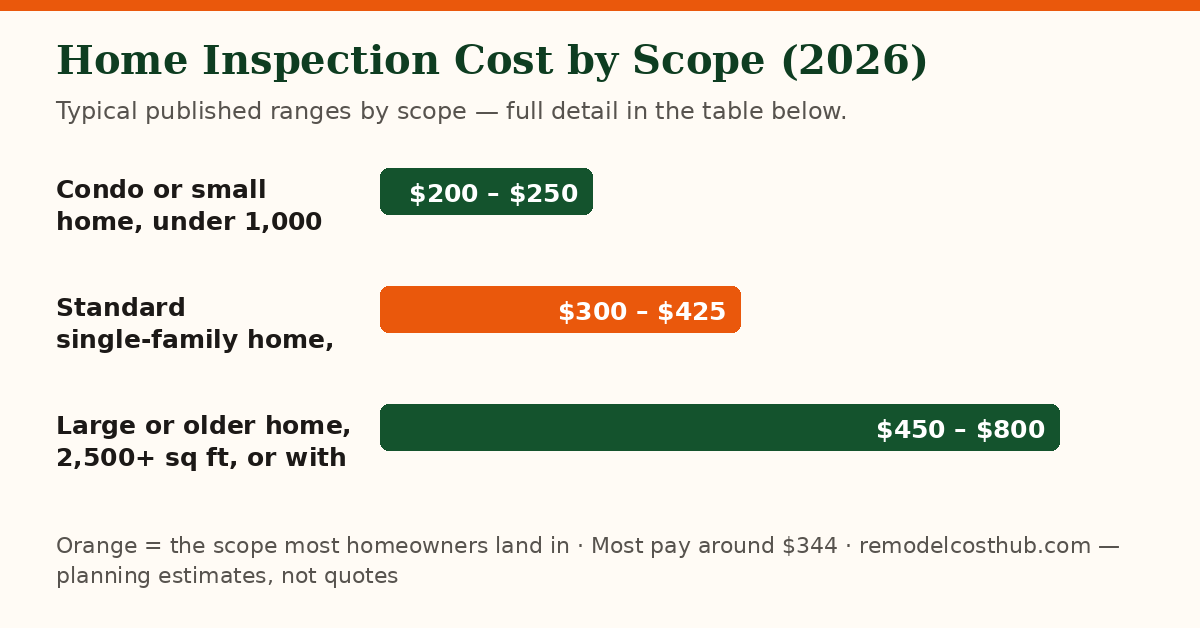
| Condo or small home, under 1,000 sq ft | $200 – $250 | The cheap end: both Angi and HomeGuide price homes under 1,000 sq ft at $200–$250 — fewer systems, fewer rooms, a shorter visit |
| Standard single-family home, 1,500–2,500 sq ft — the typical job | $300 – $425 | The shared band: Angi's $296–$425 most-pay band against HomeGuide's $300–$400 for 1,501–2,000 sq ft — the standard walk-through, systems check and written report |
| Large or older home, 2,500+ sq ft, or with outbuildings | $450 – $800 | The expensive end: HomeGuide prices 2,501–3,000 sq ft at $450–$500+ with a maximum of $800, and Angi prices specialized follow-ups at $125–$660 where the first report flags a system — age and size, not the inspector's brand, set this tier |
Where the money goes
| Part of the job | Share | Note |
|---|---|---|
| Inspector labor, site visit and analysis | 55–70% of total | Angi puts a standard visit at two to four hours, and HomeGuide notes older homes take longer because aging wiring, plumbing and code issues need more checking — size and age set the hours |
| Written report with photos | 15–25% of total | Angi describes a detailed written report with photographs delivered after the visit; on a full inspection the report is the deliverable, and it is what a buyer negotiates from |
| Tools and testing equipment | 5–15% of total | Moisture meters, thermal cameras and ladders ride on the visit — HomeGuide prices a thermal imaging inspection at $300–$500 standalone, which is why it is usually an add-on rather than base scope |
| Travel and scheduling | 3–8% of total | HomeGuide prices travel at $1–$2 per mile beyond 20–60 miles for inspectors who charge it — a local inspector usually folds it into the flat fee |
What moves the price most
Home size is first: Angi prices homes under 1,000 sq ft at $200–$250, 1,500–2,000 sq ft at $250–$375, and 2,500–3,000 sq ft at $300–$500, and adds roughly $25 per extra 500 sq ft above 2,000 sq ft — the visit length is the fee. Age is second: HomeGuide notes houses built before the 1980s can add $100–$200 for asbestos or lead-paint checks, and Angi notes older homes need more time on wiring, plumbing and code compliance. Location is third: Angi averages Detroit at $300 against New Jersey at $430, and HomeGuide's state bands run from $200–$350 in Arizona to $500–$700 in Washington. Add-ons are fourth: Angi prices specialized inspections at $125–$660 — radon $250, mold $660, foundation $600, chimney $450 — and HomeGuide's add-on table runs $70–$2,800, so a quote without a test list is not comparable. For the roof half of the report, see our roof inspection guide, and for the mold test that often follows a damp finding, see our mold testing guide.
Worked example: how a typical home inspection budget breaks down
Take the typical job — a standard inspection of a 2,000 sq ft single-family home: full walk-through, systems check, photos and a written report. Here is a realistic $344 version of that invoice, at Angi's national average: The budget below totals $344 — the "most homeowners pay around" figure from the top of this page — split using this page's own cost breakdown. It shows how a real quote at that level is usually composed; every line is built from the ranges on this page, and it is an illustration, not a quote for your project.
| Line item | Example budget |
|---|---|
| Inspector labor (visit and analysis) | $220 |
| Written report with photos | $85 |
| Tools and testing equipment | $25 |
| Travel and scheduling | $14 |
| Total | $344 |
What most people get wrong
- Comparing quotes without a scope list — a $200 quote that skips the attic, crawl space and roof is not the same inspection as a $425 quote that covers them, and only the scope list makes them comparable.
- Assuming specialist tests are included — Angi prices specialized inspections at $125–$660, so radon, mold, sewer scope and termite checks ride on top of the base fee, not inside it.
- Skipping the inspection on a new home — Angi prices new-home inspections at $280–$400 because builders miss things too, and the pre-drywall and 11-month checks exist for exactly that reason.
- Buying the cheapest report and never reading it — the report is the deliverable, and a thin report with no photos gives a buyer nothing to negotiate from.
Costs in your city
Home inspection is inspector-labor pricing around a flat visit fee: the same 2,000 sq ft home quotes near the bottom of the band where inspector rates are low and toward the top in a high-cost metro — Angi averages Detroit at $300 against New Jersey at $430, and HomeGuide's state bands run from $200–$350 in Arizona to $500–$700 in Washington. Age travels with the city too: older housing stock takes longer and pulls specialist add-ons, and some states license inspectors while others do not, which changes what the base fee buys. Ask each bidder for the scope list, the systems covered, and whether the report includes photos.
Frequently asked questions
How much does a home inspection cost on average?
Angi's 2026 national average is $344, with most homeowners paying $296–$425, and HomeGuide's national average is $340 inside a $200–$500 average range. This page's typical band is $300–$425, with about $344 the figure most standard inspections land near.
What does a standard home inspection cover?
The visible, major systems: structure and foundation, roof, exterior, attic, basement and crawl space, interior, kitchen and bath, plumbing, electrical and heating and cooling, in HomeGuide's scope table and Angi's checklist. It is visual and non-invasive — what an inspector cannot see, such as inside walls or under floors, is not covered.
How much does a home inspection cost by home size?
Angi prices homes under 1,000 sq ft at $200–$250, 1,000–1,500 sq ft at $225–$325, 1,500–2,000 sq ft at $250–$375, 2,000–2,500 sq ft at $275–$400, and 2,500–3,000 sq ft at $300–$500. HomeGuide's size table agrees at the small end and runs higher above 2,000 sq ft, at $400–$450 for 2,001–2,500 sq ft.
Who pays for a home inspection, and how long does it take?
The buyer typically hires, pays for and schedules the inspection, in HomeGuide's guide, usually within days of an accepted offer. Angi puts the visit at two to four hours, ending with a detailed written report with photographs.
Are radon, mold or sewer scope tests included?
No — they are specialist add-ons. Angi prices specialized inspections at $125–$660, including radon at $250 and mold at $660, and HomeGuide prices a 4-point insurance inspection (roof, electrical, plumbing, HVAC) at $50–$100 for older homes. A base quote that claims to include everything is usually a stripped-down visit.