Cost by scope
| Scope | Typical cost | What it includes |
|---|---|---|
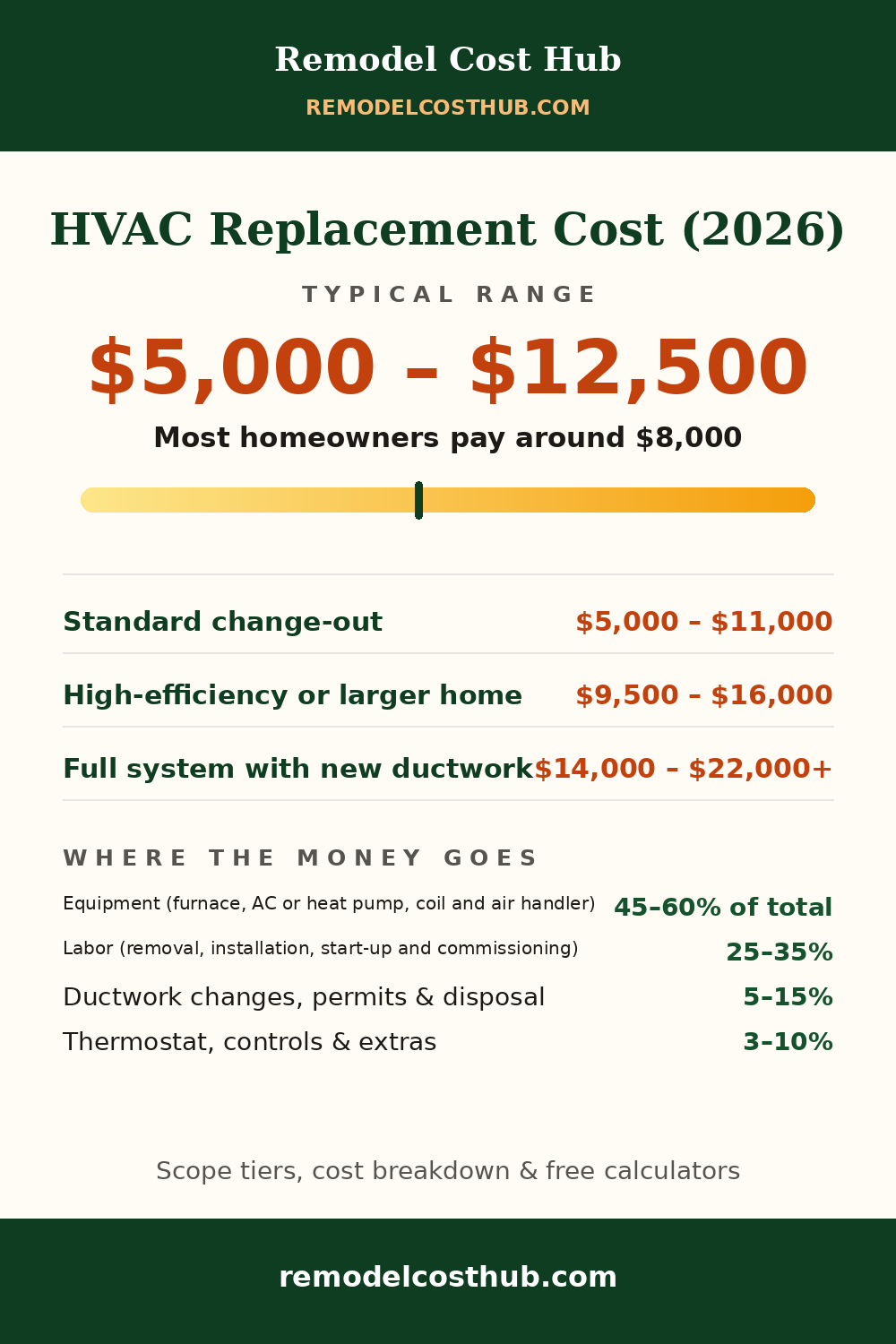
| Standard change-out | $5,000 – $11,000 | New furnace and central AC — or a standard heat pump — swapped onto existing, sound ductwork; standard-efficiency equipment; usually a one-day job |
| High-efficiency or larger home | $9,500 – $16,000 | Higher-efficiency or variable-speed equipment, a larger system for a bigger home, or a change-out plus meaningful duct repairs and add-ons such as zoning or air purification |
| Full system with new ductwork | $14,000 – $22,000+ | New equipment plus new or extensively rebuilt ductwork, premium efficiency, or a geothermal system — the top of the published range |
Where the money goes
| Part of the job | Share | Note |
|---|---|---|
| Equipment (furnace, AC or heat pump, coil and air handler) | 45–60% of total | System size, fuel type, efficiency rating and brand move this share most |
| Labor (removal, installation, start-up and commissioning) | 25–35% | Access, electrical or gas work and local labor rates drive the variation |
| Ductwork changes, permits & disposal | 5–15% | Sound existing ducts keep this low; new duct runs are priced as their own project inside the job |
| Thermostat, controls & extras | 3–10% | Smart thermostats, zoning, humidifiers and filtration add up — agree the list in writing before work starts |
What moves the price most
System size and efficiency decide the equipment price. A correctly sized system for a small, well-insulated home costs far less than a large, high-efficiency or variable-speed system for a big, leaky one — and an oversized system is not an upgrade: it cycles on and off, wears faster and controls humidity poorly, so a proper load calculation matters more than a bigger number on the box. Ductwork is the second cliff. Published guides consistently price a change-out on sound existing ducts well below the same job with new ductwork, because ducts add days of labor and materials. Fuel and system type come third — a furnace-plus-AC split, a heat pump, and a geothermal system are different products at different price points, not trim levels of one product. Finally, timing: a planned replacement in the shoulder season is quoted in a calmer market than an emergency change-out during a heatwave or cold snap, when crews are booked out and equipment choice narrows to whatever is in stock.
Costs in your city
Local labor moves a remodel price more than almost anything else, so we are publishing city-adjusted ranges metro by metro — each with its own local cost index, permit notes and climate factors, not a find-and-replace of this page. Wave 1 cities: Houston, Dallas–Fort Worth, Phoenix, Atlanta, Miami–South Florida, Orlando, Tampa, Charlotte, Austin and San Antonio. Until your city's page is live, use the national range here and weight it: Sun Belt labor often prices near or below the national middle; coastal California and the Northeast metros often price well above it.
Frequently asked questions
How much does HVAC replacement cost for a 2,000 sq ft home?
Most published guides put a standard full-system change-out for an average home in the $5,000–$12,500 typical band on this page, with the middle around $8,000. Home size matters mainly through the system size it requires — insulation, windows and climate zone can move a 2,000 sq ft home's required capacity as much as the floor area itself.
How long does an HVAC replacement take?
A like-for-like change-out on existing ductwork commonly takes about a day. Jobs that add or rebuild ductwork typically run 3–5 days, and systems with extensive add-ons can take up to a week — ask for the schedule in writing, especially in peak season.
Should I repair or replace my HVAC system?
A common planning guideline multiplies a repair quote by the system's age in years: if the result is well above $5,000, replacement is usually the better spend, because large repairs on old equipment buy little remaining life. Also weigh refrigerant type, rising energy bills and how often the system has needed repairs in the last two years.
Is a higher-efficiency system worth the extra cost?
Higher-efficiency equipment costs more up front and generally lowers running costs, with the payback depending on your climate, energy prices and how much you heat and cool. In mild climates with low usage, a standard-efficiency system often pays back faster; in extreme climates with long seasons, the efficient system's savings have more hours to accumulate. Ask each bidder to quote both tiers so you can compare the difference directly.
How long should a new HVAC system last?
Published guidance commonly puts central air conditioners and heat pumps at roughly 15–20 years and furnaces at 15–25 years with regular maintenance. Skipping annual servicing, neglected filters and poor airflow are the common reasons systems die early — maintenance is the cheapest life-extension there is.