Sewage Ejector Pump Installation cost at a glance
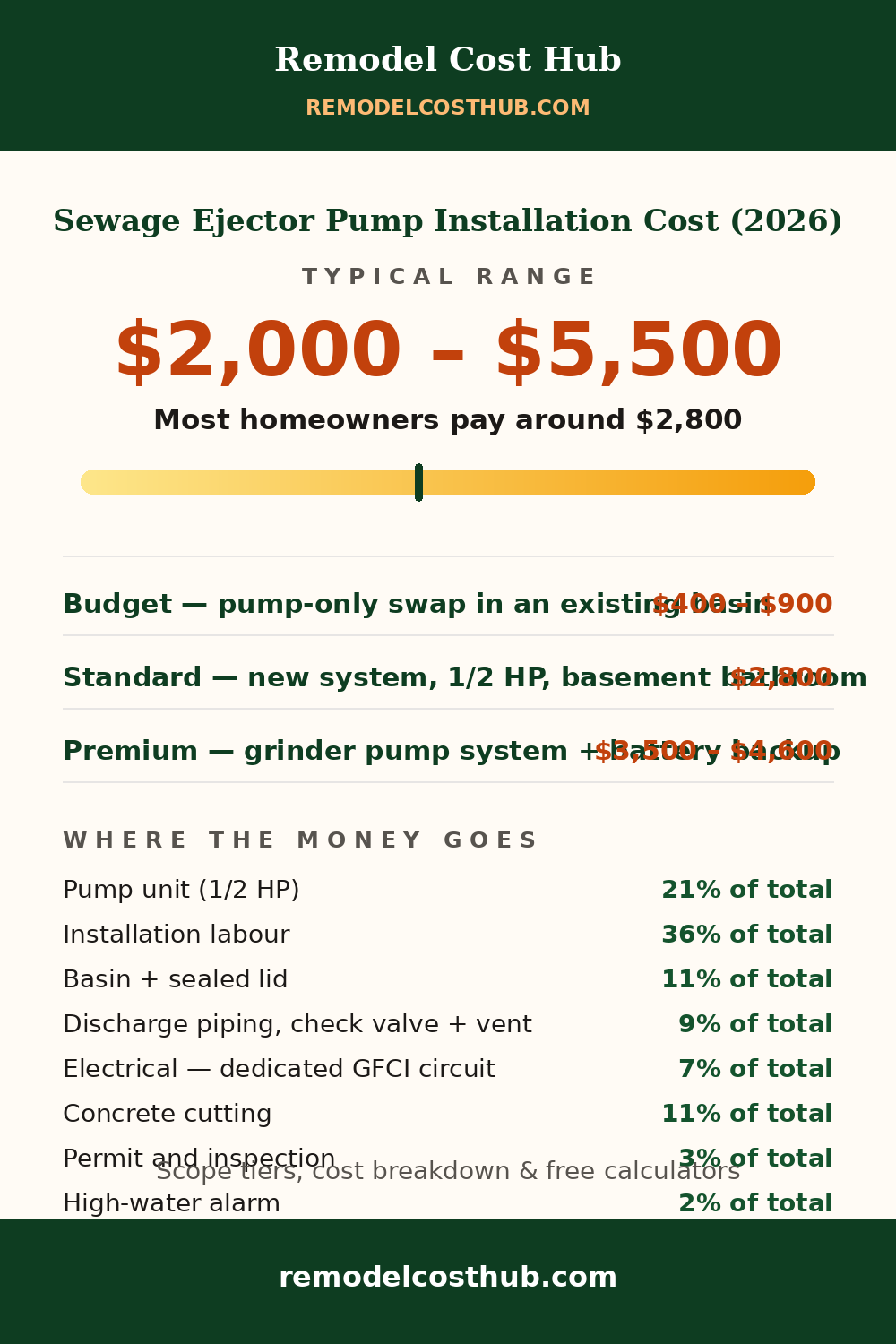
- Typical range: $2,000 – $5,500
- Most homeowners pay: around $2,800
Cross-checked against three published sources for this project. Sources used for this page: HomeGuide, 'How Much Does An Ejector Pump Cost? (2026)' — new system $2,000–$5,500; replacement $850–$3,000; new-install labour $1,850–$3,500; replacement labour $700–$1,000; pump unit $150–$2,000; grinder pump unit $1,000–$3,500; lifespan 7–10 years average, up to 20–30 years with care; running cost $30–$60 per month. Angi, 'How Much Does an Ejector Pump Replacement Cost? [2026 Data]', updated Oct 15, 2026 — national average $2,300 (REPLACEMENT average); most homeowners $850–$3,500; full range $630–$4,300; pump unit by material (plastic $325 avg, $150–$500; plastic & cast iron $440, $180–$700; stainless $525, $200–$850; cast iron $1,100, $200–$2,000); capacity 50 GPM $200 / 75 $325 / 90 $425 / 110 $700 / 190 $1,750; grinder pump unit $1,000–$2,500, installed $2,000–$4,000; standard-install labour $650–$1,200; full system replacement $2,500–$3,100; plumber $45–$200 per hour; annual inspection $100–$200; operation $30–$60 per month; battery backup $600; subpanel $400–$1,750. ABS Pipes, 'Sewage Ejector Pump Cost & Installation (2026)', published Oct 18, 2026, updated Oct 28, 2026 — typical $1,200–$3,500; complete new install $2,000–$5,000; straightforward replacement $900–$1,800; pump-only swap $400–$900; ~$2,000 typical, ~$2,800 national average for a full new system; unit typical residential $300–$800; by horsepower 1/2 HP $300–$550, 3/4 HP $450–$700, 1 HP $600–$900; grinder unit $800–$1,500; basin $150–$400; sealed lid $75–$200; check valve $50–$150; valve + discharge + vent fittings $150–$400; GFCI circuit $200–$500; alarm $50–$150; concrete cutting $300–$800, floor restoration +$500–$1,500; permit $50–$300; battery backup $400–$900; new-install labour $800–$2,000. HomeAdvisor, 'How Much Do Sewer Ejector Pumps Cost? [2025 Data]' — same figures as Angi ($850–$3,500, average $2,300); direct fetch blocked (HTTP 403), figures from search snippet; HomeAdvisor shares Angi's cost dataset, so it is the SAME data family as Angi, not an independent confirmation. Builds and Buys, 'Ejector Pump Cost Guide' (supporting) — discharge tie-in $300–$600; vent $200–$500; permit $100–$300; alarm $100–$200; concrete cutting $500–$1,000. Disagreements published, not averaged: new-install labour HomeGuide $1,850–$3,500 vs ABS Pipes $800–$2,000 (scope differs — HomeGuide bundles concrete/plumbing into labour); replacement Angi average $2,300 (to $4,300) vs ABS Pipes $900–$1,800 simple swap (different scopes); new-system top HomeGuide $5,500 vs ABS Pipes $5,000; grinder unit $800–$3,500 wide band; permit $50–$500 overlap; lifespan 7–10 years average, cast iron 10–12, up to 20–30 with meticulous care. Breakdown shares are derived from the worked example below. Checked November 2026.. Sources last checked: October 2026 — HomeAdvisor, HomeGuide, Angi. How we calculate these costs
Cost by scope
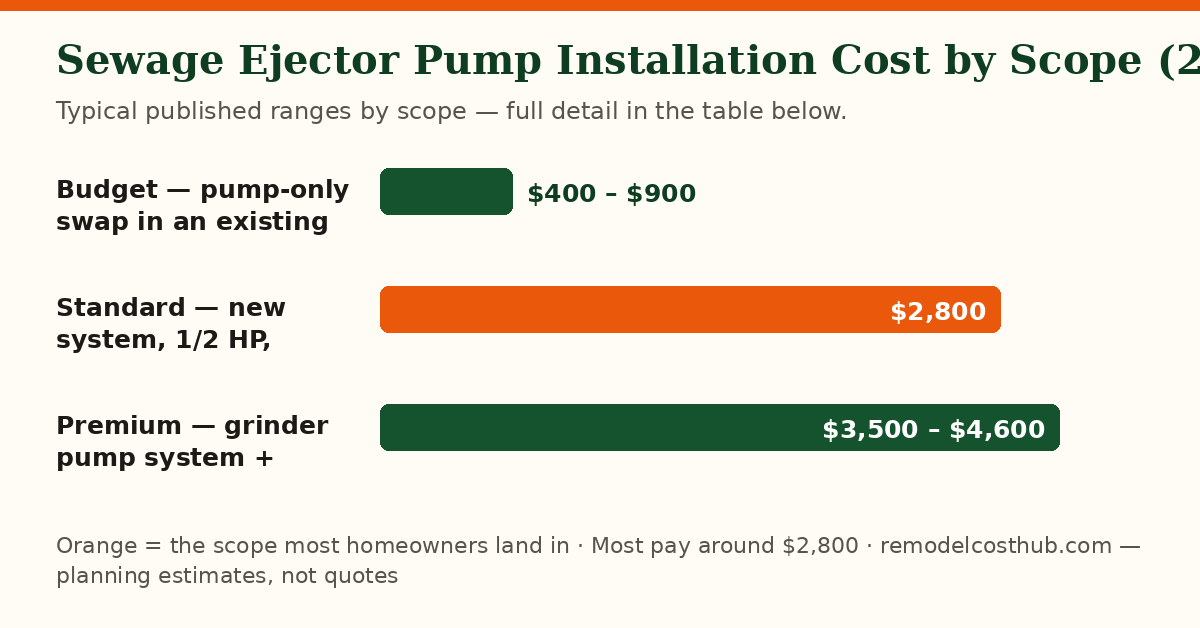
| Scope | Typical cost | What it includes |
|---|---|---|
| Budget — pump-only swap in an existing basin | $400 – $900 | A like-for-like pump swap reusing the existing basin, discharge piping, vent and wiring: pump $300–$800 (ABS Pipes' typical residential unit band) plus a short labour call. No concrete work and usually no permit for a straight swap. Angi's replacement band starts at $850 for the same scope with a premium pump. |
| Standard — new system, 1/2 HP, basement bathroom | $2,800 | The most-pay tier — the worked example below: a 1/2 HP pump in a new sealed basin, concrete cut and re-poured, discharge piping and check valve, venting, a dedicated GFCI circuit, a high-water alarm and a permit. ABS Pipes' national average for a full new system. |
| Premium — grinder pump system + battery backup | $3,500 – $4,600 | A grinder pump system for a long or uphill run to the sewer (grinder unit $1,000–$2,500, installed $2,000–$4,000 in Angi), plus a battery-powered backup pump ($400–$900 in ABS Pipes; $600 in Angi) and a subpanel if the existing panel has no spare capacity ($400–$1,750 in Angi). |
Where the money goes
| Part of the job | Share | Note |
|---|---|---|
| Pump unit (1/2 HP) | 21% of total | $600 for a 1/2 HP pump — inside ABS Pipes' $300–$800 typical residential unit band and Angi's $150–$2,000 full material range (plastic $150–$500 to cast iron $200–$2,000). Share derived from the worked example below. |
| Installation labour | 36% of total | $1,000 for installation labour — inside ABS Pipes' $800–$2,000 new-install labour band. HomeGuide prices new-install labour higher at $1,850–$3,500, but that figure appears to bundle concrete and plumbing work into labour; this page itemises concrete separately. Share derived from the worked example below. |
| Basin + sealed lid | 11% of total | $300 for a sealed polyethylene basin and gas-tight lid — basin $150–$400 and lid $75–$200 (ABS Pipes); $200 + $100 in the worked example. Share derived from the worked example below. |
| Discharge piping, check valve + vent | 9% of total | $250 for discharge piping, check valve and vent fittings — inside ABS Pipes' $150–$400 combined band. Share derived from the worked example below. |
| Electrical — dedicated GFCI circuit | 7% of total | $200 for a dedicated GFCI circuit — inside ABS Pipes' $200–$500 band. A subpanel, if needed, is $400–$1,750 (Angi) and is not in this example. Share derived from the worked example below. |
| Concrete cutting | 11% of total | $300 for concrete cutting through the basement slab — at the floor of ABS Pipes' $300–$800 band (Builds and Buys: $500–$1,000). Floor restoration adds $500–$1,500 (ABS Pipes) if the finish is restored beyond a plain re-pour. Share derived from the worked example below. |
| Permit and inspection | 3% of total | $100 for the permit and inspection — inside ABS Pipes' $50–$300, Angi's $50–$500 and Builds and Buys' $100–$300 permit bands. Share derived from the worked example below. |
| High-water alarm | 2% of total | $50 for a high-water alarm — at the floor of ABS Pipes' $50–$150 band (Builds and Buys: $100–$200). Share derived from the worked example below. |
What moves the price most
Worked example — $2,800 most-pay new system (standard 1/2 HP pump, basement bathroom, existing slab cut and re-poured): pump unit $600 (21.4%) + installation labour $1,000 (35.7%) + basin and sealed lid $300 (10.7%) + discharge piping, check valve and vent $250 (8.9%) + dedicated GFCI circuit $200 (7.1%) + concrete cutting $300 (10.7%) + permit and inspection $100 (3.6%) + high-water alarm $50 (1.8%) = $2,800. Every line sits inside its published band; the breakdown bar rounds the shares to whole numbers. Where sources disagree: new-install labour — HomeGuide $1,850–$3,500 vs ABS Pipes $800–$2,000; the gap is scope (HomeGuide bundles concrete and plumbing into labour, ABS Pipes itemises them). Replacement cost — Angi's $2,300 average (range to $4,300) covers larger and complex replacements, while ABS Pipes' $900–$1,800 is the straightforward pump, float and check-valve swap. Grinder pump unit — $800–$1,500 (ABS Pipes) vs $1,000–$2,500 (Angi) vs $1,000–$3,500 (HomeGuide); the wide $800–$3,500 band is the honest figure. Running costs: $30–$60 per month in electricity (HomeGuide; Angi) and a yearly professional inspection at $100–$200 (Angi). Lifespan: 7–10 years on average; cast-iron models often reach 10–12 years, and with meticulous care some last 20–30 years (HomeGuide). The float switch usually fails first — replacement $50–$150 installed. Not a DIY job for a new system: sewer connections, venting, permits and electrical work need a licensed plumber (Angi; ABS Pipes) — a like-for-like pump swap in an existing basin is the only DIY-friendly scope. Related costs: sump pump installation, basement bathroom addition, sewer line replacement, septic system installation and drain cleaning.
Costs in your city
Labor is the biggest variable in any remodel, and labor is local — the same bathroom can price very differently in Houston than in Boston. We are adding city editions metro by metro, each with its own labor index, permit notes and climate factors, written for that city rather than copied from this page. Wave 1: Houston, Dallas–Fort Worth, Phoenix, Atlanta, Miami–South Florida, Orlando, Tampa, Charlotte, Austin and San Antonio. Until your city's page is live, use the national range here and weight it the way contractors do: Sun Belt labor often prices near or below the national middle, while coastal California and the Northeast metros often price well above it.
Frequently asked questions
How much does a sewage ejector pump installation cost?
A full new system typically costs $2,000–$5,500 installed (HomeGuide), with ABS Pipes putting the national average for a full new system at about $2,800. Replacing just the pump in an existing basin costs $850–$3,500 installed, with Angi's national average at $2,300.
How long does a sewage ejector pump last?
7–10 years on average. Cast-iron models often reach 10–12 years, and with regular inspections and proper use some last 20–30 years (HomeGuide). The float switch usually fails first — replacement costs $50–$150 installed.
When do I need a sewage ejector pump?
Whenever a toilet, sink, shower or laundry sits below the main sewer or septic line — typically any basement bathroom. Gravity cannot drain it, so the pump lifts the waste up to the sewer line (HomeGuide; ABS Pipes; Angi).
Can I install a sewage ejector pump myself?
A like-for-like pump swap in an existing basin is doable for an experienced DIYer (pump only $150–$2,000, typically $300–$800). A new installation is not DIY-friendly — it involves sewer connections, venting, permits and electrical work, so hire a licensed plumber at $650–$1,200 labour for a standard install (Angi; ABS Pipes).
How much does it cost to run a sewage ejector pump?
$30–$60 per month in electricity, depending on local rates and wastewater volume (HomeGuide; Angi). Add a yearly professional inspection at $100–$200 (Angi).
What is the difference between an ejector pump, a grinder pump and a sump pump?
An ejector pump moves raw sewage (handling up to 2-inch solids) from below-grade fixtures to the sewer. A grinder pump also macerates the waste first and suits long or uphill runs (unit $800–$3,500 vs ejector $150–$2,000). A sump pump moves only clean groundwater (unit $100–$800) and must never be connected to sewage (HomeGuide; Angi).