Chimney Liner Installation cost at a glance
- Typical range: $1,500 – $5,000
- Most homeowners pay: around $2,500
Cross-checked against four published sources for this project. Sources used for this page: HomeGuide, 'How Much Does a Chimney Liner Cost to Install? (2026)', published Oct 5, 2022, updated Feb 9, 2026 — full range $900–$7,000; relining average $1,200–$4,600; stainless steel $900–$3,800 installed (flexible material $20–$90 per linear foot; rigid $30–$50; single-wall installed $35–$70 per foot; double-wall $50–$160); aluminium $625–$2,250 installed, gas-only, 5–15 years; clay/terracotta $2,000–$3,500 installed, up to 50 years, not recommended as a retrofit (requires opening chimney walls); cast-in-place $2,000–$7,000, 50+ years; insulation wrap $8–$15 per foot, pre-insulated liner $26–$40 per foot; labour $500–$4,000 overall ($500–$1,500 stainless; $800–$3,000 cast-in-place); Level 2 inspection $100–$600, inspection + cleaning $150–$250; permit $100–$150+; install 4–8 hours typical; old steel liner removal $250–$800, old clay tiles $500–$2,500 (replacement only); DIY kit $120–$800 uninsulated, $650–$1,000 pre-insulated stainless; lifespans stainless 15–25 years, aluminium 5–15 years, clay up to 50 years, cast-in-place 50+ years. Angi, 'How Much Does a Chimney Liner Cost? [2026 Data]', updated Sep 21, 2026 — installation costs $2,500 on average, most homeowners pay $1,500–$5,000; labour $400–$1,250; inspection about $450, sweep about $255; permits may be required; materials priced per square foot (stainless $65 per square foot) — a different unit from HomeGuide's per-linear-foot figures, never mixed into the per-foot table. RoofingDirect, 'Chimney Cap & Liner Cost in 2025', updated May 18, 2026 — flexible stainless $600–$2,000, rigid $800–$3,000; aluminium $500–$1,500; cast-in-place $3,000–$7,000; stainless cap $150–$300 materials / $250–$600 installed, overall cap $150–$900. Caveat: its data was compiled from Angi 2025 data, so its liner table is a second published data point, not a fully independent survey. Fireside Chimney Supply, 'Chimney Liner Cost Guide', Jun 24, 2026 — professional installation from $2,500, total project $2,500–$7,000+, pro quotes routinely $3,000–$7,000; DIY kit $400–$1,200; kit prices by grade 304L $350–$500, 316L $450–$700, 316Ti $550–$850 (kit materials only); labour/fees $1,700–$5,500 (includes materials markup, drive time, insurance); steep roof may need a boom lift, about +$500 (single-vendor figure). This Old House, 'How To Reline a Chimney Flue', updated May 26, 2026 — states its cost data is sourced from Angi, so it is corroboration, not an independent source; install 4–6 hours. HomeAdvisor's chimney-liner guide returned HTTP 403 when opened on 2026-11-10 and was not used. Breakdown shares are derived from the worked example below. Checked November 2026.. Sources last checked: October 2026 — This Old House, HomeAdvisor, HomeGuide, Angi. How we calculate these costs
Cost by scope
| Scope | Typical cost | What it includes |
|---|---|---|
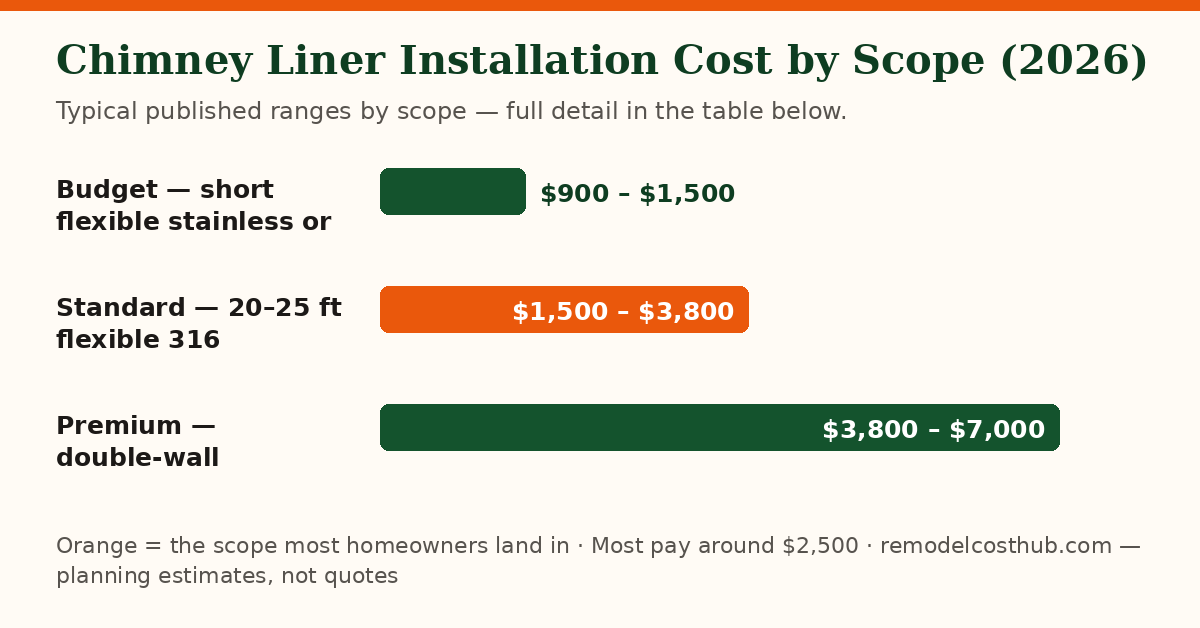
| Budget — short flexible stainless or gas-only aluminium | $900 – $1,500 | A single-wall flexible stainless liner (or aluminium for a gas-only appliance) on a short (15–20 ft), straight, easily accessed chimney — basic kit (liner, top plate, rain cap, adapter), standard labour, no or minimal insulation, permit where required. Anchors: HomeGuide's stainless installed from $900; aluminium $625–$2,250; RoofingDirect's flexible stainless from $600. |
| Standard — 20–25 ft flexible 316 stainless, insulated | $1,500 – $3,800 | The most-pay tier — the worked example below: a 316-grade flexible stainless liner, insulated, on a 20–25 ft chimney with an offset or two, Level 2 inspection and cleaning before install, tee connector for a stove through the wall, top plate and rain cap, permit and final inspection. The most common first-time install. |
| Premium — double-wall insulated or cast-in-place | $3,800 – $7,000 | A double-wall insulated stainless (316Ti) or cast-in-place liner, a tall (30 ft+) or multi-flue chimney, a steep or high roof needing scaffolding or a lift, structural or masonry prep, full permit and inspection. Anchors: HomeGuide's cast-in-place $2,000–$7,000 and total install up to $7,000; Fireside's pro quotes $3,000–$7,000 routinely. |
Where the money goes
| Part of the job | Share | Note |
|---|---|---|
| Liner material + kit hardware | 36% of total | $900 for the liner material and kit hardware — a 20–25 ft flexible 316 stainless liner with top plate, rain cap and adapter/tee. At $20–$90 per linear foot for stainless (HomeGuide), 20–25 ft of material runs $400–$2,250; $900 sits inside it, and inside the brief's derived $700–$1,100 materials-and-kit band. Share derived from the worked example below. |
| Labour — install, 4–8 hours | 32% of total | $800 for installation labour — inside HomeGuide's $500–$1,500 stainless labour band and Angi's $400–$1,250 band. Share derived from the worked example below. |
| Insulation — wrap, 20 ft | 10% of total | $250 for insulation wrap on 20 ft — inside the $160–$300 band for 20 ft of wrap at $8–$15 per linear foot (HomeGuide). Insulation is required by code for solid fuels and by most manufacturers to keep the warranty. Share derived from the worked example below. |
| Inspection + cleaning — Level 2 | 16% of total | $400 for a Level 2 inspection and cleaning before install — inside the published $150–$705 range (HomeGuide's inspection + cleaning $150–$250 vs Angi's inspection about $450 plus sweep about $255, about $705 — see the factors note). Share derived from the worked example below. |
| Permit | 6% of total | $150 for the permit — at the top of HomeGuide's $100–$150+ band. Share derived from the worked example below. |
What moves the price most
Worked example — $2,500 most-pay install (20–25 ft flexible 316 stainless liner, insulated, professionally installed in an unlined masonry chimney, Level 2 inspection + cleaning, permit): liner material + kit hardware $900 (36%) + labour $800 (32%) + insulation $250 (10%) + inspection + cleaning $400 (16%) + permit $150 (6%) = $2,500. Every line sits inside a published band. The shares are whole-percent roundings of this example — no source publishes a component percentage split. The cap is included in the liner kit (HomeGuide; Fireside); bought separately a stainless cap runs $150–$300 for materials, $250–$600 installed (RoofingDirect). No scaffolding line: no source publishes a surveyed scaffolding price — a single vendor cites about $500 for a boom lift on a steep roof, flagged as single-vendor. Ceramic/Thermocrete is NOT a new-install option for unlined chimneys — it seals a slightly cracked existing liner only — so it is excluded from the type table. Where sources disagree: the typical range — Angi $1,500–$5,000 (average $2,500) vs HomeGuide's full $900–$7,000 with a relining average of $1,200–$4,600 vs Fireside's pro quotes $3,000–$7,000 'routinely'; the page headlines the overlap, typical $1,500–$5,000, most-pay $2,500, and shows the wider $900–$7,000 as the full range; labour — Angi $400–$1,250 vs HomeGuide $500–$4,000 overall ($500–$1,500 stainless; $800–$3,000 cast-in-place) vs Fireside's labour/fees $1,700–$5,500, which bundles materials markup, drive time and insurance — the page quotes HomeGuide's by-type bands and notes Angi's lower figure is a simple-job labour-only number; inspection + cleaning — Angi inspection about $450 plus sweep about $255 (about $705) vs HomeGuide's Level 2 inspection $100–$600 and its inspection + cleaning together at $150–$250, published here as a $150–$705 range depending on inspection level; aluminium — HomeGuide installed $625–$2,250 vs RoofingDirect $500–$1,500, published as $625–$2,250, gas-only; cast-in-place low end — HomeGuide $2,000–$7,000 vs RoofingDirect $3,000–$7,000, published as $2,000–$7,000 with the $3,000 start noted; stainless low end — HomeGuide installed from $900 vs RoofingDirect flexible from $600, published with $900 as the installed floor; per-foot vs per-square-foot — Angi prices stainless at $65 per square foot while HomeGuide prices it at $20–$90 per linear foot; the units are not comparable and never appear in the same table — this page uses per-linear-foot only; lifespan — stainless 15–25 years (HomeGuide table) vs 15–20 years (HomeGuide text), aluminium 5–15 years, clay up to 50 years, cast-in-place 50+ years. This Old House states its cost data is sourced from Angi, so it is corroboration, not a fourth independent source; RoofingDirect's data was compiled from Angi 2025 data, so its liner table is a second published data point, not a fully independent survey; HomeAdvisor's guide returned HTTP 403 when opened on 2026-11-10 and was not used. Methodology: figures are the blended published ranges for install and replacement because no source isolates first-time installs; old-liner removal ($250–$800 steel / $500–$2,500 clay) is excluded and stated. Related costs: chimney liner replacement, chimney cap installation, fireplace installation, fireplace repair and wood stove installation.
Costs in your city
Labor is the biggest variable in any remodel, and labor is local — the same bathroom can price very differently in Houston than in Boston. We are adding city editions metro by metro, each with its own labor index, permit notes and climate factors, written for that city rather than copied from this page. Wave 1: Houston, Dallas–Fort Worth, Phoenix, Atlanta, Miami–South Florida, Orlando, Tampa, Charlotte, Austin and San Antonio. Until your city's page is live, use the national range here and weight it the way contractors do: Sun Belt labor often prices near or below the national middle, while coastal California and the Northeast metros often price well above it.
Frequently asked questions
How much does it cost to install a chimney liner?
A professional install typically costs $1,500–$5,000, with most homeowners paying around $2,500 (Angi). Across all liner types the full range is $900–$7,000 (HomeGuide); premium cast-in-place jobs reach $7,000.
Do I need a chimney liner if my chimney was built without one?
Yes — most local and state fire codes require one, and an unlined chimney is a fire and carbon-monoxide risk (HomeGuide). Without a liner, heat transfers directly to combustibles and acidic gases eat the masonry; many pre-1940 homes have no liner at all (RoofingDirect). A liner is also required when converting a fireplace to a different fuel or fitting a new stove or insert (HomeGuide).
What is the best liner type for a first-time install?
Flexible stainless steel for most homes — it fits offsets and bends, works with all fuel types, and costs $900–$3,800 installed (HomeGuide). Rigid stainless ($30–$50 per linear foot material) suits straight flues only. Aluminium ($625–$2,250) is gas-only. Cast-in-place ($2,000–$7,000) is for damaged or odd-shaped chimneys and lasts 50+ years (HomeGuide).
How long does it take to install a chimney liner?
4–8 hours on average for a standard single-flue install (HomeGuide); 4–6 hours in This Old House's project. Several days if there are multiple flues or masonry repairs are needed first (HomeGuide).
Does a new chimney liner need insulation, and what does it cost?
Usually yes — fire codes require insulation for solid fuels, and most manufacturers require it to keep the warranty (HomeGuide; This Old House). Insulation wrap costs $8–$15 per linear foot, or $26–$40 per foot for a pre-insulated liner (HomeGuide); it reduces creosote, improves draft and stops condensation.
Can I install a chimney liner myself to save money?
A DIY kit costs $400–$1,200 in materials (Fireside) or $120–$800 uninsulated / $650–$1,000 pre-insulated stainless (HomeGuide), versus $2,500+ professionally installed — but building codes prohibit DIY installation in many states, wrong sizing can cause fire or carbon-monoxide exposure, and warranties usually require professional installation with annual inspection (HomeGuide). All sources recommend hiring a certified (CSIA) pro.