Garage Heater Installation cost at a glance
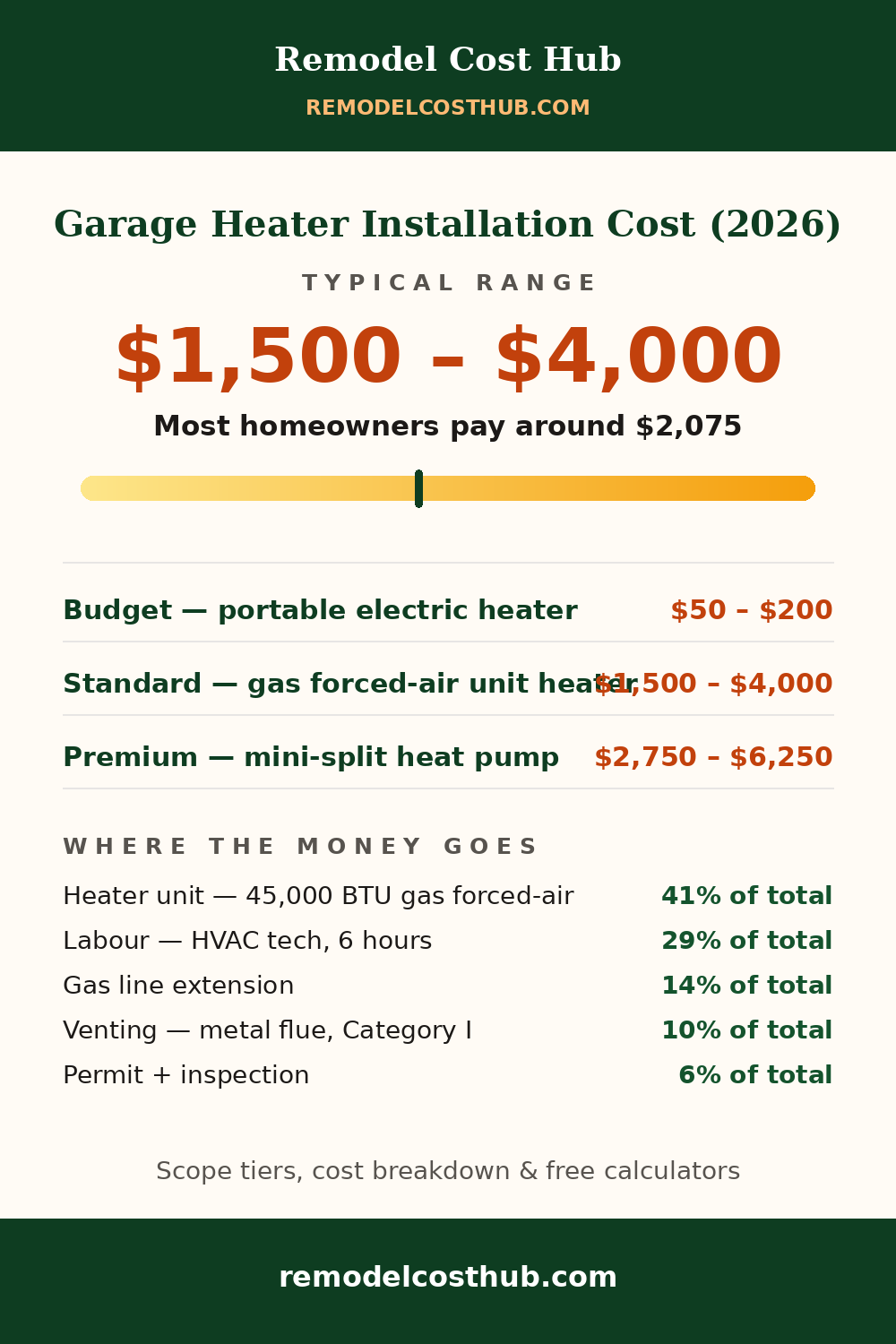
- Typical range: $1,500 – $4,000
- Most homeowners pay: around $2,075
Cross-checked against three published sources for this project. Sources used for this page: Angi, 'How Much Does Garage Heater Installation Cost? [2026 Data]', updated Oct 26, 2026 — national average $2,075 in 2026, typical range $1,500–$4,000, full range $150 (small self-installed electric) to $6,000 (large professionally installed natural gas/propane); by fuel unit cost electric $150–$1,000, propane $400–$2,000, natural gas $400–$2,000, infrared $400–$800; labour about $100/hour, typical electric/infrared install about $200 total labour, gas/propane adds $500–$800 to the labour total (Angi's table figure of $600 PER HOUR for gas labour contradicts its own prose and is not credible — never used); materials (unit) $150–$2,000; two-car garage about 45,000 BTU, three-car about 60,000 BTU; running cost $0.08–$0.80/hour, $2–$19/day, $60–$570/month, $730–$6,935/year; infrared models can use 30–40% less energy than standard electric heaters (Angi-only claim); budget tiers under $200 basic electric, $200–$300 two/three-car electric, $300–$400 electric for nearly any size, $400+ propane/infrared/gas plus several hundred (or even a thousand) extra dollars for installation; natural gas units start about $450, 60,000+ BTU units $1,000+ for the unit alone. Angi, 'What Size Heater Do You Need For Your Garage?', updated Jul 9, 2026 (same family, same data) — 20–30 BTUs per square foot recommended for most garages. The Garage Log, 'How Much Does It Really Cost to Heat Your Garage?', early 2026 (no date on page; search index last updated about mid-Jan 2026) — unit costs forced-air electric $200–$600, forced-air gas $400–$1,200, infrared electric $150–$500, portable electric $50–$200, mini-split $1,500–$3,500+; tiers basic DIY portable unit $50–$200 install $0, standard professional hardwired unit $200–$1,200 install $400–$1,500+, premium mini-split unit $1,500–$3,500+ install $1,500–$3,000+; hidden costs new 240V circuit $300–$800, gas line extension $500–$2,000, permit fees $50–$200; sizing by cubic feet and insulation (well-insulated 2.5 W/cu ft, moderate 4 W/cu ft, poor/no insulation 5 W/cu ft); worked example 24x24x8 ft moderate insulation 18,432 W / about 62,700 BTU; running costs 3 hrs/day 5,000 W electric about $67/month, 30,000 BTU natural gas about $35–$45/month, 1,500 W infrared about $20+/month; any permanent install requires a building permit, plug-in 120V portable typically does not; gas work is never DIY; unpermitted work can void homeowners insurance. HVAC Laboratory, 'Unit Heater Installation Cost and Buying Guide', mid-2026 (no date on page; search index last updated about late Jul 2026) — complete installation typical gas-fired unit heater $1,500–$4,500 (commercial garage/warehouse framing, larger units than residential), electric unit heaters $800–$2,500 installed, hydronic $1,200–$3,500 (excluding boiler); equipment gas-fired 100,000–150,000 BTU $800–$2,000, electric 10–20 kW $400–$1,200, hydronic $700–$1,800; labour 40–60% of total installation price, licensed HVAC tech $75–$150/hour, typical gas install 6–12 hours, electric 3–6 hours; venting $200–$600; gas line piping $300–$1,000; electrical work (dedicated circuit + disconnect) $150–$400; permits/inspections $50–$300; condensate drain $100–$300; sizing rule of thumb 30–40 BTU per sq ft; gas unit heaters 30,000–400,000+ BTU, standard efficiency 80–83% AFUE, high-efficiency condensing up to 95% AFUE. House Digest, 'Gas Or Electric: Which Is The Cheaper Option For Heating Your Garage?', published Oct 11, 2026 — electric garage heater buy + install $400–$1,200, gas $500–$2,000; electrician labour up to $130/hour if a new/larger circuit is needed; running cost at 10,000 BTU output electric about $0.54/hour ($12.88/day, $386.42/month) at 18.31 cents/kWh vs natural gas about $0.27/hour ($6.36/day, $190.80/month) at $2.65/therm (US EIA, July 2026); portable propane/patio heaters $50–$200 upfront but NOT safe as a garage heating solution (carbon monoxide; do not store propane tanks in a garage). NOTE: HomeAdvisor mirrors Angi's figures exactly (same Angi Inc. data family) and is NOT an independent source; Fixr has no dedicated garage-heater cost page and is NOT listed. No source publishes a thermostat price, a $/BTU or $/sq ft installed rate, radiant-tube heater cost, radiant-floor cost for a garage, mounting-hardware price, removal/disposal cost, panel-upgrade cost, a verified mini-split all-in figure, regional price variation or a lifespan/warranty figure — none is given. Breakdown shares are derived from the worked example below. Checked November 2026.. Sources last checked: October 2026 — HomeAdvisor, Fixr, Angi. How we calculate these costs
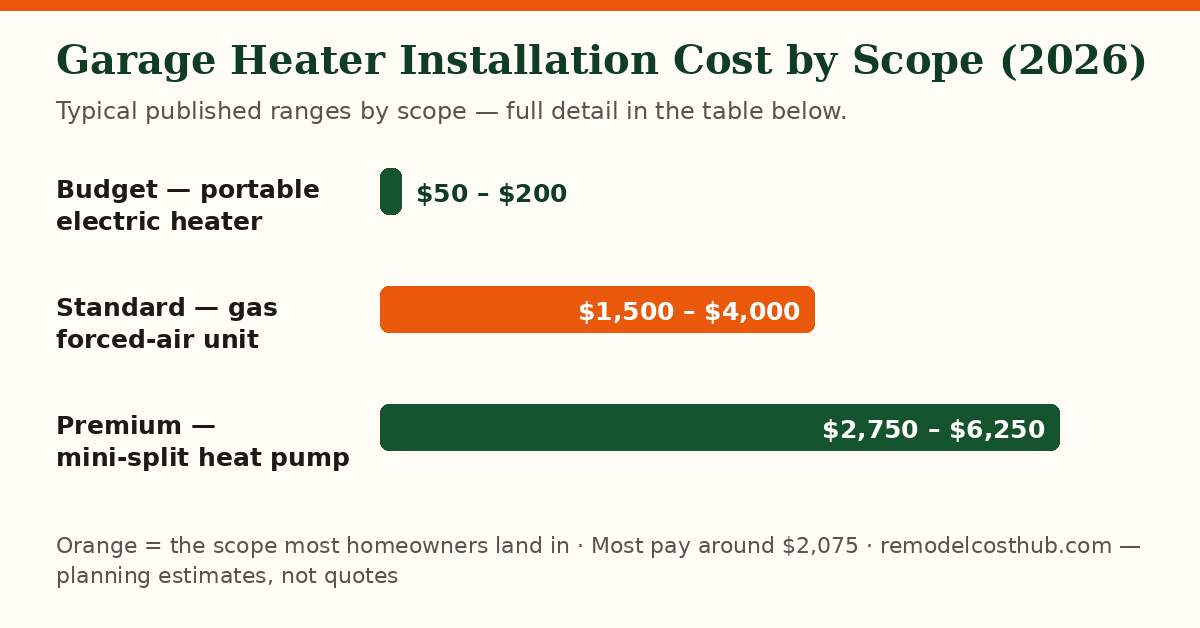
Cost by scope
| Scope | Typical cost | What it includes |
|---|---|---|
| Budget — portable electric heater | $50 – $200 | A portable plug-in 120V electric heater, DIY — $0 installation (The Garage Log; Angi's $150 floor for small self-installed heaters). Best for a small or occasionally used garage, taking the edge off. Portable PROPANE heaters are not safe indoors (carbon monoxide; do not store propane tanks in a garage — House Digest) — this tier is electric-only. |
| Standard — gas forced-air unit heater | $1,500 – $4,000 | The most-pay tier — the worked example below: a 45,000 BTU natural-gas forced-air ceiling unit heater, professionally installed, with a gas line extension and venting. Best for larger or poorly insulated garages, cold climates and frequent use — gas is cheapest to run (about $0.27 an hour vs $0.54 for electric at equal 10,000 BTU output, House Digest citing US EIA July 2026 rates). Large professionally installed gas systems can reach $6,000 (Angi). |
| Premium — mini-split heat pump | $2,750 – $6,250 | A single-zone mini-split heat pump in a garage, installed (Remodel Calculators, corroboration only; The Garage Log puts the unit at $1,500–$3,500+ plus $1,500–$3,000+ install). It heats AND cools and costs the most. This is a pointer only — the site's heat-pump-installation page covers mini-splits in full; this page's focus is gas and electric forced-air unit heaters. |
Where the money goes
| Part of the job | Share | Note |
|---|---|---|
| Heater unit — 45,000 BTU gas forced-air | 41% of total | $850 for the heater unit — a 45,000 BTU gas forced-air unit, inside Angi's $400–$2,000 gas unit band and The Garage Log's $400–$1,200 gas unit band. Share derived from the worked example below. |
| Labour — HVAC tech, 6 hours | 29% of total | $600 for labour — 6 hours at $100 an hour, inside Angi's ~$100 an hour and HVAC Laboratory's $75–$150 an hour (gas install 6–12 hours, so 6 hours at $75–$150 is $450–$900). Angi's table figure of $600 PER HOUR for gas labour is an internal contradiction — its own prose says gas adds $500–$800 to the labour total on top of ~$100 an hour — and is never used here. Share derived from the worked example below. |
| Gas line extension | 14% of total | $300 for a gas line extension — at the floor of HVAC Laboratory's $300–$1,000 band (a short run, meter nearby). The Garage Log puts a gas line at $500–$2,000; distance from the meter is the driver. Share derived from the worked example below. |
| Venting — metal flue, Category I | 10% of total | $200 for venting — at the floor of HVAC Laboratory's $200–$600 band (a short straight run, Category I metal flue vs Category III stainless). Share derived from the worked example below. |
| Permit + inspection | 6% of total | $125 for the permit and inspection — inside both HVAC Laboratory's $50–$300 band and The Garage Log's $50–$200 band. Any permanent install (hardwired electric or gas) requires a permit; a plug-in 120V portable typically does not. Share derived from the worked example below. |
What moves the price most
Worked example — $2,075 most-pay install (45,000 BTU natural-gas forced-air ceiling unit heater, two-car garage, new gas line and venting): heater unit $850 (41.0%) + labour $600 (28.9%) + gas line extension $300 (14.5%) + venting $200 (9.6%) + permit $125 (6.0%) = $2,075 — Angi's published 2026 national average. A thermostat is NOT a separate line — no source publishes a thermostat price; a basic thermostat is normally included with the unit or its control kit. Every line sits inside its published band; the breakdown bar rounds the shares to whole numbers. Where sources disagree: Angi's own figures contradict themselves on gas labour — the table's $600 per hour is not credible (a 6-hour install would be $3,600 of labour alone, exceeding the $1,500–$4,000 typical total) and is never used; the prose figure (~$100 an hour plus a $500–$800 gas add-on) is used instead; infrared unit price — Angi $400–$800 vs The Garage Log $150–$500, overlapping only at $400–$500; the gas total ceiling — Angi $4,000 typical (full range to $6,000) vs HVAC Laboratory $4,500, framed for commercial garages with 100,000–150,000 BTU units, so residential 45,000–60,000 BTU jobs sit inside Angi's band; the electric installed total — House Digest $400–$1,200 vs HVAC Laboratory $800–$2,500 vs The Garage Log's implied $600–$2,100, with the honest overlap at $800–$1,200; BTU per sq ft — Angi 20–30 vs HVAC Laboratory 30–40 (presented here as 20–40 depending on insulation); the gas line — HVAC Laboratory $300–$1,000 vs The Garage Log $500–$2,000 (Angi's $500–$800 is a labour add-on, not the pipe itself — do not conflate the two); permits — HVAC Laboratory $50–$300 vs The Garage Log $50–$200 (overlap $50–$200); labour rates — Angi ~$100 an hour vs HVAC Laboratory $75–$150 vs House Digest up to $130 an hour for an electrician (consistent; overlap $100–$130). Other heater types: electric forced-air, wall or ceiling-mounted (hardwired 240V) $800–$1,200 installed (the honest overlap of all four sources); infrared or radiant electric $400–$500 for the unit (overlap band; wider published span $150–$800), with no published all-in installed total; a new 240V circuit runs $300–$800 (The Garage Log, single source); a condensate drain for high-efficiency condensing units runs $100–$300 (HVAC Laboratory, single source); infrared models can use 30–40% less energy than standard electric heaters (Angi, single source). Gas is never a DIY job: gas line work and venting must be done by a licensed professional because of carbon monoxide and fire risk (The Garage Log; Angi), and unpermitted work can void homeowners insurance. Running costs run about $0.08–$0.80 an hour, or $60–$570 a month, depending on heater type and use (Angi, single source). A garage heater does not heat the house — it heats one space with no ductwork, which is what separates this page from furnace-replacement. Related costs: garage door replacement, garage conversion, heat pump installation, furnace replacement and garage addition.
Costs in your city
Labor is the biggest variable in any remodel, and labor is local — the same bathroom can price very differently in Houston than in Boston. We are adding city editions metro by metro, each with its own labor index, permit notes and climate factors, written for that city rather than copied from this page. Wave 1: Houston, Dallas–Fort Worth, Phoenix, Atlanta, Miami–South Florida, Orlando, Tampa, Charlotte, Austin and San Antonio. Until your city's page is live, use the national range here and weight it the way contractors do: Sun Belt labor often prices near or below the national middle, while coastal California and the Northeast metros often price well above it.
Frequently asked questions
How much does it cost to install a garage heater?
Most homeowners pay $1,500–$4,000 for a professionally installed permanent unit heater; the 2026 national average is $2,075 (Angi). Small plug-in electric heaters start at $150; large professionally installed gas systems can reach $6,000.
What size heater do I need for a two-car garage?
About 45,000 BTU for a two-car garage and 60,000 BTU for a three-car garage (Angi). As a rule of thumb, allow 20–40 BTU per square foot — the lower end for a well-insulated garage, the higher end for a drafty one (Angi; HVAC Laboratory).
Is a gas or electric garage heater cheaper?
Electric is cheaper to install — roughly $400–$1,200 all-in versus $500–$2,000 for gas (House Digest) — because it needs no gas line or venting. Gas is cheaper to run: at equal 10,000 BTU output, gas costs about $0.27 an hour versus $0.54 an hour for electric at July 2026 average US energy prices (House Digest, citing US EIA).
Can I install a garage heater myself?
A plug-in portable electric heater, yes — just plug it in. A hardwired 240V electric unit is a confident-DIY job for mounting, but the final panel connection should be done by a licensed electrician. A gas heater is never a DIY job: gas line work and venting must be done by a licensed professional because of carbon monoxide and fire risk (The Garage Log; Angi).
Do I need a permit to install a garage heater?
Yes for any permanent installation — a hardwired electric heater or any gas or propane heater. A plug-in 120V portable heater typically does not need one. Permit fees run $50–$200 (The Garage Log; HVAC Laboratory: $50–$300). Unpermitted work can void your homeowners insurance if a fire occurs.
How much does it cost to run a garage heater?
About $0.08–$0.80 per hour, or $60–$570 per month depending on heater type and use (Angi). As a worked example, a 5,000-watt electric heater run 3 hours a day costs roughly $67 a month, while a 30,000 BTU gas heater run the same way costs about $35–$45 a month (The Garage Log). Insulation is the biggest factor in the bill.