Sewer Line Replacement cost at a glance
- Typical range: $2,000 – $6,500
- Most homeowners pay: around $3,319
- Prices vary most by: Labor (plumbing + excavation crew) (≈ 60–75% of the budget)
Cross-checked against four published sources for this project. Sources used for this page: the Angi sewer line replacement cost guide (August 2026), HomeGuide's sewer line replacement cost guide (December 2025), Fixr's sewer line cost data and NW Sewer & Drain's contractor-authored sewer line replacement guide (October 2024). Sources last checked: October 2026 — HomeGuide, Fixr, Angi, NW Sewer & Drain. How we calculate these costs
Cost by scope
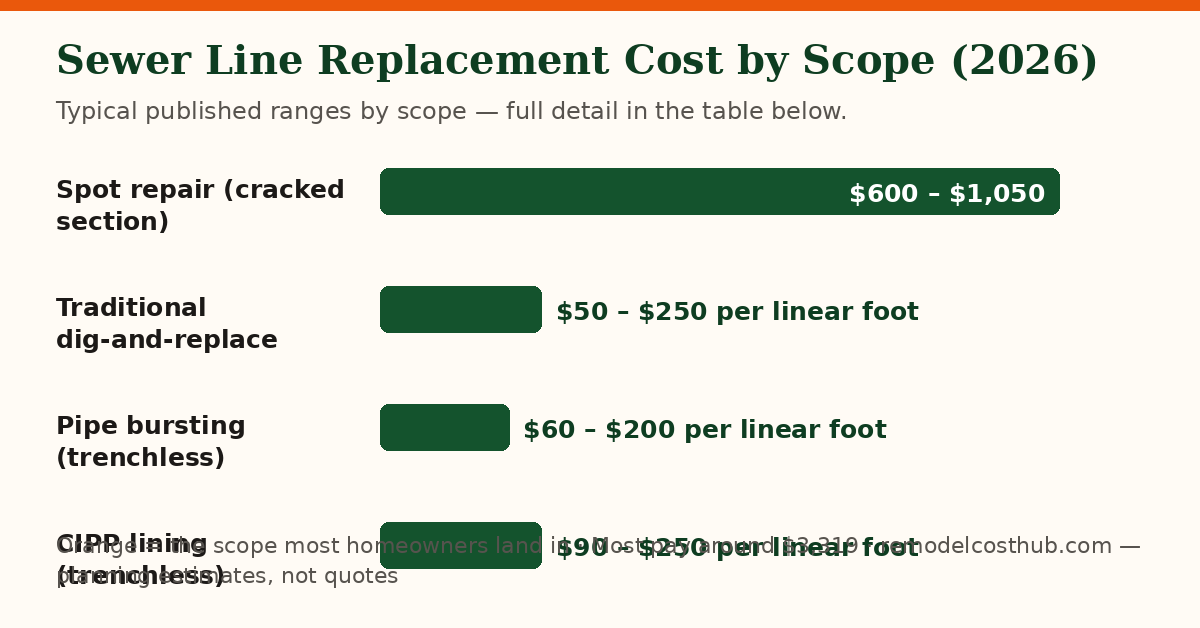
| Scope | Typical cost | What it includes |
|---|---|---|
| Spot repair (cracked section) | $600 – $1,050 | Fixing one bad section where the rest of the line is sound — the repair route when a camera inspection finds isolated damage |
| Traditional dig-and-replace | $50 – $250 per linear foot | Open trench, old pipe out and new pipe in — the band most full replacements land in; excavation alone runs $50–$200 a foot in Angi |
| Pipe bursting (trenchless) | $60 – $200 per linear foot | A bursting head pulls new pipe through the old line's path — minimal digging, the go-to trenchless method where the old pipe is too damaged to line |
| CIPP lining (trenchless) | $90 – $250 per linear foot | A resin liner cures inside the old pipe — no trench, but only for pipes whose shape and slope are still intact |
Where the money goes
| Part of the job | Share | Note |
|---|---|---|
| Labor (plumbing + excavation crew) | ≈ 60–75% of total | The single biggest share — Angi prices plumber labor at $45–$200 an hour and calls the work labor-intensive; excavation alone runs $50–$200 a linear foot |
| Pipe materials | ≈ 5–15% of total | The smallest line on most invoices — PVC about $4.50 a linear foot in Angi's materials table, cast iron about $50, copper $85 (materials only, before labor) |
| Camera inspection | ≈ 2–10% of total | $100–$500 in Angi, $125–$500 in HomeGuide for the video inspection that diagnoses the line and prices the job — the line that prices every other line |
| Permits, access & restoration | ≈ 5–20% of total | Permits $30–$500 in HomeGuide; breaking and restoring a concrete slab runs $300–$350 a linear foot in Angi; landscaping $4–$12 a square foot |
What moves the price most
Length and depth are the budget. The lateral runs from your house to the street hookup, and every foot of it is $50–$250 installed in Angi — a 20-foot run and a 60-foot run are different projects, and HomeGuide's length table runs $1,000–$5,000 at 20 feet against $3,000–$15,000 at 60. What's over the pipe is the second lever: soil and sod are the cheap case, while pipe under a driveway, patio or slab needs excavation ($50–$200 a foot) or concrete break-out and restoration ($300–$350 a foot in Angi). Method is third — trenchless bursting ($60–$200 a foot) and CIPP lining ($90–$250) overlap the digging band on the pipe itself but skip most of the restoration, though a collapsed or improperly sloped pipe rules trenchless out entirely. Soil, roots and damage type round it out: rocky ground digs slower, tree roots are the classic cause, and a simple clog ($80–$1,000 to address in Angi) prices nothing like a collapse.
Worked example: how a typical sewer line replacement budget breaks down
Take the typical job — a 50-foot lateral replaced by traditional trenching: camera inspection first, excavation, old pipe out, new PVC in, backfilled and the yard roughly restored. Here is a realistic $3,319 version of that invoice, at Angi's 2026 national average: The budget below totals $3,319 — the "most homeowners pay around" figure from the top of this page — split using this page's own cost breakdown. It shows how a real quote at that level is usually composed; every line is built from the ranges on this page, and it is an illustration, not a quote for your project.
| Line item | Example budget |
|---|---|
| Labor & excavation crew | $2,050 |
| Pipe materials (PVC, 50 ft + fittings) | $350 |
| Camera inspection | $300 |
| Permits & yard restoration | $619 |
| Total | $3,319 |
What most people get wrong
- Skipping the camera inspection to save $100–$500. The $100–$600 video inspection in Angi, HomeGuide and Fixr is what prices the job — length, depth, damage type and method all come from that footage. Quoting blind is how a $3,000 job becomes a $6,000 one.
- Comparing a trenchless quote with a dig-and-replace quote on the total alone. Trenchless ($60–$250 a foot) and digging ($50–$250) overlap on the pipe itself — but the digging quote can hide $1–$25 a square foot of restoration that the trenchless quote never triggers.
- Assuming trenchless works for every failed line. CIPP lining needs a pipe with its shape and slope intact; collapsed or improperly sloped pipe must be excavated. Angi is explicit — the camera decides the method, not the price.
- Forgetting the line doesn't end at the house. The lateral runs to the street hookup, and driveways, patios and slabs it crosses are the cost — concrete break-out and restoration runs $300–$350 a linear foot in Angi, priced before the pipe itself.
Costs in your city
Sewer work is digging-labor pricing around commodity pipe: Angi prices plumber labor at $45–$200 an hour, so the same 50-foot lateral quotes near the bottom of the band where crew rates are low and toward the top in a high-cost metro, while the pipe itself costs the same everywhere. Depth rules vary by municipality — frost lines in the north mean deeper trenches than Sun Belt codes — and some cities mandate specific pipe materials or backflow devices. Rocky soil, mature tree-root pressure in older neighborhoods and lines running under driveways are the local multipliers; permits run $30–$500 in HomeGuide, and some municipalities require a camera inspection record before sign-off. Call 811 before any digging, and ask each bidder to state the method, the linear footage and the restoration as separate lines.
How we got these numbers
Cross-checked against the Angi sewer line replacement cost guide — read in full this run, August 2026 (national average $3,319; most homeowners paying $1,388–$5,323; full range $225–$10,000; new pipe $50–$250 a linear foot installed, averaging $150; complete $60–$250, CIPP $90–$250, pipe bursting $60–$200; labor $45–$200 an hour; excavation $50–$200 a foot; slab break-out and restore $300–$350 a foot; inspection $100–$500), HomeGuide's sewer line replacement cost guide — read in full this run, December 2025 (national average $6,000; average range $2,000–$10,000; replacement $50–$250 a foot; pipe bursting $60–$200; CIPP $90–$250; permits $30–$500; inspection $125–$500) and Fixr's sewer line cost data — read in full this run (replacement $1,000–$20,000; labor $75–$150 an hour; inspection $300–$600), with NW Sewer & Drain's contractor-authored sewer line replacement guide (October 2024) as corroboration (traditional trenching $50–$250 a foot; under-slab work adding $2,000–$5,000). Genuine disagreements are published as-is: the national averages (Angi $3,319 vs HomeGuide $6,000 — Angi's mix carries more partial and shorter jobs), camera inspection bands and permit bands. No source publishes percentage cost shares, so the breakdown shares are derived from the guides' dollar figures and are labelled as derived on the page. Checked October 2026. Full method: How We Estimate Costs.
Frequently asked questions
How much does sewer line replacement cost?
$2,000–$6,500 is the typical band for a full replacement, and Angi's 2026 data averages $3,319 across verified projects (most paying $1,388–$5,323). HomeGuide publishes a higher average, $6,000 — its data mix carries more full-length replacements, and the page names that disagreement honestly.
What does sewer line replacement cost per linear foot?
$50–$250 a linear foot installed in Angi, averaging about $150 — a band HomeGuide publishes identically. Trenchless methods sit inside it: pipe bursting $60–$200 and CIPP lining $90–$250.
Is trenchless sewer replacement cheaper than digging?
On the pipe itself the bands overlap — but trenchless skips most of the restoration, and digging's restoration runs $1–$25 a square foot in Angi (landscaping, driveways, decks). Trenchless is not an option for collapsed or improperly sloped pipe, which must be excavated.
How long does sewer line replacement take?
1–5 days on average in HomeGuide, depending on obstacles and length — trenchless methods take less time than open trenching.
How long does a new sewer line last?
30–100 years depending on material in HomeGuide — clay and Orangeburg at the low end, PVC, cast iron and copper toward 50–100 years. Angi puts PVC at around 100 years.
Will homeowners insurance cover sewer line replacement?
Usually not under a standard policy — which is why Angi suggests asking about an endorsement clause for sewer line damage before you need it.