Ductwork Installation cost at a glance
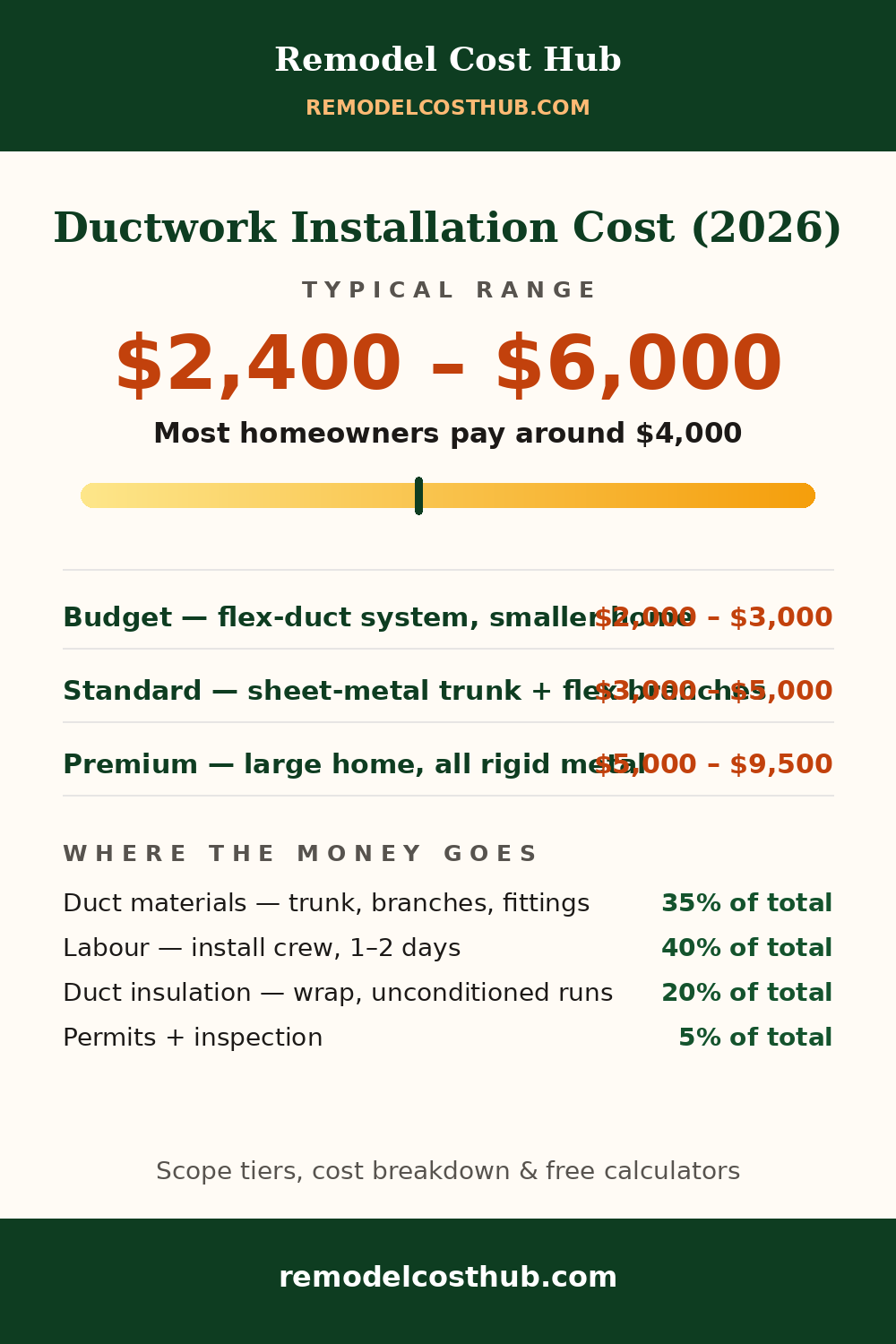
- Typical range: $2,400 – $6,000
- Most homeowners pay: around $4,000
Cross-checked against three published sources for this project. Sources used for this page: Angi, 'How Much Does It Cost to Install Ductwork? [2026 Data]', updated Oct 29, 2026 — typical $2,000–$7,500, national average $4,000, high end $12,000; new install $10–$25 per linear foot; by home size 1,000–1,500 sq ft (80–120 LF) $2,000–$3,000, 1,500–2,500 sq ft (120–180 LF) $3,000–$5,000, 2,500–4,000 sq ft (180–300 LF) $5,000–$7,500, 4,000+ sq ft (300+ LF) $7,500–$12,000+; sheet metal $12–$25/LF, flexible $5–$10, fibreglass-lined $10–$20, fibreboard $8–$15; labour $50–$150/hour, $5–$15/LF labour alone; permits $50–$300; new construction keeps routing efficient, retrofitting a finished home adds complexity and cost. HomeGuide, 'How Much Does It Cost to Install or Replace Ductwork? (2026)', published Oct 13, 2022, updated Dec 19, 2025 (399 member-reported project costs) — NEW ductwork installation $2,400–$6,600; retrofit $40–$65/LF; replacement $1,400–$5,600, $25–$55/LF; national average (all ductwork jobs, replacement-weighted) $3,500; materials only flexible non-insulated $1–$3/LF, flexible insulated $2–$4, fibreglass/fibreboard $4–$6, sheet metal $7–$13; duct-wrap insulation $800–$2,000 total, $1–$8/sq ft; permits $50–$250 for ductwork alone, $250–$1,500 as part of a full HVAC install; HVAC + new ductwork retrofit $7,000–$16,000; install 1–2 days (up to 4 for larger/complex); adding a vent $250–$500; ductwork lifespan 10–20 years. HVAC Laboratory, 'Ductwork Installation Cost and Buying Guide', published Jul 24, 2026, updated Aug 7, 2026 — complete install $2,000–$6,000; small homes/additions from ~$1,200; large multi-storey $7,000–$9,500; $10–$35/LF; $1.50–$4.50/sq ft (1,500 sq ft $2,250–$5,000; 2,500 sq ft $3,750–$7,500); permits $50–$300; ducts in unconditioned spaces need R-6 to R-8 (recommends R-8); sheet-metal lifespan 30–50+ years; unsealed systems can lose 20–30% of conditioned air. Fixr, 'Cost to Install Central Air', updated Aug 29, 2025 (corroborating) — new ductwork retrofit $3,600–$9,500 labour + material for a 2,000 sq ft home; duct labour $965–$2,325; retrofit labour nearly 3x new-construction labour; 3-ton AC + new ductwork $8,650–$20,200. Breakdown shares are derived from the worked example below. Checked November 2026.. Sources last checked: October 2026 — HomeGuide, Fixr, Angi. How we calculate these costs
Cost by scope
| Scope | Typical cost | What it includes |
|---|---|---|
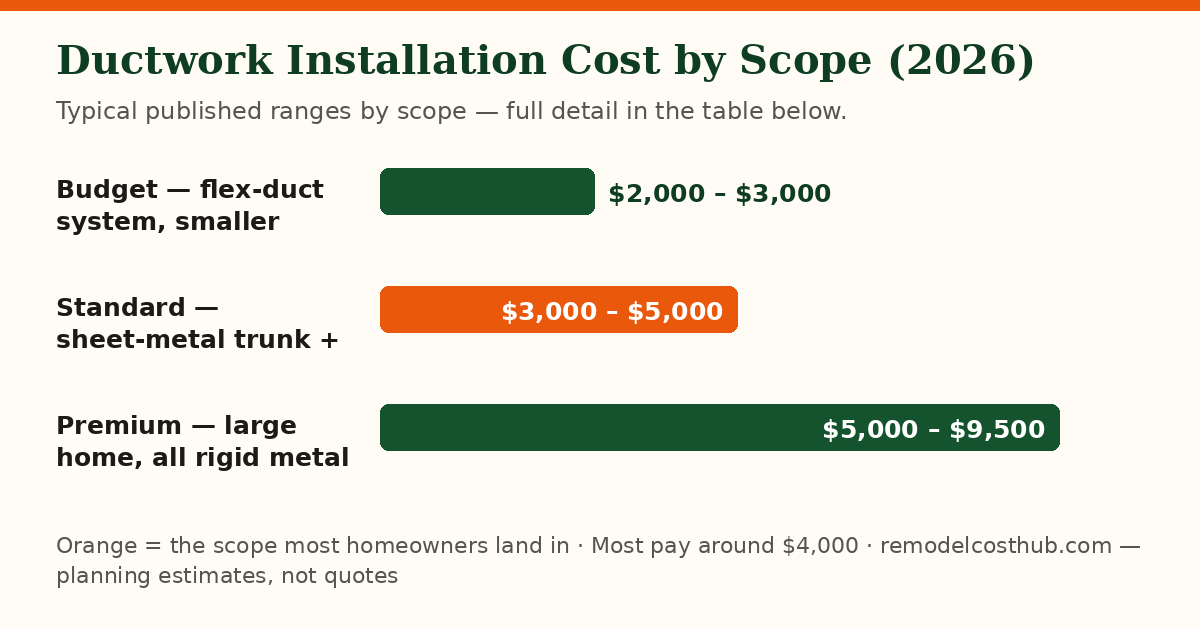
| Budget — flex-duct system, smaller home | $2,000 – $3,000 | A whole-house flex-duct system for a smaller home (1,000–1,500 sq ft, 80–120 linear feet), installed in open or unfinished framing during new construction or an addition — flexible branch runs, a basic sheet-metal plenum, standard registers and insulated boots, permit included. The very bottom of the range (~$1,200, HVAC Laboratory) is small additions only, not a whole house. |
| Standard — sheet-metal trunk + flex branches | $3,000 – $5,000 | The most-pay tier — the worked example below: a whole-house system for a 1,500–2,500 sq ft home (120–180 linear feet) — sheet-metal main trunk with flexible branch runs, plenum, fittings, dampers, insulated register boots, supply and return registers, duct wrap insulation where runs pass through unconditioned space, sealing with mastic, permit and inspection included. |
| Premium — large home, all rigid metal | $5,000 – $9,500 | A large or multi-storey home (2,500–4,000 sq ft, 180–300+ linear feet), all-rigid sheet-metal system, zoned dampers, heavier R-8 insulation throughout, complex routing with multiple floors, long trunk lines and extra return runs, permit and inspection included. Retrofitting a finished home also lands here. Homes over 4,000 sq ft can exceed this tier — Angi publishes $7,500–$12,000+ for them. |
Where the money goes
| Part of the job | Share | Note |
|---|---|---|
| Duct materials — trunk, branches, fittings | 35% of total | $1,400 for duct materials — a sheet-metal trunk with flexible branch runs, plenum, fittings, dampers, insulated register boots and registers for about 150 linear feet, inside HomeGuide's material-only sheet-metal band of $7–$13 per linear foot (150 LF = $1,050–$1,950). Share derived from the worked example below. |
| Labour — install crew, 1–2 days | 40% of total | $1,600 for installation labour — inside Angi's labour-only band of $5–$15 per linear foot (150 LF = $750–$2,250) and Fixr's duct-labour band of $965–$2,325. Share derived from the worked example below. |
| Duct insulation — wrap, unconditioned runs | 20% of total | $800 for duct-wrap insulation on runs through unconditioned space (attic or crawl space) — at the floor of HomeGuide's $800–$2,000 total installed band. Share derived from the worked example below. |
| Permits + inspection | 5% of total | $200 for permits and inspection — inside Angi's $50–$300 band and HomeGuide's $50–$250 band for ductwork alone. Share derived from the worked example below. |
What moves the price most
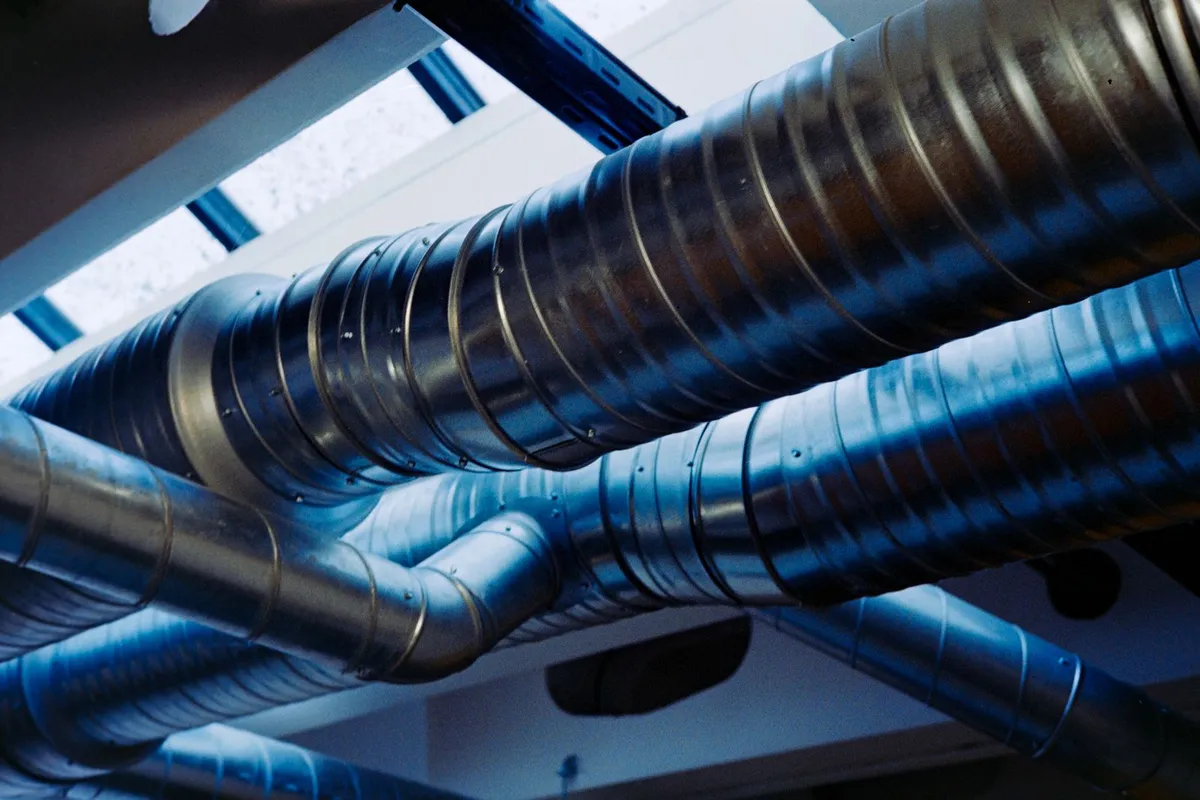
Worked example — $4,000 most-pay install (whole-house new ductwork, ~1,500–2,000 sq ft home, ~150 linear feet, mixed sheet-metal trunk and flexible branches, accessible framing, ductwork only): duct materials $1,400 (35%) + labour $1,600 (40%) + duct insulation $800 (20%) + permits $200 (5%) = $4,000. The shares (35/40/20/5) are derived arithmetic that sums to the sourced $4,000 total — no source publishes a labour/material percentage split. The insulation line applies only where ducts run through unconditioned space; in new construction with ducts inside the conditioned envelope it may be near $0, and the materials/labour lines would be correspondingly higher. Registers, boots, dampers and the plenum are folded into the materials line — no source prices them as a standalone whole-system line. Sealing is assumed included in the labour line (mastic sealing is standard install practice, HVAC Laboratory); drywall and wall-opening repair are NOT in this total — they apply to retrofits into finished homes. Per-linear-foot — never quote one number: a new install in accessible framing runs $10–$25 per linear foot installed (Angi) or $10–$35 (HVAC Laboratory); a retrofit into a finished existing home runs $40–$65 per linear foot (HomeGuide). Fixr states retrofit labour is nearly three times new-construction labour. Material rates by basis: flexible duct $5–$10 per linear foot vs sheet metal $12–$25 (Angi, presented on an installed basis) against flexible insulated $2–$4 and sheet metal $7–$13 (HomeGuide, material only, excluding installation and mark-up) — presented in separate columns on the sources line, never compared as like-for-like. Where sources disagree: the typical total — Angi $2,000–$7,500 (average $4,000) vs HomeGuide $2,400–$6,600 vs HVAC Laboratory $2,000–$6,000 vs Fixr $3,600–$9,500 (retrofit-with-AC context); the page publishes the $2,400–$6,000 overlap as typical. The high end for large homes — Angi $7,500–$12,000+ for 4,000+ sq ft vs HVAC Laboratory $7,000–$9,500 for large multi-storey homes vs Fixr $9,500 top; the Premium tier is capped at $9,500 with the Angi exception stated. Labour rates — Angi $50–$150 an hour (ductwork specialists) vs Fixr $75–$250 an hour (central-AC installation labour generally). Lifespan — HomeGuide 10–20 years system average vs HVAC Laboratory 30–50+ years for sheet metal (material-specific; both can be true — flex duct and duct board fail sooner, rigid metal lasts decades). National average — Angi $4,000 (new install) vs HomeGuide $3,500 (all ductwork jobs, replacement-weighted); the page uses $4,000 for new installs. Methodology: ranges are the honest overlap of Angi, HomeGuide and HVAC Laboratory (Fixr corroborating); where sources disagree on $/LF, both rates are shown with their scopes. Related costs: ductwork replacement, furnace replacement, heat pump installation, air conditioner installation and mini-split installation.
Costs in your city
Labor is the biggest variable in any remodel, and labor is local — the same bathroom can price very differently in Houston than in Boston. We are adding city editions metro by metro, each with its own labor index, permit notes and climate factors, written for that city rather than copied from this page. Wave 1: Houston, Dallas–Fort Worth, Phoenix, Atlanta, Miami–South Florida, Orlando, Tampa, Charlotte, Austin and San Antonio. Until your city's page is live, use the national range here and weight it the way contractors do: Sun Belt labor often prices near or below the national middle, while coastal California and the Northeast metros often price well above it.
Frequently asked questions
How much does it cost to install new ductwork?
Typically $2,400–$6,000 for a whole-house new install in a 1,500–2,000 sq ft home, with most homeowners paying around $4,000. That is the overlap of Angi ($2,000–$7,500, average $4,000), HomeGuide ($2,400–$6,600) and HVAC Laboratory ($2,000–$6,000). Ductwork only — the HVAC unit is extra.
How much does ductwork cost per linear foot?
It depends on the job type, and sources disagree. For a new install in accessible framing: $10–$25 per linear foot installed (Angi) or $10–$35 (HVAC Laboratory). For a retrofit into a finished existing home: $40–$65 per linear foot (HomeGuide). Get quotes on a per-project basis, not a single per-foot number.
How long does it take to install new ductwork?
Installing new ducts takes 1–2 days on average, up to 4 days for larger homes or complex projects (HomeGuide). When ductwork is added as part of a central-AC install, it adds about 2 extra days (Fixr).
Is installing ductwork cheaper in new construction than in an existing home?
Yes. New construction allows efficient routing through open framing, which keeps material and labour costs lower (Angi). Retrofitting a finished home means working around existing structure and finished walls; Fixr states retrofit labour is nearly three times new-construction labour, and HomeGuide's retrofit rate ($40–$65 per linear foot) is roughly double-to-triple Angi's new-install rate ($10–$25).
Do I need a permit to install new ductwork?
In most areas, yes. Permit fees run $50–$300 (Angi; HVAC Laboratory) or $50–$250 for ductwork alone (HomeGuide). If the ductwork is permitted as part of a full HVAC system install, HomeGuide puts permits at $250–$1,500. Contractors usually pull the permit and manage inspections (HomeGuide).
Does the ductwork price include the furnace or air conditioner?
No. The figures on this page are ductwork only. A complete HVAC system with new ductwork runs $7,000–$16,000 for a retrofit (HomeGuide); a 3-ton central AC plus new ductwork for a 2,000 sq ft home runs $8,650–$20,200 (Fixr). By unit type with ductwork (HomeGuide): central AC $4,700–$11,500, furnace $3,400–$11,000, heat pump $5,200–$13,800.