Radon Mitigation Installation cost at a glance
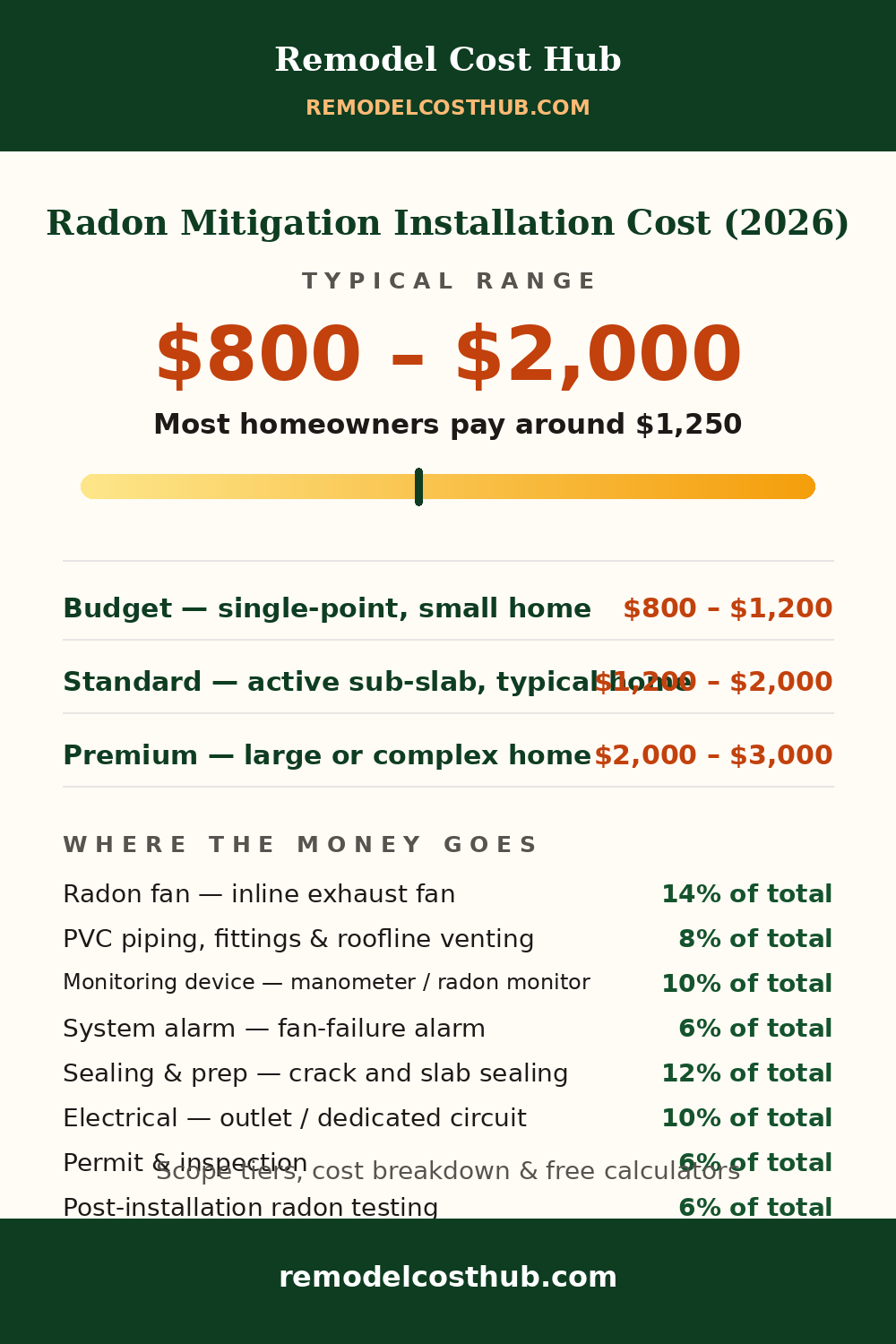
- Typical range: $800 – $2,000
- Most homeowners pay: around $1,250
Cross-checked against six published sources for this project. Sources used for this page: Angi, 'How Much Does It Cost to Remediate Radon? [2026 Data]', published Jul 28, 2025, updated Oct 30, 2026 — national average $1,000 in 2026, most homeowners $800–$1,300, low $400, high $2,500; active fan-powered systems typically $800–$1,300; sub-slab depressurization $500–$2,500 by complexity; by home size up to 1,500 sq ft $800–$1,200, 1,500–2,500 sq ft $1,200–$2,000, 2,500–4,000 sq ft $2,000–$3,000; components fan $100–$350, PVC piping $50–$200, monitoring device $100–$300, system alarm $50–$150; pre-installation testing $15–$200; site prep and sealing adds $100–$500; permit + inspection $50–$200; post-installation testing $50–$200; additional features $50–$400; removal of old systems $100–$300; foundation repairs $200–$1,000; electrical upgrades (dedicated circuit) $100–$300; add-ons digital monitor $100–$300, secondary suction points $300–$800, crawl space encapsulation $1,500–$4,000, sump pump cover/upgrade $100–$400, decorative vent cover $50–$200, noise reduction $100–$400, annual maintenance contract $100–$300/year; fan inspection $50–$150 every 1–2 years, resealing $30–$100 every 2–5 years, fan replacement $150–$350 every 5–10 years; DIY can save around $400–$1,500; standard homeowners insurance does not cover radon remediation; labour is typically a flat fee bundled into the quote — NO separate dollar labour rate is published. HomeGuide, 'How Much Does a Radon Mitigation System Cost? (2026)', published Oct 16, 2022, updated Feb 5, 2026 — installed $1,200–$2,000 on average, national average $1,600, minimum $500, maximum $8,000; active soil depressurization $1,200–$2,000 ($2,500+ for larger homes); other foundation-based $900–$8,000; wall-based $500–$3,000; ventilation $1,300–$2,500; water mitigation $1,200–$5,000; crawl space encapsulation $3,000–$15,000 or $3–$10 per sq ft; basement sealing/waterproofing $6,000–$18,000; drain-tile suction $900–$1,800; sump pit and sump crock sealing $900–$2,500; block-wall depressurization $1,800–$3,000; above-slab air pressure differential barrier $500–$1,200; ERV $1,500–$2,500; HRV $1,300–$2,200; carbon/charcoal scrubbing $1,200–$1,800; aeration $4,000–$5,000; professional radon testing $125–$400 (kit $10–$30); permit $25–$150; digital radon detector $150–$300; fan energy about the same as a 60-watt bulb, around $70–$80 per year; fix homes above 4.0 pCi/L; active soil depressurization can reduce radon by up to 99%; piping 20–50+ years, exhaust fan 5–10 years, most fan warranties 5 years; homeowners insurance does not cover radon mitigation or testing; 1 in 15 US homes has elevated radon. HomeAdvisor, 'How Much Does a Radon Mitigation System Cost? [2025 Data]' (same Angi Inc. family — same-family check only, not an independent source) — most homeowners $786–$1,274, average $1,028, low $395, high $2,453; active systems $786–$1,274; passive $500–$2,500; active suction $1,000–$3,000; professional testing $150–$800; permits $25–$150; fans last 5–10 years; systems generally 10–30 years. Fixr, 'Radon Testing Prices | Radon Mitigation Cost', updated Jan 31, 2025 — headline $650–$2,850 with most paying $1,700 is TESTING + passive depressurization COMBINED, NOT an installation-only average — never cited as one; mitigation by type installed lower-level pressurization $500–$1,000, passive depressurization $500–$2,500, active suction $500–$2,500, fan-assisted ventilation $800–$2,500, water treatment $2,500–$4,000, basement sealing $3,000–$5,000; dirt-foundation sealing $300–$1,000; testing short-term $20–$350, long-term $30–$350, professional inspection $100–$400; EPA recommends action at 4 pCi/L or higher, consider mitigation over 2 pCi/L; radon the second leading cause of lung cancer in the US after cigarette smoke, around 21,000 lung cancer deaths annually. ThePricer, 'How Much Does A Radon Mitigation System Cost?', updated Oct 16, 2026 — planning range $1,200–$3,000 professionally installed; straightforward active sub-slab $1,200–$2,000; complex active $2,500–$3,500+; block-wall $1,800–$3,000; ventilation $1,300–$2,500; fan replacement $300–$600 installed; relays HomeGuide Feb 2026 $1,200–$2,000, Minnesota Dept. of Health $1,500–$3,000, Wisconsin Jun 2026 $1,000–$2,000 average, Idaho Dept. of Health $1,500–$3,500 professional and $300–$600 DIY parts only, Angi Sep 28, 2026 average $1,043 from 1,184 projects, typical $805–$1,326; illustrative first-year project cost $1,925 ($1,500 install + $175 + $75 + $175); fan electricity calculated examples only (60W about $94.61/year at $0.18/kWh); EPA recommends fixing homes at 4 pCi/L or higher and considering mitigation at 2–4 pCi/L; no system should be assumed to achieve zero radon; sealing cracks alone has not demonstrated large reductions; Wisconsin cautions sub-slab depressurization is not suitable for ordinary DIY. Stasis, 'How much does a radon mitigation system cost?', updated Aug 2026 — Illinois state programme $800–$1,200 vs Minnesota $1,500–$3,000 (the two state ranges do not overlap); the $1,200 average most sites quote comes from an EPA page last updated in 2018 and now archived (about $1,200, range about $500–$2,500) — at minimum eight years stale, and EPA today declines to name a price; Kansas State National Radon Program Services national average $1,200 with $800–$1,500 common (undated); HomeAdvisor Jun 2026 $1,028 average, most $786–$1,274; Minnesota warns against mitigation rates under $1,000 from unlicensed installers (Minnesota-calibrated, not a national floor); no government or institutional source publishes a dollar premium for a crawlspace or mixed-foundation home; fan typically under 90 watts, similar to a 60–90 watt bulb; fan warranties typically five years, lifespans 10–15 years (Kansas State); EPA fans may last five years or more; test kit under $25 (EPA). NOTE: Angi + HomeGuide + HomeAdvisor are one Angi Inc. family and count as ONE source; the three independent sources are the Angi family, Fixr and ThePricer, with Stasis as a fourth independent check. No source publishes a $/sq ft rate for sub-slab work, a $ per suction point, a separate labour rate, an exterior-vs-interior price difference, or a dollar premium for a crawl-space home — none is given. Breakdown shares are derived from the worked example below; the $350 labour line is a derived residual, not a sourced rate. Checked November 2026.. Sources last checked: October 2026 — HomeAdvisor, HomeGuide, Fixr, Angi, EPA, ThePricer. How we calculate these costs
Cost by scope
| Scope | Typical cost | What it includes |
|---|---|---|
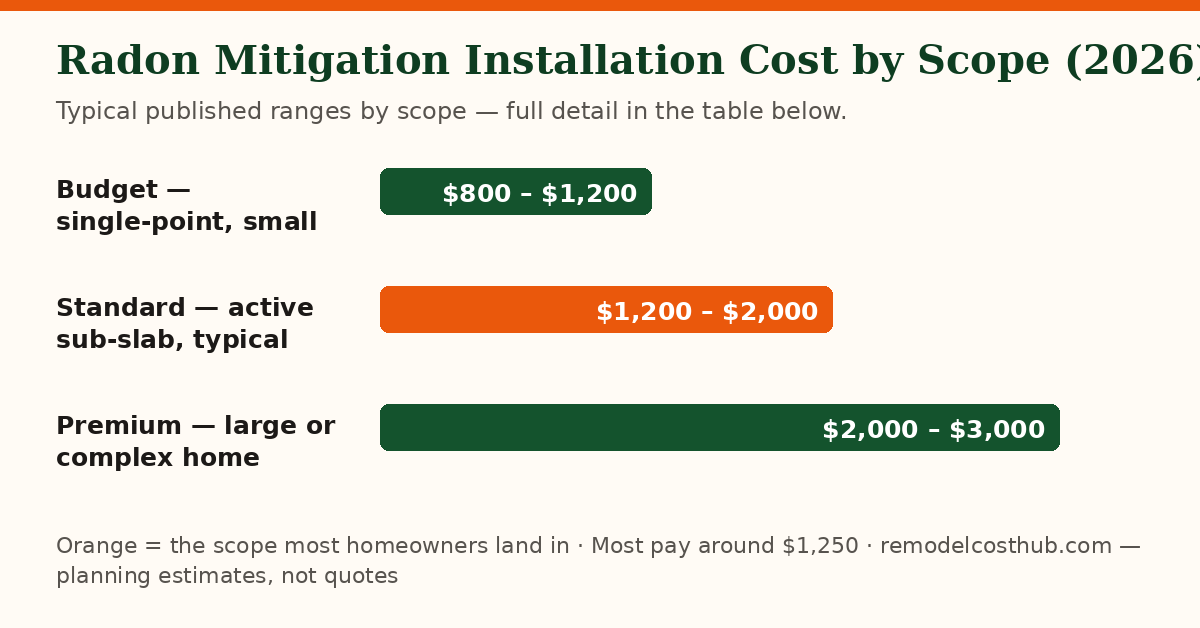
| Budget — single-point, small home | $800 – $1,200 | A single-point active sub-slab system on a home up to 1,500 sq ft with one suction point and an easy pipe route (Angi size table, Angi-only figure). |
| Standard — active sub-slab, typical home | $1,200 – $2,000 | The most-pay tier — the worked example below: an active sub-slab depressurization system on a typical 1,500–2,500 sq ft home, with multiple suction points as needed. Angi, HomeGuide and ThePricer all publish this exact band — the strongest agreement on the page. |
| Premium — large or complex home | $2,000 – $3,000 | A multi-point or dual system on a 2,500–4,000 sq ft home, with multiple suction points, difficult pipe routing or a finished basement (Angi size table, Angi-only; corroborated in direction by ThePricer's complex active $2,500–$3,500+ and HomeGuide's $2,500+ for larger homes). |
Where the money goes
| Part of the job | Share | Note |
|---|---|---|
| Radon fan — inline exhaust fan | 14% of total | $175 for the radon fan — inside Angi's $100–$350 band. The fan is the wear part: typically replaced after 5–10 years (Angi, HomeGuide, HomeAdvisor) or 10–15 years (Kansas State via Stasis). Share derived from the worked example below. |
| PVC piping, fittings & roofline venting | 8% of total | $100 for PVC piping, fittings and roofline venting — inside Angi's $50–$200 band. The pipe vents soil gas above the roofline. Share derived from the worked example below. |
| Monitoring device — manometer / radon monitor | 10% of total | $125 for the monitoring device — inside Angi's $100–$300 band. Share derived from the worked example below. |
| System alarm — fan-failure alarm | 6% of total | $75 for the fan-failure alarm — inside Angi's $50–$150 band. Share derived from the worked example below. |
| Sealing & prep — crack and slab sealing | 12% of total | $150 for sealing and prep — inside Angi's $100–$500 prep band. Sealing cracks alone has not demonstrated large reductions and is not a substitute for a system (ThePricer, citing Wisconsin). Share derived from the worked example below. |
| Electrical — outlet / dedicated circuit | 10% of total | $125 for the electrical connection for the fan — inside Angi's $100–$300 band for a dedicated circuit. Share derived from the worked example below. |
| Permit & inspection | 6% of total | $75 for the permit and inspection — inside both Angi's $50–$200 band and HomeGuide and HomeAdvisor's $25–$150 band. Share derived from the worked example below. |
| Post-installation radon testing | 6% of total | $75 for the post-installation verification test — inside Angi's $50–$200 band. The result must be confirmed by a test; no system should be assumed to reach zero radon. Share derived from the worked example below. |
| Labour, system design & overhead | 28% of total | $350 for labour, system design and overhead — a DERIVED RESIDUAL (the total minus the published-band lines), NOT a published labour rate. No source publishes a separate labour rate for radon installation; every source says labour is bundled as a flat fee inside the quote. Share derived from the worked example below. |
What moves the price most
Worked example — $1,250 most-pay system (standard single-point active sub-slab depressurization, typical basement or slab home): fan $175 (14.0%) + PVC piping $100 (8.0%) + monitoring device $125 (10.0%) + system alarm $75 (6.0%) + sealing and prep $150 (12.0%) + electrical $125 (10.0%) + permit and inspection $75 (6.0%) + post-installation testing $75 (6.0%) + labour, design and overhead $350 (28.0%) = $1,250. The $350 labour line is a derived residual, not a sourced rate. Pre-installation testing is EXCLUDED from this $1,250 — it is often a separate earlier cost (Angi $15–$200; HomeGuide professional test $125–$400; HomeAdvisor $150–$800). Every materials line sits inside its published band; the breakdown bar rounds the shares to whole numbers. Where sources disagree: the typical range — Angi $800–$1,300 vs HomeGuide $1,200–$2,000, overlapping only at $1,200–$1,300; the published averages spread $1,000–$1,600 (Angi $1,000; HomeAdvisor $1,028; Angi September 2026 $1,043 from 1,184 projects; Kansas State $1,200 undated; HomeGuide $1,600; the EPA's archived $1,200 is from a page last updated in 2018 and is stale — Stasis); the high end — Angi $2,500 vs HomeGuide $8,000, but HomeGuide's $8,000 covers other foundation-based and water systems, not a standard sub-slab job; Fixr's $1,700 is testing PLUS passive depressurization combined ($650–$2,850) and must never be cited as an installation average; crawl-space encapsulation — Angi lists it as an add-on at $1,500–$4,000 while HomeGuide lists full encapsulation at $3,000–$15,000 (different scopes, irreconcilable top ends; no government source prices the crawl-space premium at all — Stasis); permits — Angi $50–$200 vs HomeGuide and HomeAdvisor $25–$150 (overlap $50–$150); professional testing — $15–$200 (Angi) vs $125–$400 (HomeGuide) vs $150–$800 (HomeAdvisor), no settled price; fan electricity — HomeGuide about $70–$80 a year vs HomeAdvisor $30–$300 a year (internally inconsistent — Stasis) vs ThePricer's calculated $47–$142 a year, so this page publishes watts only (typically under 90 watts, about like a 60–90 watt bulb running continuously); fan replacement installed — Angi $150–$350 vs ThePricer $300–$600 vs PickHVAC $350–$900, no agreement; state ranges do not overlap — Illinois $800–$1,200 vs Minnesota $1,500–$3,000 (state programmes via Stasis), so a national figure cannot replace a local quote. Other system types (clearly separated, not in the headline range): passive depressurization (fanless pipe only) $500–$2,500 (Fixr; HomeAdvisor) — weaker performance than active; drain-tile suction $900–$1,800 and sump-pit sealing $900–$2,500 (HomeGuide, single source — homes with a pre-existing perimeter drain or sump pit only); block-wall depressurization $1,800–$3,000 (HomeGuide; ThePricer agrees); ventilation (ERV $1,500–$2,500; HRV $1,300–$2,200, HomeGuide) — less effective for radon; water mitigation $1,200–$5,000 (HomeGuide; HomeAdvisor) — a SEPARATE job for radon in well water; an air system does not treat well water. No source publishes a $/sq ft rate for sub-slab work, a price difference between exterior and interior routing, or a dollar premium for a crawl-space or mixed-foundation home — none is given here. The EPA recommends fixing a home at 4 pCi/L or higher and considering mitigation at 2–4 pCi/L; an active system can reduce radon by up to 99% (HomeGuide; EPA via ThePricer), but the result must be confirmed by a post-installation test. About 1 in 15 US homes has elevated radon (HomeGuide, citing EPA). Related costs: sump pump installation, carbon monoxide detector installation, basement finishing, crawl space repair and attic insulation.
Costs in your city
Labor is the biggest variable in any remodel, and labor is local — the same bathroom can price very differently in Houston than in Boston. We are adding city editions metro by metro, each with its own labor index, permit notes and climate factors, written for that city rather than copied from this page. Wave 1: Houston, Dallas–Fort Worth, Phoenix, Atlanta, Miami–South Florida, Orlando, Tampa, Charlotte, Austin and San Antonio. Until your city's page is live, use the national range here and weight it the way contractors do: Sun Belt labor often prices near or below the national middle, while coastal California and the Northeast metros often price well above it.
Frequently asked questions
How much does radon mitigation cost?
Most professionally installed active sub-slab systems cost $800–$2,000, with $1,250 as the midpoint where the published typical ranges agree (Angi $800–$1,300; HomeGuide $1,200–$2,000; Fixr $500–$2,500 for active suction). Larger or complex homes can reach $2,500–$3,000+.
At what radon level do I need a mitigation system?
The EPA recommends fixing a home at 4 pCi/L or higher and considering mitigation at 2–4 pCi/L (ThePricer; Fixr; HomeGuide). A test is the only way to know your level — radon has no smell or colour.
How does a sub-slab depressurization system work?
A fan draws radon-carrying soil gas from beneath the slab through a pipe and vents it above the roofline before it can enter the home (HomeGuide; Angi). Active (fan-powered) systems perform more strongly than passive fanless ones (Angi). A well-designed system can reduce radon by up to 99% (HomeGuide; EPA via ThePricer), but the result must be confirmed by a post-installation test.
How long does a radon mitigation system last?
The piping lasts 20–50+ years (HomeGuide); the fan is the wear part and typically needs replacement after 5–10 years (Angi; HomeGuide; HomeAdvisor), with Kansas State putting fan lifespan at 10–15 years (Stasis). Most fan warranties are 5 years (HomeGuide; Stasis). Retest every 2 years after installation (Minnesota via ThePricer).
Does homeowners insurance cover radon mitigation?
No — standard homeowners insurance does not cover radon testing or mitigation, as it is treated as maintenance (Angi; HomeGuide). In a home sale the seller typically pays, but that is negotiable (HomeGuide).
Can I install a radon mitigation system myself, or just seal the cracks?
The EPA discourages DIY mitigation and the sources route the work to licensed or certified (NRPP/NRSB) professionals (HomeAdvisor; HomeGuide). Sealing cracks alone has not demonstrated large reductions and is not a substitute for a proper system (ThePricer, citing Wisconsin). DIY parts alone run about $300–$600 (Idaho via ThePricer), but that excludes labour, design and verification — and a DIY system may not satisfy real-estate requirements.