Sump Pump Installation cost at a glance
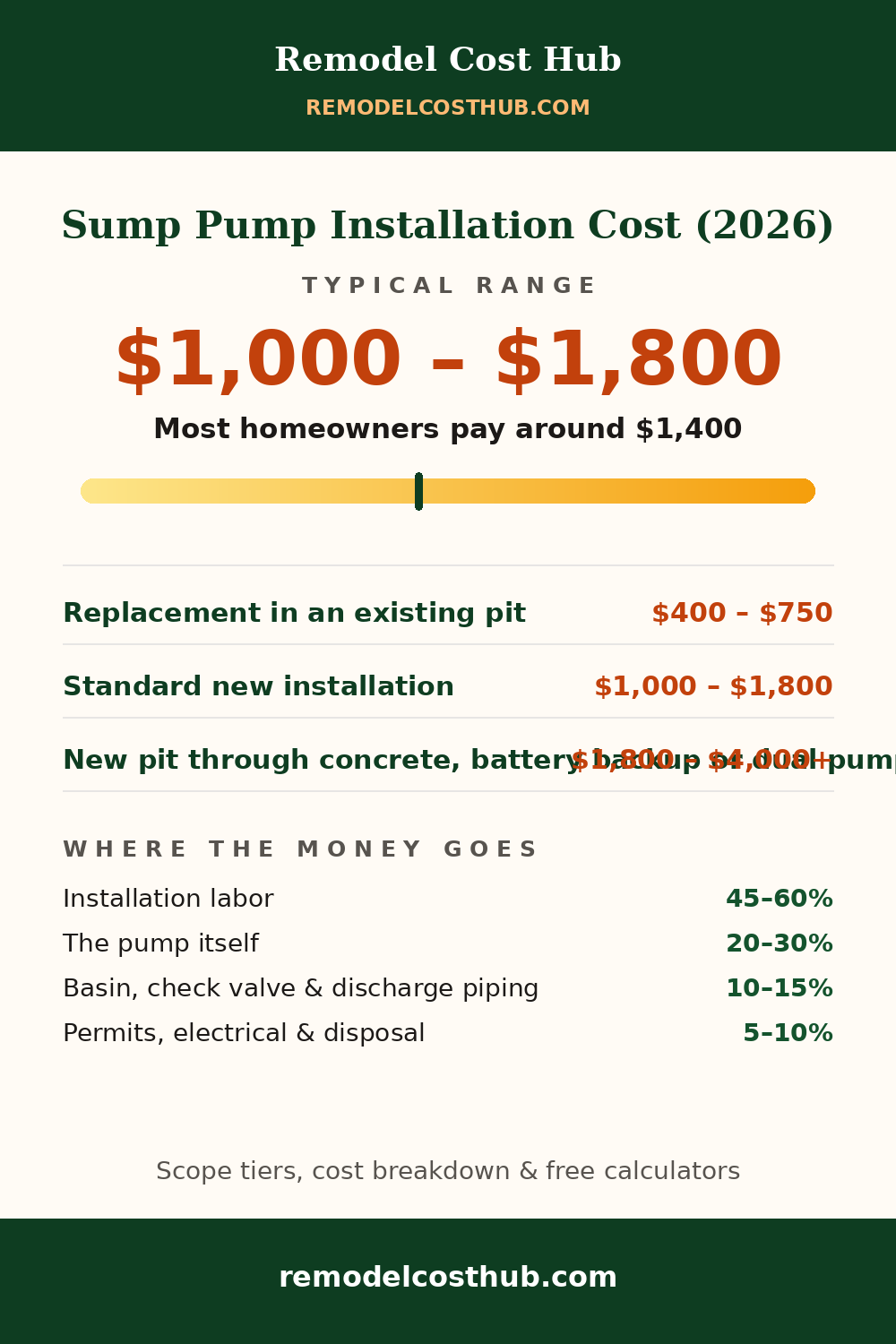
- Typical range: $1,000 – $1,800
- Most homeowners pay: around $1,400
- Prices vary most by: Installation labor (45–60% of the budget)
Cross-checked against three published sources for this project. Sources used for this page: Angi's sump pump installation cost guide, HomeGuide's sump pump installation cost guide and Forbes Home's sump pump cost data. Sources last checked: October 2026 — Forbes Home, HomeGuide, Angi. Last updated October 2026 · How we calculate these costs
Cost by scope
| Scope | Typical cost | What it includes |
|---|---|---|
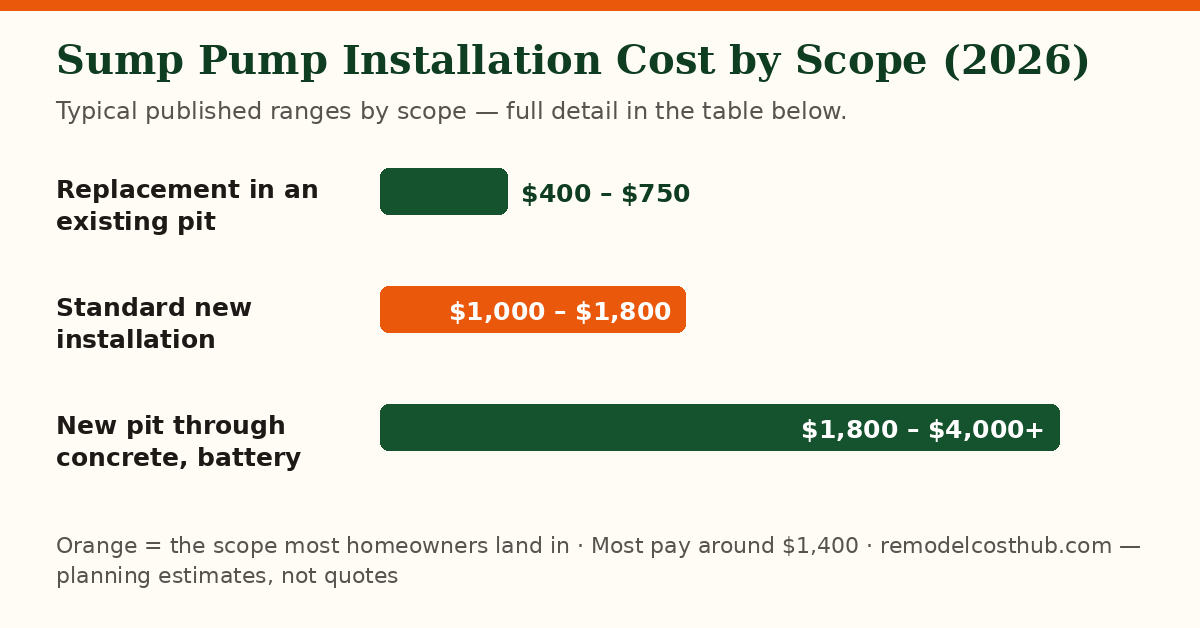
| Replacement in an existing pit | $400 – $750 | The swap, not the system. HomeGuide prices replacing an existing sump pump at $400–$700 and Angi's replacement guide averages $531 inside $309–$755 — pit, discharge and wiring already exist, so the money is the pump and an hour or two of labor. |
| Standard new installation | $1,000 – $1,800 | The typical project on this page. Angi prices a new installation at $800–$1,500 with a $1,100 average, Forbes Home puts the typical range at $1,200–$2,500 around a $1,500 average, and HomeGuide spans $600–$2,500 — a standard pit, pump and discharge sits where the three overlap. |
| New pit through concrete, battery backup or dual pumps | $1,800 – $4,000+ | Where the system grows. HomeGuide prices installations that need a concrete floor cut at $2,500–$5,000, Angi prices a battery backup at an extra $1,000–$2,000 and dual pumps or multiple pits at $2,000–$4,000 or more, before any perimeter drainage work. |
Where the money goes
| Part of the job | Share | Note |
|---|---|---|
| Installation labor | 45–60% | HomeGuide prices labor at $500–$1,700 and notes it is often 65–80% of a small project's total; Angi prices installers at $50–$150 per hour. Digging the pit, setting the basin and running the discharge is the job — the pump is the part that arrives in a box |
| The pump itself | 20–30% | HomeGuide prices the unit at $100–$800 — pedestal $100–$400, submersible $100–$800 — and Angi's size ladder runs 1/3 HP installations at $800–$1,200 against $1,600–$2,500 for 3/4 HP and above |
| Basin, check valve & discharge piping | 10–15% | The basin, the check valve that stops water running back into the pit, and the PVC discharge run to outside. Angi prices accessories like check valves, pit covers and upgraded discharge lines at $50–$300 each |
| Permits, electrical & disposal | 5–10% | Angi prices permits at $50–$250 where new electrical or drainage work triggers them, and a dedicated GFCI outlet at the pit is the electrical line that appears when the basement has none nearby |
What moves the price most
Whether a pit already exists is the budget. HomeGuide prices a replacement in an existing pit at $400–$700 against $600–$2,500 for a new installation, and Angi's replacement average of $531 sits at barely half its $1,100 new-installation average — the digging, not the pump, is the money. The floor is the second cliff: HomeGuide prices a dirt-floor dig as the easy version and a concrete floor that needs a jackhammer or saw at $2,500–$5,000 all-in. Pump size and type come third: Angi's installed ladder runs $800–$1,200 for 1/3 HP, $1,000–$1,600 for 1/2 HP and $1,600–$2,500 for 3/4 HP, with submersible systems at $1,200–$3,000 against pedestal at $800–$1,500. The backup decision is the one owners revisit: a battery backup adds $1,000–$2,000 in Angi, and it is the difference between a pump that works in a storm and one that stops when the power does — which is usually when the water arrives.
Worked example: how a typical sump pump installation budget breaks down
A typical job: a new 1/2 HP submersible pump in a freshly dug basement pit — basin set and gravel-bedded, pump and check valve fitted, discharge run outside, outlet confirmed and the float test-run before the crew leaves. The budget below totals $1,400 — the "most homeowners pay around" figure from the top of this page — split using this page's own cost breakdown. It shows how a real quote at that level is usually composed; every line is built from the ranges on this page, and it is an illustration, not a quote for your project.
| Line item | Example budget |
|---|---|
| Labor — pit, basin, discharge & installation | $770 |
| The pump (1/2 HP submersible) | $350 |
| Basin, check valve & discharge piping | $182 |
| Permits, electrical & disposal | $98 |
| Total | $1,400 |
What most people get wrong
- Comparing a replacement quote with a new-installation quote — HomeGuide prices the swap at $400–$700 and a new system at $600–$2,500, so the two numbers were never the same job.
- Skipping the battery backup to hit a budget — Angi prices it at $1,000–$2,000, and the storm that fills the pit is the same storm that cuts the power.
- Letting the discharge end at the foundation — water pumped two feet from the wall runs straight back to the pit, and the pump cycles forever moving the same water.
- Buying horsepower by fear instead of by lift and inflow — Angi's ladder runs $800–$1,200 installed for 1/3 HP against $1,600–$2,500 for 3/4 HP, and an oversized pump short-cycles itself to an early death.
Costs in your city
Sump pump pricing is plumber and waterproofing labor around a shipped pump: HomeGuide prices the labor at $500–$1,700 and plumbers at $45–$80 per hour, while Angi prices installers at $50–$150 per hour — so the same system installs near the bottom of the band in a low-rate market and well above it in a coastal metro. The local variable that actually sets the specification is the water table: high-water-table regions spec bigger pumps, deeper pits and the battery backup as standard, while dry-climate homes may never run their pump outside spring. Permit practice follows the electrical and drainage work — Angi prices permits at $50–$250 where they are pulled. Ask each bidder whether the pit, the check valve and the discharge run are all inside the number.

Frequently asked questions
How much does it cost to install a sump pump?
Most homeowners pay $1,000–$1,800 for a standard new sump pump installation, with $1,400 typical. Angi averages $1,100 inside $800–$1,500, Forbes Home puts the typical range at $1,200–$2,500 around a $1,500 average, and HomeGuide spans $600–$2,500 depending on the pit and floor.
How much does it cost to replace a sump pump in an existing pit?
HomeGuide prices a replacement at $400–$700 and Angi's replacement data averages $531 inside $309–$755. The pit, discharge line and wiring already exist, so the job is the pump itself plus an hour or two of labor — unless the check valve or discharge has failed with it.
How long does a sump pump installation take?
HomeGuide puts a simple installation at 8 to 10 hours — a full working day once the pit is dug, the basin set and the discharge run. A replacement in an existing pit is far quicker, and concrete cutting, new drainage or electrical work is what stretches a new install past a day.
Is a battery backup sump pump worth it?
In a flood-prone home, usually yes: Angi prices the backup at $1,000–$2,000 extra, and storms are exactly when mains power fails. HomeGuide notes battery units run $150–$800 for the pump with batteries replaced every 3 to 5 years — cheap insurance against the one failure mode a primary pump cannot cover.
How long does a sump pump last?
HomeGuide puts pedestal pumps at 10 to 30 years and submersible pumps at 5 to 20 years, depending on how often they run. Angi's guidance is similar: most pumps last seven to 10 years in regular service, and a pump that runs constantly, cycles oddly or leaves water standing is telling you its remaining life is short.