Electrical Subpanel Installation cost at a glance
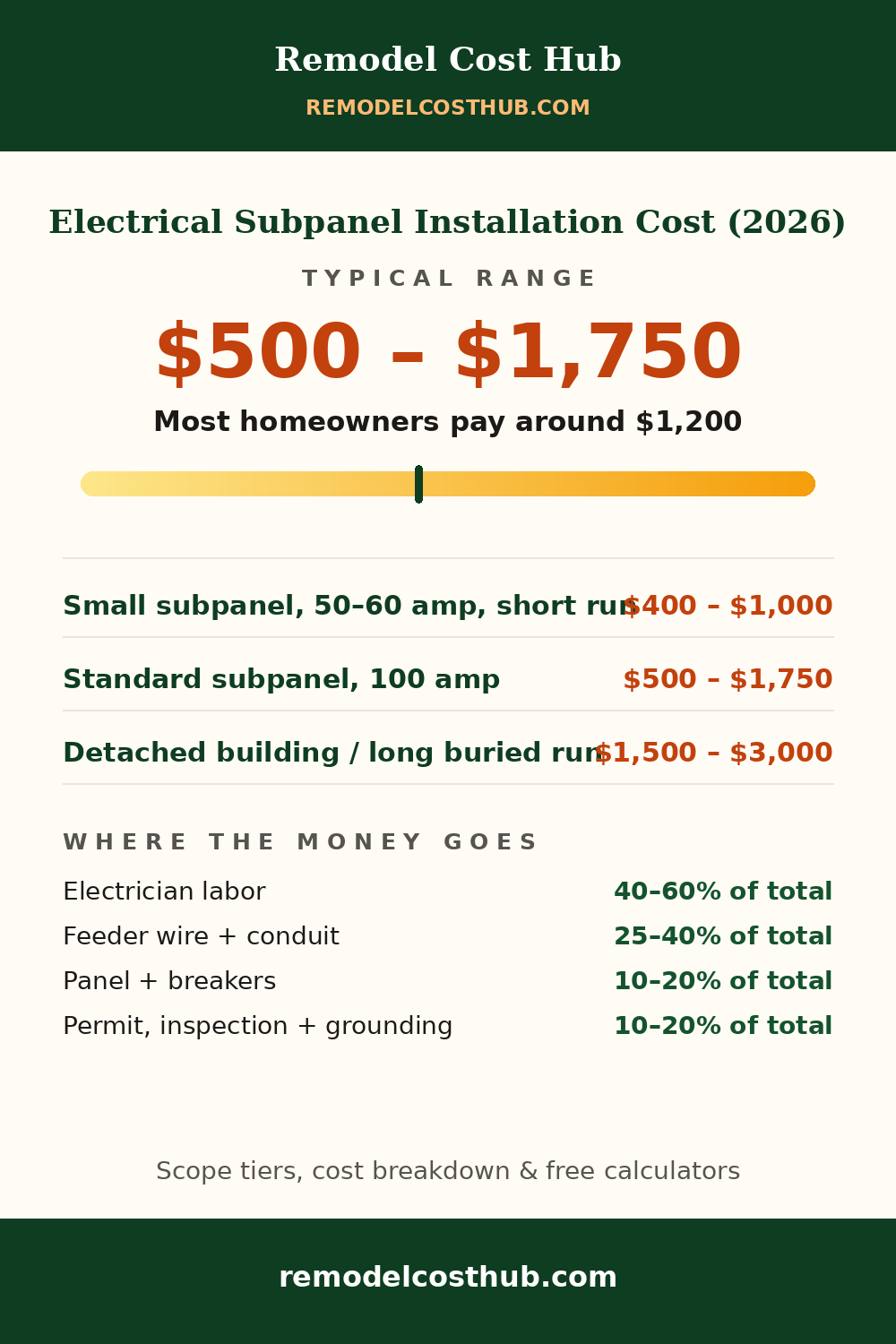
- Typical range: $500 – $1,750
- Most homeowners pay: around $1,200
- Prices vary most by: Electrician labor (40–60% of the budget)
Cross-checked against two published sources for this project. Sources used for this page: Angi's subpanel installation cost guide, updated October 12, 2026 (national average $1,200, most $400–$1,750; 100-amp $400–$1,000, 125-amp $500–$1,250, 150-amp $600–$1,750; new wiring about $1,400 on average, range $600–$2,200; grounding rod $200–$500; electricians $50–$130 an hour), HomeGuide's subpanel installation cost guide (total $500–$1,700; subpanel box $20–$150; installation labor $430–$1,000; wiring $7–$10 per linear foot; 50-amp $400–$600, 100-amp $500–$1,500) and Bob Vila's electrical panel replacement guide (subpanel installation $530–$1,940). Synthesized typical = the Angi most-pay band overlapped with HomeGuide's total, with Angi's $1,200 average as most-pay; the detached-building tier sums Angi's wiring and grounding bands. Checked November 2026.. Sources last checked: October 2026 — HomeGuide, Angi. How we calculate these costs
Cost by scope
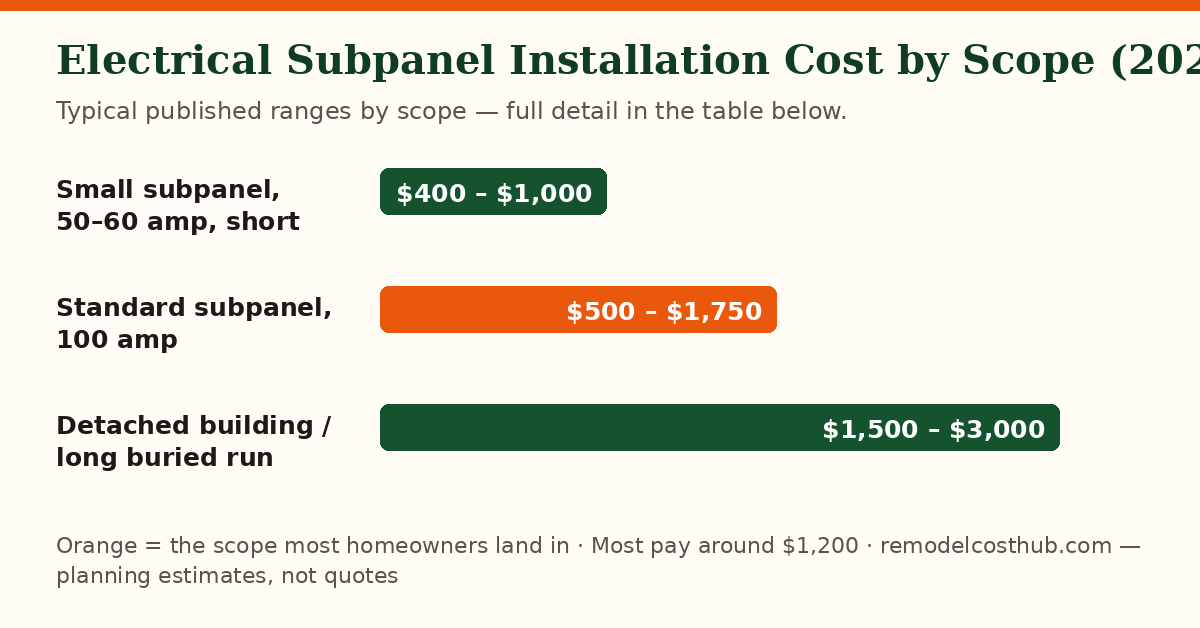
| Scope | Typical cost | What it includes |
|---|---|---|
| Small subpanel, 50–60 amp, short run | $400 – $1,000 | A small panel for a few new circuits close to the main panel. Angi prices a 50-amp panel from around $400 and a 100-amp panel at $400–$1,000; HomeGuide prices a 50-amp subpanel at $400–$600. |
| Standard subpanel, 100 amp | $500 – $1,750 | The typical project on this page. Angi's most-pay band is $400–$1,750 with a $1,200 average, HomeGuide prices a full subpanel job at $500–$1,700, and Bob Vila prices subpanel installation at $530–$1,940. |
| Detached building / long buried run | $1,500 – $3,000 | A subpanel in a detached garage or workshop fed by a buried line. The panel itself is the same, but Angi prices the feeder wiring at $600–$2,200 on average and a grounding rod at $200–$500, and trenching and conduit push the run well past an interior job. |
Where the money goes
| Part of the job | Share | Note |
|---|---|---|
| Electrician labor | 40–60% of total | The largest share on a standard job. HomeGuide prices subpanel installation labor at $430–$1,000, and Angi prices electricians at $50–$130 an hour for a multi-hour job including testing. |
| Feeder wire + conduit | 25–40% of total | The run from the main panel to the subpanel — the cost that distance drives. Angi prices new subpanel wiring at $600–$2,200 on average, and HomeGuide prices subpanel wiring at $7–$10 per linear foot. |
| Panel + breakers | 10–20% of total | The hardware itself is the smallest share. HomeGuide prices the subpanel box at $20–$150, with breakers and fittings on top; amperage rating moves this line, not the total. |
| Permit, inspection + grounding | 10–20% of total | Most jurisdictions require a permit and inspection for a new panel, and a detached building needs its own grounding. Angi prices a grounding rod at $200–$500. |
What moves the price most
Amperage is the first choice, distance the second: a 50-amp panel for a few circuits is a different job from a 100-amp panel feeding a workshop, and Angi's own rule is that distance from the main panel drives the wiring bill — a panel 10 feet away and a panel 100 feet away are not the same quote. Interior versus detached is the third cliff: a buried feeder needs trenching, conduit and its own grounding rod, which is why the detached tier starts where the standard tier ends. Main-panel capacity is the gate: a subpanel does not add service capacity — it only moves circuits closer to where they are used — so a full or undersized main panel needs an upgrade instead. For the main-panel alternative, see our electrical panel upgrade guide, for the most common reason a subpanel is added, see our EV charger guide, and for a detached living space that usually needs one, see our garage conversion guide.
Costs in your city
Labor is the biggest variable in any remodel, and labor is local — the same bathroom can price very differently in Houston than in Boston. We are adding city editions metro by metro, each with its own labor index, permit notes and climate factors, written for that city rather than copied from this page. Wave 1: Houston, Dallas–Fort Worth, Phoenix, Atlanta, Miami–South Florida, Orlando, Tampa, Charlotte, Austin and San Antonio. Until your city's page is live, use the national range here and weight it the way contractors do: Sun Belt labor often prices near or below the national middle, while coastal California and the Northeast metros often price well above it.
Frequently asked questions
How much does a 100-amp subpanel cost?
Angi prices a 100-amp subpanel at $400–$1,000 for the panel job itself, and the full installed project — panel, feeder, labor, permit — lands in the $500–$1,750 typical band on this page, with $1,200 the Angi average.
Does a subpanel increase my home's amps?
No. A subpanel adds circuits and moves capacity closer to where it is used, but it does not change your service size — a 100-amp service with a new subpanel is still a 100-amp service. If the main panel itself is undersized, that is a panel upgrade, not a subpanel.
How far can a subpanel be from the main panel?
As far as the feeder allows, but cost rises with every foot: HomeGuide prices subpanel wiring at $7–$10 per linear foot, and Angi prices a full new wiring run at $600–$2,200. Long or buried runs are the reason detached-building subpanels cost $1,500–$3,000.
Do I need a permit for a subpanel?
In most jurisdictions, yes — a new panel is permitted and inspected work, and a detached building additionally needs its own grounding rod, which Angi prices at $200–$500. Unpermitted panel work is also the kind of thing that surfaces at resale or after an insurance claim.
Subpanel or panel upgrade — which one?
A subpanel when the main panel has capacity but no free breaker spaces, or when circuits are needed far from it — a garage, addition or EV charger. A panel upgrade when the main panel is full, undersized for the load, or a fuse box; see the panel upgrade guide linked above.