Gas Line Installation cost at a glance
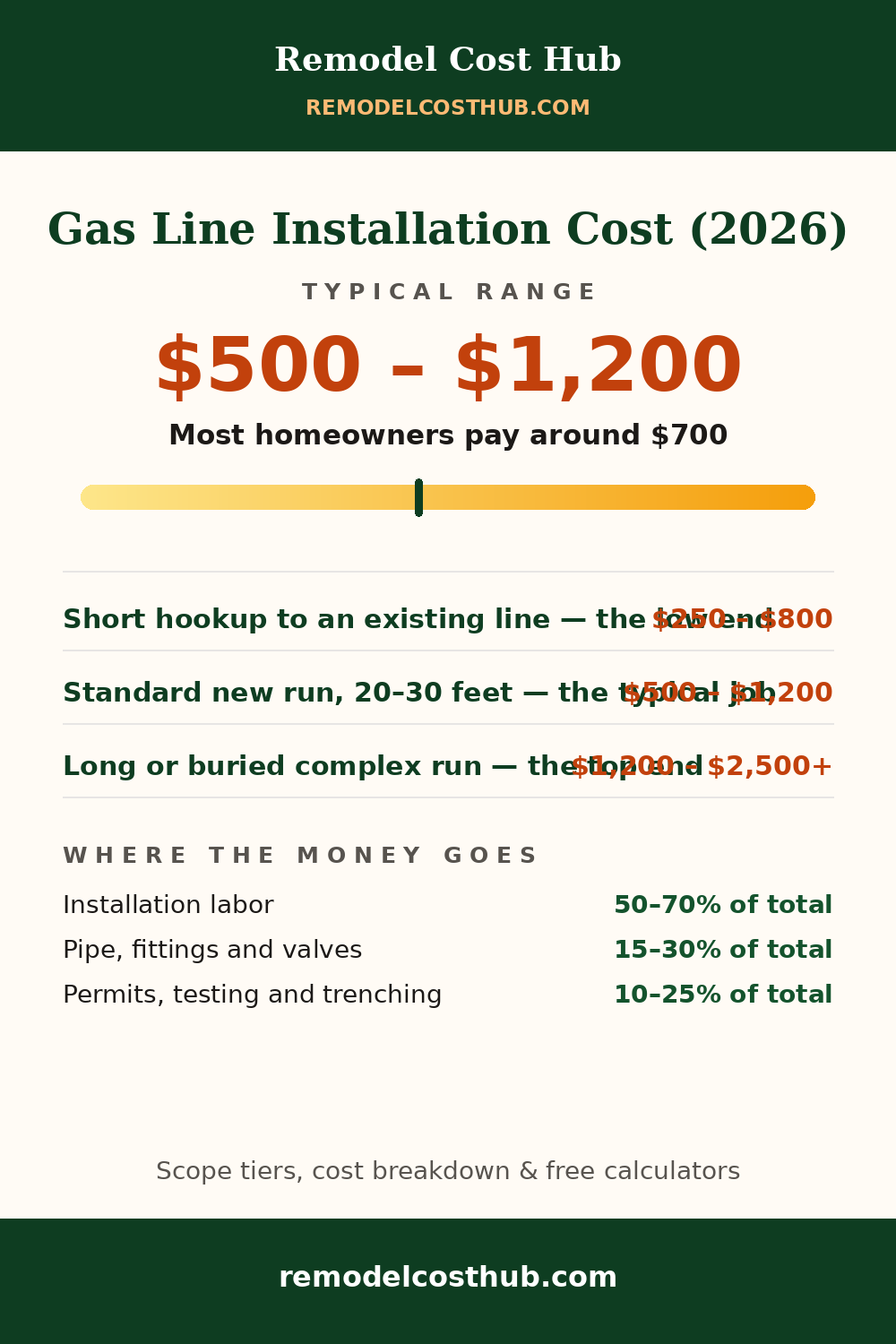
- Typical range: $500 – $1,200
- Most homeowners pay: around $700
- Prices vary most by: Installation labor (50–70% of the budget)
Cross-checked against two published sources for this project. Sources used for this page: Angi's 2026 gas line data (national average $540, normal range $260–$820; $15–$25 per linear foot; materials $1–$10 per linear foot; plumbers $45–$200 per hour), HomeGuide's gas line installation cost guide ($15–$50+ per linear foot including materials and labor; simple $15–$25, complex $35–$50+; 30-foot simple run $450–$750, complex $1,100–$1,500+; 50-foot complex $1,800–$2,500+; black iron material $5–$10 per foot; trenching $5–$15 per linear foot; directional boring $10–$30) and EngineerFix's gas line installation guide (simple appliance connection $350–$800 for a 10–30-foot run; new line from the meter $500–$2,000; outdoor grill or fire-pit line $600–$1,300; simple $15–$25 per linear foot, buried $25–$30; gas-fitter labor $45–$200 per hour), with CostOwl's gas line guide (permits $100–$500+) and CleverPatio's gas line guide (pressure test $75–$100) as corroboration for the compliance lines. Sources last checked: October 2026 — HomeGuide, Angi. How we calculate these costs
Cost by scope
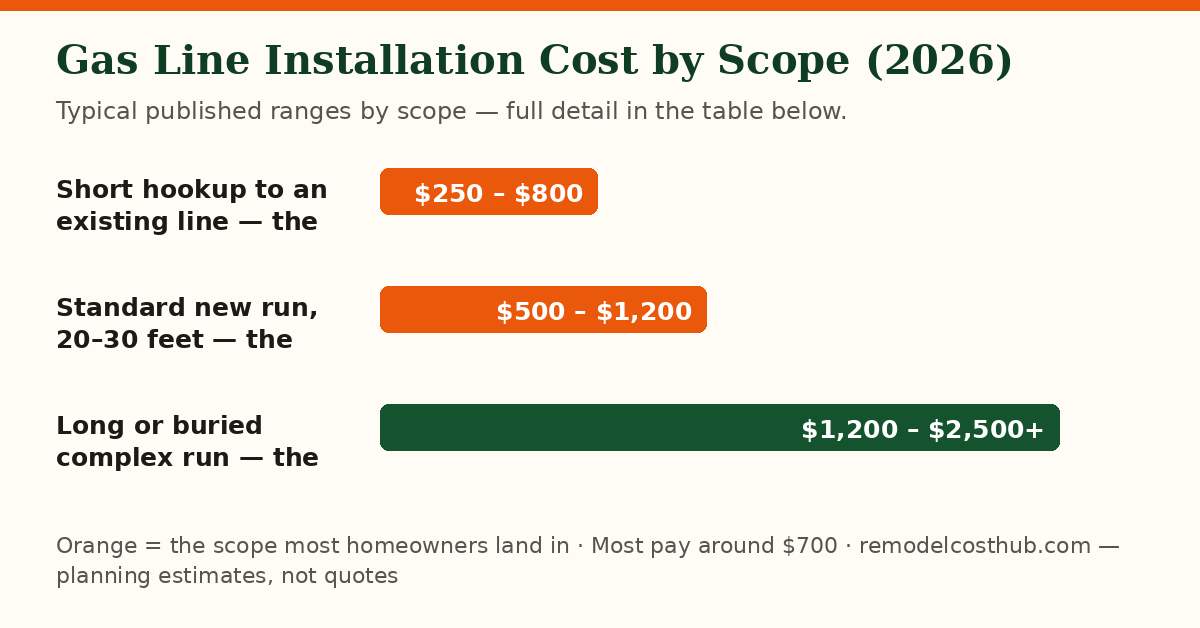
| Scope | Typical cost | What it includes |
|---|---|---|
| Short hookup to an existing line — the low end | $250 – $800 | The cheap end: Angi’s most-jobs band starts at $260 and EngineerFix prices a simple appliance connection at $350–$800 for a 10–30-foot run — pipe, fittings and a shut-off valve, with no trenching |
| Standard new run, 20–30 feet — the typical job | $500 – $1,200 | The shared band itself: HomeGuide’s simple 30-foot run at $450–$750, Angi’s $15–$25 per linear foot over 20–30 feet, and EngineerFix’s $500–$2,000 meter-run band — sized, permitted and pressure-tested |
| Long or buried complex run — the top end | $1,200 – $2,500+ | The expensive end: HomeGuide prices a complex 50-foot run at $1,800–$2,500+, trenching at $5–$15 per linear foot and directional boring at $10–$30 — distance, obstacles and excavation are what push a run here |
Where the money goes
| Part of the job | Share | Note |
|---|---|---|
| Installation labor | 50–70% of total | The dominant line: Angi prices plumbers at $45–$200 an hour and EngineerFix puts gas-fitter labor at $45–$200 an hour, with master fitters at the top — sizing, routing, joining and testing are all licensed work |
| Pipe, fittings and valves | 15–30% of total | The material: Angi prices materials at $1–$10 per linear foot and HomeGuide prices black iron at $5–$10 per foot for the material alone — CSST, black iron and polyethylene sit on different rungs of that ladder |
| Permits, testing and trenching | 10–25% of total | The compliance lines: permits commonly add $100–$500, a pressure test runs $75–$100, and trenching adds $5–$15 per linear foot in HomeGuide — every new line is pressure-tested before gas is turned on |
What moves the price most
Length is the first driver: Angi and HomeGuide both price a simple run at $15–$25 per linear foot, while HomeGuide prices complex runs at $35–$50+ — every extra foot is pipe, labor and fittings. Route and access are second: an interior run along open joists is the cheapest path, while a buried run pays trenching at $5–$15 per linear foot or directional boring at $10–$30 in HomeGuide, and crossing driveways or landscaping adds more. Material and size are third: Angi prices materials at $1–$10 per linear foot, HomeGuide prices black iron at $5–$10, and longer runs and bigger appliance loads need larger-diameter pipe, which costs more per foot. Appliance count is fourth: each added appliance is another branch, valve and test, and EngineerFix prices a single appliance connection at $350–$800 against $500–$2,000 for a new line from the meter. Finally, permits and inspection close the bill: gas work is licensed work everywhere, the line is pressure-tested before it is put into service, and the permit fee depends on the city, not the pipe.
Costs in your city
Labor is the biggest variable in any remodel, and labor is local — the same bathroom can price very differently in Houston than in Boston. We are adding city editions metro by metro, each with its own labor index, permit notes and climate factors, written for that city rather than copied from this page. Wave 1: Houston, Dallas–Fort Worth, Phoenix, Atlanta, Miami–South Florida, Orlando, Tampa, Charlotte, Austin and San Antonio. Until your city's page is live, use the national range here and weight it the way contractors do: Sun Belt labor often prices near or below the national middle, while coastal California and the Northeast metros often price well above it.
Frequently asked questions
How much does it cost to install a gas line?
About $500–$1,200 for a standard new run of 20–30 feet to one appliance, with about $700 the common middle. Angi averages $540 across all gas line jobs, most at $260–$820 — smaller hookups pull that average down.
How much does a gas line cost per linear foot?
About $15–$25 per linear foot for a simple run in both Angi and HomeGuide, rising to $35–$50+ per foot for complex runs in HomeGuide — underground work, obstacles and difficult access are what push the rate up.
Can I install a gas line myself?
No. Gas line work is licensed work: the line must be sized, joined, permitted and pressure-tested by a licensed plumber or gas fitter, and Angi prices that labor at $45–$200 an hour. A leak is a fire and explosion risk, not a DIY saving.
What makes a gas line job expensive?
Length first, then route: a long or buried run pays trenching or boring on top of the pipe, and HomeGuide prices a complex 50-foot run at $1,800–$2,500+ against $450–$750 for a simple 30-foot run. Material, diameter and the number of appliances stack on top.
Do I need a permit for a gas line?
Yes, in almost every jurisdiction: permits commonly add $100–$500, the work is inspected, and the line gets a pressure test — typically $75–$100 — before gas is turned on. The fee depends on the city, so confirm it with the local building department before work starts.