Carbon Monoxide Detector Installation cost at a glance
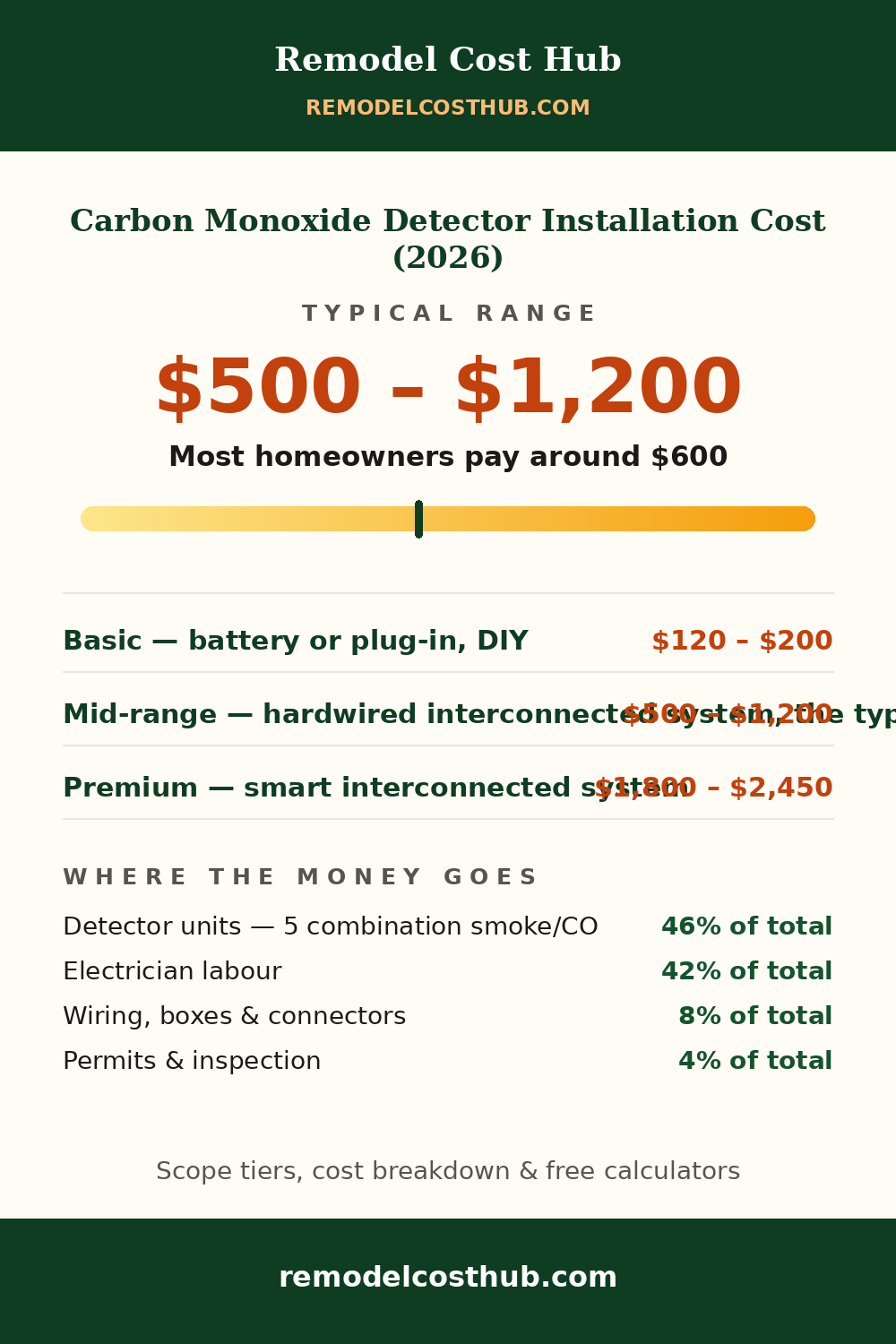
- Typical range: $500 – $1,200
- Most homeowners pay: around $600
Cross-checked against two published sources for this project. Sources used for this page: Angi, Carbon Monoxide Detector Installation Cost (updated Aug 30, 2026 — typical $500-$1,200 for 5-7 hardwired units, $120 per unit installed, 10+ units $1,200-$3,000+, electrician $50-$100/hr); HomeGuide, Smoke Detector Installation Cost (published Jun 27, 2024 — per-unit device and installed bands, combo $40-$100+, hardwired $65-$125 device, electrician $50-$130/hr); CostToRenovate, Smoke & Carbon Monoxide Detector Cost (2026 — tiers $120 / $600-$2,800, most-pay worked example $1,125 for 6-8 units, battery vs hardwired difference $500-$2,000, regional variation, new circuit $150-$300, permits $25-$150, inspection $50-$100); EngineerFix, Carbon Monoxide Detector Cost (CO-specific — battery units $20-$50, hardwired $65-$125); Jon Wayne (San Antonio, local — $400-$800 whole-home band used as a local figure only, not the national typical). No major publisher has a CO-only national cost guide — figures come from smoke/CO-combined guides except EngineerFix (CO-specific) and Jon Wayne (local). Worked example and shares are derived from Angi's $120-per-unit figure, not published percentages. Checked November 2026.. Sources last checked: October 2026 — HomeGuide, Angi. How we calculate these costs
Cost by scope
| Scope | Typical cost | What it includes |
|---|---|---|
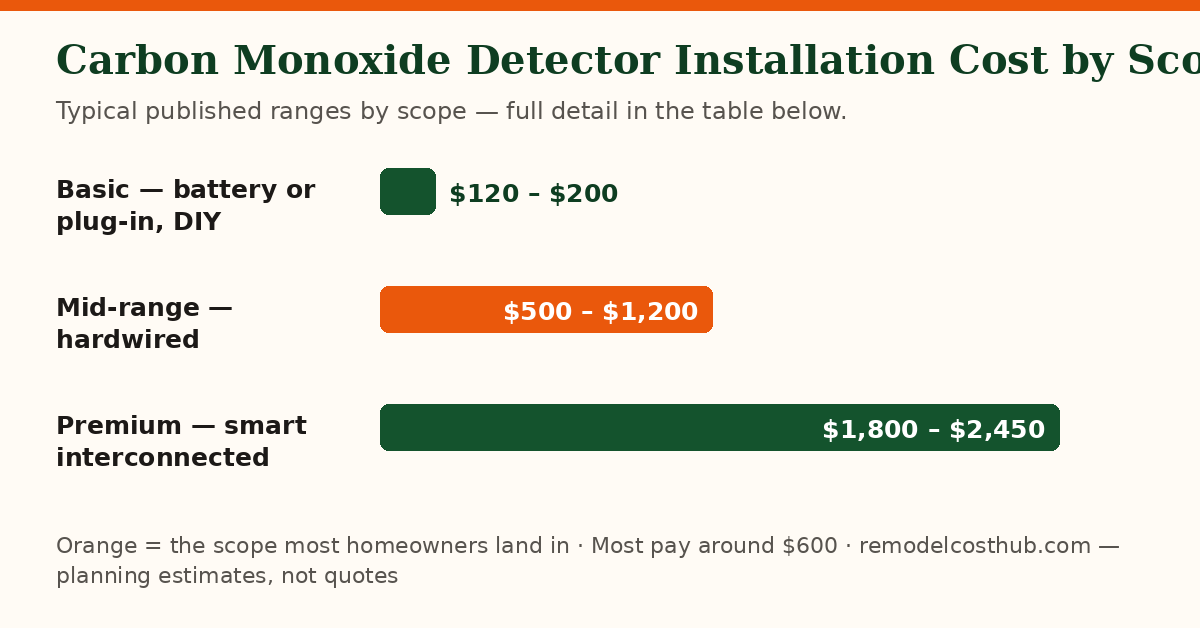
| Basic — battery or plug-in, DIY | $120 – $200 | Three to four battery or plug-in CO units fitted by the homeowner, no electrician. CostToRenovate prices this tier at $120 for 3–4 battery units; devices run $20–$50 each. No interconnection — each unit alarms on its own. |
| Mid-range — hardwired interconnected system, the typical job | $500 – $1,200 | Five to eight hardwired combination smoke/CO units installed by an electrician on existing circuits, so all alarms sound together. Angi prices 5–7 units at $500–$1,200; CostToRenovate's mid-range worked example is $1,125 for 6–8 units. |
| Premium — smart interconnected system | $1,800 – $2,450 | Eight to fourteen smart combo units (Nest Protect-type) with phone alerts and voice alarms, plus a new dedicated circuit and security-system integration. CostToRenovate prices this tier at $2,450; Angi prices 10+ units at $1,200–$3,000+. |
Where the money goes
| Part of the job | Share | Note |
|---|---|---|
| Detector units — 5 combination smoke/CO | 46% of total | Five hardwired combo units at $55 each — $275. HomeGuide prices combo devices at $40–$100+ and Angi at $30–$80; $55 sits inside both bands. Share derived from the worked example below, not a published percentage. |
| Electrician labour | 42% of total | About 3 hours at $85 an hour — $255. HomeGuide prices electricians at $50–$130 an hour and Angi at $50–$100; labour is the dominant share of a hardwired job. Share derived from the worked example below. |
| Wiring, boxes & connectors | 8% of total | $45 of cable, boxes and connectors for the five locations on existing circuits. A new dedicated circuit is a separate $150–$300 in CostToRenovate's figures and is not in this example. Share derived from the worked example below. |
| Permits & inspection | 4% of total | $25 where a permit is required — permits run $25–$150 plus a $50–$100 inspection in CostToRenovate's figures, and many replacements need no permit at all. Share derived from the worked example below. |
What moves the price most
Detector type and power source set the tier: battery CO-only units $20–$50 each (EngineerFix), hardwired CO units $65–$125, combo smoke/CO units $40–$100+ (HomeGuide) and smart units $50–$150+ — installed per unit, battery $44–$100, hardwired $100–$220 on existing wiring or $150–$300 with new wiring, combo $140–$360+ and smart $150–$410+. Number of units: more units raise the total but lower the per-unit cost on a single visit — a 3-bedroom, two-storey home needs at least 7–8 detectors to meet NFPA 72 (one on every level, outside each sleeping area, within 10 ft of bedroom doors). Existing versus new wiring is the biggest swing: replacing units on existing wiring costs $100–$220 per unit, while new wiring runs $150–$300 per unit, and a new dedicated circuit adds $150–$300 — CostToRenovate puts the battery-versus-hardwired difference at $500–$2,000 for a whole home. Permits: $25–$150 plus a $50–$100 inspection where required; many like-for-like replacements need none. Accessibility: high or vaulted ceilings, attics and plaster walls add labour time. Region: Northeast +15–25%, West Coast +20–35%, Southeast −15 to −8%, Midwest −18 to −8% against the national average (CostToRenovate). Smart features: phone alerts and voice alarms add device cost and sometimes a $5–$10-a-month subscription. Where the sources disagree: the whole-home range spans $400–$2,800 depending on scope — Jon Wayne's $400–$800 is a local San Antonio band for a standard 3-bedroom home, not the national typical, while CostToRenovate's $600–$2,800 national range (average $1,400) covers larger 6–8-unit interconnected systems; and per-unit installed spans $70–$410+ because Angi's $70–$150 is smoke-detector-typical while HomeGuide's CO-specific $120–$360 includes 1–2 hours of labour with a $100 minimum. No major publisher has a CO-only national cost guide — the figures here come from smoke/CO-combined guides, except EngineerFix (CO-specific) and Jon Wayne (local). Worked example at the most-pay figure: 5 combination smoke/CO units at $55 each $275 + electrician labour, about 3 hours at $85 an hour, $255 + wiring, boxes and connectors $45 + permits and inspection $25 = $600. For the smoke side see our smoke detector installation guide, for the panel that feeds them see our electrical panel upgrade guide, for rewiring see our whole-house rewiring guide, for the wider safety setup see our security system installation guide, and for the smart-home side see our smart home installation guide.
Costs in your city
Labor is the biggest variable in any remodel, and labor is local — the same bathroom can price very differently in Houston than in Boston. We are adding city editions metro by metro, each with its own labor index, permit notes and climate factors, written for that city rather than copied from this page. Wave 1: Houston, Dallas–Fort Worth, Phoenix, Atlanta, Miami–South Florida, Orlando, Tampa, Charlotte, Austin and San Antonio. Until your city's page is live, use the national range here and weight it the way contractors do: Sun Belt labor often prices near or below the national middle, while coastal California and the Northeast metros often price well above it.
Frequently asked questions
How many carbon monoxide detectors do I need?
One on every level, outside each sleeping area and within 10 ft of bedroom doors. A 3-bedroom, two-storey home needs at least 7–8 detectors in total to meet NFPA 72. (Jon Wayne; CostToRenovate; HomeGuide)
Where should carbon monoxide detectors go?
Near sleeping areas, not directly above fuel-burning appliances. Smoke units go on ceilings or high on walls, at least 10 ft from cooking appliances and away from windows, doors and vents. (Jon Wayne; HomeGuide)
Battery or hardwired carbon monoxide detectors?
Battery and plug-in units are cheapest and DIY-friendly; hardwired units connect to the mains with battery backup and interconnect so all alarms sound together — required by code in many newer homes — and need a licensed electrician. (HomeGuide; Angi; Jon Wayne)
Do I need an electrician to install a carbon monoxide detector?
Yes for hardwired units, new wiring or new circuits. A homeowner can install battery units and swap like-for-like hardwired units at an existing box (same brand, so interconnection still works); new locations and boxes are electrician work. (HomeGuide; CostToRenovate)
How long do carbon monoxide detectors last?
Smoke detectors last 8–10 years and CO sensors 5–7 years. Test monthly, replace batteries at least yearly (sealed 10-year lithium excepted), and replace the whole unit at the end of its life. (CostToRenovate; HomeGuide; Jon Wayne)
Do smoke detectors detect carbon monoxide?
No — a standard smoke detector does not detect CO. You need a separate CO detector or a combination smoke/CO unit. (HomeGuide)