Furnace Replacement cost at a glance
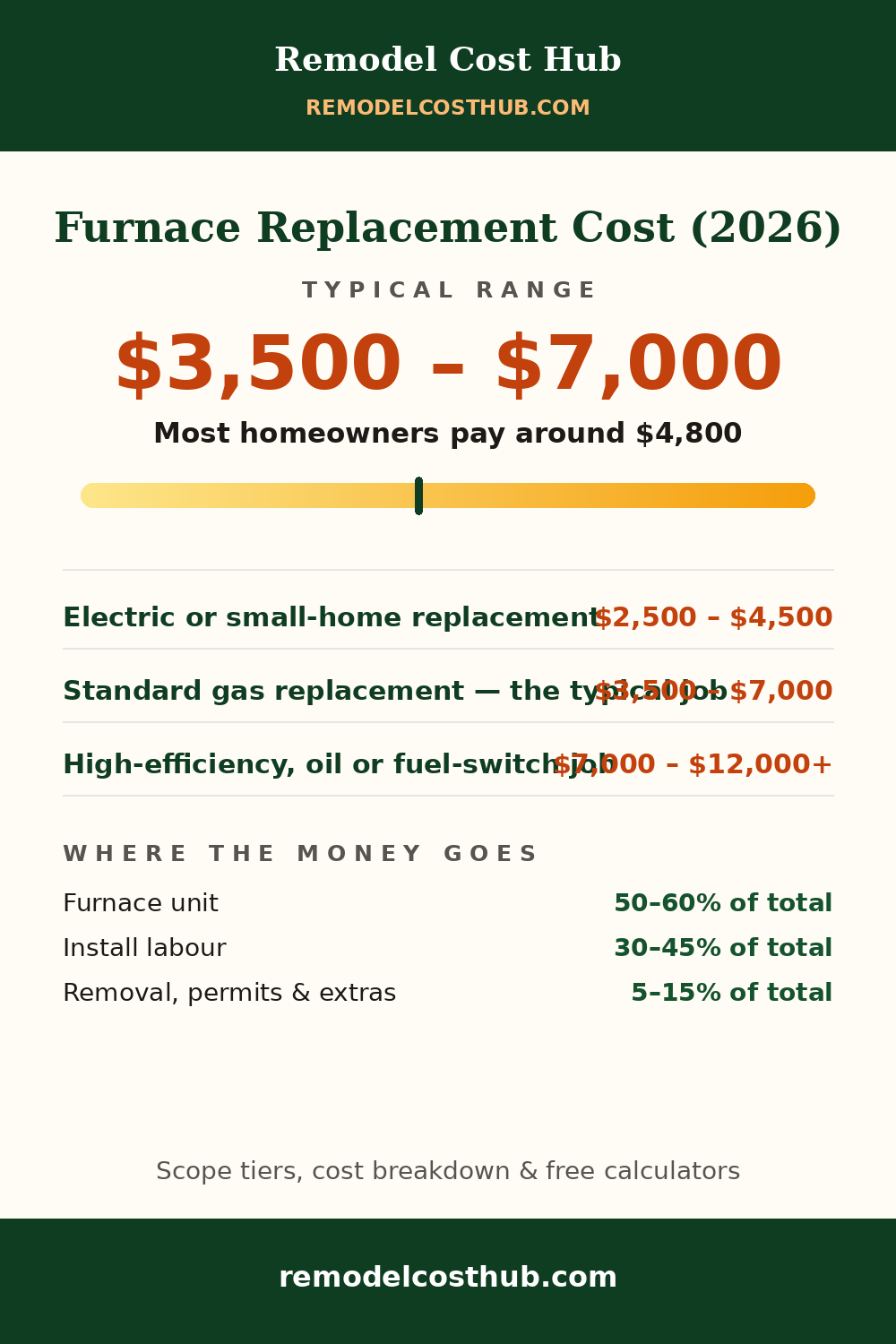
- Typical range: $3,500 – $7,000
- Most homeowners pay: around $4,800
- Prices vary most by: Furnace unit (50–60% of the budget)
Cross-checked against three published sources for this project. Sources used for this page: the Angi furnace replacement cost guide (2026, 11,869 verified projects), HomeGuide's furnace replacement cost guide and Fixr's furnace replacement cost data. Sources last checked: October 2026 — HomeGuide, Fixr, Angi. How we calculate these costs
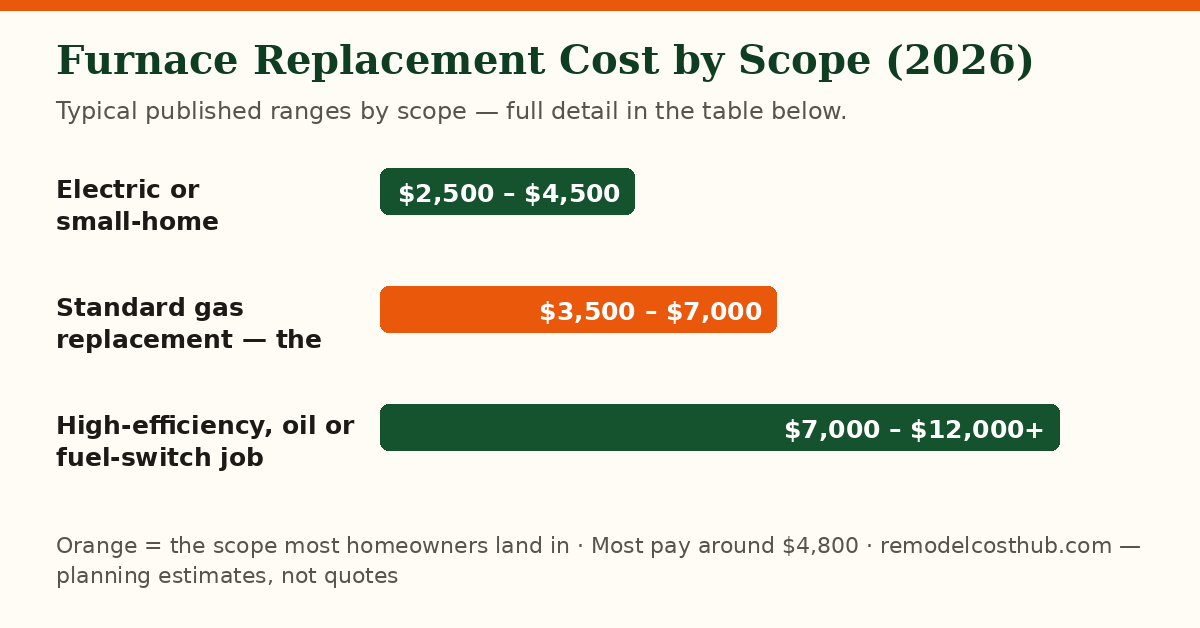
Cost by scope
| Scope | Typical cost | What it includes |
|---|---|---|
| Electric or small-home replacement | $2,500 – $4,500 | Electric furnaces run $1,800–$7,300 installed in Fixr and $2,000–$7,000 in Angi — the cheapest way in — and the guides' home-size tables price a 1,500–2,000 sq ft home at $1,800–$4,000. Smaller homes with existing wiring and no gas line are the bottom of the market. |
| Standard gas replacement — the typical job | $3,500 – $7,000 | The guides' published averages sit at $4,800–$4,814, inside Angi's $2,823–$6,896 most-pay band, Fixr's $2,800–$7,500 and HomeGuide's $3,500–$7,500+ standard-efficiency band. A same-fuel swap onto existing ductwork, with removal and the permit in the quote. |
| High-efficiency, oil or fuel-switch job | $7,000 – $12,000+ | HomeGuide prices high-efficiency units up to $11,500 installed; oil furnaces run $6,750–$10,000 in Angi and Fixr, propane to $14,200; switching fuels adds $500–$2,000+ in HomeGuide. New ductwork at $1,400–$6,000 is the classic scope that moves a quote into this tier. |
Where the money goes
| Part of the job | Share | Note |
|---|---|---|
| Furnace unit | 50–60% of total | HomeGuide prices the equipment at $2,000–$4,000+ against an install that runs $1,500–$3,500+ in labour — the box itself is the biggest single line, and efficiency and brand move it more than any other line |
| Install labour | 30–45% of total | A day's work at $75–$150 an hour in HomeGuide and Fixr (Angi $75–$100), four to ten hours on the job in Fixr — setting, venting, gas and electrical connections, start-up and commissioning |
| Removal, permits & extras | 5–15% of total | Old-furnace removal at $50–$330 across the guides, permits at $50–$300 in HomeGuide (up to $1,500 in Angi — a genuinely wide spread), and add-ons like a smart thermostat at $200–$500 |
What moves the price most
Fuel type is the first fork. Gas furnaces are the most popular (58% of Angi customers) and the middle of the price ladder; electric is the cheapest way in; oil and propane sit higher, with propane's $14,200 top in Angi and Fixr the tallest number on any tier. Efficiency is the second lever: 80–89% AFUE is the low-efficiency band and 96%+ the high-efficiency one in Angi, and HomeGuide prices high-efficiency units up to $11,500 — with the federal credit (97%+ AFUE, up to $600 through 2032) softening the premium for gas. Sizing is set in BTUs, 30–60 per square foot in both Angi and HomeGuide, and an average home needs 80,000–100,000 — but the band is not the answer, and Angi warns that a furnace that is too large or too small wastes energy and wears out faster. Ductwork is the classic hidden line: $2,000–$5,000 for new ducts in Angi, $1,400–$6,000 in Fixr, and a job that needs it is a different price than one that does not.
Worked example: how a typical furnace replacement budget breaks down
Take the typical job — a like-for-like gas furnace replacement in a 2,000 sq ft home: the old unit pulled and hauled away, a new 90,000–100,000 BTU gas furnace set, vented and connected to the existing ductwork, permitted and commissioned. Here is a realistic $4,800 version of that invoice, at the $4,800–$4,814 average the guides publish: The budget below totals $4,800 — the "most homeowners pay around" figure from the top of this page — split using this page's own cost breakdown. It shows how a real quote at that level is usually composed; every line is built from the ranges on this page, and it is an illustration, not a quote for your project.
| Line item | Example budget |
|---|---|
| Furnace unit — 90,000–100,000 BTU gas | $2,700 |
| Install labour — set, vent, connect & commission | $1,700 |
| Removal, permit & smart thermostat | $400 |
| Total | $4,800 |
What most people get wrong
- Sizing by the square-foot rule of thumb alone. 30–60 BTUs per square foot is a band, not an answer — Angi warns that a furnace too large or too small wastes energy and wears out faster. A load calculation costs far less than the wrong furnace.
- Forgetting the ductwork question. New ducts run $2,000–$5,000 in Angi and $1,400–$6,000 in Fixr — leaky or undersized ducts undo the efficiency gains of the new furnace, and addressing them during the install avoids a second disruption.
- Chasing efficiency without checking the payback. High-efficiency units price up to $11,500 in HomeGuide; the $600 federal credit trims the premium but does not erase it. Run the AFUE premium against your actual heating bills before upgrading.
- Assuming the permit is nobody's job. Permits run $50–$300 in HomeGuide and $400–$1,500 in Angi — a genuinely wide spread. Confirm who pulls the permit before work starts, not when the inspector asks.
Costs in your city
Furnace prices follow crew rates and fuel mix together. Angi prices labour at $75–$100 an hour nationally, so high-cost metros land toward the top of the $3,500–$7,000 band while the same swap prices lower where rates sit low. Gas-heavy regions see the most competitive gas-furnace pricing; oil and propane country pays its own ladder. Permits are the most local line on the invoice — $50 to $1,500 across the guides — so ask each contractor for the permit number in writing and city quotes become comparable line by line.
How we got these numbers
Cross-checked against the Angi furnace replacement cost guide — opened and read in full this run, September 2026 data (national average $4,814 across 11,869 verified projects; most homeowners pay $2,823–$6,896; fuel table electric $2,000–$7,000 / gas $3,800–$10,000 / oil $6,750–$10,000 / propane $3,700–$14,200; home-size table $1,200–$2,000 at 1,000 sq ft to $6,000–$10,000 at 5,000 sq ft; labour $75–$100 an hour; permits $400–$1,500; removal $60–$330; new ductwork $2,000–$5,000; 97%+ AFUE credit up to $600 through 2032), HomeGuide's furnace replacement cost guide — read in full this run (standard-efficiency $3,500–$7,500+ installed, high-efficiency to $11,500; equipment $2,000–$4,000+, labour $1,500–$3,500+; fuel switch adds $500–$2,000+; permits $50–$300; removal $50–$200+) and Fixr's furnace replacement cost data — read in full this run (average $4,800, band $2,800–$7,500; labour 10–40% of project, 4–10 hours at $75–$150 an hour; ductwork $1,400–$6,000; permits $50–$1,500). The typical band $3,500–$7,000 is the overlap of the three published ranges; the $4,800 most-pay figure is the average Angi and Fixr publish. Angi and Fixr publish the identical home-size cost table — treated as one dataset for that table, with HomeGuide's fuel bands as the independent check. The permit spread is genuinely wide ($50–$1,500 across the three), so this page publishes the full spread. Breakdown shares are derived from HomeGuide's equipment/labour dollar splits and Fixr's 10–40% labour share, and are labelled as derived on the page.
Frequently asked questions
How much does a new furnace cost installed?
Angi prices the national average at $4,814 across 11,869 verified projects (September 2026), with most homeowners paying $2,823–$6,896; Fixr prices the average at $4,800 and the band at $2,800–$7,500; HomeGuide prices a standard-efficiency install at $3,500–$7,500+. Around $4,800 is the middle of the market for a standard same-fuel replacement.
Is a gas or electric furnace cheaper to install?
Electric is cheaper to install — $1,800–$7,300 in Fixr, $2,000–$7,000 in Angi. Gas runs $3,800–$10,000 in both, oil $6,750–$10,000, propane $3,700–$14,200. Electric's edge is upfront only: gas remains the most popular choice in Angi's customer data, and the cheapest install is not always the cheapest to run.
What size furnace does my home need?
The guides size in BTUs: 30–60 per square foot of living space, with an average home needing 80,000–100,000 BTUs. Fixr adds climate-zone tables — Zone 1 homes need fewer BTUs per square foot than Zone 7. Angi warns that oversizing is as costly as undersizing: a too-large furnace short-cycles, wears faster and leaves rooms unevenly heated. A real load calculation beats a square-foot rule of thumb every time.
Is the furnace tax credit still available?
Yes — for now, through 2032. All three guides agree: gas furnaces at 97%+ AFUE (and some oil units) qualify for a credit worth up to 60% of the project cost, capped at $600, for systems purchased and installed from January 1, 2023 through December 31, 2032. That is real money off a high-efficiency unit, but the $600 cap means it trims the premium rather than erasing it.
Should I replace my ductwork with the furnace?
Only if the ducts need it — but the guides price it as a separate decision. Angi prices new ductwork at $2,000–$5,000; Fixr at $1,400–$6,000 for full replacement, $5–$45 a linear foot for repairs. Your technician should assess the existing ducts during the install quote: leaky or undersized ducts undo the efficiency gains of a new furnace, and addressing them at the same time avoids a second disruption.