Tiny House Construction cost at a glance
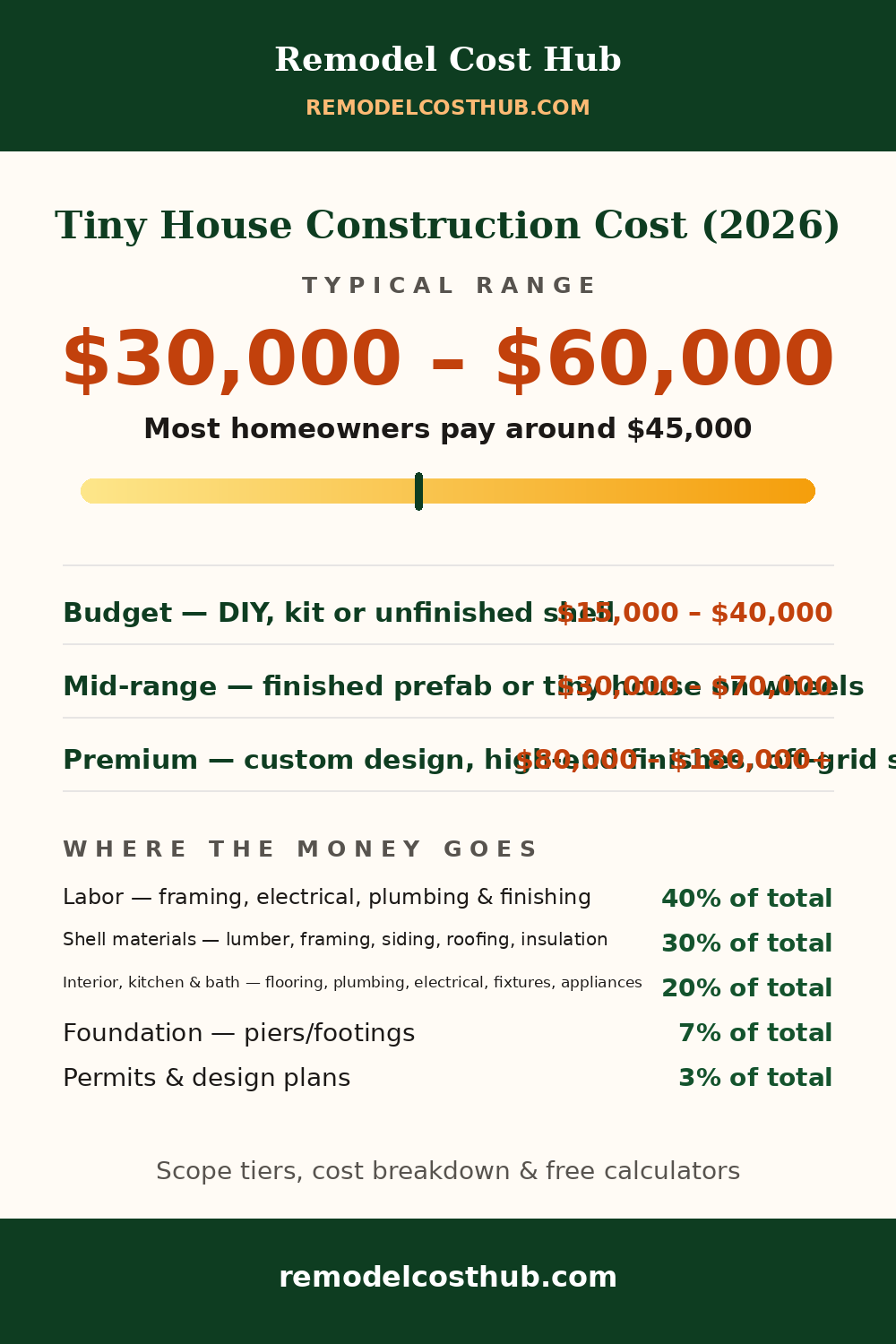
- Typical range: $30,000 – $60,000
- Most homeowners pay: around $45,000
Cross-checked against three published sources for this project. Sources used for this page: HomeGuide, How Much Does a Tiny House Cost? (2026) (published Apr 11, 2023, updated Jan 27, 2026 — $30,000-$70,000 on average incl. materials and labor for 100-300 sq ft; average size 225 sq ft incl. loft, max 400 sq ft per IRC; prefab $150-$250/sq ft, custom $250-$450/sq ft; prefab kit $4,000-$30,000, shell $15,000-$40,000, fully finished prefab $25,000-$80,000; on wheels finished $30,000-$70,000+, trailer $4,500-$11,000; on foundation finished $33,000-$78,000+ excl. land, foundation $3,000-$8,000; container $1,500-$8,000, finished one-container $20,000-$50,000+; skoolie bus $4,000-$10,000+, finished $30,000-$50,000; labor 40-60% of total; lumber/framing $1,000-$14,000, doors/windows $1,000-$6,000, roofing $500-$2,000, insulation $500-$3,000, siding $1,000-$3,000, electrical $750-$3,500, flooring $2,000-$7,500, plumbing $1,000-$7,000, fixtures $600-$4,300, appliances $400-$3,000; solar $3,500-$8,800 (2-4 kW, after 30% federal tax credit), septic $3,500-$8,500, composting toilet $100-$1,500, rainwater $200-$2,500; land $5,000-$18,000/acre (up to $150,000+), utility hookup $4,000-$12,000, lot rent $250-$1,500/month; permits $1,000-$1,400 table / $1,000-$2,000 text; design plans $100-$750; pro build 2-4 months, DIY 500-1,000 hrs / 6-12 months; wood stove $3,000-$8,000 installed, mini-split $2,500-$6,000, window AC $150-$800); Angi, How Much a Tiny House Costs (published Jan 22, 2024, updated Oct 27, 2026 — 2026 national average $45,000, most $30,000-$60,000, range $2,000-$180,000; ~$150/sq ft, up to $300-$400; prefab $4,000-$180,000+, shell $15,000-$40,000; foundation $51,000-$53,000 average up to $180,000+, foundation add $5,000-$8,000 / $4-$7/sq ft, survey $500-$750; on wheels $60,000-$80,000; container $20,000-$45,000; shed conversion $2,000-$25,000; materials 30-50% of total, $14,100-$54,800; DIY materials $14,100-$54,800, saves 30-60%, pro ~120 hrs vs DIY 480+ hrs; permits $400-$2,300); Quicken Loans (Rocket Mortgage), Tiny House Prices: What To Expect (published Mar 25, 2022, updated Sep 2, 2026 — $30,000-$60,000 in 2025 per HomeAdvisor; ~$150/sq ft; prefab under $20,000 at the budget end, fully outfitted prefab can exceed $150,000, luxury custom well over $150,000; lot rent $200-$1,200/month; permit average $1,647; financing routes — builder-partnered lenders, manufactured-home loan on foundation, RV loan if RVIA-certified, construction/personal/home-equity loan; most tiny homes not FHA-eligible). Disagreements flagged, not averaged away: on-wheels pricing HomeGuide $30,000-$70,000+ vs Angi $60,000-$80,000; permits $400-$2,300 (Angi) vs $1,000-$2,000 / $1,000-$1,400 (HomeGuide) vs $1,647 average (Quicken); per-sq-ft ceiling $450 (HomeGuide) vs $300-$400 (Angi); custom top end $140,000 (HomeGuide) vs $180,000+ (Angi). Quicken Loans leans on HomeAdvisor for its headline range and on HomeGuide for per-sq-ft figures — the genuinely independent anchors are HomeGuide vs Angi. HomeGuide's small-house comparison contradicts itself ($350,000-$800,000 text vs $60,000-$155,000 table) — neither figure is published. Worked example and shares are derived from the source ranges, not published percentages. Checked November 2026.. Sources last checked: October 2026 — HomeAdvisor, HomeGuide, Angi. How we calculate these costs
Cost by scope
| Scope | Typical cost | What it includes |
|---|---|---|
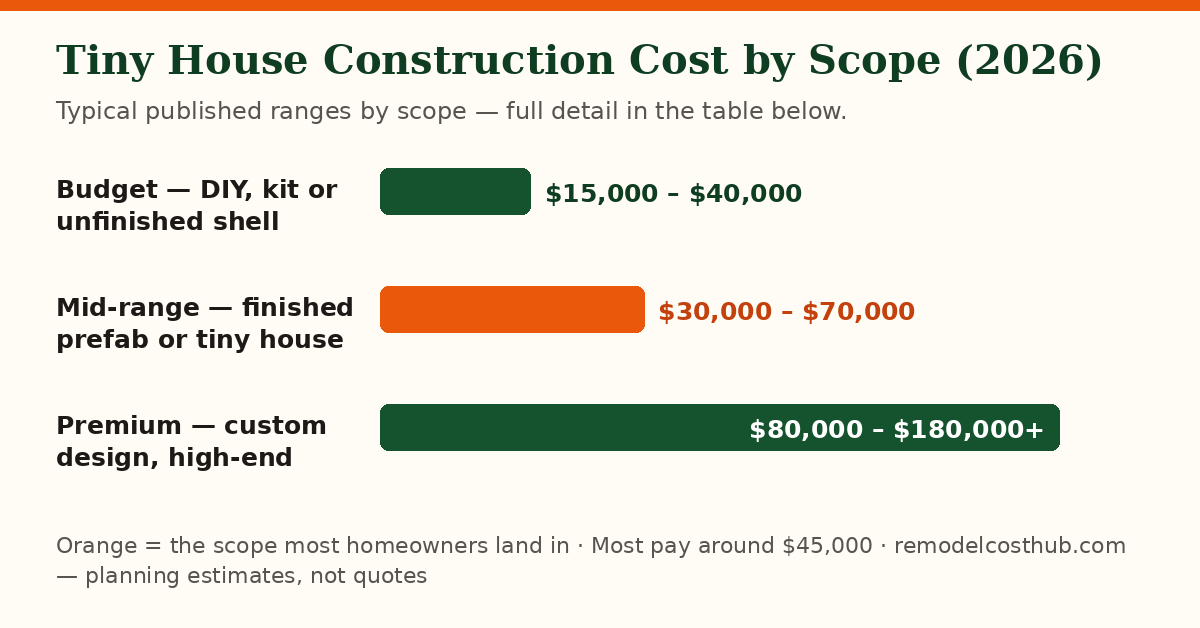
| Budget — DIY, kit or unfinished shell | $15,000 – $40,000 | A prefab kit ($4,000–$30,000, HomeGuide) or a finished-exterior shell ($15,000–$40,000 — HomeGuide and Angi agree exactly) that you finish yourself, or a shed-to-tiny-house conversion ($2,000–$25,000, Angi). DIY materials alone run $14,100–$54,800 (Angi), and doing the labor yourself saves 30–60% of the total — but a DIY build takes 480+ hours against about 120 for a pro. |
| Mid-range — finished prefab or tiny house on wheels | $30,000 – $70,000 | The typical project on this page: a fully finished prefab ($25,000–$80,000, HomeGuide) or a finished tiny house on wheels ($30,000–$70,000+, HomeGuide) with standard finishes and compact appliances. Angi's 2026 national average is $45,000; a finished home on a foundation runs $33,000–$78,000 excluding land (HomeGuide). |
| Premium — custom design, high-end finishes, off-grid systems | $80,000 – $180,000+ | A custom-built tiny house ($50,000–$140,000, HomeGuide; up to $180,000+ with high-end finishes, Angi), with premium finishes, a custom layout and off-grid systems — solar panels $3,500–$8,800 for a 2–4 kW system after the 30% federal tax credit, a septic system $3,500–$8,500 and a composting toilet $100–$1,500 (HomeGuide). |
Where the money goes
| Part of the job | Share | Note |
|---|---|---|
| Labor — framing, electrical, plumbing & finishing | 40% of total | $18,000 — the low end of HomeGuide's published 40–60% labor share of total construction cost. Share derived from the worked example below, not a published percentage. |
| Shell materials — lumber, framing, siding, roofing, insulation | 30% of total | $13,500 — inside the combined HomeGuide component bands (lumber/framing $1,000–$14,000, siding $1,000–$3,000, roofing $500–$2,000, insulation $500–$3,000). Share derived from the worked example below, not a published percentage. |
| Interior, kitchen & bath — flooring, plumbing, electrical, fixtures, appliances | 20% of total | $9,000 — inside the combined HomeGuide bands (flooring $2,000–$7,500, plumbing $1,000–$7,000, electrical wiring $750–$3,500, fixtures $600–$4,300, appliances $400–$3,000). Share derived from the worked example below, not a published percentage. |
| Foundation — piers/footings | 7% of total | $3,150 — inside HomeGuide's $3,000–$8,000 foundation band (a trailer for an on-wheels build runs $4,500–$11,000 instead). Share derived from the worked example below, not a published percentage. |
| Permits & design plans | 3% of total | $1,350 — inside the combined published bands (permits $400–$2,300, Angi; design plans $100–$750, HomeGuide; the national average permit cost is $1,647, Quicken Loans). Share derived from the worked example below, not a published percentage. |
What moves the price most
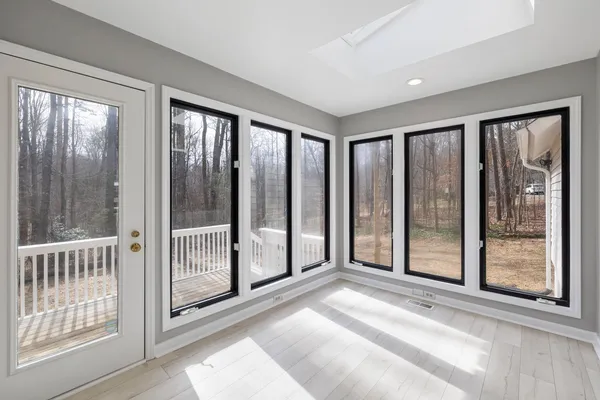
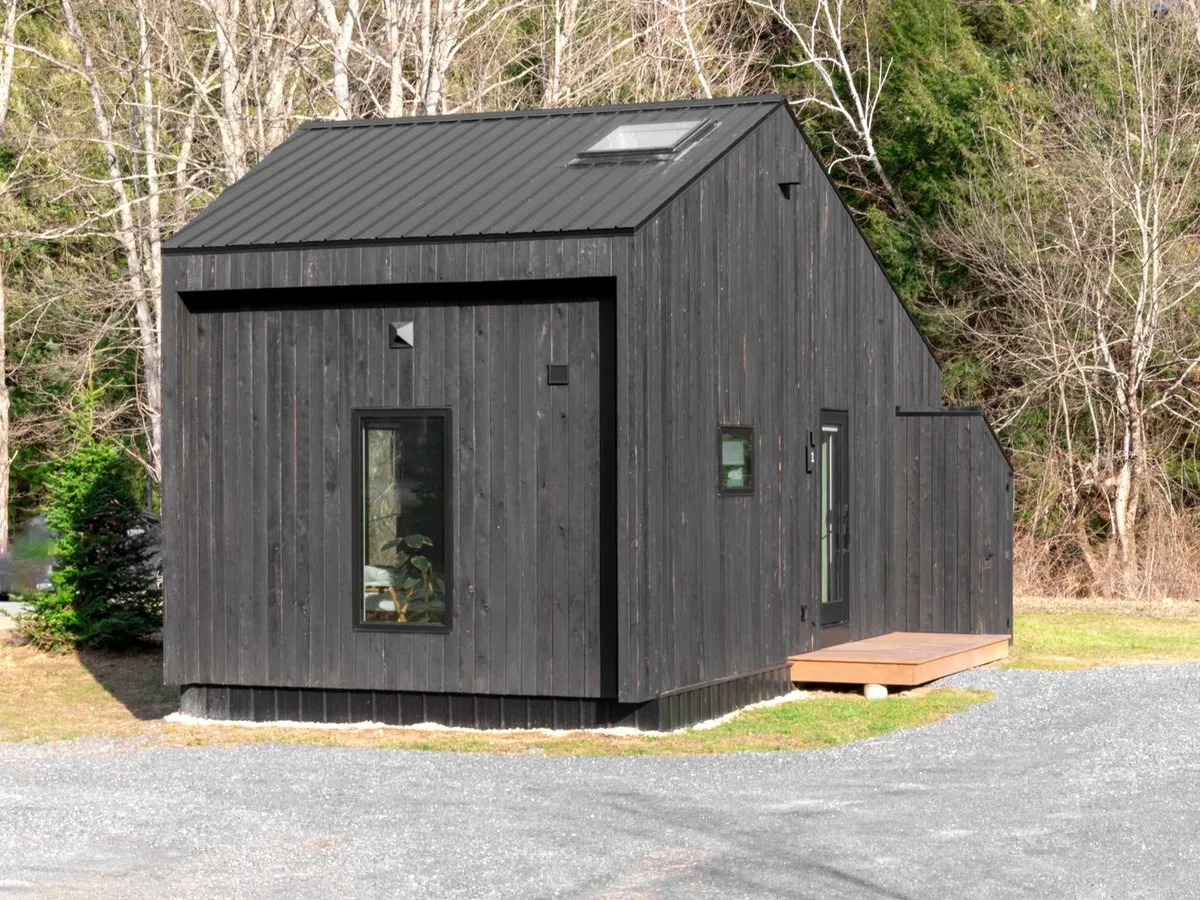
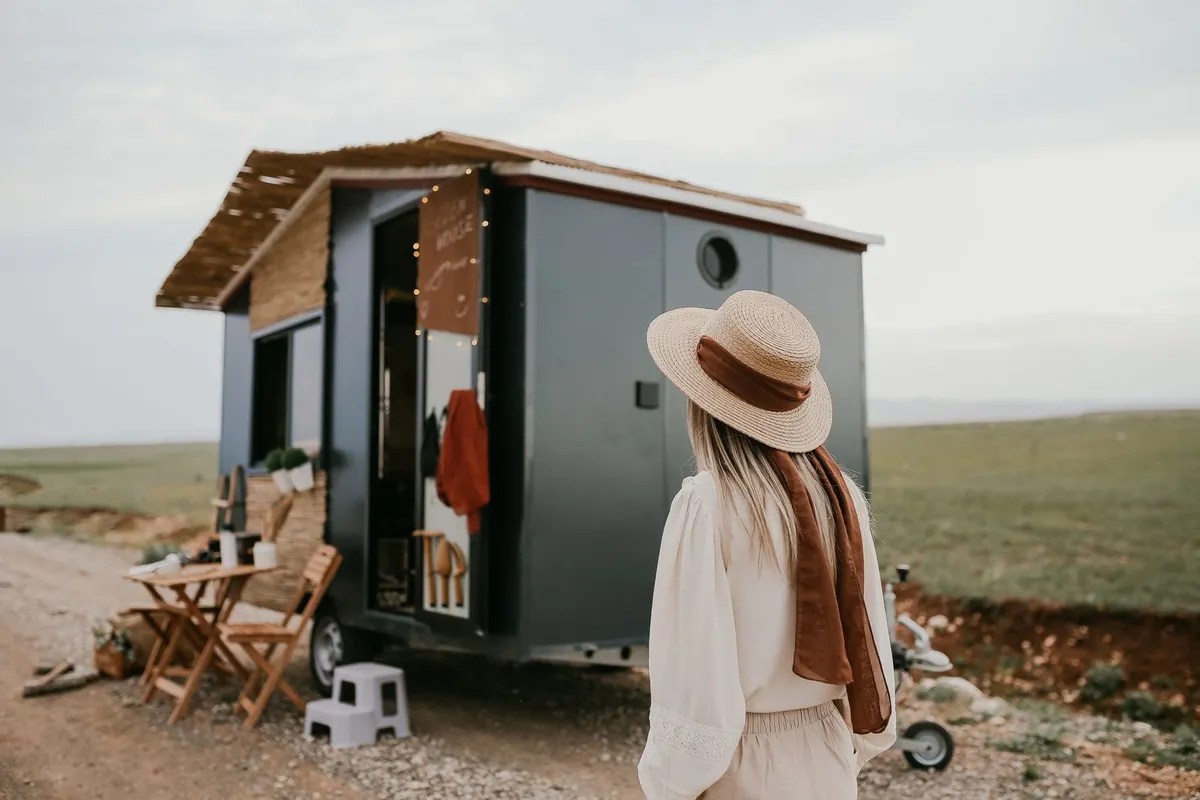
Size is the single biggest driver. A tiny house is a dwelling of 400 sq ft or less (HomeGuide, Quicken Loans, both citing the International Residential Code); the average US tiny house is 225 sq ft including loft space. Building averages around $150 per square foot — prefab $150–$250, custom $250–$450 (HomeGuide; Angi agrees on $150 and reaches $300–$400) — which is higher per square foot than a conventional home, because the kitchen, bath and systems are squeezed into so little space. On wheels vs on a foundation: a finished tiny house on wheels runs $30,000–$70,000+ (HomeGuide) but $60,000–$80,000 (Angi) — the two sources genuinely disagree, probably because Angi's figure reflects professionally built units. A finished home on a foundation runs $33,000–$78,000 excluding land (HomeGuide), averaging $51,000–$53,000 (Angi). Wheels skip the land cost but need a tow vehicle and parking at $200–$1,500 a month; a foundation adds $3,000–$8,000 plus land, survey and excavation. DIY vs professional: DIY materials alone run $14,100–$54,800 (Angi) and doing the work yourself saves 30–60%, but a pro finishes in about 120 hours and 2–4 months against 480+ hours and 6–12 months for a DIYer. Prefab vs custom: prefab kits start around $4,000 and finished prefabs run $25,000–$80,000, while a custom build runs $50,000–$140,000 (HomeGuide). Finishes and appliances: builder-grade vs luxury is the main swing inside any type, and compact appliances often cost a premium. Off-grid systems add thousands: solar $3,500–$8,800, septic $3,500–$8,500, rainwater collection $200–$2,500 (HomeGuide). Land and site work are excluded from every headline figure: land averages $5,000–$18,000 per acre (up to $150,000+), and utility hookups run $4,000–$12,000 (HomeGuide). Zoning and permits vary sharply — many cities do not allow a tiny home on wheels as a permanent residence, and some states treat it as an RV that cannot be a permanent dwelling; check zoning before committing. Permits run $400–$2,300 (Angi), averaging $1,647 (Quicken Loans). Where the sources disagree: on-wheels pricing (see above) and permit costs (HomeGuide $1,000–$2,000 in its text, $1,000–$1,400 in its own table, Angi $400–$2,300). Quicken Loans leans on HomeAdvisor for its headline range and on HomeGuide for per-square-foot figures, so the genuinely independent anchors on this page are HomeGuide vs Angi. Worked example at the most-pay figure: a finished 225 sq ft tiny house on a foundation — labor $18,000 + shell materials $13,500 + interior, kitchen & bath $9,000 + foundation $3,150 + permits & design plans $1,350 = $45,000. Materials total $22,500 (50%), inside Angi's $14,100–$54,800 materials band. Land, site work and utility hookups are not in this example. For a bigger build on the same land see our home addition guide, for turning a garage into a small dwelling see our garage conversion (ADU) guide, for a backyard shed shell see our shed installation guide, for a glass-walled extra room see our sunroom addition guide, and for the deck outside it see our deck building guide.
Costs in your city
Labor is the biggest variable in any remodel, and labor is local — the same bathroom can price very differently in Houston than in Boston. We are adding city editions metro by metro, each with its own labor index, permit notes and climate factors, written for that city rather than copied from this page. Wave 1: Houston, Dallas–Fort Worth, Phoenix, Atlanta, Miami–South Florida, Orlando, Tampa, Charlotte, Austin and San Antonio. Until your city's page is live, use the national range here and weight it the way contractors do: Sun Belt labor often prices near or below the national middle, while coastal California and the Northeast metros often price well above it.

Frequently asked questions
How much does a tiny house cost to build?
Most homeowners pay $30,000–$60,000, averaging $45,000 in 2026 (Angi). HomeGuide's range is $30,000–$70,000 including materials and labor; Quicken Loans, citing HomeAdvisor, gives $30,000–$60,000. Land, site work and utility hookups are extra in all three sources.
Is it cheaper to build or buy a tiny house?
Building can be cheaper if the design is kept simple, the labor is DIY and affordable materials are used (Quicken Loans) — DIY plans build for as little as $30,000 or so. Otherwise a move-in-ready prefab from a dealer may be the better deal (Angi), and a professionally built high-end tiny house exceeds $150,000 (Quicken Loans).
Can you finance a tiny house?
Yes, but most banks and mortgage lenders will not finance one — the dollar amount and square footage fall below their minimums (HomeGuide, Quicken Loans). Options are builder-partnered specialized lenders (typically 20% down or more), a manufactured/mobile-home loan if it is on a permanent foundation, an RV loan if it is RVIA-certified on wheels, or a construction loan, personal loan or home-equity loan. Most tiny homes are not FHA-eligible — FHA requires at least 400 sq ft, a permanent foundation and full code compliance.
Do tiny homes appreciate in value?
Typically no — all three sources agree. Resale depends on condition and features, and the niche market limits buyers. On wheels they can depreciate like cars and RVs (Angi, Quicken Loans); a foundation build on valuable land may hold value better because of the land (Quicken Loans).
How long does it take to build a tiny house?
A custom-built or fully finished prefab home takes 2–4 months (HomeGuide); DIY takes 500–1,000 hours, or 6–12 months. Angi frames it as about 120 hours professional vs at least 480 hours DIY — different units, same direction.
Can I put a tiny house on my property — are they legal everywhere?
Only if local zoning allows it (HomeGuide, Quicken Loans). Many cities do not allow a tiny home on wheels as a permanent residence or parked in a residential yard, and some classify tiny houses as ADUs requiring a permanent foundation on a lot with an existing larger structure. There is no national standard; rules vary by municipality, town, city and state, and rural areas typically have fewer restrictions. Check zoning before committing.