Seismic Retrofit cost at a glance
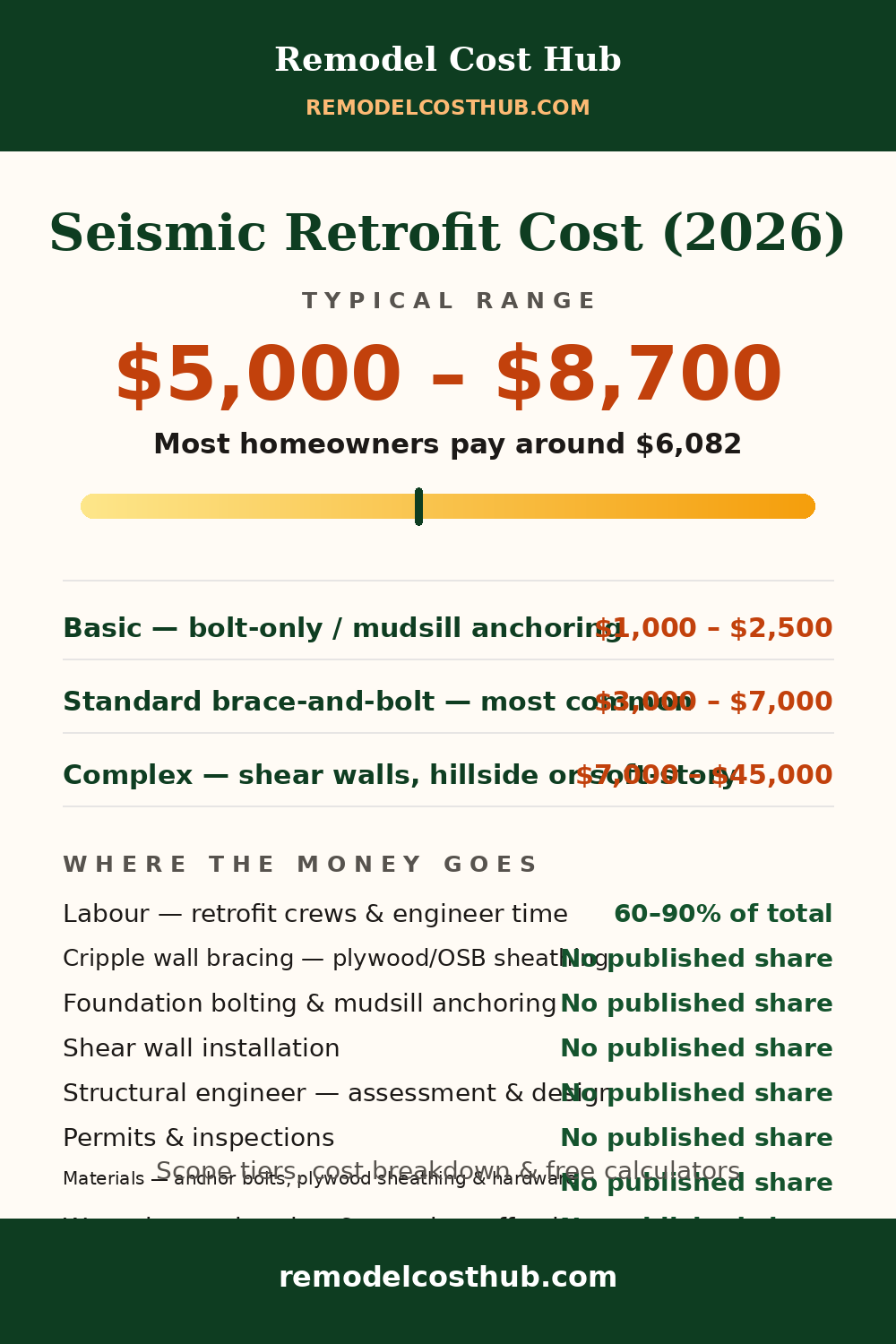
- Typical range: $5,000 – $8,700
- Most homeowners pay: around $6,082
- Per square foot: $3 – $7 per sq ft
- Prices vary most by: Labour — retrofit crews & engineer time (60–90% of the budget)
Cross-checked against four published sources for this project. Sources used for this page: Angi, 'How Much Does an Earthquake Retrofit Cost? [2026 Data]', updated Sep 29, 2026, read in full 2026-11-21 (national average $6,082; most homeowners pay $3,489-$8,676; low $800, high $15,000; $3-$7 per sq ft; permits $500-$3,000; by method: cripple wall bracing $1,000-$3,000, foundation bolting $1,000-$5,000, shear wall installation $3,000-$6,000, mudsill anchoring $1,000-$2,500; by size, labour included: 1,200 sq ft $3,600-$8,400, 1,500 $4,500-$10,500, 2,000 $6,000-$14,000, 2,500 $7,500-$17,500; by type: mobile/manufactured $2,000-$13,000, soft story $10,000-$45,000, hillside $7,000-$20,000, raised foundation $5,000-$10,000; structural engineer $2,000-$8,500 per project or $70-$250 per hour; general contractor 10-20% of total; inspector $200-$600 per inspection; permit expediter $200-$1,000; cleanup $100-$400; demolition and preparation $500-$2,000; DIY materials $1,500-$5,000; repairs $1,000-$4,000; return on investment 30-80%; materials last 20-30 years), Fixr, 'Earthquake Retrofit Cost', updated January 31, 2025, via a verbatim compilation at meetchet.com, updated November 1, 2026, read in full 2026-11-21 (national average $7,000; typical $5,000-$10,000; low $800, high $20,000; $3-$7 per sq ft; 1,500 sq ft $4,500-$10,500, 2,000 $6,000-$14,000; by method: cripple wall bracing $1,000-$3,000, foundation bolting $1,000-$5,000, shear wall reinforcement $3,000-$6,000, mudsill anchoring $1,000-$2,500, house without cripple walls $1,000-$2,500 on average; by type: hillside $7,000-$20,000, soft story $20,000-$45,000, brick foundation $2,000-$10,000, post and pier $3,000-$10,000, footing and stem wall $3,500-$7,200; labour $2,000-$8,000 at $50-$100 per hour per worker, about 70% of the total cost, between 60% and 90%; engineer assessment $100-$300; brick chimney $2,000-$8,000; water heater bracing $250-$400; gas shut-off valve $200-$500; crews of 2-4 take 3-4 days on small jobs and 1-2 weeks on larger ones), the California Residential Mitigation Program's Earthquake Brace + Bolt and soft-story program pages, read in full 2026-11-21 (typical brace-and-bolt retrofit $3,000-$7,000; a retrofit can cost less than $3,000 done by the homeowner; grant up to $3,000 toward a code-compliant retrofit; supplemental grants may pay up to 100% of the cost for income-eligible households at or below $94,480 a year — Northern California brace-and-bolt up to $7,000, bolt-only up to $2,800, Southern California brace-and-bolt up to $2,650, bolt-only up to $1,125, plus up to $250 for one contractor bid and the full permit cost; 76% of the raised-foundation retrofits it funded cost less than $7,000; registration closed October 17, 2025 and not open as of November 2026; soft-story retrofit of a single-family home estimated $15,000-$28,000, with reimbursement up to 75% of the cost, capped at $13,000; program in over 1,100 high-hazard ZIP codes as of January 15, 2025) and the Oregon Construction Contractors Board's 'Earthquake Retrofitting' guide, read in full 2026-11-21 (standard work by a licensed contractor about $2-$5 per sq ft of crawl space or basement, translating to $4,000-$10,000 for a 2,000 sq ft single-level home; an open crawl space costs less than a finished basement; homes built before 1974 suffer the worst damage; Portland's Bulletin 12 prescriptive standards). Corroboration, labelled: a Fixr-derived 2026 guide (its Sources & Methodology section names Fixr's earthquake retrofit cost guide as its only national source; headline most $3,000-$10,000, average $5,000; per project $2,000-$8,000; low $1,500, high $25,000; standard cripple-wall retrofit $3,000-$7,000; anchor-bolt-only $1,500-$4,000; advanced framing connectors $4,000-$10,000; post-and-pier strengthening $5,000-$20,000; cripple-wall bracing $3,000-$8,000; post-and-pier foundations $5,000-$15,000; $300-$500 per linear foot of cripple wall braced; debris and insulation removal $300-$800; custom engineer plans $500-$1,500; timeline 2-5 days typical, 2-3 weeks complex; DIY saves 30-50%; insurer discounts 5-20%; California +30%, about a $6,500 average). INDEPENDENCE: the three independent confirmations are Angi, Fixr and the two public bodies (the California program and the Oregon board). Angi and Fixr publish identical method and size tables, so those tables count as one confirmation, published once with both named. SCOPE DISAGREEMENT, published not averaged away: the averages — Angi $6,082, Fixr $7,000 and the Fixr-derived guide $5,000 — are three published averages, never averaged into one; the soft-story floor — Angi $10,000 vs Fixr $20,000; the per-sq-ft band — Angi and Fixr $3-$7 vs the Oregon board $2-$5 per sq ft of crawl space or basement (a different denominator: crawl-space area, not house area). Synthesized typical $5,000-$8,700 = the honest overlap of Angi's most-pay band ($3,489-$8,676) and Fixr's typical band ($5,000-$10,000); most-pay $6,082 = Angi's published national average, labelled as such; per sq ft $3-$7 = the Angi-Fixr agreement. The only published % share is Fixr's labour 60-90%; all other breakdown rows carry dollar lines only and there is no share bar on this page. Checked November 2026.. Sources last checked: October 2026 — Fixr, Angi, Oregon Construction Contractors Board, California Residential Mitigation Program. How we calculate these costs
Cost by scope
| Scope | Typical cost | What it includes |
|---|---|---|
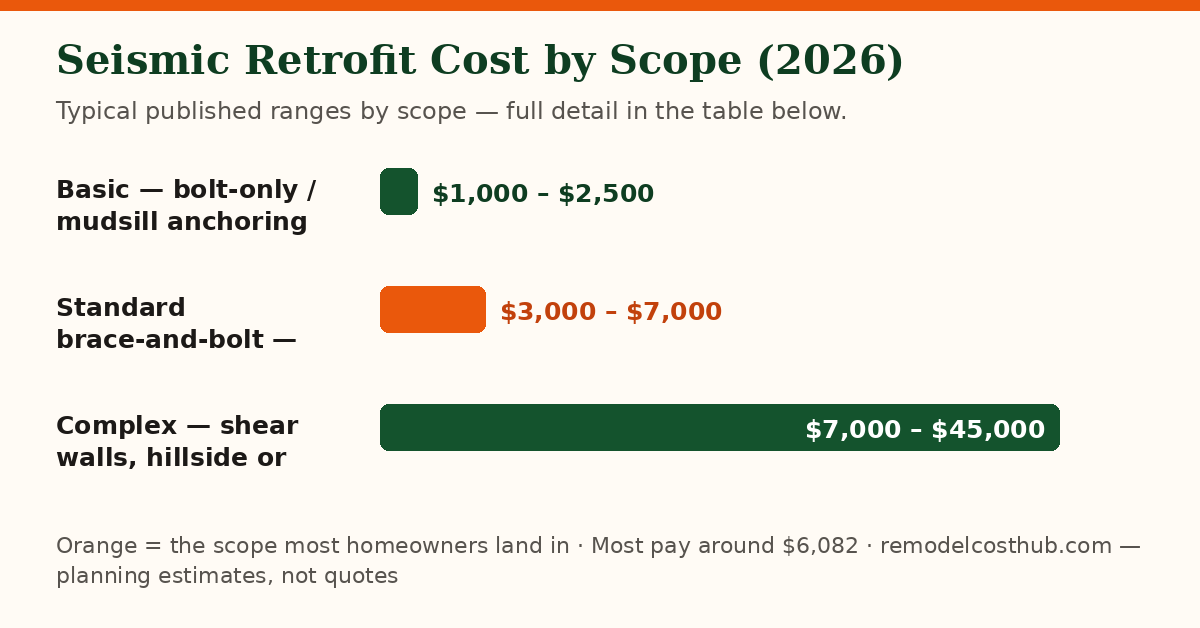
| Basic — bolt-only / mudsill anchoring | $1,000 – $2,500 | The cheapest end: anchor bolts (or plates) tie the wood frame to the concrete foundation with no bracing work. Fixr prices a house without cripple walls — joists bolted to sill and foundation — at $1,000–$2,500 on average, and Angi prices mudsill anchoring at $1,000–$2,500. A Fixr-derived 2026 guide prices anchor-bolt-only work slightly higher, at $1,500–$4,000. This tier only fits a house on a continuous concrete foundation that lacks bolts — if the house has cripple walls, they still need bracing |
| Standard brace-and-bolt — most common | $3,000 – $7,000 | The standard job, and the one the state program is built around: anchor bolts plus plywood or OSB bracing on the cripple walls, with the water heater strapped. The California program prices a typical brace-and-bolt retrofit at $3,000–$7,000, and a Fixr-derived 2026 guide prices a standard cripple-wall retrofit at the same $3,000–$7,000. The program's own data says 76% of the raised-foundation retrofits it funded cost less than $7,000. This is the tier most pre-1980 houses with cripple walls land in |
| Complex — shear walls, hillside or soft-story | $7,000 – $45,000 | The expensive end, where the house itself is the problem: shear-wall installation runs $3,000–$6,000 in Angi and Fixr, a hillside house $7,000–$20,000 in both, and a soft-story home — living space over a garage or an open ground floor — $10,000–$45,000 in Angi and $20,000–$45,000 in Fixr. The state program estimates a soft-story retrofit of a single-family home at $15,000–$28,000, with foundation work able to push it higher. The '+' covers engineered steel frames and major foundation work on the hardest sites |
Where the money goes
| Part of the job | Share | Note |
|---|---|---|
| Labour — retrofit crews & engineer time | 60–90% of total | Fixr puts labour at about 70% of the total project cost, between 60% and 90% — the ONLY published % share on this page; it drives the estimator's note and the 'Prices vary most by' glance row. Crews of 2 to 4 take 3 to 4 days on small jobs and 1 to 2 weeks on larger ones (Fixr), at $50–$100 per hour per worker, with the whole job's labour at $2,000–$8,000. A tight crawl space is where labour grows: work under 18 inches of clearance is far slower, and a finished basement needs drywall opened for access. |
| Cripple wall bracing — plywood/OSB sheathing | No published share | Angi and Fixr publish the identical band: $1,000–$3,000 for bracing the short wood walls between the foundation and the first floor. A Fixr-derived 2026 guide prices cripple-wall bracing slightly higher, at $3,000–$8,000, and $300–$500 per linear foot of cripple wall braced — published here as the disagreement, not merged. |
| Foundation bolting & mudsill anchoring | No published share | Angi and Fixr publish the identical bands: foundation bolting $1,000–$5,000 and mudsill anchoring $1,000–$2,500. A house without cripple walls — joists bolted straight to the sill and foundation — averages $1,000–$2,500 in Fixr. This is the hardware that keeps the house from sliding off its foundation, and it is the whole of the basic tier. |
| Shear wall installation | No published share | Angi and Fixr publish the identical band: $3,000–$6,000 for panels added to resist sideways movement. Shear walls are the step up from bracing when the cripple walls alone cannot carry the load — common on taller or hillside houses. |
| Structural engineer — assessment & design | No published share | Angi prices a structural engineer at $2,000–$8,500 per project for assessment and design, or $70–$250 per hour; Fixr prices an assessment alone at $100–$300. A standard cripple-wall house can often follow a pre-approved standard plan set with no custom engineering; a hillside, soft-story or unusual house needs an engineered plan, and a Fixr-derived 2026 guide adds $500–$1,500 for custom engineer plans. |
| Permits & inspections | No published share | Angi prices permit fees at $500–$3,000 depending on region and project size, with a building inspector at $200–$600 per inspection and a permit expediter at $200–$1,000 if the paperwork is complex. Most jurisdictions require at least one inspection to confirm code compliance; the state program requires the permit to be dated after acceptance into the program. |
| Materials — anchor bolts, plywood sheathing & hardware | No published share | Angi prices DIY materials — bolts, plywood and hardware — at $1,500–$5,000, which bounds the materials component of a professional job; the rest of the bill is labour. Buying standard hardware keeps this line down; engineered connectors (a Fixr-derived 2026 guide prices a Simpson Strong-Tie system at $4,000–$10,000 per project) push it up. |
| Water heater bracing & gas shut-off valve | No published share | Fixr prices water heater bracing at $250–$400 and an earthquake gas shut-off valve at $200–$500. Strapping the water heater is part of the standard job and is required by the state program; a gas valve is the add-on that stops a leak after the shaking. |
| Demolition, prep & cleanup | No published share | Angi prices demolition and site preparation — clearing the crawl space or removing old materials — at $500–$2,000, with post-construction cleanup at $100–$400. A Fixr-derived 2026 guide adds $300–$800 for debris and insulation removal before work begins. Clearing the crawl space yourself is the one prep job Angi says can cut the bill. |
| Chimney reinforcement — only if a brick chimney | No published share | Fixr prices reinforcing or strapping a brick chimney at $2,000–$8,000. It applies only to houses with a masonry chimney; a house without one skips this line entirely, which is why it sits outside the typical band. |
What moves the price most
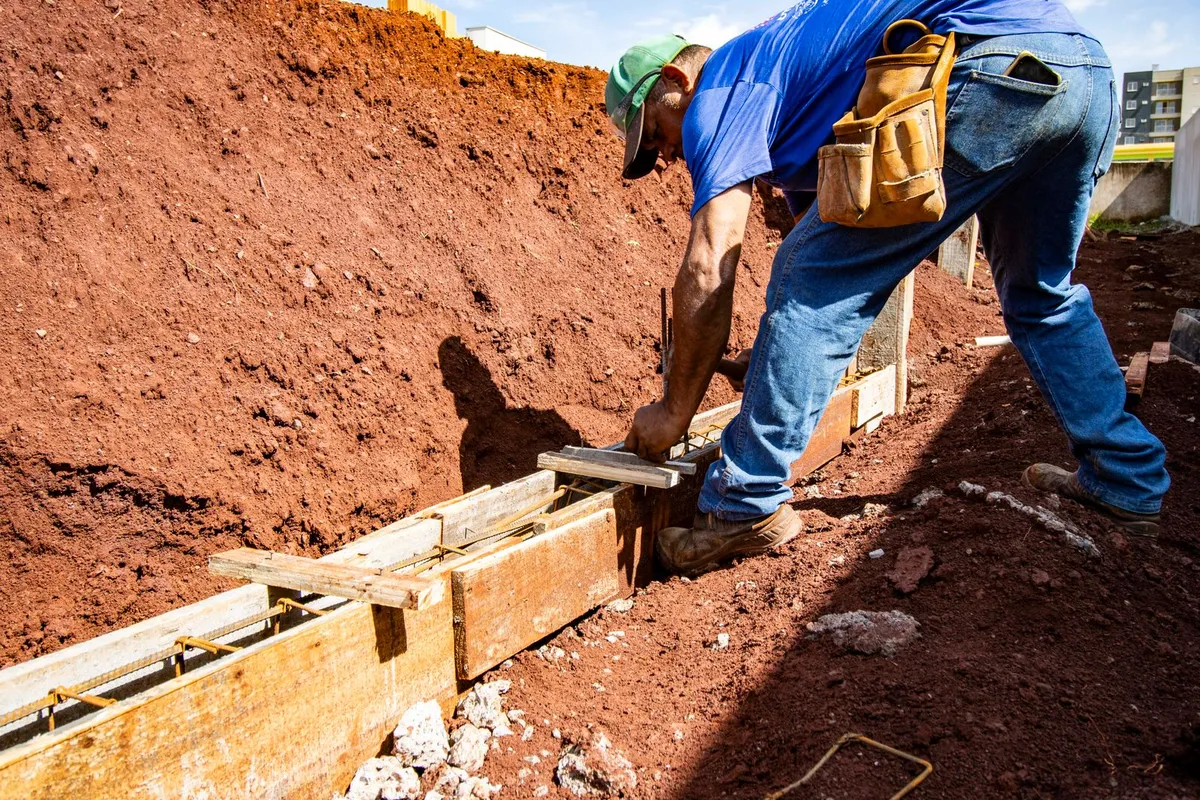
What a seismic retrofit is: bolting the wood frame to the concrete foundation and bracing the short cripple walls in the crawl space with plywood or OSB, so the house moves with the ground instead of sliding off it — plus strapping the water heater. It is structural strengthening of a sound foundation, not a repair: cracked or sinking foundations are priced on the foundation repair page, and a brand-new foundation on the foundation installation page. Method is the first driver: bolt-only work is $1,000–$2,500 (Fixr) and mudsill anchoring $1,000–$2,500 (Angi); the standard brace-and-bolt job is $3,000–$7,000 (the California program); shear walls add $3,000–$6,000 (Angi and Fixr). Foundation type is second: a house on cripple walls is the standard retrofit; a post-and-pier house runs $3,000–$10,000 in Fixr (a Fixr-derived 2026 guide prices post-and-pier strengthening at $5,000–$20,000); a footing-and-stem-wall foundation is $3,500–$7,200 in Fixr; a brick foundation is $2,000–$10,000. Home size is third: at $3–$7 per sq ft, Angi and Fixr price a 1,200 sq ft home at $3,600–$8,400, a 1,500 sq ft home at $4,500–$10,500, a 2,000 sq ft home at $6,000–$14,000 and a 2,500 sq ft home at $7,500–$17,500 — the size table is identical in both guides, so it is published once. Home type is fourth: a raised-foundation house is $5,000–$10,000 in Angi; a hillside house $7,000–$20,000 in both; a soft-story home $10,000–$45,000 in Angi against $20,000–$45,000 in Fixr; a mobile or manufactured home $2,000–$13,000 in Angi. Access is fifth: the Oregon board says an open crawl space costs less than a finished basement to work in, and a Fixr-derived 2026 guide says clearances under 18 inches push labour up sharply — the crawl space is where the work happens, and a cramped one is paid for in hours. Region is sixth: Angi says California, Oregon and Washington run higher with stricter codes and higher labour rates, and the Midwest lower; a Fixr-derived 2026 guide localises California at +30%, about a $6,500 average. Grants are seventh: the California program's Earthquake Brace + Bolt grant pays up to $3,000 toward a code-compliant retrofit, with supplemental grants up to $7,000 for a brace-and-bolt job in Northern California for households at or below $94,480 a year — but registration is closed as of November 2026, with sign-up to be notified when it opens; the soft-story program reimburses up to 75% of the cost, capped at $13,000. Worked scale — a 2,000 sq ft home: at $3–$7 per sq ft, $6,000–$14,000 (Angi and Fixr, identical) — the published size-table band, wider than the typical band because it spans bolt-only to shear-wall scopes. Where sources disagree: the averages — Angi $6,082 (September 2026), Fixr $7,000 (January 2025) and a Fixr-derived 2026 guide $5,000 — three published averages, never averaged into one; the soft-story floor — Angi $10,000 vs Fixr $20,000; the per-sq-ft band — Angi and Fixr $3–$7 vs the Oregon board $2–$5 per sq ft of crawl space or basement (a different denominator: crawl-space area, not house area); the method tables — Angi and Fixr publish identical cripple-wall, bolting, shear-wall and mudsill bands, so those tables count as one confirmation, published once with both named. Timeline: a typical job takes 2–5 days, a complex one 2–3 weeks (a Fixr-derived 2026 guide); Fixr's crews of 2–4 take 3–4 days on small jobs and 1–2 weeks on larger ones, plus 1–6 weeks for the permit. Value: Angi puts the return on investment at 30–80% depending on seismic risk, and a Fixr-derived 2026 guide puts insurer premium discounts at 5–20%; the comparison that matters is earthquake damage repair, which Angi averages at $5,000–$25,000. Methodology: figures cross-checked across Angi (updated Sep 29, 2026, read in full 2026-11-21), Fixr (January 31, 2025, via a verbatim compilation at meetchet.com, updated November 1, 2026, read in full 2026-11-21), the California Residential Mitigation Program's Earthquake Brace + Bolt and soft-story pages (read in full 2026-11-21) and the Oregon Construction Contractors Board's earthquake retrofitting guide (read in full 2026-11-21), with a Fixr-derived 2026 guide as labelled corroboration. The three independent confirmations are Angi, Fixr and the two public bodies (the California program and the Oregon board); the method and size tables are identical in Angi and Fixr and count once. Related costs: foundation repair, foundation installation, crawl space repair, house leveling, water heater replacement, gas line installation and Remodel Cost Index.
Costs in your city
Labor is the biggest variable in any remodel, and labor is local — the same bathroom can price very differently in Houston than in Boston. We are adding city editions metro by metro, each with its own labor index, permit notes and climate factors, written for that city rather than copied from this page. Wave 1: Houston, Dallas–Fort Worth, Phoenix, Atlanta, Miami–South Florida, Orlando, Tampa, Charlotte, Austin and San Antonio. Until your city's page is live, use the national range here and weight it the way contractors do: Sun Belt labor often prices near or below the national middle, while coastal California and the Northeast metros often price well above it.
Frequently asked questions
How much does a seismic retrofit cost?
A standard house typically costs $5,000–$8,700, with about $6,082 the figure most jobs land near — $6,082 is Angi's published national average (September 2026), not a mean of averages; Fixr's published average is $7,000 (January 2025). That works out to $3–$7 per sq ft. A brace-and-bolt retrofit — the standard method — is cheaper, at $3,000–$7,000 in the California program's own figures.
What is the cheapest seismic retrofit?
Bolt-only work: anchor bolts tying the frame to the foundation with no bracing, at $1,000–$2,500 in Fixr and $1,000–$2,500 for mudsill anchoring in Angi. It only fits a house on a continuous concrete foundation that lacks bolts — a house with cripple walls still needs them braced, which is the $3,000–$7,000 standard job.
How much does a seismic retrofit cost per square foot?
$3–$7 per sq ft in both Angi and Fixr, who publish the identical band. The Oregon Construction Contractors Board prices it lower, at $2–$5 per sq ft — but of crawl space or basement area, not house area, which is why its 2,000 sq ft home still comes to $4,000–$10,000. At $3–$7 per sq ft, a 2,000 sq ft home is $6,000–$14,000 in both Angi and Fixr.
Will the Earthquake Brace + Bolt program pay for my retrofit?
In California, the program's grant pays up to $3,000 toward a code-compliant retrofit, and income-eligible homeowners (household income at or below $94,480 a year) can get a supplemental grant of up to $7,000 more for a brace-and-bolt job in Northern California — but registration is closed as of November 2026, with sign-up to be notified when it opens. The separate soft-story program reimburses up to 75% of the cost, capped at $13,000.
How long does a seismic retrofit take?
A typical job takes 2–5 days and a complex one 2–3 weeks, with the permit adding 1–6 weeks. Fixr's crews of 2–4 people take 3–4 days on small jobs and 1–2 weeks on larger ones. A standard brace-and-bolt job on a house with an open crawl space is the fast end; a hillside or soft-story job with engineering is the slow end.
Does a seismic retrofit increase home value?
Angi puts the return on investment at 30–80% depending on how high the seismic risk is where the home sits, and insurer premium discounts of 5–20% are reported for retrofitted homes. The comparison that matters is the cost of earthquake damage repair, which Angi averages at $5,000–$25,000 — against $5,000–$8,700 for the retrofit itself.