Fence Staining cost at a glance
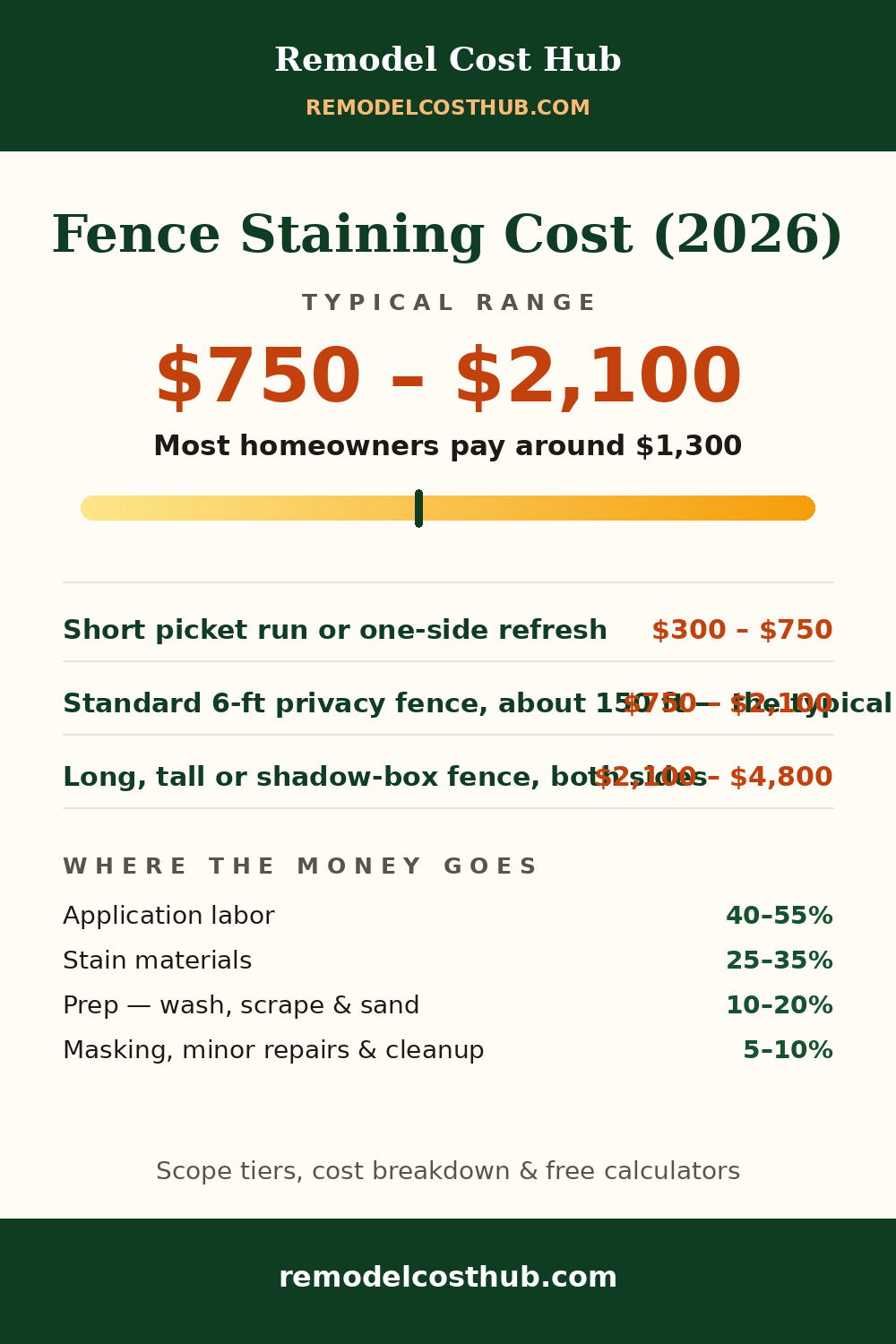
- Typical range: $750 – $2,100
- Most homeowners pay: around $1,300
- Per square foot: $0.50 – $2.50 per sq ft
- Prices vary most by: Application labor (40–55% of the budget)
Cross-checked against two published sources for this project. Sources used for this page: the Angi fence painting cost guide, HomeGuide's fence staining and painting cost guide and Ergeon's fence staining cost data. Sources last checked: October 2026 — HomeGuide, Angi. How we calculate these costs
Cost by scope
| Scope | Typical cost | What it includes |
|---|---|---|
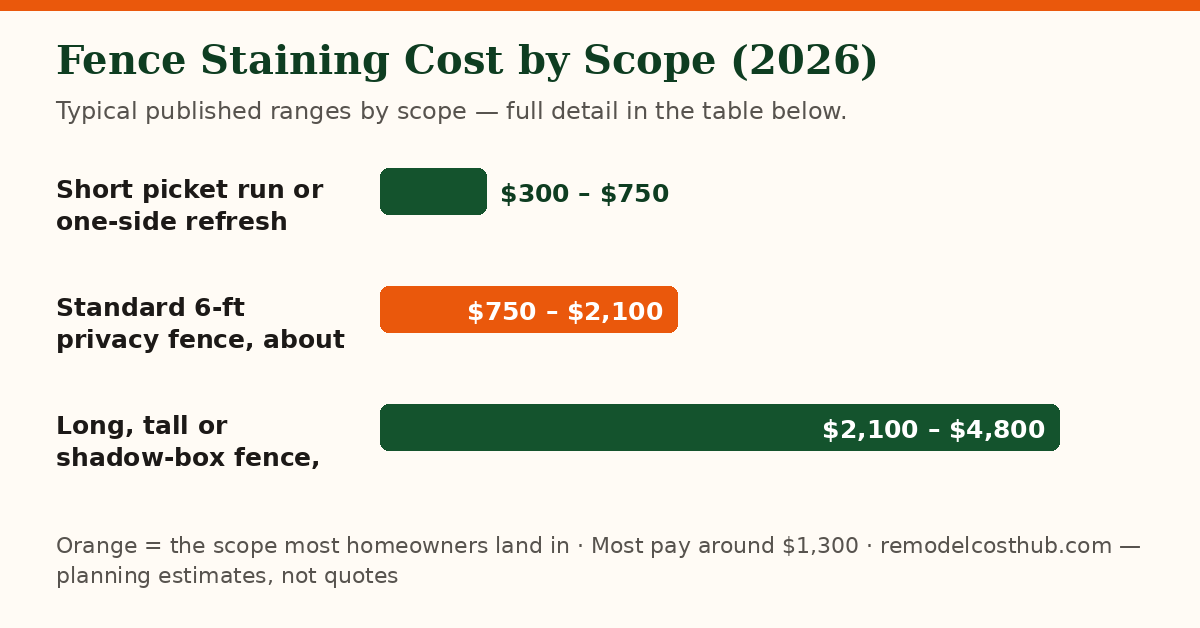
| Short picket run or one-side refresh | $300 – $750 | HomeGuide prices a 150-ft wood picket fence at $300–$750 in total and picket work at $2–$5 per linear foot; Angi prices 50 ft at $150–$700 for one coat. One face, one to two coats, sound wood. |
| Standard 6-ft privacy fence, about 150 ft — the typical job | $750 – $2,100 | The typical project on this page. HomeGuide prices a 150-ft privacy fence at $450–$1,500 and 6-ft work at $4–$9 per linear foot, with a $1,700 national average across staining and painting; Angi averages $1,700 with most fence painting projects at $750–$4,250; Ergeon's 111 completed staining projects run $655–$2,118 with a $1,298 median. |
| Long, tall or shadow-box fence, both sides | $2,100 – $4,800 | HomeGuide's maximum runs to $4,800, its shadow-box band reaches $4–$14 per linear foot and its height ladder climbs to $7.50–$15 per foot at 12 ft; Angi prices 300 ft at $900–$4,200 for a single coat. Height, board overlap and the second face are what is being bought in this tier. |
Where the money goes
| Part of the job | Share | Note |
|---|---|---|
| Application labor | 40–55% | Brushing, rolling or spraying two coats along every board — HomeGuide's per-foot ladder is mostly this, and shadow-box and lattice work sits at the top because every overlap is hand work |
| Stain materials | 25–35% | Ergeon prices DIY materials alone at $1–$2 per square foot of fence surface; a gallon covers roughly 150–300 sq ft, and weathered wood drinks the first coat, which is why old fences use more product than new ones |
| Prep — wash, scrape & sand | 10–20% | Angi budgets $150–$900 or more for pressure washing and repairs before the finish — grey, weathered wood needs the most prep and drinks the most stain, which is why skipping this line shortens the finish's life |
| Masking, minor repairs & cleanup | 5–10% | Taping off the house, gate hardware and plantings, spot board repairs, and the drip-and-overspray cleanup — small lines that decide whether the yard looks finished or splattered |
What moves the price most
Length times height is the price. HomeGuide's height ladder runs $2–$7 per linear foot at 4 ft, $4–$9 at 6 ft and $5–$11 at 8 ft, and Angi's length table runs $300–$1,400 at 100 ft to $900–$4,200 at 300 ft for one coat — measure the run and the height before you read any quote. Both sides roughly double the surface: a 150-ft, 6-ft fence is 900 sq ft of wood per face, and the neighbour-side face is a separate negotiation with a separate price. Condition sets the prep line — Angi budgets $150–$900 or more for washing and repairs before any stain, and grey, weathered wood needs it most. Stain type trades money against years: transparent stains sit at the cheap, short-lived end and solid stains at the long end of the two-to-five-year lifespan the guides publish. Minimums bite on small jobs: Angi notes a $250–$500 painter minimum, which is why 30 ft of fence never prices at 30 times the per-foot rate.
Worked example: how a typical fence staining budget breaks down
Take the typical job — a 150-linear-foot, 6-foot wood privacy fence, washed, prepped and stained two coats on the yard side. Here is a realistic $1,300 version of that invoice, Ergeon's published median: The budget below totals $1,300 — the "most homeowners pay around" figure from the top of this page — split using this page's own cost breakdown. It shows how a real quote at that level is usually composed; every line is built from the ranges on this page, and it is an illustration, not a quote for your project.
| Line item | Example budget |
|---|---|
| Prep — wash, scrape & light sanding | $260 |
| Stain materials — about 10 gallons | $390 |
| Application labor — two coats | $520 |
| Masking, touch-up & cleanup | $130 |
| Total | $1,300 |
What most people get wrong
- Staining a brand-new fence the week it is built. Pressure-treated wood has to dry first — stain over wet lumber traps moisture and the finish fails early. The water-drop test decides: beads mean wait.
- Pricing one side and expecting two. A 150-ft fence is about 900 sq ft of wood per face. A quote that never says which faces it covers will cover one of them.
- Skipping the wash to save $200. Angi budgets $150–$900 for prep for a reason — stain over algae and grey, oxidized wood peels with the surface it never bonded to.
- Comparing a per-foot quote with a per-project quote blind. They should reconcile: $4–$9 per linear foot at 6 ft in HomeGuide, $0.50–$2.50 per square foot of surface. A bid that cannot be restated in the other unit has not been measured.
Costs in your city
Fence staining tracks painter wages and sun. High-labor metros pull the same 150-ft job toward Angi's $1,700 average and above, while Ergeon's project data — concentrated in California, Texas and Georgia — medians at $1,298. Climate sets the calendar as much as the price: intense-sun regions burn transparent stains off in about two years, wet regions grow the algae that makes prep the biggest line, and freeze-thaw country splits boards that then drink a second first coat. Wood species is local too — cedar country and pressure-treated-pine country take stain differently and price differently per gallon of coverage. The quote to trust anywhere names the footage, the height, the faces and the prep, because $4–$9 a foot at standard height is the yardstick every honest bid is measured against.
How we got these numbers
Cross-checked against the Angi fence painting cost guide (national average $1,700, most projects $750–$4,250; $3–$14 per linear foot; $1–$3 per square foot; prep $150–$900 or more; $250–$500 minimums), HomeGuide's fence staining and painting cost guide (national average $1,700, average range $300–$2,800; $2–$14 per linear foot; $0.50–$2.50 per square foot; 6-ft work $4–$9 per foot; 150-ft privacy fence $450–$1,500) and Ergeon's fence staining cost data (111 completed projects at $655–$2,118, median $1,298; professional work $3–$5 per square foot all-in). The typical band published here is the overlap for a standard privacy fence; the most-pay figure is Ergeon's median, rounded. Checked October 2026. Full method: How We Estimate Costs.
Frequently asked questions
How much does fence staining cost on average?
Ergeon's 111 completed projects median at $1,298 inside a $655–$2,118 band. Angi and HomeGuide both average $1,700 across the wider staining-and-painting category, which includes long and painted fences. For a standard 150-ft privacy fence, budget about $1,300.
How much does it cost to stain a fence per linear foot?
HomeGuide prices $2–$14 per linear foot overall — $4–$9 at the standard 6-ft height — and Angi prices painting or staining at $3–$14 per linear foot, $1–$3 per square foot. Per square foot of fence surface, HomeGuide prices $0.50–$2.50, which is the unit to use when both sides are being coated.
How long does fence stain last?
Two to five years, depending on stain type, wood species, sun exposure and climate — transparent stains at the short end, solid stains at the long end, and south- and west-facing runs fading fastest. Restaining on that cycle is what stretches a wood fence toward the top of its lifespan instead of a replacement.
Is it better to stain or paint a fence?
Stain soaks in and shows the grain, fades gradually and never peels — it is the usual choice for new or sound wood. Paint films over the surface, covers weathered or mismatched boards better and lasts longer per coat, but eventually peels and costs more to strip. The guides price them in one band ($2–$14 per linear foot in HomeGuide) because the labor is nearly the same.
Can a new fence be stained right away?
Usually not the week it is built: pressure-treated lumber needs to dry — commonly a few weeks to a few months depending on weather — before it will take stain evenly. Staining wet wood traps moisture and the finish fails early, which is why reputable stainers test with a water drop: if it beads instead of soaking in, the fence is not ready.