Attic Insulation Removal cost at a glance
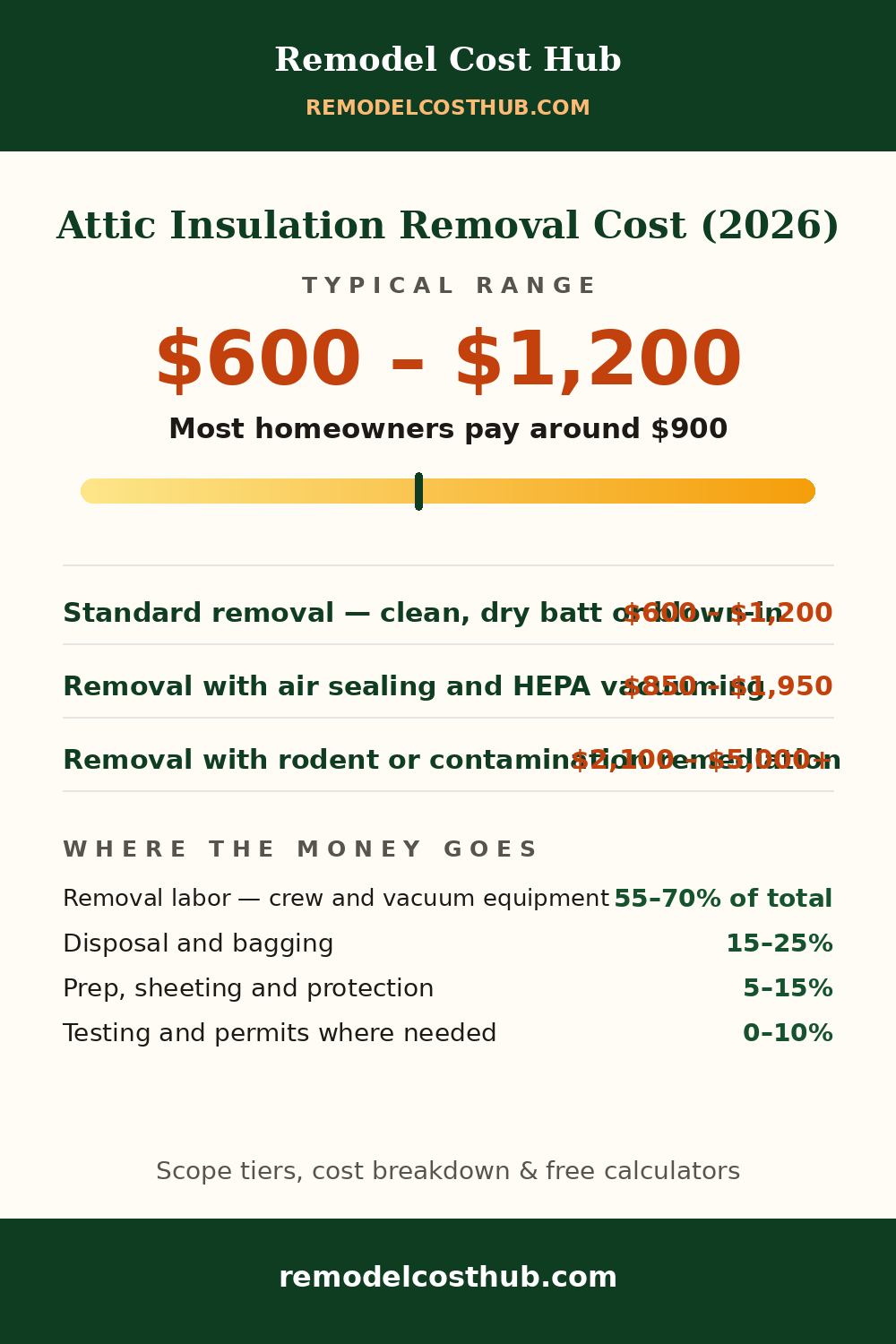
- Typical range: $600 – $1,200
- Most homeowners pay: around $900
- Per square foot: $1–$2 per sq ft
- Prices vary most by: Removal labor — crew and vacuum equipment (55–70% of the budget)
Cross-checked against three published sources for this project. Sources used for this page: Angi's attic insulation removal cost guide, updated October 29, 2026 (typical $600–$1,200, national average $900; $1–$2 per sq ft for dry, undamaged, non-asbestos material; blown-in $600–$1,000, batts/rolls $800–$1,100, rigid $900–$1,200; 1,000 sq ft $1,000–$2,000; labor $35–$85 per hour; hard-to-reach areas up to +$1 per sq ft; air sealing $250–$750; asbestos removal $1,190–$3,255; mold remediation $1,225–$3,750; severe pest treatment up to $8,000 extra), HomeGuide's attic insulation removal cost guide, updated November 5, 2025 ($1–$2 per sq ft; average total $1,600–$3,600 for the larger 1,600–1,800 sq ft average US attic; 1,000 sq ft $1,000–$2,000; remove + replace $2–$6 per sq ft; air sealing $350–$3,000; sanitation-service minimum $1,500–$3,000; rodent cleanup $600–$1,000; mold $1,500–$6,000; asbestos $1,000–$11,000+; DIY vacuum rental $200–$350 per day; job duration 4 hours to 2 days+) and Fixr's attic insulation cost data (removal $1–$3 per sq ft; 1,000 sq ft $1,000–$3,000 to remove; remove + reinstall $3,000–$6,250 total for most attics). Synthesized typical = the $600–$1,200 Angi band, corroborated by HomeGuide and Fixr at $1–$2 per sq ft, with $900 most-pay as Angi's national average. Breakdown shares are an editorial estimate derived from the published labor and disposal lines — no source publishes a % split for removal alone. Checked November 2026.. Sources last checked: October 2026 — HomeGuide, Fixr, Angi. How we calculate these costs
Cost by scope
| Scope | Typical cost | What it includes |
|---|---|---|
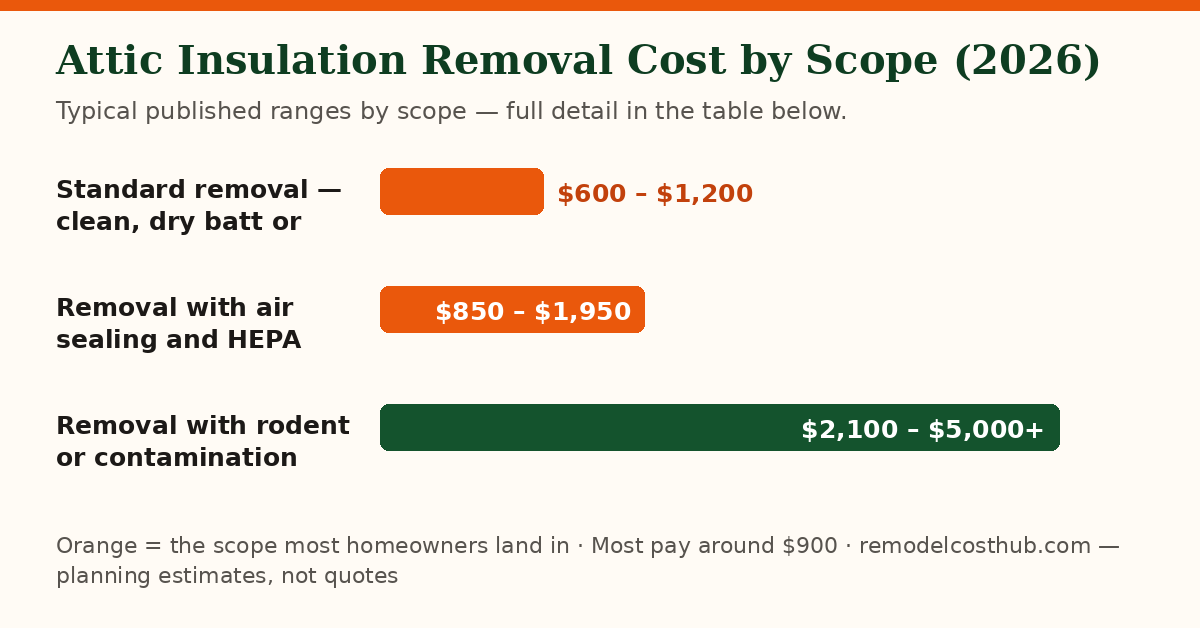
| Standard removal — clean, dry batt or blown-in | $600 – $1,200 | The typical job on this page: a crew vacuums or bags out dry, undamaged batts or blown-in insulation and hauls it away. Angi prices this at $600–$1,200 with a $900 national average, and HomeGuide prices it at $1–$2 per sq ft with disposal of non-hazardous material included |
| Removal with air sealing and HEPA vacuuming | $850 – $1,950 | Removal plus sealing the gaps the old insulation was hiding: Angi prices air sealing at $250–$750 on top of removal, and HomeGuide prices it at $350–$3,000 depending on how many penetrations the crew finds once the floor is exposed |
| Removal with rodent or contamination remediation | $2,100 – $5,000+ | The open-ended tier: HomeGuide puts a sanitation-service minimum at $1,500–$3,000 before removal, rodent cleanup at $600–$1,000, mold remediation at $1,225–$3,750 in Angi's data and asbestos removal at $1,190–$3,255 — hazardous material can push the job past $11,000 in HomeGuide's data |
Where the money goes
| Part of the job | Share | Note |
|---|---|---|
| Removal labor — crew and vacuum equipment | 55–70% of total | The dominant share, and the one no source publishes as a percentage — Angi prices removal labor at $35–$85 per hour, and a 4-hour to 2-day job (HomeGuide) is mostly crew time with the vacuum truck. The shares on this page are an editorial estimate derived from those published labor and disposal lines, not a quoted split |
| Disposal and bagging | 15–25% | Bagging the old material and hauling it away — HomeGuide states disposal of non-hazardous material is included in its $1–$2 per sq ft price, and local rules govern where it can go |
| Prep, sheeting and protection | 5–15% | Sealing the attic hatch, laying sheeting over the rooms below and protecting the house from dust — the prep that keeps a dirty job out of the living space |
| Testing and permits where needed | 0–10% | Asbestos or mold testing when the material's history is unknown, and any local disposal permits — $0 on a clean job, a real line when contamination is suspected |
What moves the price most
Condition is the first lever. Dry, undamaged insulation comes out at $1–$2 per sq ft in all three guides — Angi's $600–$1,200 band, HomeGuide's $1–$2 and Fixr's $1–$3 all agree — while wet, moldy or pest-damaged material moves the job into remediation pricing, where HomeGuide's sanitation minimum alone is $1,500–$3,000. Type is second: Angi prices blown-in removal at $600–$1,000, batts and rolls at $800–$1,100 and rigid boards at $900–$1,200, so the form the old insulation takes moves the quote inside the same band. Size is third: all three guides' size tables agree that a 1,000 sq ft attic runs $1,000–$2,000 to clear — HomeGuide's higher average total of $1,600–$3,600 reflects the larger 1,600–1,800 sq ft average US attic it prices, not a higher rate. Access is fourth: Angi adds up to $1 per sq ft for hard-to-reach areas, and a low, cramped attic with no proper hatch slows the crew the same way. What you do next matters too: removal plus replacement runs $2–$6 per sq ft in HomeGuide ($3,000–$6,250 for a 1,000 sq ft attic in Fixr), so price the removal and the new insulation as one job when the old material is coming out anyway. Worked example at the most-pay figure: removal labor, crew with vacuum truck for one day $585 + disposal and bagging $180 + prep, sheeting and protection $135 = $900. For the insulation that goes back in, see our attic insulation guide, spray foam insulation guide and wall insulation guide, and for the same work under the house see our crawl space insulation guide.
Costs in your city
Labor is the biggest variable in any remodel, and labor is local — the same bathroom can price very differently in Houston than in Boston. We are adding city editions metro by metro, each with its own labor index, permit notes and climate factors, written for that city rather than copied from this page. Wave 1: Houston, Dallas–Fort Worth, Phoenix, Atlanta, Miami–South Florida, Orlando, Tampa, Charlotte, Austin and San Antonio. Until your city's page is live, use the national range here and weight it the way contractors do: Sun Belt labor often prices near or below the national middle, while coastal California and the Northeast metros often price well above it.
Frequently asked questions
Do I have to remove old insulation before adding new?
No — only if it is damaged by moisture, mold, fire or pests; if it is dry and in good condition, new insulation goes on top. Removal also exposes the attic floor so penetrations can be air-sealed. (HomeGuide; Angi)
How much does attic insulation removal cost?
$1–$2 per sq ft; $600–$1,200 for a typical attic, $900 on average; a 1,000 sq ft attic runs $1,000–$2,000. (Angi; HomeGuide)
How long does removal take?
4 hours to 2 days or more, depending on attic size and job complexity. (HomeGuide)
How long does attic insulation last?
20–100 years by type: fiberglass 80–100 years, cellulose 20–30 years, spray foam 80+ years on attic floors. (HomeGuide)
What makes removal much more expensive?
Contamination: rodent cleanup adds $600–$1,000 plus a $1,500–$3,000 sanitation minimum; mold remediation $1,225–$3,750; asbestos removal $1,190–$3,255 (up to $11,000+); severe pest jobs up to $8,000 extra. (Angi; HomeGuide)
Can I remove it myself?
Only in the simplest case: renting an insulation vacuum costs $200–$350 a day and suits accessible blown-in insulation with no damage or contamination. Otherwise hire a pro — old insulation can harbor dust, mold and contaminants, and disposal must follow local rules. (HomeGuide; Angi)