Oil Tank Removal cost at a glance
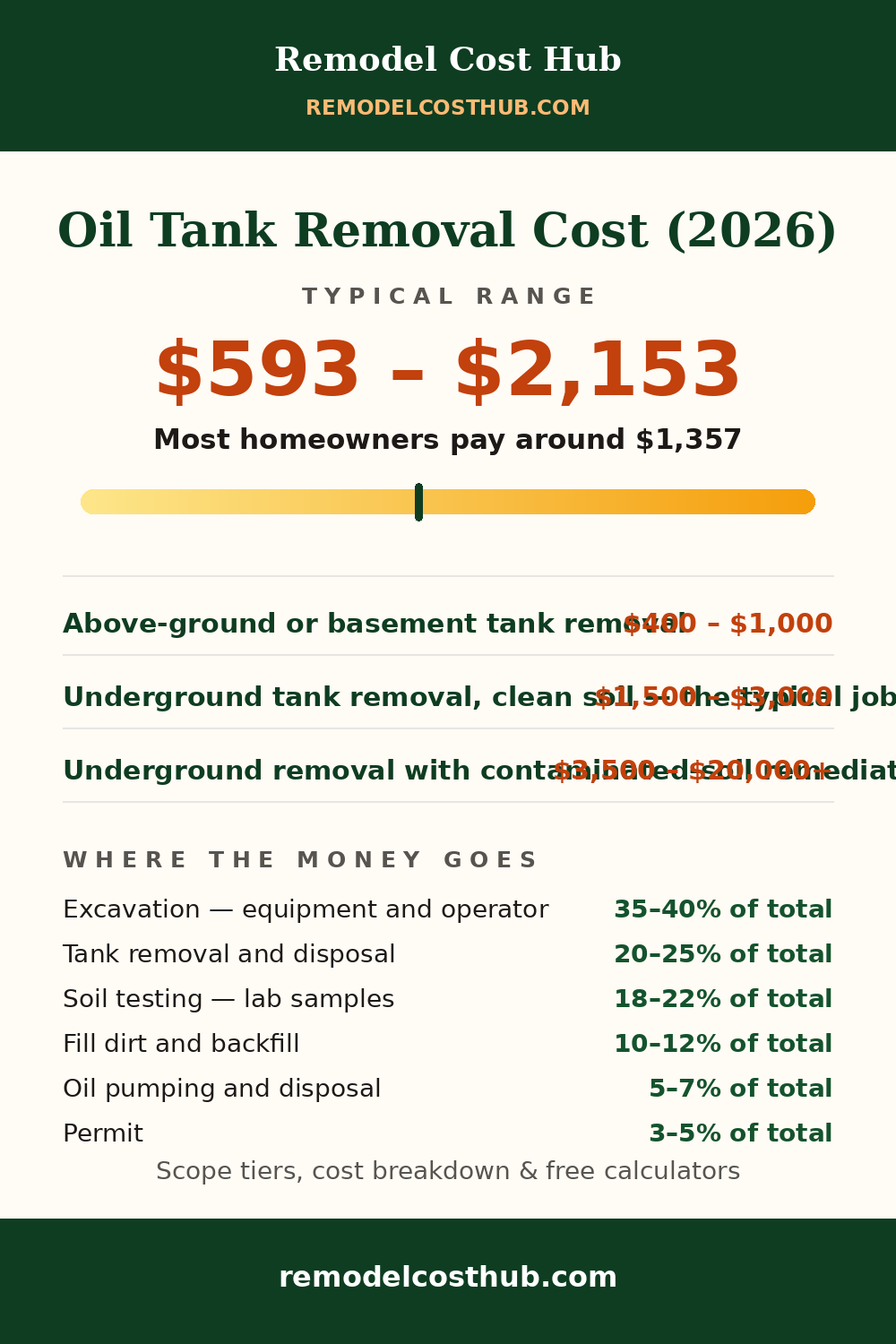
- Typical range: $593 – $2,153
- Most homeowners pay: around $1,357
- Prices vary most by: Excavation — equipment and operator (35–40% of the budget)
Cross-checked against three published sources for this project. Sources used for this page: Angi's oil tank removal cost guide, updated September 8, 2026 (national average $1,357 across 266 verified projects; most homeowners pay $593–$2,153; above-ground $400–$1,000; underground $1,500–$3,000; 275-gallon $800–$1,200, 500-gallon $1,200–$1,800, 1,000-gallon $1,300–$2,000+; soil testing $100–$300 per test, $50–$200 per sample, $300–$1,000 per project; remediation $50–$200 per cubic yard or $1,000–$10,000 per project, and over $100,000 where a tank leaks into soil or groundwater; permits $50–$500; labor $50–$150 per hour; backfill and grading $5–$15 per sq ft; landscaping restoration $500–$3,000; fuel-line and vent removal $200–$800), HomeGuide's oil tank removal cost guide, published April 12, 2023 (overall $400–$3,400; above-ground $400–$1,800; basement $500–$2,000; underground $800–$3,400; buried 550-gallon $900–$1,600, 1,000-gallon $1,500–$2,400, 1,500-gallon $2,100–$2,700, 2,000-gallon $2,300–$2,900, 3,000-gallon $2,800–$3,600; excavation $500–$2,500; tank removal and disposal $250–$600; soil testing $250–$550; remediation $2,500–$17,000; oil pumping and disposal $50–$150; fill dirt $150–$600, $5–$25 per yard; permits $30–$160; abandonment instead of removal $600–$3,400), Bob Vila's oil tank removal cost guide, published May 31, 2023 (overall $400–$3,000; above-ground $300–$1,000; basement $500–$1,500; underground $1,000–$3,500; buried 550-gallon $400–$1,200, 1,000-gallon $1,300–$1,800, 1,500-gallon $1,900–$2,200, 2,000-gallon $2,300–$2,700, 3,000-gallon $2,800–$3,000; soil testing $500–$1,800; remediation $500–$10,000; permits $30–$160; abandonment $1,000–$3,000) and HomeAdvisor's oil tank removal cost guide, dated June 20, 2026 (same $1,357 average and $593–$2,153 band as Angi — sister brands, one dataset). Synthesized typical = Angi's most-pay band at $593–$2,153, sitting inside HomeGuide's $400–$3,400 and Bob Vila's $400–$3,000 overall bands, with $1,357 most-pay at Angi's published national average. Breakdown shares are derived from the worked example, not published percentages. Checked November 2026.. Sources last checked: October 2026 — HomeAdvisor, HomeGuide, Angi. How we calculate these costs
Cost by scope
| Scope | Typical cost | What it includes |
|---|---|---|
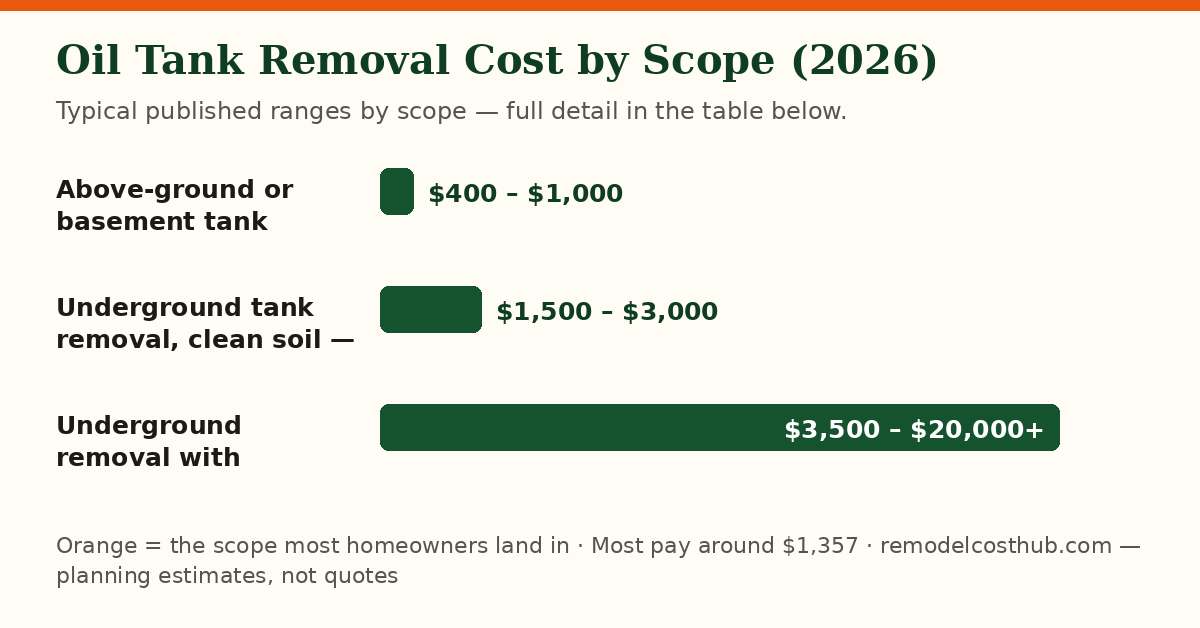
| Above-ground or basement tank removal | $400 – $1,000 | Drain and pump out remaining oil, disconnect the fuel lines, cut and dismantle the tank in place if it will not fit through a door, then haul away and dispose or recycle. No excavation. Angi prices above-ground removal at $400–$1,000, and Bob Vila and HomeAdvisor at $300–$1,000. |
| Underground tank removal, clean soil — the typical job | $1,500 – $3,000 | The typical project on this page: everything in the basic tier plus mini-excavator excavation, tank extraction, soil testing and lab samples, permits, and backfill with fill dirt and rough grading. Angi prices it at $1,500–$3,000, corroborated by HomeGuide at $900–$3,600 and Bob Vila at $1,000–$3,500. |
| Underground removal with contaminated-soil remediation | $3,500 – $20,000+ | The expensive end: the standard removal plus contaminated-soil excavation and disposal, groundwater washing and stabilization, and regulatory reporting to the state environmental agency. Remediation alone runs $2,500–$17,000 in HomeGuide's figures; severe groundwater cases can reach $50,000+ in contractor-reported figures and, in the worst case, over $100,000 in Angi's figures. |
Where the money goes
| Part of the job | Share | Note |
|---|---|---|
| Excavation — equipment and operator | 35–40% of total | HomeGuide prices excavation at $500–$2,500 and HomeAdvisor notes it can account for up to half of the bill — the mini-excavator and operator are the biggest single line on a clean underground job. Share derived from the worked example below, not a published percentage. |
| Tank removal and disposal | 20–25% of total | HomeGuide prices tank removal and disposal at $250–$600. Share derived from the worked example below. |
| Soil testing — lab samples | 18–22% of total | HomeGuide prices soil testing at $250–$550, corroborated by Angi's per-project band of $300–$1,000. Share derived from the worked example below. |
| Fill dirt and backfill | 10–12% of total | HomeGuide prices fill dirt at $150–$600, or $5–$25 per yard. Share derived from the worked example below. |
| Oil pumping and disposal | 5–7% of total | HomeGuide prices oil pumping and disposal at $50–$150. Share derived from the worked example below. |
| Permit | 3–5% of total | HomeGuide, Bob Vila and HomeAdvisor all price permits at $30–$160, against $50–$500 in Angi's figures. Share derived from the worked example below. |
What moves the price most
Where the tank sits is the first lever: Angi prices above-ground removal at $400–$1,000 against $1,500–$3,000 for an underground tank with clean soil — the underground job costs roughly three times as much because it needs excavation, extraction and soil testing. Size is second: HomeGuide prices a buried tank at $900–$1,600 for 550 gallons or less, $1,500–$2,400 for 1,000 gallons, $2,300–$2,900 for 2,000 gallons and $2,800–$3,600 for 3,000 gallons, with Bob Vila and HomeAdvisor agreeing on the 1,000-gallon band at $1,300–$1,800. Soil testing is third: at $250–$550 in HomeGuide's figures, the lab samples decide whether the job stays in the typical band or moves into remediation — a leaking tank shows as an oil smell, dead or stained vegetation, dark patches or an oily sheen on water. Contamination is fourth: remediation alone runs $2,500–$17,000 in HomeGuide's figures, and a leak into soil or groundwater must be reported to the state environmental agency. Worked example at the most-pay figure: excavation, mini-excavator and operator $500 + tank removal and disposal $300 + soil testing, lab samples $275 + fill dirt and backfill $150 + oil pumping and disposal $75 + permit $57 = $1,357. This is a hazardous job for licensed, insured professionals — not a DIY removal — and most standard homeowners policies do not cover it. To replace the heat instead of the tank see our furnace replacement guide, our heat pump installation guide and our boiler replacement guide, for the fuel line that fed it see our gas line installation guide, and for the other tank in the yard see our propane tank installation guide.
Costs in your city
Labor is the biggest variable in any remodel, and labor is local — the same bathroom can price very differently in Houston than in Boston. We are adding city editions metro by metro, each with its own labor index, permit notes and climate factors, written for that city rather than copied from this page. Wave 1: Houston, Dallas–Fort Worth, Phoenix, Atlanta, Miami–South Florida, Orlando, Tampa, Charlotte, Austin and San Antonio. Until your city's page is live, use the national range here and weight it the way contractors do: Sun Belt labor often prices near or below the national middle, while coastal California and the Northeast metros often price well above it.

Frequently asked questions
How much does it cost to remove an oil tank?
On average $1,357, with most homeowners paying $593–$2,153 in Angi's 2026 data across 266 verified projects. Above-ground tanks run $400–$1,000; underground tanks run $1,500–$3,000 when the soil is clean. (Angi)
Do I need a permit to remove an oil tank?
Yes — removal is regulated in most areas. Permits cost $30–$160 and are issued by the local government or fire department, and many jurisdictions also require a licensed contractor. (HomeGuide; Bob Vila; HomeAdvisor)
Can I remove my own oil tank?
No — it is a hazardous job best left to licensed, insured professionals. DIY removal risks fines, environmental contamination and legal liability, and many states require certified pros for underground tanks. (HomeGuide; Bob Vila; HomeAdvisor; Angi)
How do I know if my oil tank is leaking?
Look for an oil smell in the yard or home, dead or stained vegetation, dark patches or an oily sheen on water, and unexplained rises in heating bills. (HomeAdvisor; Bob Vila; HomeGuide)
Do I have to report a leaking oil tank?
Yes — report it to your state environmental agency as soon as possible; leaking oil can contaminate soil and drinking water, and remediation must be reported to the EPA. (Bob Vila; HomeGuide)
Does homeowners insurance cover oil tank removal?
Most standard policies do not cover removal, though some insurers offer separate oil-tank policies, and many states offer financial assistance for leak remediation. (HomeGuide; Bob Vila)