Wall Insulation Installation cost at a glance
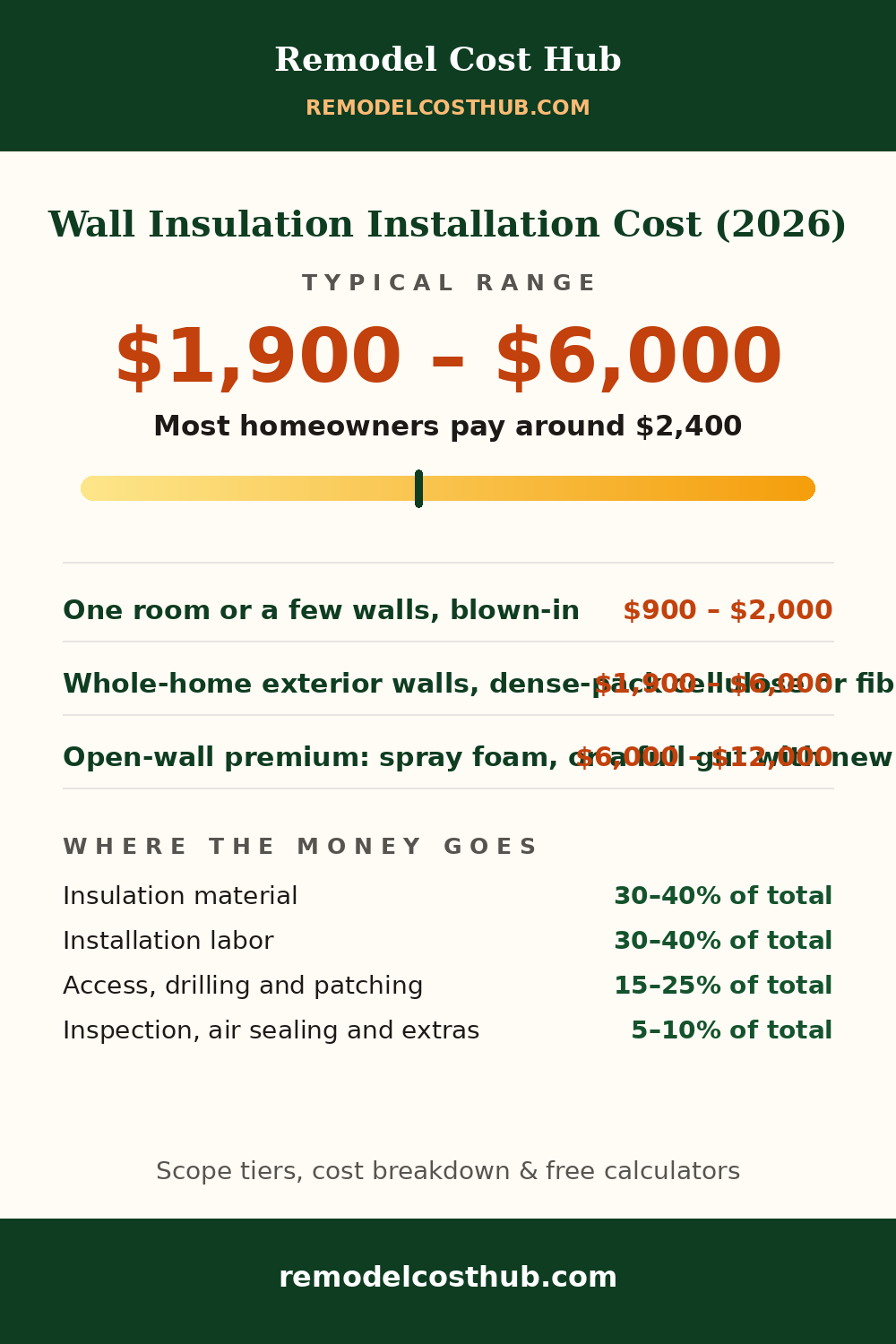
- Typical range: $1,900 – $6,000
- Most homeowners pay: around $2,400
- Prices vary most by: Insulation material (30–40% of the budget)
Cross-checked against two published sources for this project. Sources used for this page: Angi's wall insulation cost guide, updated October 20, 2026 (national average $2,400, most homeowners $1,150–$6,000, installed $1–$4 per square foot; batt material $0.30–$1.50, loose-fill $1–$2, spray foam $0.50–$2 and foam board $0.25–$2 per square foot; professional labor $0.25–$0.50 per square foot; removing and reinstalling drywall adds $1.50–$3 per square foot); HomeGuide's wall insulation guide ($1–$5 per square foot installed, $1,700–$8,500 for the exterior walls of an average 2,000-square-foot home; batt material $0.80–$1.75, blown-in $1.25–$2.50 and spray or injection foam $1.00–$2.50 per square foot) and its blown-in insulation guide ($1,900–$7,800 for a home's exterior walls); EngineerFix's existing-walls insulation guide (dense-pack cellulose $1.60–$4.20 per square foot installed, blown-in fiberglass $1.00–$2.80, closed-cell spray foam $3.00–$5.00; the drill-and-fill method). Typical band = Angi's most-pay band overlapped with HomeGuide's blown-in walls band; most-pay = Angi's published average.. Sources last checked: October 2026 — HomeGuide, Angi. How we calculate these costs
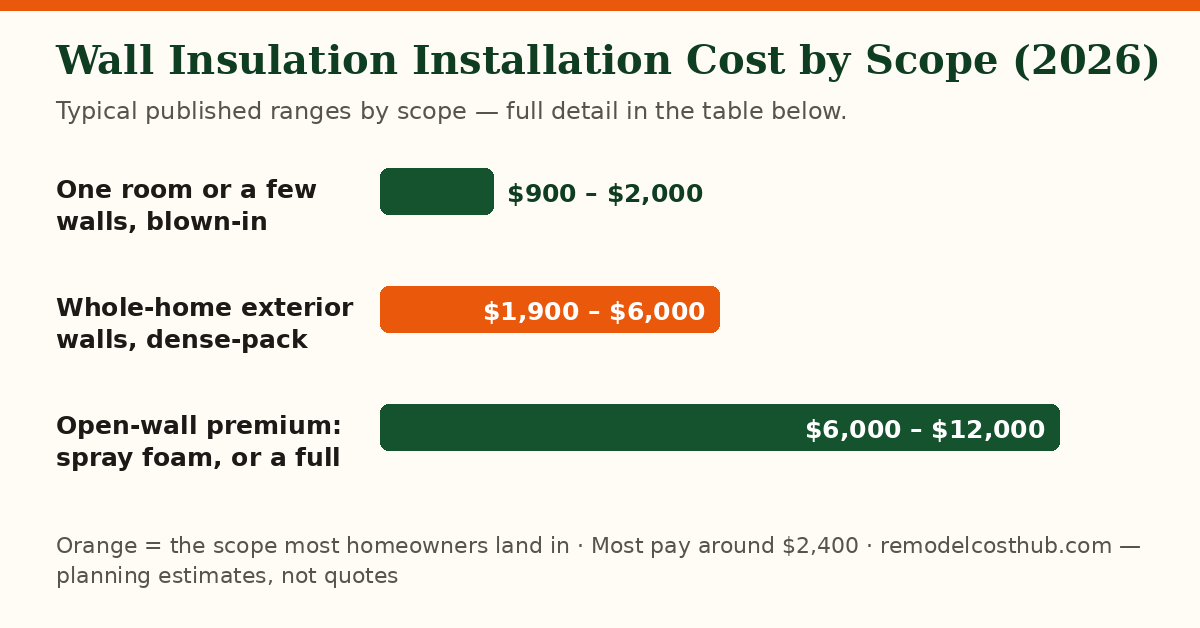
Cost by scope
| Scope | Typical cost | What it includes |
|---|---|---|
| One room or a few walls, blown-in | $900 – $2,000 | The cheap end: Angi prices blown-in jobs from $986 in its most-pay band, so a small scope — a few cold walls rather than the whole house — lands here, with patching limited to a handful of access holes |
| Whole-home exterior walls, dense-pack cellulose or fiberglass — the typical job | $1,900 – $6,000 | The shared band itself: Angi's $2,400 average inside $1,150–$6,000, against HomeGuide's $1,900–$7,800 for blown-in exterior walls — every exterior wall cavity filled, drilled, plugged and patched |
| Open-wall premium: spray foam, or a full gut with new drywall | $6,000 – $12,000 | The expensive end: EngineerFix prices closed-cell spray foam at $3.00–$5.00 per square foot installed, and Angi adds $1.50–$3 per square foot for removing and reinstalling drywall — the price of opening walls up, insulating them properly, and finishing them again |
Where the money goes
| Part of the job | Share | Note |
|---|---|---|
| Insulation material | 30–40% of total | The fill itself: Angi prices batt material at $0.30–$1.50 per square foot, loose-fill at $1–$2 and foam board at $0.25–$2, while HomeGuide prices blown-in material at $1.25–$2.50 — denser, higher-R material costs more per square foot |
| Installation labor | 30–40% of total | The crew and the blower: Angi prices professional labor at $0.25–$0.50 per square foot for wall work, and HomeGuide splits blown-in installed cost into $0.50–$2.80 material plus $0.50–$1.70 labor — closed walls take longer than open ones |
| Access, drilling and patching | 15–25% of total | The retrofit tax: drilling access holes, plugging them, taping and painting — HomeGuide notes drywall repair after a drill-and-fill job can add $300–$1,500+ depending on how many access points the walls needed |
| Inspection, air sealing and extras | 5–10% of total | The tail: finding the gaps first, sealing the worst air leaks around outlets and penetrations, and any moisture or venting fixes found once the walls are open |
What moves the price most
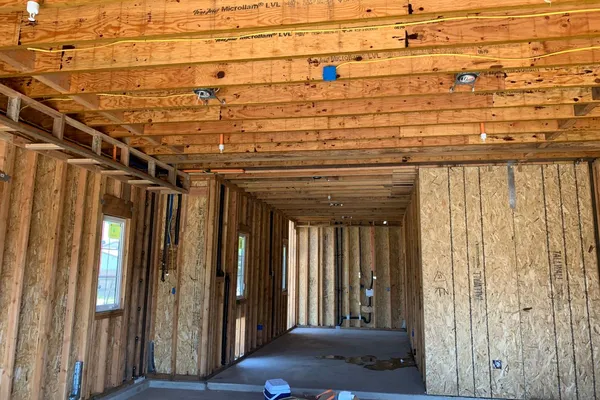
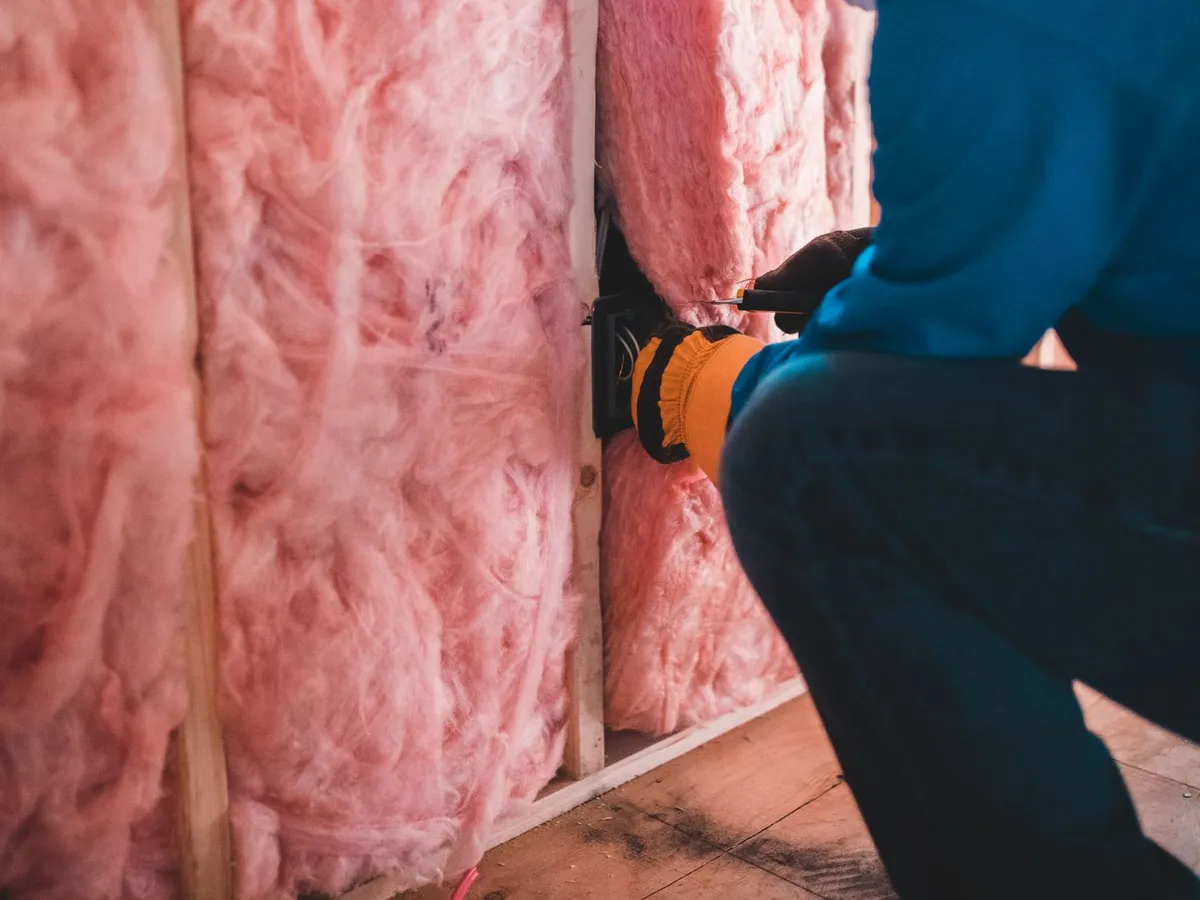
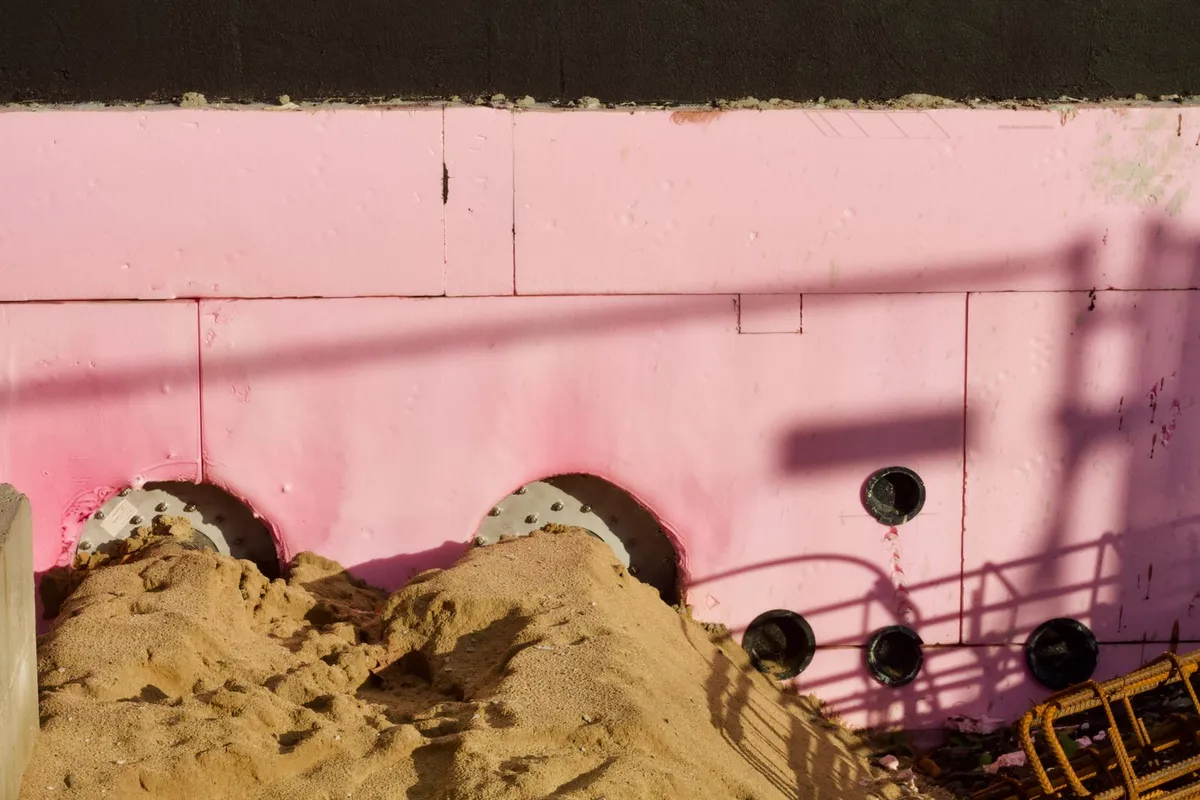
Open or closed walls decide most of it. Open cavities in new construction or a gut renovation take batts at Angi's $0.30–$1.50 per square foot material, while closed existing walls need the drill-and-fill route: EngineerFix prices dense-pack cellulose at $1.60–$4.20 per square foot installed and blown fiberglass at $1.00–$2.80. Material is second: fiberglass is cheapest, cellulose packs denser (R-3.2–R-3.8 per inch in EngineerFix's guide) and closed-cell spray foam is the premium at $3.00–$5.00 per square foot installed. Wall area and target R-value are third: HomeGuide's $1,700–$8,500 total is for the exterior walls of an average 2,000-square-foot home, so a bigger house or a colder climate target scales the bill directly. Finally, patching and paint: a retrofit leaves holes to fill, and the finish standard you ask for — paint-ready versus paint-included — is what separates a cheap quote from a finished wall. For the ceiling above these walls, see our attic insulation guide; for foam as the material itself, see our spray foam insulation guide.
Costs in your city
Labor is the biggest variable in any remodel, and labor is local — the same bathroom can price very differently in Houston than in Boston. We are adding city editions metro by metro, each with its own labor index, permit notes and climate factors, written for that city rather than copied from this page. Wave 1: Houston, Dallas–Fort Worth, Phoenix, Atlanta, Miami–South Florida, Orlando, Tampa, Charlotte, Austin and San Antonio. Until your city's page is live, use the national range here and weight it the way contractors do: Sun Belt labor often prices near or below the national middle, while coastal California and the Northeast metros often price well above it.
Frequently asked questions
How much does it cost to insulate walls?
Typically $1,900–$6,000 for the exterior walls of an average home, with about $2,400 the figure most jobs land near — Angi's national average of $2,400 inside its $1,150–$6,000 band, against HomeGuide's $1,900–$7,800 for blown-in exterior walls.
Can you insulate existing walls without removing the drywall?
Yes, with the drill-and-fill method: the crew drills small holes between studs, blows dense-pack cellulose or fiberglass into the cavities, then plugs and patches the holes. EngineerFix prices dense-pack cellulose at $1.60–$4.20 per square foot installed for exactly this job, and HomeGuide notes the patching can add $300–$1,500+ depending on the number of access points.
Blown-in cellulose or fiberglass batts — which is better for walls?
It depends on whether the wall is open or closed. Batts suit open cavities (Angi: $0.30–$1.50 per square foot material) and are the cheapest route where the wall is already open. Closed walls need blown-in material that flows around wires and boxes: HomeGuide prices blown-in at $1.25–$2.50 per square foot material, and cellulose packs denser than fiberglass for the same cavity.
Is spray foam worth it for walls?
Only where its air seal earns its premium: EngineerFix prices closed-cell spray foam at $3.00–$5.00 per square foot installed, roughly double dense-pack cellulose, but it seals air leaks that batts and blown-in cannot. For most existing-wall retrofits the cellulose or fiberglass tier is the value choice; foam earns its place in open walls, rim joists and problem walls. See our spray foam insulation guide for the full foam picture.
Does wall insulation include patching and painting?
Patching is part of a proper drill-and-fill quote, but painting often is not: HomeGuide flags drywall repair after insulation at $300–$1,500+ by access count, so confirm in writing whether the quote leaves walls paint-ready or fully painted. A quote that skips patching is not a finished job.
How is wall insulation different from attic insulation?
Walls are priced by wall area and need access work — drilling, plugging and patching — while an attic is a flat, open floor that takes blown-in material with no patching at all. That is why this guide's $1,900–$6,000 wall band sits above our attic insulation guide at $1,700–$2,500 for an average attic, even though the materials overlap.