EV Charger Installation cost at a glance
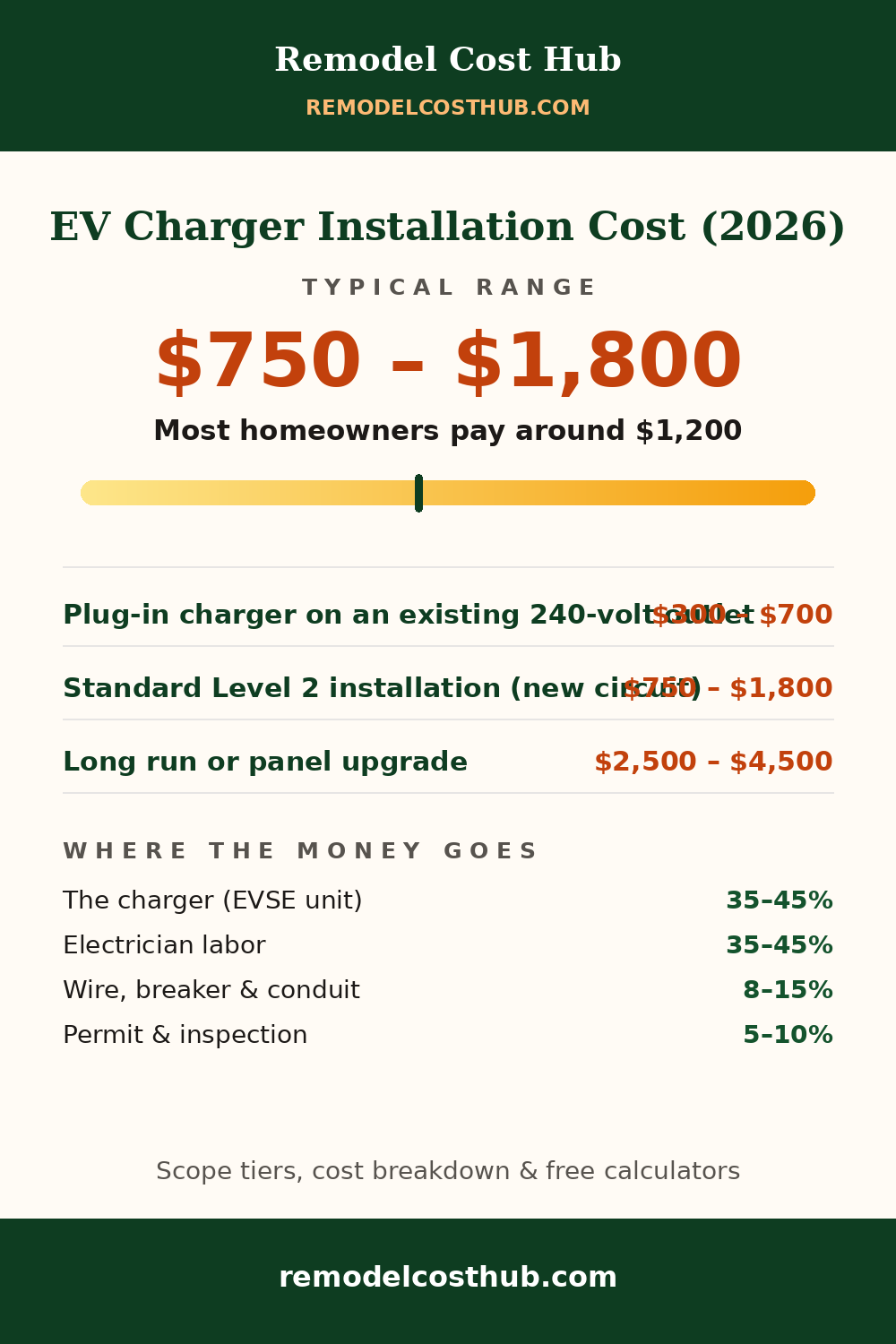
- Typical range: $750 – $1,800
- Most homeowners pay: around $1,200
- Prices vary most by: The charger (EVSE unit) (35–45% of the budget)
Cross-checked against three published sources for this project. Sources used for this page: Angi's EV charger installation cost guide, HomeGuide's published EV charging station cost data and FixUpFirst's EV charger installation cost guide. Sources last checked: October 2026 — HomeGuide, Angi. Last updated October 2026 · How we calculate these costs
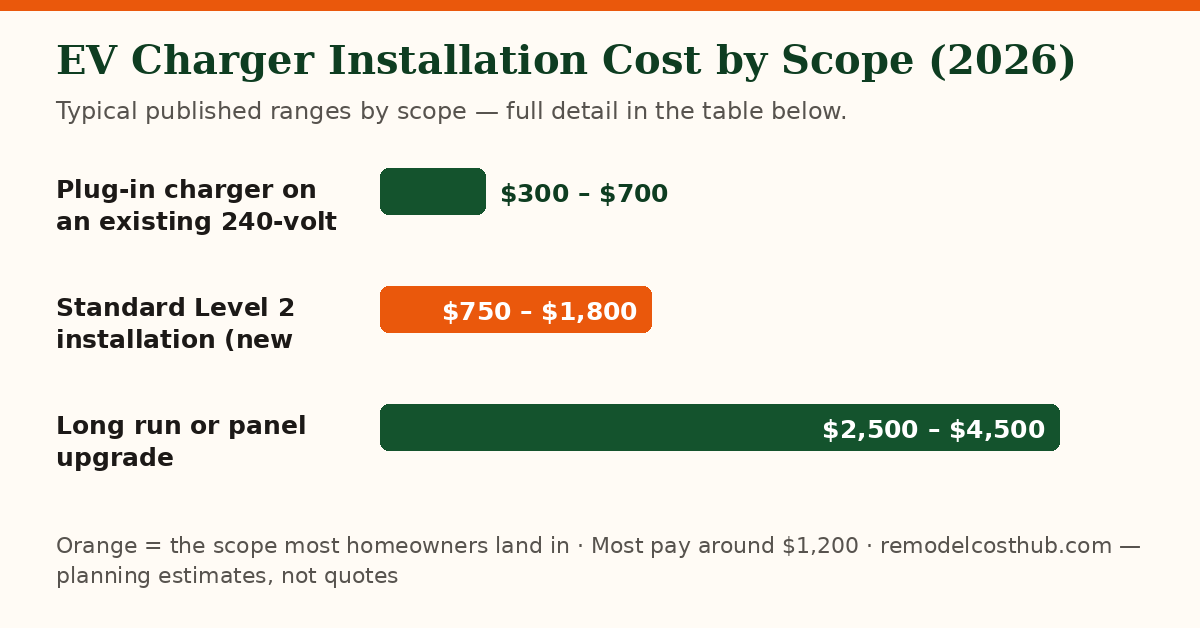
Cost by scope
| Scope | Typical cost | What it includes |
|---|---|---|
| Plug-in charger on an existing 240-volt outlet | $300 – $700 | The charger only, where a suitable outlet already exists by the parking spot. FixUpFirst prices Level 2 hardware at $200–$700 and its existing-outlet scenario at $200–$700 all-in; Angi prices Level 1 stations at $300–$600 and Level 2 hardware from $300. No electrician is needed to plug in — the circuit check still is. |
| Standard Level 2 installation (new circuit) | $750 – $1,800 | The typical project on this page: charger, a new dedicated circuit and a short wire run. Angi's professional-installation band is $552–$1,379 with a $965 average, HomeGuide publishes $750–$2,600 with professional installation, and FixUpFirst puts most homeowners at $1,000–$1,800 all-in with the charger included. |
| Long run or panel upgrade | $2,500 – $4,500 | A panel at the far end of the house, a detached garage, or a full 100-amp panel. FixUpFirst budgets $2,500–$4,500 with a panel upgrade (the upgrade alone at $1,500–$3,000, or a load-management device at $200–$500), Angi budgets a panel upgrade at $800–$2,000 on top of the install, and its Level 2 totals run to $2,000 and beyond before that work. |
Where the money goes
| Part of the job | Share | Note |
|---|---|---|
| The charger (EVSE unit) | 35–45% | The wall unit itself: FixUpFirst prices Level 2 hardware at $200–$700 — budget units at $200–$350, smart mid-range at $350–$500 and premium 48-amp units at $500–$700+; Angi's stations run from $300, with Level 2 units easily exceeding $1,000 at the feature-heavy end |
| Electrician labor | 35–45% | Fitting the circuit, mounting the charger and testing it: FixUpFirst prices a short-run installation at $500–$1,000 of labor with $100–$300 of materials, and $1,000–$2,000 of labor on long or difficult runs; Angi's installers work to the same structure, with distance from the panel the deciding variable |
| Wire, breaker & conduit | 8–15% | The dedicated 240-volt circuit between panel and charger: FixUpFirst allows $100–$300 of wire, breaker and conduit on a short run and $200–$500 on a long one, where thicker copper is needed against voltage drop |
| Permit & inspection | 5–10% | The electrical permit and the inspection that closes it: Angi budgets permits at $150–$200, FixUpFirst at $50–$200 depending on the city — small money that decides whether the installation is insurable and saleable |
What moves the price most
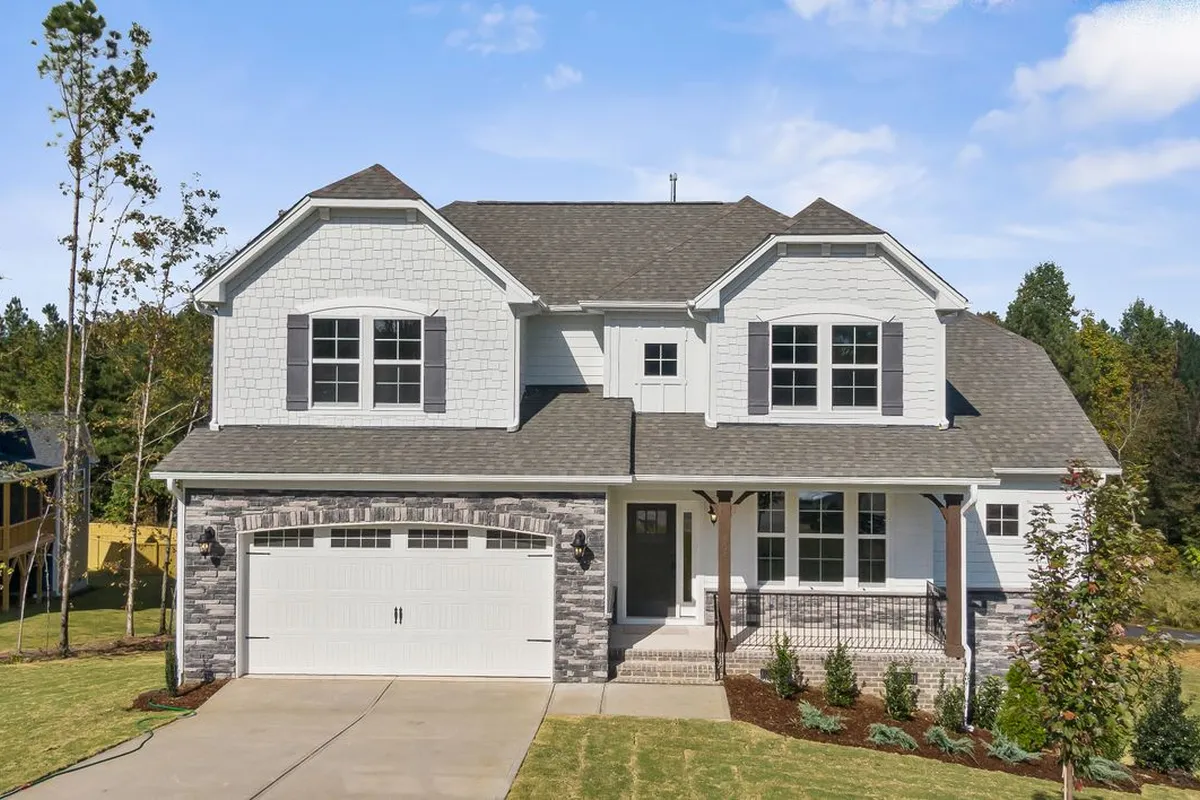
The panel decides the tier. FixUpFirst's rule is the one every electrician quotes: a 200-amp panel with open slots is usually fine, while a 100-amp or full panel needs a $1,500–$3,000 upgrade or a $200–$500 load-management device; Angi budgets panel upgrades at $800–$2,000. Distance is the second lever: the same charger on a short run installs at $600–$1,300 all-in in FixUpFirst's worked scenarios, against $1,200–$2,500 for a long run through finished construction. Charger choice is the third: hardware spans $200–$700 in FixUpFirst and past $1,000 in Angi at the smart, high-amperage end — speed and app features, not charging ability, are what the extra money buys, since Level 2 charging at 25–40 miles of range per hour covers an overnight charge either way. Finally, incentives change the net, not the quote: the federal 30C credit has covered 30% of equipment and installation up to $1,000 for qualifying homes, and FixUpFirst and Angi both note utility rebates on top — check current eligibility for your address rather than assuming it.
Worked example: how a typical ev charger installation budget breaks down
A typical job: a mid-range 40-amp Level 2 charger hardwired on a new dedicated 240-volt circuit, panel in the garage with spare capacity, a wire run under 25 feet, permit pulled and inspection passed. The budget below totals $1,200 — the "most homeowners pay around" figure from the top of this page — split using this page's own cost breakdown. It shows how a real quote at that level is usually composed; every line is built from the ranges on this page, and it is an illustration, not a quote for your project.
| Line item | Example budget |
|---|---|
| Level 2 charger (40-amp, smart) | $480 |
| Electrician labor (circuit, mounting, testing) | $480 |
| Wire, breaker and conduit (short run) | $144 |
| Permit and inspection | $96 |
| Total | $1,200 |
What most people get wrong
- Buying the charger before the load calculation — FixUpFirst's panel check (200-amp with open slots versus 100-amp or full) decides whether the job is $1,200 or $2,500–$4,500; the charger is the one part that can be returned, and the panel work is the part that cannot be skipped.
- Comparing quotes without the wire run — the same installation is $600–$1,300 on a short run and $1,200–$2,500 on a long one in FixUpFirst's scenarios; a quote that never states the distance is not yet a quote.
- Skipping the permit to save $50–$200 — both Angi ($150–$200) and FixUpFirst ($50–$200) price it as a small line; unpermitted 240-volt work can void insurance and surfaces when the house is sold.
- Paying for amperage the car cannot use — hardware runs $200–$700 in FixUpFirst and past $1,000 in Angi, and the premium buys speed only up to the car's own charging limit; check the vehicle's maximum rate before paying for a 48-amp unit.
Costs in your city
Charger pricing is electrician pricing plus your permit office: labor is the local half of the bill, and permit fees run $50–$200 in FixUpFirst and $150–$200 in Angi depending on the jurisdiction. Housing stock travels with the city — newer suburbs with 200-amp panels and garage panels are standard-tier jobs, while older city housing with 100-amp service and detached garages is where the panel-upgrade and long-run tiers live. The charger itself is national retail everywhere, and utility rebates vary by provider rather than by city. Ask each electrician for the load calculation, the wire-run distance in the quote, and whether permit and inspection are inside the number.
Frequently asked questions
How much does it cost to install a Level 2 EV charger at home?
Angi's professional installations run $552–$1,379 with a $965 average, HomeGuide publishes $750–$2,600 with professional installation, and FixUpFirst puts most homeowners at $1,000–$1,800 all-in including the charger. A standard job — new circuit, short run, spare panel capacity — lands around $1,200.
Do I need to upgrade my electrical panel for an EV charger?
Only if it lacks capacity. FixUpFirst's check: a 200-amp panel with open breaker slots is probably fine, while a 100-amp service or a full panel points to a $1,500–$3,000 upgrade or a $200–$500 load-management device that throttles the charger when other big loads run. Angi budgets panel upgrades at $800–$2,000. The load calculation is part of a proper quote — a quote given without one is a guess.
How much does the charger itself cost?
FixUpFirst prices Level 2 hardware at $200–$700: basic 40-amp units at $200–$350, Wi-Fi smart chargers at $350–$500 and premium 48-amp units at $500–$700 or more. Angi's Level 2 stations start at $300 and can exceed $1,000. Every unit charges the same overnight job; the spread buys amperage, cable length and app features.
Can I install a home EV charger myself?
The plug-in end, yes; the circuit, no. FixUpFirst is explicit: mounting a plug-in charger on an existing 240-volt outlet is a homeowner job, but running a new 240-volt circuit means working inside the panel, pulling a permit and passing inspection, and Angi makes the same licensed-electrician recommendation. Unpermitted circuit work can void insurance and surface at resale.
Is Level 1 charging enough, or do I need Level 2?
It depends on the commute. FixUpFirst puts Level 1 at 3–5 miles of range per hour — 30–50 miles overnight — which covers plug-in hybrids and commutes under about 40 miles, using the cable that came with the car at no installation cost. Level 2 delivers 25–40 miles per hour and a full battery overnight, which is why it is the installation most EV owners end up buying.