Driveway Extension cost at a glance
- Typical range: $800 – $3,000
- Most homeowners pay: around $1,900
- Per square foot: $3 – $12 per sq ft
Cross-checked against four published sources for this project. Sources used for this page: Angi, 'How Much Does a Driveway Extension Cost? [2026 Data]', angi.com/articles/should-you-widen-your-driveway.htm, updated October 10, 2026, Barbara Bellesi Zito, read in full 2026-11-25 (national average $1,900; most homeowners spend $800-$3,000; average for a 200-square-foot concrete installation; materials: concrete $10 per square foot, asphalt $2.50-$5 per square foot at 4 inches thick ($100-$200 per ton), gravel $4-$5, brick $10-$15, pavers $15-$30; shape of extension, location and condition of the yard drive labour costs; budget for permits, demolition of existing pavement and material disposal; permits typically needed where an extension meets or intersects a public road; drainage systems to consider; sealing every 1-3 years; HOA may not allow an extension), HomeGuide, 'How Much Does a Driveway Cost? (2026)', homeguide.com/costs/driveway-cost, updated December 19, 2025, read in full 2026-11-25 (driveway extension $3-$12 per square foot; adding 200 square feet $600-$2,400; driveway by material: concrete $4-$8 per square foot in the comparison table and $6-$15 in the concrete section ($2,400-$8,600 for a standard two-car driveway), asphalt $3-$7 in the table and $5-$12+ in the asphalt section ($3,000-$7,200 for 600 sq ft), gravel $1-$3 per square foot material and $4-$10 installed, pavers $10-$30; labour 50% of the total project cost; excavation $1-$5 per square foot; grading and site prep $5-$8 per square foot; drainage $400-$2,400; permit $50-$200; concrete lasts 30-40 years, asphalt 15-30; asphalt takes 48-72 hours minimum to cure, concrete 7-10 days, gravel and pavers immediately; sealing $1-$2 per square foot), Asphalt Calculator, 'Driveway Extension Cost: Adding a Parking Pad', asphaltcalculator.shop/blog/driveway-extension-cost/, published May 15, 2026, updated June 17, 2026, read in full 2026-11-25 (asphalt extensions $6-$12 per square foot installed, national averages around $7-$9; single-car parking pad 10x20 ft $1,200-$2,400; side strip 4x50 ft $1,200-$2,400; boat or trailer pad 10x30 ft $1,800-$3,600; RV pad 12x30 ft $2,500-$4,500; two-car parking pad 20x20 ft $2,400-$4,800; cost shares for an asphalt extension: asphalt material 25-40%, mobilization 20-35%, base prep 10-20%, tie-in to existing 5-15%, hauling and disposal 5-15%; standard residential extension 2.5-3 inches compacted asphalt over a 4-6 inch base, RV pads 3-4 inches over a 6-8 inch base; the seam is always visible and converges in colour over 1-2 years; saw-cut the existing driveway, tack coat the cut, match thickness, sealcoat both surfaces together 6-12 months after install; permits usually needed if the extension changes the curb cut or touches the public right of way; alternatives: asphalt millings $1-$3, gravel pad $1-$4, concrete pad $8-$15, pavers $15-$30 per square foot), and Lakewood Ranch Concrete, 'Concrete Driveway Cost in Lakewood Ranch & Bradenton (2026)', lakewoodranchconcretefl.com/blog/concrete-driveway-cost/, published November 17, 2026, Rafael (owner), read in full 2026-11-25 (new 4-inch concrete driveway $8-$12 per square foot installed, 600 sq ft $4,800-$7,200; tear-out and replace $11-$16; stamped $15-$24; exposed aggregate $13-$19; integral/broadcast colour +$1.50-$3.50; driveway widening per added strip $9-$14 per square foot installed, tied to the existing slab; extra base prep on poor subgrade $2-$5 per square foot; penetrating sealer $0.85-$1.75 per square foot, reapply about every 3 years; a 10x20 ft widening strip $1,800-$2,800; widening usually cheaper than replacing if the existing slab is sound; walk on it the next day, cars off about 7 days; the apron usually sits in the public right-of-way and needs a right-of-way or driveway permit). INDEPENDENCE: the three independent confirmations are the Angi/HomeGuide dataset, Asphalt Calculator and Lakewood Ranch Concrete; no two of the three share a publisher or a data table. SCOPE DISAGREEMENT, published not averaged away: the asphalt rate — Angi's $2.50-$5 per square foot is the material at 4 inches thick, Asphalt Calculator's $6-$12 is installed, and HomeGuide's own table says $3-$7 while its asphalt section says $5-$12 or more; the concrete rate — Angi's $10 per square foot against HomeGuide's $6-$15 in its section and $4-$8 in its table, and Lakewood Ranch Concrete's $8-$12 new and $9-$14 for a widening strip; the headline — Angi's $800-$3,000 most-pay band and $1,900 average against HomeGuide's $600-$2,400 for 200 sq ft and Asphalt Calculator's $1,200-$2,400 asphalt pad; the permit — HomeGuide's $50-$200 against the permit-when-it-meets-the-road rule in Angi and Asphalt Calculator; the dates — Angi updated October 10, 2026, HomeGuide updated December 19, 2025, Asphalt Calculator updated June 17, 2026, Lakewood Ranch Concrete published November 17, 2026. Synthesized typical $800-$3,000 = Angi's most-pay band, corroborated by HomeGuide's 200 sq ft $600-$2,400 overlapping it and Asphalt Calculator's asphalt pad $1,200-$2,400 sitting inside it; most-pay $1,900 = Angi's published average, labelled as such. Asphalt Calculator publishes % shares for an asphalt extension (material 25-40%, mobilization 20-35%, base prep 10-20%, tie-in 5-15%, hauling 5-15%), but those shares cover asphalt only while this page covers all materials, so there is no share bar on this page; the shares are recorded in the factors instead. A per-square-foot rate exists for an extension ($3-$12 in HomeGuide), so there IS a per-sq-ft glance row. Angi's $4,900 concrete-extension figure in its value section is NOT used — its scope is undefined and it conflicts with the same page's $800-$3,000 band. Checked November 2026.. Sources last checked: October 2026 — HomeGuide, Angi, Asphalt Calculator, Lakewood Ranch Concrete. How we calculate these costs
Cost by scope
| Scope | Typical cost | What it includes |
|---|---|---|
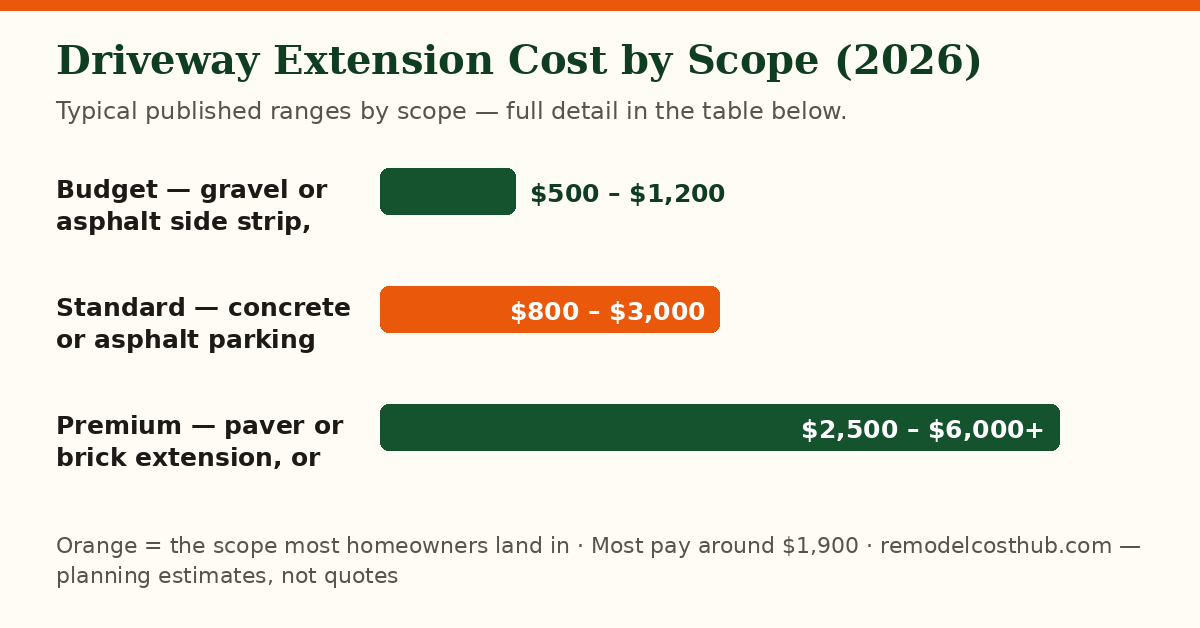
| Budget — gravel or asphalt side strip, about 100–200 sq ft | $500 – $1,200 | Gravel is the cheapest extension material at $4–$5 per square foot in Angi, so a 100–200 sq ft gravel strip lands at $400–$1,000 before site work, and HomeGuide prices gravel material lower still at $1–$3 per square foot. Asphalt Calculator's cheapest asphalt pad, a 10-by-20 single-car pad, starts at $1,200 — so a small asphalt strip at the bottom of this tier is a materials-and-minimums job, and most asphalt work lands in the standard tier |
| Standard — concrete or asphalt parking pad, about 200 sq ft | $800 – $3,000 | The typical project on this page. Angi prices the job at $800–$3,000 with a $1,900 average for a 200 sq ft concrete installation, HomeGuide prices adding 200 sq ft at $600–$2,400, and Asphalt Calculator prices a 10-by-20 asphalt pad at $1,200–$2,400 — a second parking bay beside the existing drive, in the material the house already has |
| Premium — paver or brick extension, or an RV or heavy pad | $2,500 – $6,000+ | The expensive end: pavers run $15–$30 per square foot installed in Angi, so a 200 sq ft paver extension lands at $3,000–$6,000, and Asphalt Calculator prices an RV pad with a thicker section at $2,500–$4,500 and a two-car pad at $2,400–$4,800 — the top of this tier is a premium surface or a pad built for heavy weight, not a bigger strip of the same work |
Where the money goes
| Part of the job | Share | Note |
|---|---|---|
| Surface material — priced by type | No published share | The biggest line and the widest spread: Angi prices concrete at about $10 per square foot, asphalt at $2.50–$5, gravel at $4–$5, brick at $10–$15 and pavers at $15–$30 — and HomeGuide prices an extension at $3–$12 per square foot across materials, so the material choice is the budget choice. |
| Base prep, excavation & grading | No published share | What the new section sits on: HomeGuide prices excavation at $1–$5 per square foot and grading and site prep at $5–$8, Lakewood Ranch Concrete prices extra base prep on poor subgrade at $2–$5, and Asphalt Calculator puts base prep at 10–20% of an asphalt extension — the new section has to match the structural depth of the old one or it breaks out at the seam. |
| Tie-in to the existing driveway | No published share | Where new meets old: Asphalt Calculator puts the tie-in at 5–15% of an asphalt extension — a saw cut on the existing driveway, edge prep and a tack coat, with the new section matched to the old thickness — and Lakewood Ranch Concrete prices a widening strip doweled into the old slab at $9–$14 per square foot. |
| Mobilization & labour | No published share | The small-job premium: Asphalt Calculator puts mobilization at 20–35% of an asphalt extension, higher than on a full driveway, because the paver, roller, transfer trucks and crew have to mobilize for a small area, and HomeGuide puts labour at 50% of a driveway total. |
| Drainage & the street apron | No published share | Water has to go somewhere: HomeGuide prices adding a drainage system at $400–$2,400 for trenches or channels along the driveway, an extension may need a new paved apron where it meets the public street, and Lakewood Ranch Concrete notes the apron usually sits in the public right-of-way. |
| Permits & HOA approval | No published share | HomeGuide prices a driveway permit at $50–$200; Angi notes extensions typically need permits where they meet or intersect a public road, Asphalt Calculator notes a permit is usually needed if the extension changes the curb cut or touches the public right-of-way, and an HOA can refuse the extension outright. |
| Removal of old pavement, where needed | No published share | Only where the extension replaces part of the old drive: HomeGuide prices removing an old driveway at $1–$3 per square foot including haul-away, and Angi tells owners to budget for demolition and material disposal alongside the permit. |
| Sealing & finishing | No published share | HomeGuide prices sealing at $1–$2 per square foot, Lakewood Ranch Concrete prices a penetrating sealer at $0.85–$1.75 per square foot reapplied about every three years, Angi advises sealing every one to three years, and Asphalt Calculator advises waiting 6–12 months after install, then sealing old and new together so the seam blends. |
What moves the price most
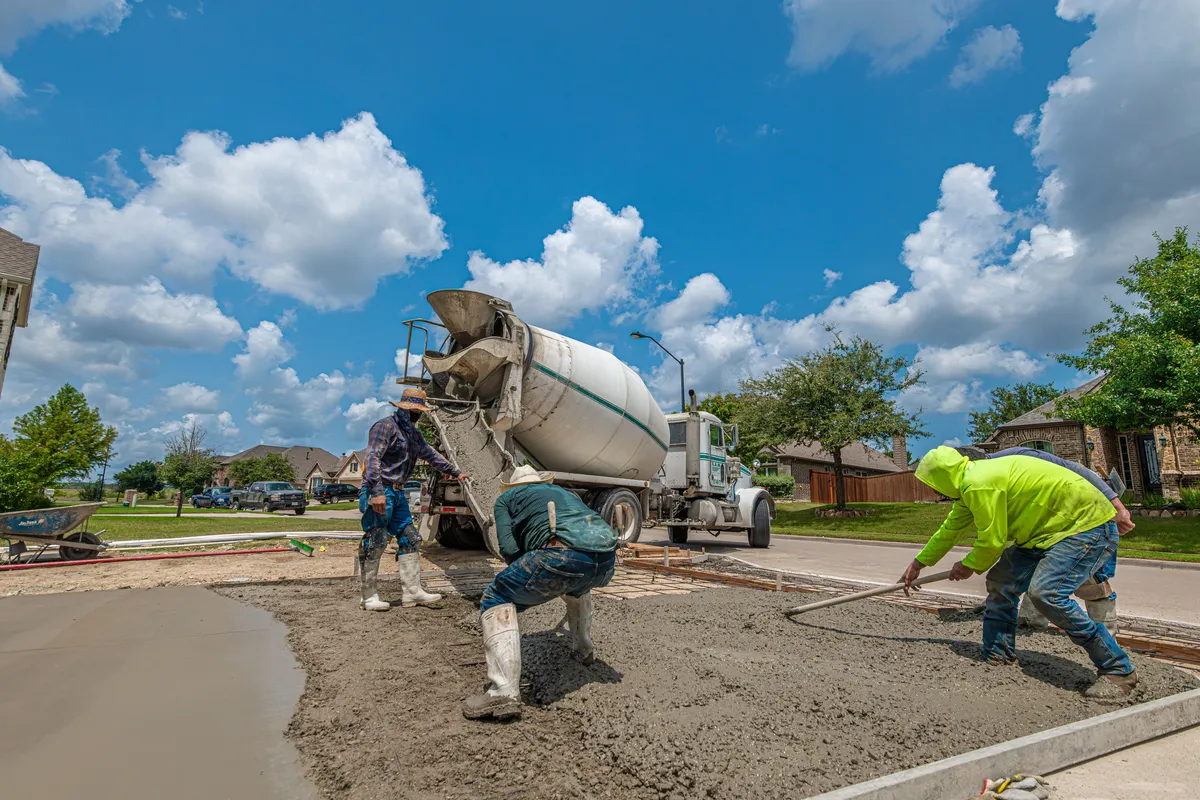
An extension is not a new driveway. This page prices adding paved area to the driveway you already have — a side strip, a second parking bay or an RV pad tied into the existing slab. A whole new driveway is a different job, priced on the concrete driveway guide, and replacing the old one is priced on the driveway replacement guide. Material is first: Angi prices concrete at about $10 per square foot, asphalt at $2.50–$5, gravel at $4–$5, brick at $10–$15 and pavers at $15–$30, and HomeGuide prices an extension at $3–$12 per square foot across materials — the same 200 sq ft can cost $600 or $6,000 on material alone. Size is second: a 10-by-20 extension adds 200 sq ft, enough for one more car, and every published guide prices from that unit — Angi's $1,900 average is for a 200 sq ft concrete installation and Asphalt Calculator's pad table runs from a 10-by-20 single-car pad at $1,200–$2,400 to a 20-by-20 two-car pad at $2,400–$4,800. The tie-in is third, and it is the line most budgets miss: a saw cut on the old driveway, a tack coat, and a new section matched to the old thickness, priced at 5–15% of an asphalt extension in Asphalt Calculator and at $9–$14 per square foot for a concrete strip doweled into the old slab in Lakewood Ranch Concrete — feathering new asphalt over old, or pouring thinner than the existing slab, is how extensions break out at the seam. Small jobs cost more per square foot: Asphalt Calculator puts mobilization at 20–35% of an asphalt extension because the crew and the trucks cost the same for 200 sq ft as for 600, which is why its asphalt rate runs $6–$12 installed while Angi's $2.50–$5 is the material at 4 inches thick. Drainage and the street apron are fourth: HomeGuide prices drainage at $400–$2,400 and notes an extension may need a new apron where it meets the street, and the apron usually sits in the public right-of-way, so the permit belongs to whoever owns that road. DIY versus pro is fifth: hot-mix asphalt is paver-and-roller work in Asphalt Calculator, but an owner can DIY the base prep, excavation and edge cleanup before the crew arrives, and gravel is the one material a careful owner can lay alone. Where sources disagree: the asphalt rate — Angi's $2.50–$5 per square foot is the material at 4 inches thick, Asphalt Calculator's $6–$12 is installed, and HomeGuide's own table says $3–$7 while its asphalt section says $5–$12 or more; the concrete rate — Angi's $10 against HomeGuide's $6–$15 in its section and $4–$8 in its table, and Lakewood Ranch Concrete's $8–$12 new and $9–$14 for a widening strip; the headline — Angi's $800–$3,000 most-pay band and $1,900 average against HomeGuide's $600–$2,400 for 200 sq ft and Asphalt Calculator's $1,200–$2,400 asphalt pad. Timeline: a small extension is a day or two of fieldwork in Lakewood Ranch Concrete, then the cure — cars off asphalt for 48–72 hours and off concrete for 7–10 days in HomeGuide. Methodology: figures cross-checked across Angi's driveway extension guide, updated October 10, 2026 (read in full 2026-11-25), HomeGuide's driveway cost guide, updated December 19, 2025 (read in full 2026-11-25), Asphalt Calculator's driveway extension guide, published May 15, 2026 and updated June 17, 2026 (read in full 2026-11-25) and Lakewood Ranch Concrete's concrete driveway cost guide, published November 17, 2026 (read in full 2026-11-25). The three independent confirmations are the Angi/HomeGuide dataset, Asphalt Calculator and Lakewood Ranch Concrete. Related costs: concrete driveway, asphalt driveway, excavation, yard grading, concrete slab installation and Remodel Cost Index.
Costs in your city
Labor is the biggest variable in any remodel, and labor is local — the same bathroom can price very differently in Houston than in Boston. We are adding city editions metro by metro, each with its own labor index, permit notes and climate factors, written for that city rather than copied from this page. Wave 1: Houston, Dallas–Fort Worth, Phoenix, Atlanta, Miami–South Florida, Orlando, Tampa, Charlotte, Austin and San Antonio. Until your city's page is live, use the national range here and weight it the way contractors do: Sun Belt labor often prices near or below the national middle, while coastal California and the Northeast metros often price well above it.
Frequently asked questions
How much does a driveway extension cost?
Typically $800–$3,000 for a standard 200 sq ft extension, with about $1,900 the figure most jobs land near — $1,900 is Angi's published average for the job, not a figure averaged across the guides. A small gravel or asphalt strip lands below the band and a paver extension or an RV pad lands above it.
How much does a driveway extension cost per square foot?
About $3–$12 per square foot for an extension in HomeGuide, with the material deciding where inside that band a job lands — Angi prices concrete at about $10, asphalt at $2.50–$5, gravel at $4–$5, brick at $10–$15 and pavers at $15–$30 per square foot. The asphalt figures disagree by scope: Angi's $2.50–$5 is the material at 4 inches thick, while Asphalt Calculator's $6–$12 is the installed price.
Is it cheaper to extend a driveway than to replace it?
Usually, if the existing slab is sound. Lakewood Ranch Concrete prices a widening strip doweled into the current driveway at $9–$14 per square foot, so adding a 10-by-20 strip costs about $1,800–$2,800, while tearing out and replacing a 600 sq ft driveway runs $6,600–$9,600 at its $11–$16 rate. If the old slab is badly cracked or sunken, widening only ties new concrete to a failing one.
Do I need a permit to extend my driveway?
Often, yes if the extension touches the public right-of-way or changes the curb cut. HomeGuide prices a driveway permit at $50–$200, Angi notes permits are typically needed where an extension meets or intersects a public road, and Asphalt Calculator notes side and rear extensions on private property usually do not need one — local rules vary, so check with the local building department before starting.
Can the new driveway be matched to the old one?
Not exactly. Asphalt Calculator is blunt about it: the seam where new meets old will be visible, because new asphalt is darker than aged asphalt, and the two converge in color over 1–2 years. A clean saw cut, a tack coat on the cut, matching the new thickness to the old, and sealing both surfaces together 6–12 months after install give the best long-term result.
How long before I can drive on a driveway extension?
HomeGuide puts asphalt at 48–72 hours minimum to cure and concrete at 7–10 days before it cures enough for a passenger car, while gravel and paver driveways can be driven on immediately after installation. Lakewood Ranch Concrete advises walking on new concrete the next day but keeping cars off for about seven days.