Dry Well Installation cost at a glance
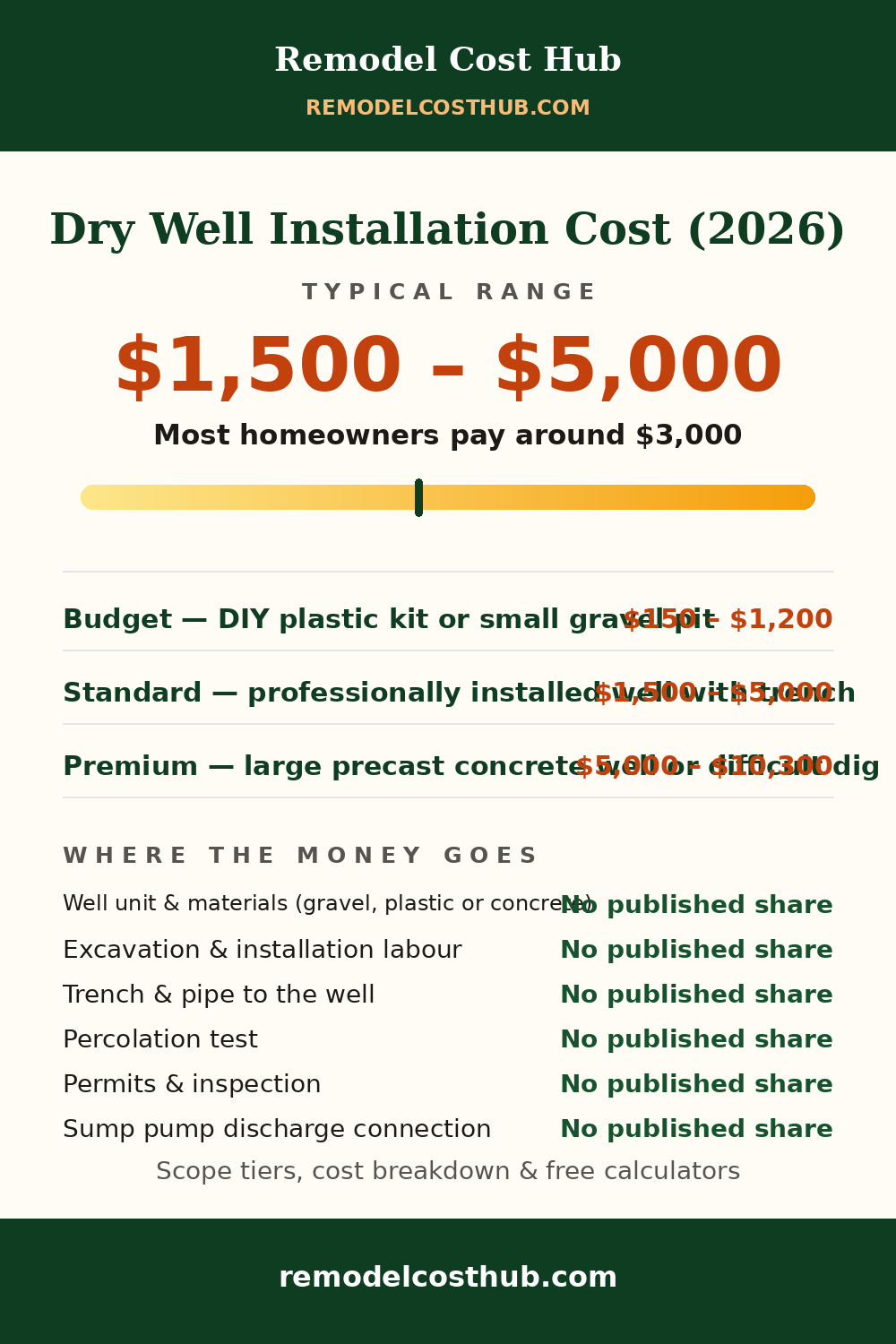
- Typical range: $1,500 – $5,000
- Most homeowners pay: around $3,000
Cross-checked against three published sources for this project. Sources used for this page: Angi, 'How Much Does Dry Well Installation Cost? [2026 Data]', angi.com/articles/dry-well-installation-cost.htm, updated October 15, 2026, read in full 2026-11-27 (national average $3,110 from 1,339 verified projects; most homeowners pay $1,334-$5,139; concrete systems up to $10,300; type materials gravel $50-$250, plastic $90-$650, concrete $300-$4,500+; by volume 50-250 gallons $500-$1,200, 250-500 gallons $1,200-$4,400, 500-3,000 gallons $4,400+; labour $50-$100 per hour; perc test $150-$1,000; permit $25-$50, renewed every five years; DIY materials $185-$385; maintenance $45-$150 per hour; at least 10 feet from the house, 3 feet from the property line), Reckon Home, 'Dry Well Installation Cost (2026)', reckonhome.com/basement/dry-well-cost/, updated November 6, 2026, read in full 2026-11-27 (installed $1,500-$6,000, about $3,000 typically including the trench; plastic modular $1,000-$3,500, gravel pit $1,200-$4,000, precast concrete $2,500-$7,000; DIY plastic kit $150-$600 materials; trench and pipe $15-$40 per foot, $300-$2,000 for a typical 10-50 foot run; sump pump discharge connection $300-$1,200; perc test and permit $100-$300 typical, perc test alone $100-$500; rock or hard clay excavation add $500-$3,000; lasts 20-30 years, concrete longer; clean annually; clay soil drains poorly), and HomeGuide, 'How Much Does Dry Well Installation Cost? (2026)', homeguide.com/costs/dry-well-installation-cost, published December 17, 2025, read in full 2026-11-27 ($1,200-$5,200 average; by size 50-250 gallons $500-$1,200, 250-500 gallons $1,200-$5,200, 500+ gallons $5,200+; type materials gravel $50-$250, plastic $90-$650, concrete $300-$4,500+; perc test $200-$3,000+ by method; labour $5-$13 per linear foot; well inspection $250-$550; depth 5-6 feet ideal; clean annually; French drain $10-$35 per linear foot or $500-$8,800 total, sump pump $600-$2,500). INDEPENDENCE: Angi and HomeGuide share the type table ($50-$250 / $90-$650 / $300-$4,500+) and the 50-250 gallon size row ($500-$1,200) — one dataset for those rows; Reckon Home is the independent check and corroborates the headline band and the ~$3,000 typical. SCOPE DISAGREEMENT, published not averaged away: the headline — Angi's most-pay $1,334-$5,139 against Reckon Home's $1,500-$6,000 and HomeGuide's $1,200-$5,200; the perc test — Angi's $150-$1,000 against Reckon Home's $100-$500 and HomeGuide's $200-$3,000+ by method; the concrete well — Reckon Home's $2,500-$7,000 installed against Angi's up to $10,300; the dates — Angi updated October 15, 2026, Reckon Home updated November 6, 2026, HomeGuide published December 17, 2025. Synthesized typical $1,500-$5,000 = the honest overlap of the three bands ($1,500-$5,139); most-pay $3,000 = Reckon Home's published typical, corroborated by Angi's $3,110 average. The ONLY published figures are dollars — no source publishes % shares, so there is no share bar on this page and no estimator's note; the 'Prices vary most by' glance row does not render. There is no per-square-foot rate for a dry well, so there is NO per-sq-ft glance row; the trench is priced per linear foot ($15-$40). Checked November 2026.. Sources last checked: October 2026 — HomeGuide, Angi, Reckon Home. How we calculate these costs
Cost by scope
| Scope | Typical cost | What it includes |
|---|---|---|
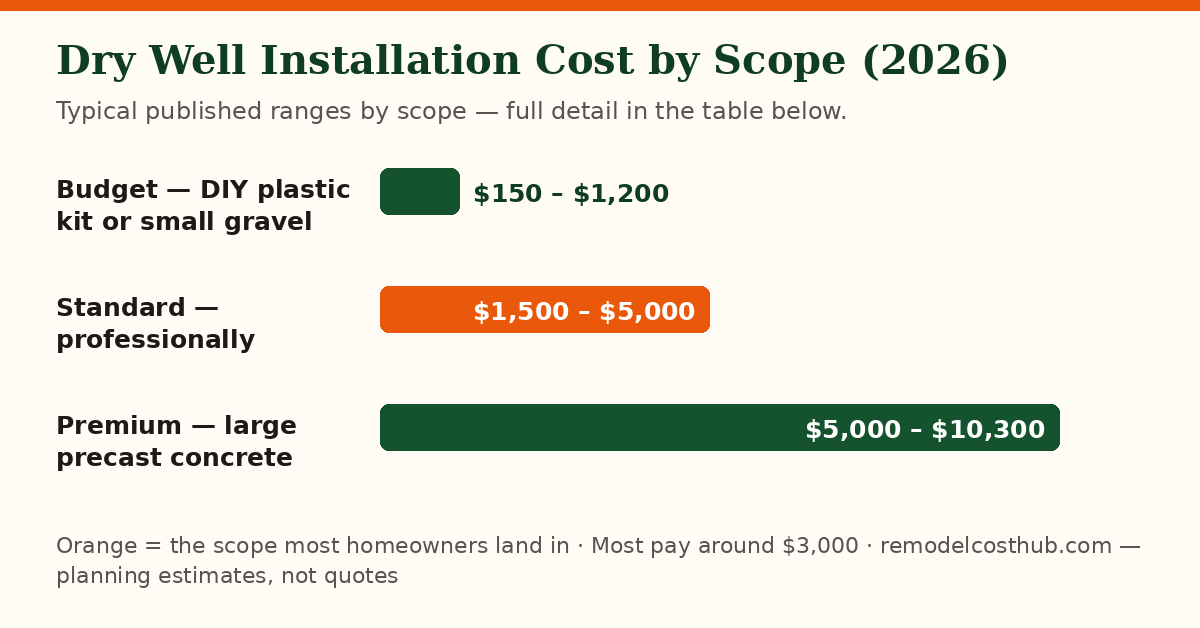
| Budget — DIY plastic kit or small gravel pit | $150 – $1,200 | The cheapest route: Reckon Home prices a DIY plastic kit at $150–$600 in materials and Angi at $185–$385, and a small 50–250 gallon well at $500–$1,200 in both Angi and HomeGuide — you dig, and the soil has to drain well |
| Standard — professionally installed well with trench | $1,500 – $5,000 | The typical band itself: a plastic modular well at $1,000–$3,500 or a gravel pit at $1,200–$4,000 in Reckon Home, installed with the trench and pipe to reach it, sized by the roof area feeding it |
| Premium — large precast concrete well or difficult dig | $5,000 – $10,300 | The expensive end: Reckon Home prices precast concrete at $2,500–$7,000 installed and Angi prices concrete systems up to $10,300, with rock or hard clay excavation adding $500–$3,000 — the route for big roofs, slow soil or multiple wells |
Where the money goes
| Part of the job | Share | Note |
|---|---|---|
| Well unit & materials (gravel, plastic or concrete) | No published share | Angi and HomeGuide price the unit alone at $50–$250 for gravel, $90–$650 for plastic and $300–$4,500+ for concrete — the type is the first price decision |
| Excavation & installation labour | No published share | Angi prices labour at $50–$100 per hour, and HomeGuide at $5–$13 per linear foot — machine time rises sharply in rock or hard clay, which Reckon Home prices at $500–$3,000 extra |
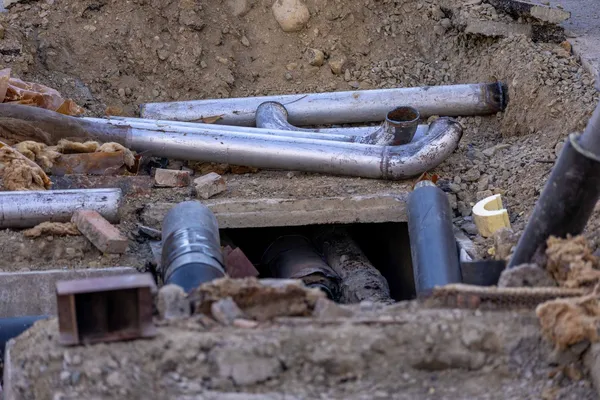
| Trench & pipe to the well | No published share | Reckon Home prices the trench from the downspout or sump pump at $15–$40 per foot, $300–$2,000 for a typical 10–50 foot run |
| Percolation test | No published share | Angi prices a perc test at $150–$1,000, Reckon Home at $100–$500 and HomeGuide at $200–$3,000+ depending on the method — it sizes the well and tells you whether the soil drains at all |
| Permits & inspection | No published share | Angi prices the permit at $25–$50, and HomeGuide prices a well inspection at $250–$550 — requirements vary by municipality, so the local building department decides |
| Sump pump discharge connection | No published share | Reckon Home prices connecting a sump pump discharge at $300–$1,200 — check valve, pipe and connection where the well takes sump water instead of downspout water |

What moves the price most
Well type is the first driver: gravel is cheapest, plastic modular sits in the middle and precast concrete costs most — Angi and HomeGuide price the units at $50–$250, $90–$650 and $300–$4,500+ before installation, and Reckon Home's installed bands run $1,200–$4,000 for a gravel pit, $1,000–$3,500 for plastic and $2,500–$7,000 for concrete. Size is second: wells are sized by the water they must absorb, and Angi and HomeGuide agree a 50–250 gallon well runs $500–$1,200 while a 250–500 gallon well runs $1,200–$4,400 — a large roof in a wet climate may need two wells. Soil decides whether the job works at all: a dry well only empties as fast as the soil absorbs water, and Reckon Home is blunt that dense clay absorbs very little — the perc test, $100–$1,000, is cheaper than a $3,000 hole that holds water. Distance and digging conditions close the bill: most codes put the well at least 10 feet from the foundation, every extra foot of trench adds $15–$40, and rock or hard clay adds $500–$3,000 in machine time — call 811 before anyone digs. Where sources disagree: the headline — Angi's most-pay $1,334–$5,139 against Reckon Home's $1,500–$6,000 and HomeGuide's $1,200–$5,200; the perc test — Angi's $150–$1,000 against Reckon Home's $100–$500 and HomeGuide's $200–$3,000+ by method. Methodology: figures cross-checked across Angi's dry well guide, updated October 15, 2026 (read in full 2026-11-27), Reckon Home's dry well guide, updated November 6, 2026 (read in full 2026-11-27) and HomeGuide's dry well guide, published December 17, 2025 (read in full 2026-11-27). The independent confirmations are Angi/HomeGuide (one dataset for the type and size tables) and Reckon Home. A French drain is the other half of the same job: it collects water along a line and carries it away, while the dry well is the destination where it soaks in — priced on the French drain installation guide, and the two are often installed together. Related costs: sump pump installation, gutter installation, downspout installation and Remodel Cost Index.
Costs in your city
Labor is the biggest variable in any remodel, and labor is local — the same bathroom can price very differently in Houston than in Boston. We are adding city editions metro by metro, each with its own labor index, permit notes and climate factors, written for that city rather than copied from this page. Wave 1: Houston, Dallas–Fort Worth, Phoenix, Atlanta, Miami–South Florida, Orlando, Tampa, Charlotte, Austin and San Antonio. Until your city's page is live, use the national range here and weight it the way contractors do: Sun Belt labor often prices near or below the national middle, while coastal California and the Northeast metros often price well above it.
Frequently asked questions
How much does dry well installation cost?
A professionally installed dry well typically costs $1,500–$5,000, with about $3,000 the figure most jobs land near. Angi's 2026 average from 1,339 verified projects is $3,110, Reckon Home puts the typical job at about $3,000 including the trench, and HomeGuide's band is $1,200–$5,200 — the three guides agree on the band.
Dry well or French drain — what's the difference?
They solve different halves of the problem: a French drain collects groundwater along a line and carries it away, while a dry well is a destination where collected water soaks into the ground. They are often installed together — the French drain or downspout line empties into the dry well — when there is nowhere downhill to send the water.
Will a dry well work in clay soil?
Poorly. A dry well only empties as fast as the soil around it absorbs water, and dense clay absorbs very little. A perc test, usually $100–$500 in Reckon Home, tells you before you dig — in clay, or where the water table is high, a pop-up emitter on a slope or a connection to a storm drain is usually the better money.
How far should a dry well be from my house?
At least 10 feet from the house or another structure and at least 3 feet from a property line, in Angi — the water needs space to seep into the soil, and too close it can damage the foundation. Always check local building codes for the exact distance.
How deep should a dry well be?
HomeGuide puts the ideal depth at 5–6 feet to prevent freezing and drain stormwater effectively, though the exact depth depends on the water volume, the soil type and the local climate.
How long does a dry well last?
A well-built dry well lasts 20–30 years in Reckon Home, concrete longer — the usual cause of failure is silt clogging the stone, so a leaf filter on the downspout and fabric around the well slow it down, and HomeGuide recommends cleaning annually.