Concrete Driveway cost at a glance
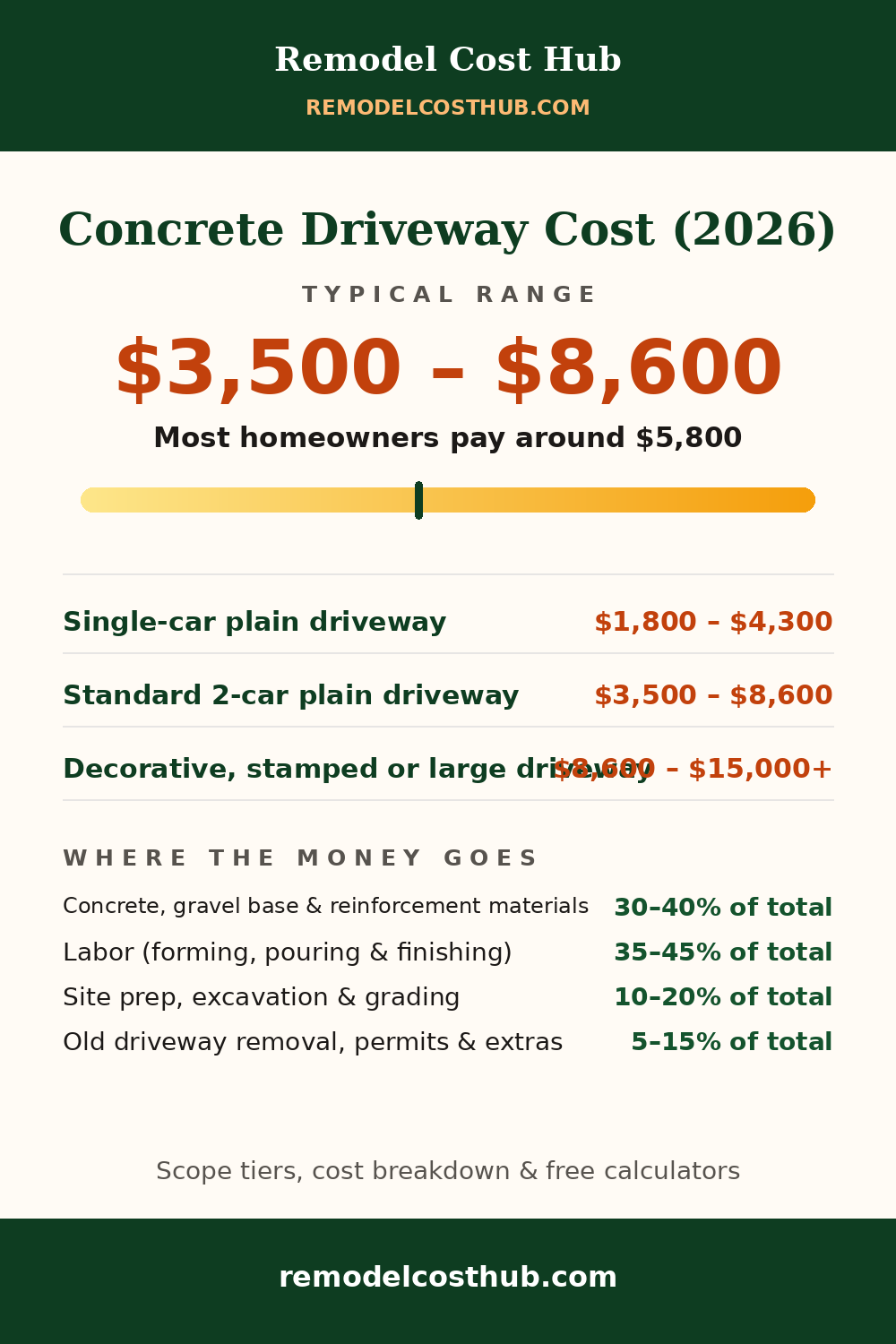
- Typical range: $3,500 – $8,600
- Most homeowners pay: around $5,800
- Per square foot: $6 – $15 per sq ft
- Prices vary most by: Labor (forming, pouring & finishing) (35–45% of the budget)
Cross-checked against three published sources for this project. Sources used for this page: the Angi concrete driveway cost guide, HomeGuide's concrete driveway cost guide and Fixr's concrete driveway cost data. Last updated October 2026 · How we calculate these costs
Cost by scope
| Scope | Typical cost | What it includes |
|---|---|---|
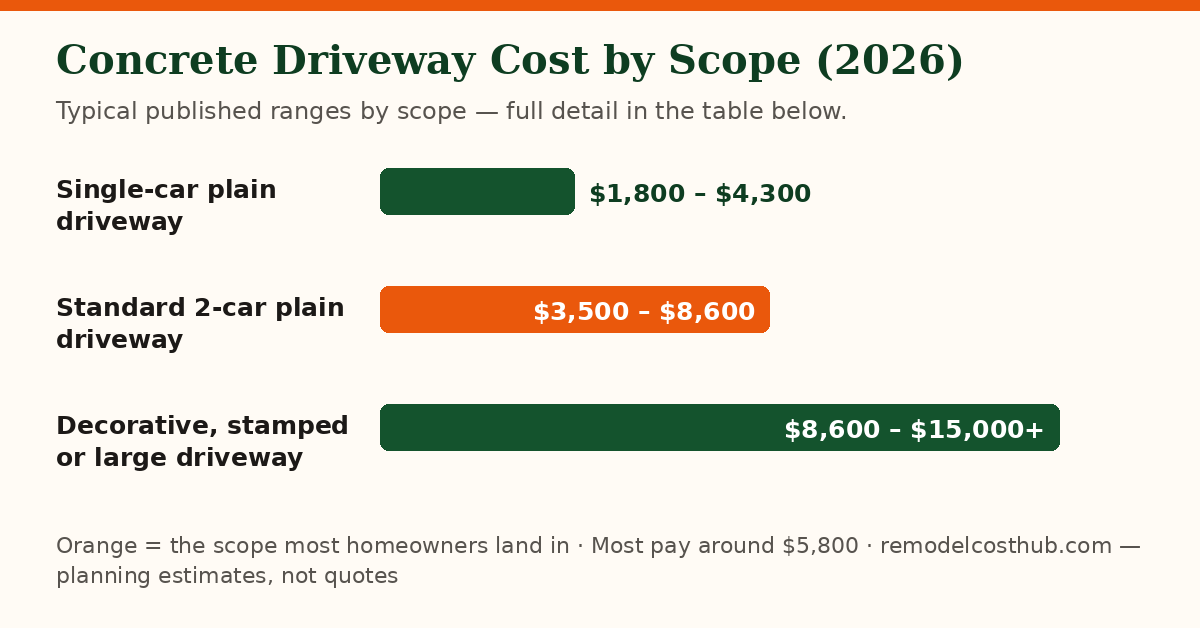
| Single-car plain driveway | $1,800 – $4,300 | About 288 sq ft (12x24) in plain broom-finished concrete on a prepared base, standard thickness and reinforcement |
| Standard 2-car plain driveway | $3,500 – $8,600 | About 576 sq ft (24x24) in plain concrete, formed, poured and finished — where most driveway replacements land |
| Decorative, stamped or large driveway | $8,600 – $15,000+ | Stamped, stained or exposed-aggregate finish, a 3-car or long driveway, thicker slab or added drainage and apron work |
Where the money goes
| Part of the job | Share | Note |
|---|---|---|
| Concrete, gravel base & reinforcement materials | 30–40% of total | Concrete volume (thickness and area), the compacted base and mesh or rebar — decorative mixes and colors raise this line |
| Labor (forming, pouring & finishing) | 35–45% of total | A crew job measured in days: setting forms, placing and screeding, finishing and cutting control joints |
| Site prep, excavation & grading | 10–20% of total | Removing grass or failed surface, grading for drainage slope and compacting the base — poor soil and slopes raise this share |
| Old driveway removal, permits & extras | 5–15% of total | Breaking out and hauling the old driveway where there is one, permit fees, drainage fixes and sealing |
What moves the price most
Size is the budget, priced per square foot. Published guides converge on roughly $6–$15 per square foot installed for plain concrete, so the footprint decision is the cost decision: a 2-car driveway of about 576 sq ft carries roughly twice the concrete, base and finishing labor of a single-car pad. Finish is the second cliff: a plain broom finish is the baseline in every guide, while stamped, stained or exposed-aggregate work is priced as a distinct step up per square foot — the pattern labor, color and release agents are real added work, not a surcharge. Thickness and reinforcement come third: a standard 4-inch slab suits cars, while thicker pours and rebar for heavy vehicles, poor soil or freeze-thaw climates add material on every square foot. Finally, what is already there decides the surprises — removing a failed old driveway, regrading a slope that drains toward the garage, or adding drainage are each priced separately in published guides, so get them itemized before you compare totals.
Costs in your city
Local labor moves a remodel price more than almost anything else, so we are publishing city-adjusted ranges metro by metro — each with its own local cost index, permit notes and climate factors, not a find-and-replace of this page. Wave 1 cities: Houston, Dallas–Fort Worth, Phoenix, Atlanta, Miami–South Florida, Orlando, Tampa, Charlotte, Austin and San Antonio. Until your city's page is live, use the national range here and weight it: Sun Belt labor often prices near or below the national middle; coastal California and the Northeast metros often price well above it.
Frequently asked questions
How much does a concrete driveway cost per square foot?
Installed, published guides put plain concrete at about $6–$15 per square foot, with decorative stamped or stained work above that band. At those rates a standard 2-car driveway of about 576 sq ft lands in the $3,500–$8,600 typical band on this page.
How long does a concrete driveway take to install?
Removal, prep and pouring commonly take about 2–4 days of work. The curing is the longer wait: most guides advise keeping cars off a new driveway for about a week, and full cure strength takes roughly a month — ask your contractor for their written curing schedule.
How long should a concrete driveway last?
Published guidance commonly puts a well-built concrete driveway at about 25–40 years. A compacted base, correct thickness, control joints and drainage away from the slab are what separate a 40-year driveway from a cracked 10-year one.
Is stamped concrete worth the extra cost?
Stamped and stained finishes are priced noticeably above plain concrete per square foot in every published guide, and they buy appearance, not strength — the slab underneath is the same. They make the most sense on a front driveway you see every day, and the least on a purely functional side pad.
Should I resurface or replace a damaged driveway?
Resurfacing is the cheaper route when the base is sound and damage is surface-level; replacement is the right spend when slabs are cracked through, settled or heaved, or the drainage slope is wrong. Published guides price resurfacing well below replacement per square foot — but resurfacing over a failed base fails again quickly.