Stucco Siding Installation cost at a glance
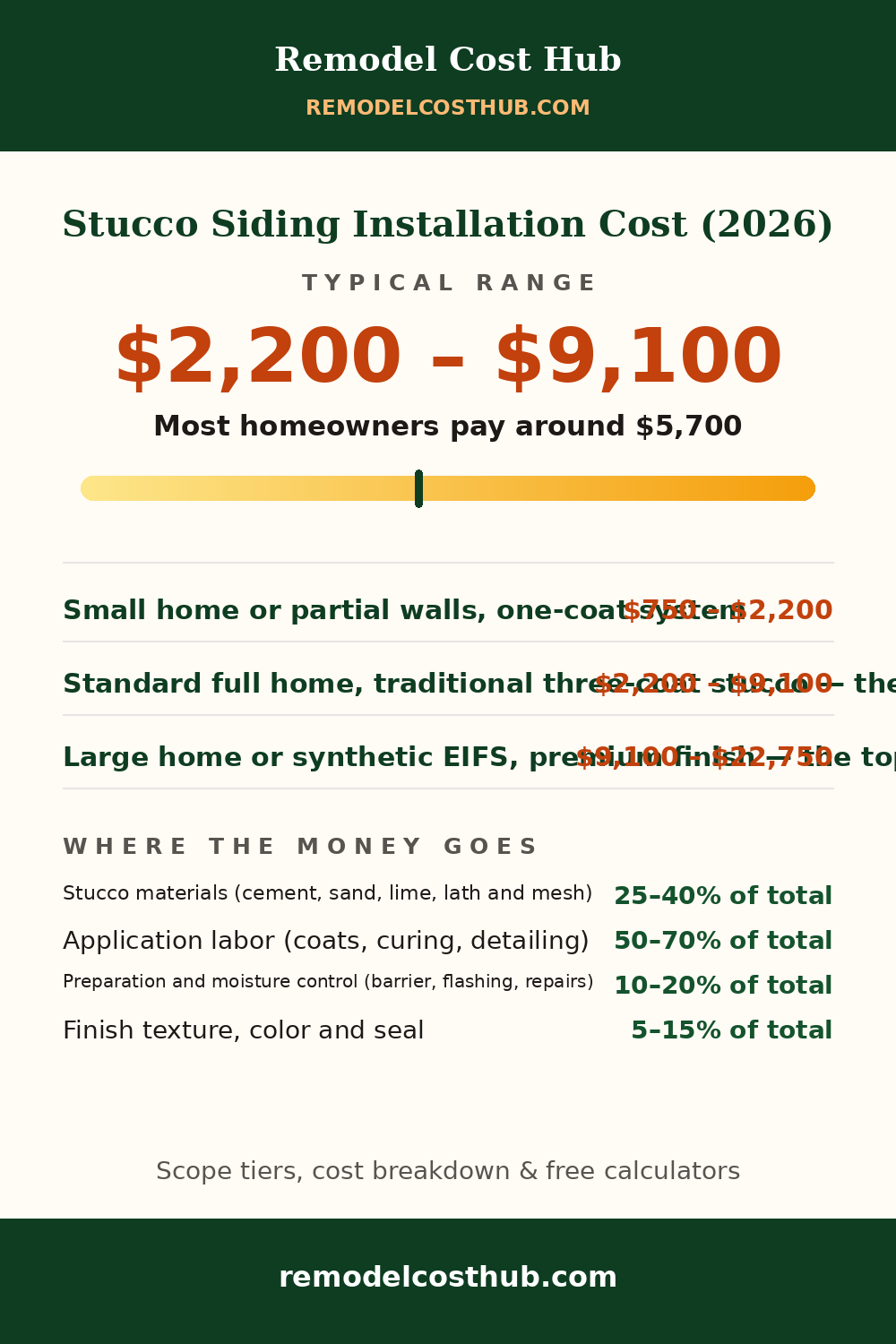
- Typical range: $2,200 – $9,100
- Most homeowners pay: around $5,700
- Per square foot: $7–$9 per sq ft
- Prices vary most by: Application labor (coats, curing, detailing) (50–70% of the budget)
Cross-checked against four published sources for this project. Sources used for this page: Angi's stucco cost guide, updated July 9, 2026 (average about $5,700, most $2,200–$9,100, overall $750–$22,750; $7–$9 per square foot installed, most of it labor; traditional cement $6–$9, synthetic EIFS $7–$10, one-coat $5–$7 per square foot; over brick about $7, over wood siding $8.50 per square foot), HomeGuide's house siding cost guide (stucco $7–$17 per square foot installed, $17,500–$42,500 for a 2,500-square-foot house; cement, sand, binding agents and water applied in multiple layers; 50–80-year lifespan) and This Old House's siding replacement cost guide, using Homewyse data (stucco material $6.36, installed $9.66 per square foot, 50–80-year lifespan, average 2,000-square-foot home $19,320; prone to cracking and expensive to repair) — HomeGuide's and This Old House's higher totals are published as their larger-house, all-in scope, not averaged away. Sources last checked: October 2026 — This Old House, HomeGuide, Angi, Homewyse. How we calculate these costs
Cost by scope
| Scope | Typical cost | What it includes |
|---|---|---|
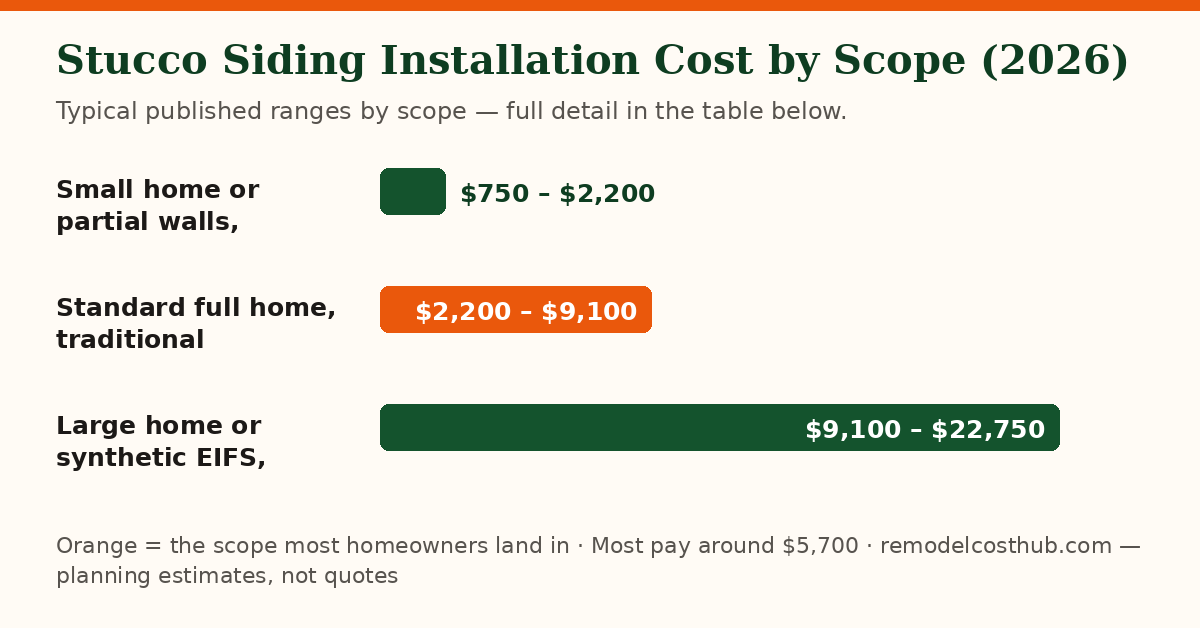
| Small home or partial walls, one-coat system | $750 – $2,200 | The cheap end: Angi runs its overall range down to $750, and one-coat systems — its cheapest system at $5–$7 per square foot — are what that end is built from |
| Standard full home, traditional three-coat stucco — the typical job | $2,200 – $9,100 | The shared band itself: Angi's most-pay band at $7–$9 per sq ft, with HomeGuide's $7–$17 band overlapping it at the standard end |
| Large home or synthetic EIFS, premium finish — the top end | $9,100 – $22,750 | The expensive end: Angi runs its overall range to $22,750, and synthetic EIFS at $7–$10 per square foot with HomeGuide's band reaching $17 puts large and premium-finish houses here |
Where the money goes
| Part of the job | Share | Note |
|---|---|---|
| Stucco materials (cement, sand, lime, lath and mesh) | 25–40% of total | The coats: traditional stucco is Portland cement, sand, lime and water over lath and mesh, applied in layers — and the system (traditional, one-coat or EIFS) sets this line before a trowel is lifted |
| Application labor (coats, curing, detailing) | 50–70% of total | The work: Angi notes most of its $7–$9 per square foot goes to labor, because stucco is applied coat by coat with curing time between coats — it is a labor job with material in it, not the other way around |
| Preparation and moisture control (barrier, flashing, repairs) | 10–20% of total | The protection: a moisture barrier, flashing and substrate repairs sit under the finish, and in wet climates this line grows — This Old House lists moisture-barrier work as a named stucco cost driver |
| Finish texture, color and seal | 5–15% of total | The surface: texture and color are chosen at the finish coat, and sealing is the recurring line — the guides price the finish as part of the installed rate, with resealing on its own cycle |
What moves the price most
System choice is the first fork. Traditional three-coat cement stucco, one-coat systems and synthetic EIFS are priced separately in every guide — $6–$9, $5–$7 and $7–$10 per square foot in Angi — because they differ in layers, curing time and labor, not just in material. Climate is the second driver: stucco performs best in dry climates and the guides flag humidity and wet exposure as its risk — moisture barriers, flashing and repair access all cost more where rain is constant. Substrate changes the quote: Angi prices stucco over brick at about $7 per square foot and over wood siding at $8.50, because what the plaster bonds to decides the preparation. Finally, size and stories move the total mechanically — multi-story work adds scaffolding and labor to every coat.
Costs in your city
Labor is the biggest variable in any remodel, and labor is local — the same bathroom can price very differently in Houston than in Boston. We are adding city editions metro by metro, each with its own labor index, permit notes and climate factors, written for that city rather than copied from this page. Wave 1: Houston, Dallas–Fort Worth, Phoenix, Atlanta, Miami–South Florida, Orlando, Tampa, Charlotte, Austin and San Antonio. Until your city's page is live, use the national range here and weight it the way contractors do: Sun Belt labor often prices near or below the national middle, while coastal California and the Northeast metros often price well above it.
Frequently asked questions
How long does stucco last?
The material tables in HomeGuide and This Old House both give stucco a 50–80-year lifespan — among the longest of any siding — provided its moisture detailing is sound and cracks are repaired rather than left open.
Does stucco crack?
Yes, and the guides name it as stucco's main weakness: This Old House lists cracking and expensive repair as stucco's drawback, and HomeGuide's cost table runs to $17 per square foot installed partly because repair access matters. Hairline cracks are common; cracks that admit water are the ones that cost money.
What is the difference between traditional stucco and EIFS?
Traditional stucco is cement plaster applied in coats over lath and mesh; EIFS (synthetic stucco) is a lightweight insulated system with a synthetic finish. Angi prices traditional at $6–$9 per square foot and EIFS at $7–$10 — EIFS is lighter and more insulating, traditional is harder and more familiar to most plaster crews.
Is stucco a good choice in a wet climate?
It needs more care there: the guides agree stucco performs best in dry climates, and wet-climate jobs need proper moisture barriers, flashing and drainage detailing. In a humid region, budget the moisture-control line generously and treat any quote that skips it as incomplete.