Brick Veneer Installation cost at a glance
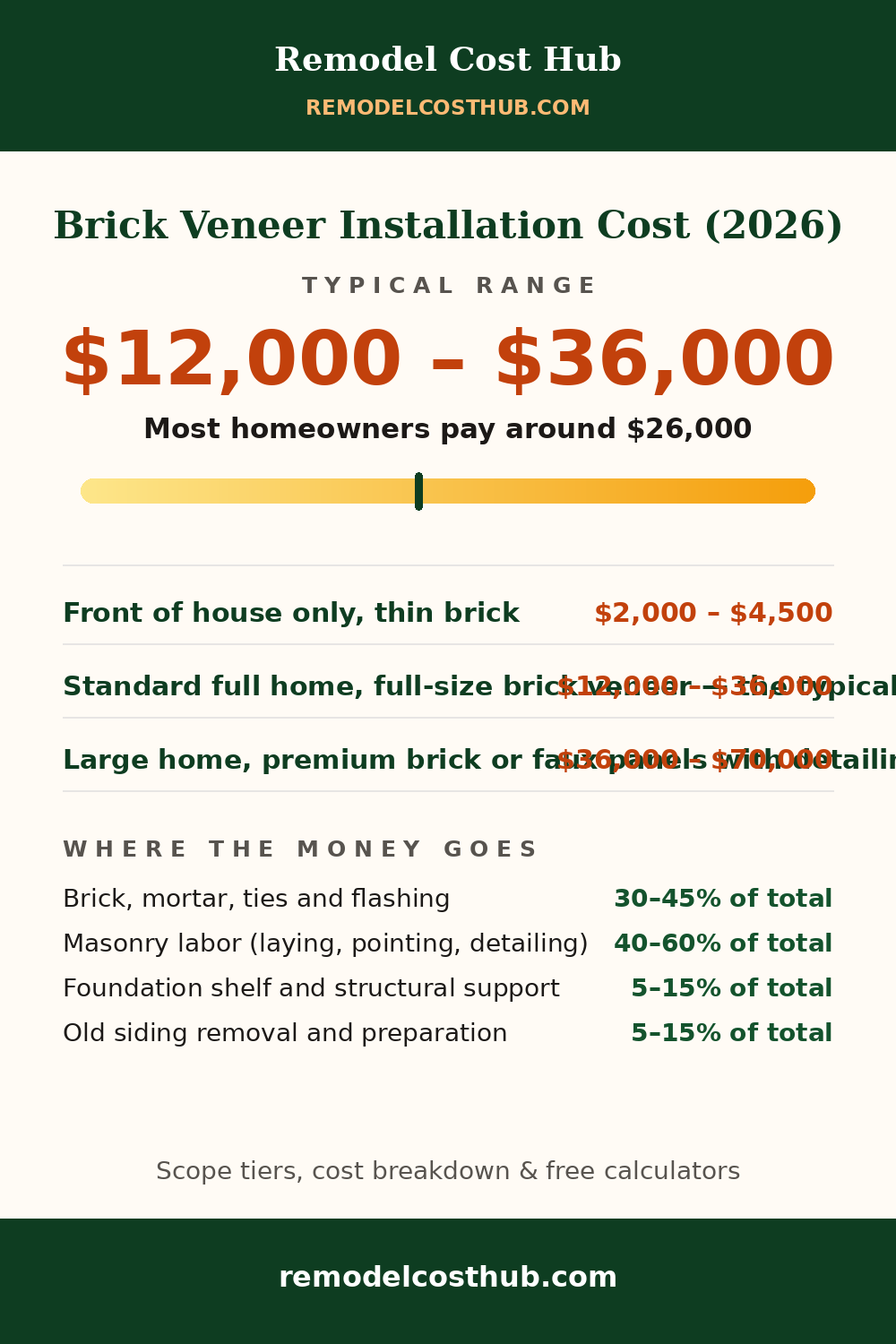
- Typical range: $12,000 – $36,000
- Most homeowners pay: around $26,000
- Per square foot: $9–$28 per sq ft
- Prices vary most by: Masonry labor (laying, pointing, detailing) (40–60% of the budget)
Cross-checked against three published sources for this project. Sources used for this page: Angi's brick siding cost guide, updated October 23, 2026 (national average $26,000 for a 2,000-square-foot home, most $22,500–$70,000; $9–$28 per square foot installed; thin brick strips $3–$10, faux panels $6–$11, face brick $4–$8 per square foot for materials; labor $3–$20 per square foot), HomeGuide's brick veneer cost guide (installed $8–$24 per square foot overall; thin brick $8–$18, full-size brick veneer $12–$18, faux panels $14–$24; front of house $2,000–$18,000 for 250–750 square feet; removal $3–$6 per square foot; labor $2–$8 per square foot) and Fixr's brick siding cost guide (national average $26,000, most $22,500–$50,000; thin veneer $8–$18, brick veneer $12–$18, solid brick $14–$30 per square foot installed; 2,000-square-foot home $12,000–$36,000 by wall area; labor 40–60% of total; foundation shelf modification $5–$15 per square foot) — Angi's wider most-pay band is published as its premium and solid-brick scope, not averaged away. Sources last checked: October 2026 — HomeGuide, Fixr, Angi. How we calculate these costs
Cost by scope
| Scope | Typical cost | What it includes |
|---|---|---|
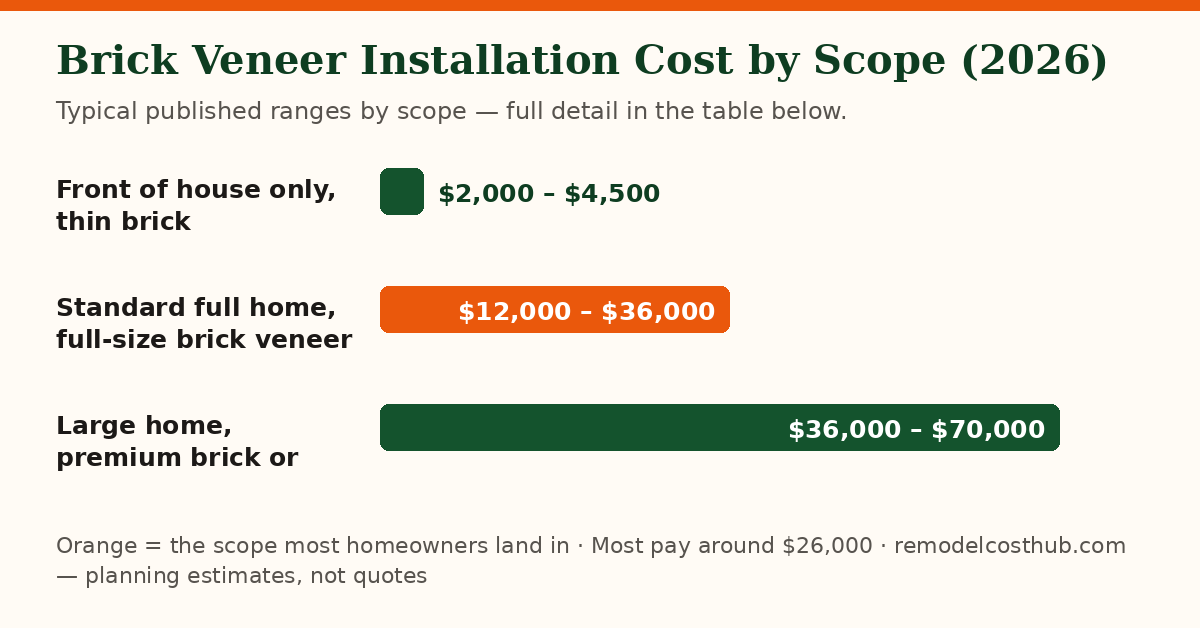
| Front of house only, thin brick | $2,000 – $4,500 | The cheap end: HomeGuide prices the front of a house at $2,000–$18,000 for 250–750 square feet, and 250 square feet of thin brick at its $8–$18 installed rate is what the bottom of that range is built from |
| Standard full home, full-size brick veneer — the typical job | $12,000 – $36,000 | The shared band itself: Fixr's 2,000-square-foot-home band at $12–$18 per square foot for full-size veneer, with Angi's $26,000 average and HomeGuide's $12–$18 band both inside it |
| Large home, premium brick or faux panels with detailing — the top end | $36,000 – $70,000 | The expensive end: Angi runs its most-pay band to $70,000, and faux panels at $14–$24 per square foot with premium brick and detailing put large houses here |
Where the money goes
| Part of the job | Share | Note |
|---|---|---|
| Brick, mortar, ties and flashing | 30–45% of total | The wall: Angi prices face brick at $4–$8 per square foot for materials and thin strips at $3–$10, with mortar, wall ties and flashing priced alongside — brick choice alone spans most of this line |
| Masonry labor (laying, pointing, detailing) | 40–60% of total | The craft: Fixr puts labor at 40–60% of a brick siding total, and Angi prices brick labor at $3–$20 per square foot by type and complexity — veneer is a mason's job, and the rate reflects it |
| Foundation shelf and structural support | 5–15% of total | The base: full brick veneer needs a structural shelf angle at the base of the wall, and Fixr notes that modifying a foundation that does not extend far enough adds $5–$15 per square foot |
| Old siding removal and preparation | 5–15% of total | The prep: HomeGuide prices removing exterior brick at $3–$6 per square foot, and substrate preparation and flashing sit in this line before any brick is laid |
What moves the price most
Veneer type is the first fork. Thin brick at $8–$18 per square foot installed, full-size veneer at $12–$18 and faux panels at $14–$24 are not interchangeable in HomeGuide and Fixr — thin brick is adhered, full-size brick is laid by a mason, and faux panels are hung, so the labor line differs as much as the material. Wall area, not living area, sets the total: Fixr prices by exterior wall area and warns the two numbers are rarely the same, so a house with a large footprint carries more brick than its floor area suggests. The foundation shelf is the hidden line: if the existing foundation does not extend far enough to support a brick ledge, Fixr's $5–$15 per square foot modification lands on top of the veneer price. Finally, maintenance is a cycle, not a one-off: Angi notes repointing every 20–30 years at about $8 per square foot, which belongs in the lifetime comparison against lower-maintenance sidings.
Costs in your city
Labor is the biggest variable in any remodel, and labor is local — the same bathroom can price very differently in Houston than in Boston. We are adding city editions metro by metro, each with its own labor index, permit notes and climate factors, written for that city rather than copied from this page. Wave 1: Houston, Dallas–Fort Worth, Phoenix, Atlanta, Miami–South Florida, Orlando, Tampa, Charlotte, Austin and San Antonio. Until your city's page is live, use the national range here and weight it the way contractors do: Sun Belt labor often prices near or below the national middle, while coastal California and the Northeast metros often price well above it.

Frequently asked questions
What is the difference between brick veneer and solid brick?
Veneer is one layer of brick over a framed wall; solid brick is multiple load-bearing layers that form the wall itself. Angi prices veneer at $5–$12 per square foot against $9–$20 for solid brick masonry — veneer gives the brick look without the structural brick cost.
Is thin brick real brick?
Yes — Fixr notes thin brick veneer is real fired clay, sliced thin to 3/8–1 inch and adhered to the wall substrate. It is the most affordable real-brick option at $8–$18 per square foot installed, against $12–$18 for full-size veneer.
How long does brick veneer last, and what maintenance does it need?
Brick itself lasts decades; the maintenance cycle is the mortar. Angi notes repointing every 20–30 years at about $8 per square foot, and the guides agree veneer is fire-, mold-, wind- and pest-resistant where its flashing and ties are sound.
Can brick veneer be added over existing siding?
Only on a sound substrate with proper flashing, ties and a foundation shelf to carry it — the guides price substrate preparation and shelf work as separate lines for exactly this reason. An installer should assess the existing wall and foundation before quoting, not after.