Mold Testing cost at a glance
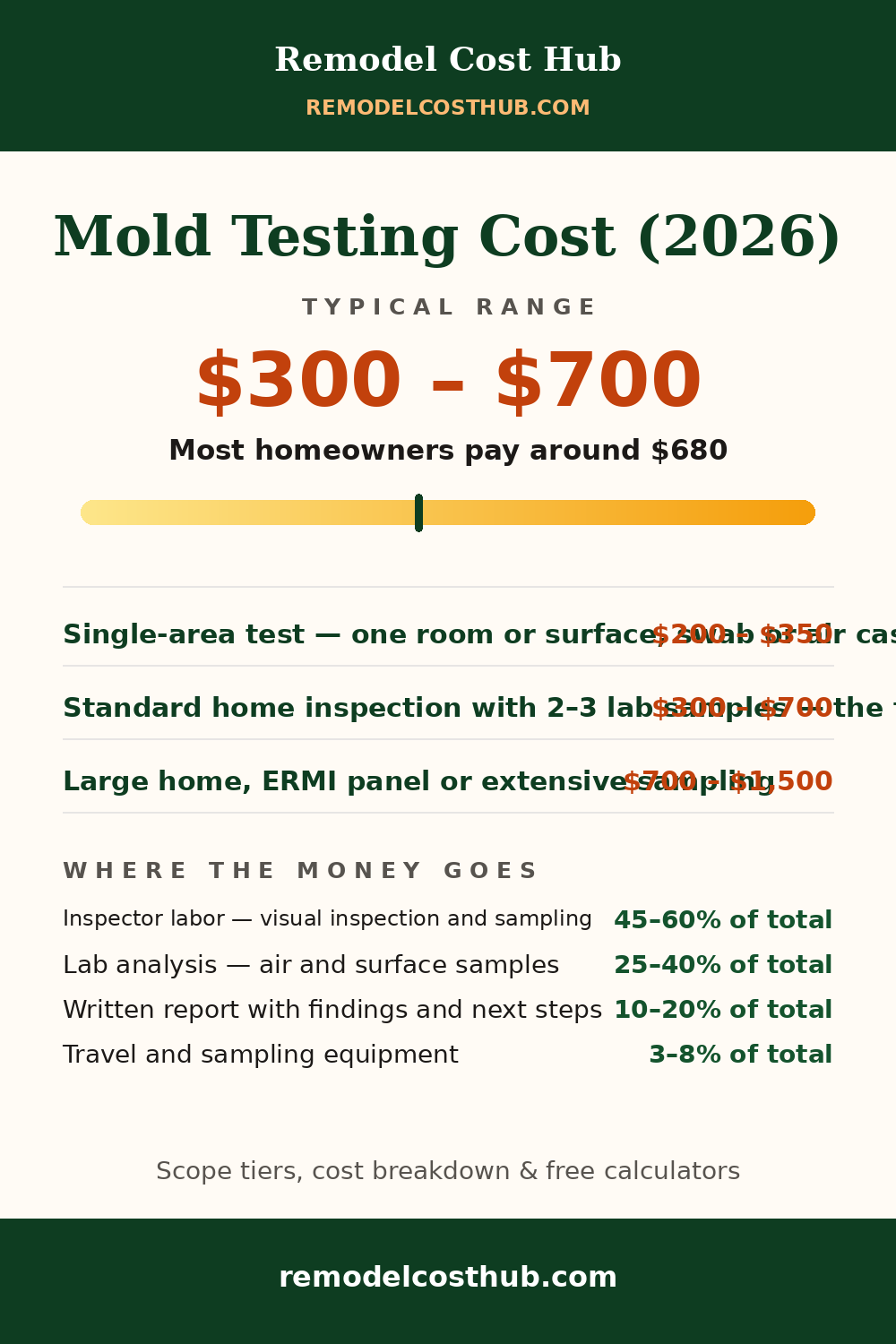
- Typical range: $300 – $700
- Most homeowners pay: around $680
- Prices vary most by: Inspector labor — visual inspection and sampling (45–60% of the budget)
Cross-checked against two published sources for this project. Sources used for this page: Angi's mold inspection cost guide, updated October 5, 2026 (national average $689 across 7,940 verified projects, most $303–$1,075; a mold test alone $250–$500; swab test $200–$300; air test $250–$350, up to $700 for extensive testing; HVAC check $50–$75 extra; homes under 4,000 sq ft $300–$400; larger homes $700–$1,000; remediation $1,150–$3,400), iBuyer's 2026 mold inspection cost guide (most homes $300–$700, national average around $670; lab samples $25–$150 each with most inspections bundling 2–3; ERMI 36-species panel $250–$500 additional; rush processing $50–$100 for 24–48 hours; at-home kits $10–$50 in Angi) and HomeGuide's inspection cost data (mold inspection $300–$650; crawl-space mold testing $200–$400 for a visual inspection and samples). The page's typical band is the three-way overlap at $300–$700, and its $680 most-pay figure sits between the two published averages. Sources last checked: October 2026 — HomeGuide, Angi. How we calculate these costs
Cost by scope
| Scope | Typical cost | What it includes |
|---|---|---|
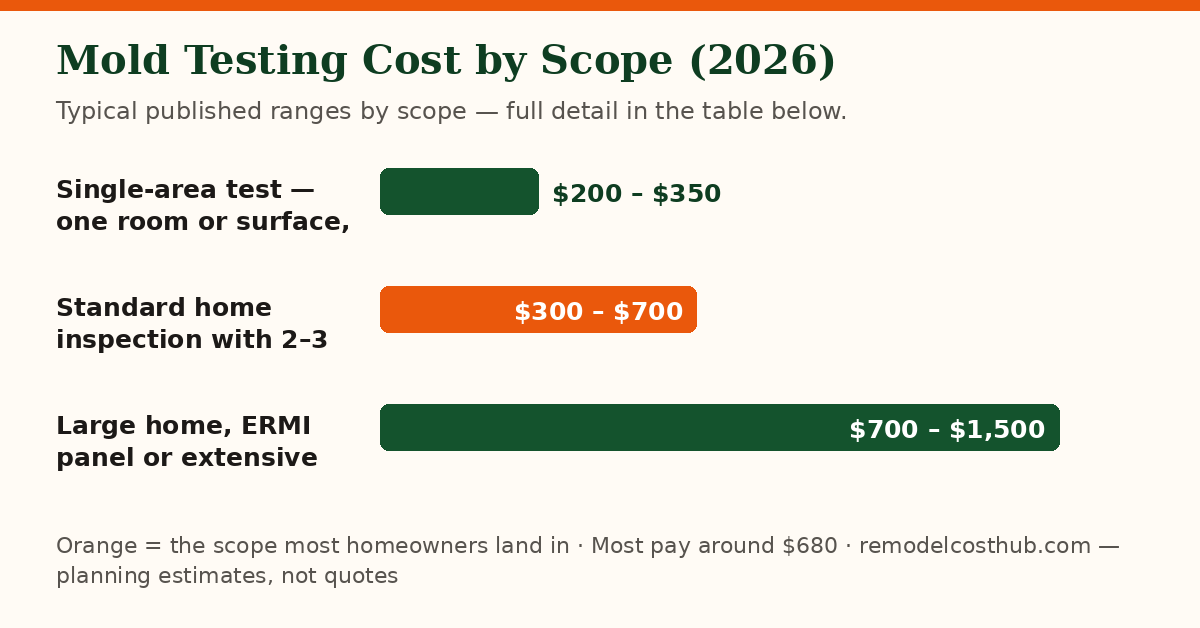
| Single-area test — one room or surface, swab or air cassette | $200 – $350 | The cheap end: Angi prices a swab test at $200–$300 and an air test at $250–$350, and Thumbtack prices residential testing for an isolated area at $300 including inspection, report and two tests |
| Standard home inspection with 2–3 lab samples — the typical job | $300 – $700 | The shared band: iBuyer's $300–$700 most-homes band against HomeGuide's $300–$650 inspection band and Angi's $300–$400 for homes under 4,000 sq ft — visual inspection plus lab samples, the typical call |
| Large home, ERMI panel or extensive sampling | $700 – $1,500 | The expensive end: Angi prices larger homes at $700–$1,000, and iBuyer prices an ERMI 36-species panel at $250–$500 on top of the inspection — whole-home sampling with a full species panel |
Where the money goes
| Part of the job | Share | Note |
|---|---|---|
| Inspector labor — visual inspection and sampling | 45–60% of total | The visit is the job: moisture readings, suspect areas and sample collection — Angi notes home size, accessibility and sample count drive the fee |
| Lab analysis — air and surface samples | 25–40% of total | iBuyer prices lab samples at $25–$150 each with most inspections bundling 2–3; an ERMI panel adds $250–$500 on top |
| Written report with findings and next steps | 10–20% of total | The deliverable: findings, photos, lab results and next steps — lookmold prices a written remediation plan at $150–$300 where one is needed |
| Travel and sampling equipment | 3–8% of total | Moisture meters, infrared scans where used, and travel — iBuyer's regional table notes travel fees in rural markets |
What moves the price most
Sample count is first: most inspections bundle 2–3 samples, and iBuyer prices additional samples at $25–$150 each — a quote without a sample count is not comparable with one that names it. Home size is second: Angi prices homes under 4,000 sq ft at $300–$400 against $700–$1,000 for larger homes, and hard-to-reach areas like ducts, crawl spaces and wall cavities add cost in every guide. Test type is third: Angi prices a swab test at $200–$300, an air test at $250–$350 and up to $700 for extensive air testing, with an HVAC check adding $50–$75 — the question being asked picks the test. Whether testing is needed at all is fourth: the EPA says sampling is usually unnecessary when mold is already visible — clean it and fix the moisture source instead. Testing earns its fee for hidden mold, for a purchase decision, or when symptoms point nowhere visible. For the removal job itself, see our mold remediation guide, and for a related hazard test see our asbestos removal guide.
Worked example: how a typical mold testing budget breaks down
Take the typical job — a standard 3-bedroom home, visual inspection plus two air samples and one surface swab sent to a certified lab, written report with findings and next steps. Here is a realistic $680 version of that invoice, between the two published averages: The budget below totals $680 — the "most homeowners pay around" figure from the top of this page — split using this page's own cost breakdown. It shows how a real quote at that level is usually composed; every line is built from the ranges on this page, and it is an illustration, not a quote for your project.
| Line item | Example budget |
|---|---|
| Inspector labor (visual inspection and sampling) | $340 |
| Lab analysis (3 samples) | $225 |
| Written report with findings and next steps | $75 |
| Travel and sampling equipment | $40 |
| Total | $680 |
What most people get wrong
- Testing mold you can already see — the EPA says sampling is usually unnecessary when growth is visible, so a test fee on visible mold buys a report for a job that starts with cleaning and fixing the moisture source.
- Hiring the same firm to test and remediate — Angi's guide stresses keeping testing and remediation separate, because a tester who sells the cleanup has a financial reason to find a bigger problem.
- Comparing quotes without a sample count — most inspections bundle 2–3 samples and iBuyer prices extras at $25–$150 each, so a cheaper quote with one sample and a dearer quote with four are not competing bids.
- Paying for an ERMI panel when a standard panel answers the question — iBuyer prices the 36-species ERMI panel at $250–$500 on top of the inspection, and it belongs on a complex or medical case, not a routine purchase check.
Costs in your city
Mold testing is inspector-labor pricing around lab fees: the same inspection quotes near the bottom of the band where inspector rates are low and toward the top in a high-cost metro, while lab analysis ships nationally. Humidity travels with the city — humid and coastal markets test more often and find more, while dry markets test mostly for purchases. Home size and access travel too: Angi prices larger homes at $700–$1,000, and ducts, crawl spaces and wall cavities add cost everywhere. Ask each bidder for the sample count, the lab used, and whether they also sell remediation.
Frequently asked questions
How much does mold testing cost?
Angi's 2026 national average for a mold inspection is $689, with most homeowners paying $303–$1,075, and iBuyer puts most homes at $300–$700 with an average near $670. This page's typical band is $300–$700, with about $680 the figure most standard jobs land near.
What does a mold test include?
A visual inspection for moisture and suspect growth, air or surface samples taken to a certified lab, and a written report with findings and next steps. iBuyer puts standard lab turnaround at 3–5 business days, with rush processing at $50–$100 extra for 24–48 hours.
What does a swab test cost versus an air test?
Angi prices a swab test at $200–$300 and an air test at $250–$350, rising to $700 for extensive air testing. An HVAC check adds $50–$75, and an ERMI 36-species panel adds $250–$500 in iBuyer.
Is a DIY mold test kit enough?
A kit answers a narrower question: Angi prices at-home kits at $10–$50, and CostHelper prices kits at $5–$100 plus $30–$150 per sample for lab identification. A kit shows growth; a professional test gives species, spore counts and a chain of custody a remediation quote can be built on.
Do I need testing if I can see the mold?
Usually not — the EPA says sampling is unnecessary when mold growth is visible, and the right move is to clean it and fix the moisture source. Testing earns its fee when mold is hidden, when a purchase depends on it, or when symptoms point nowhere visible. Remediation itself is priced separately, at $1,150–$3,400 in Angi.