Home Energy Audit cost at a glance
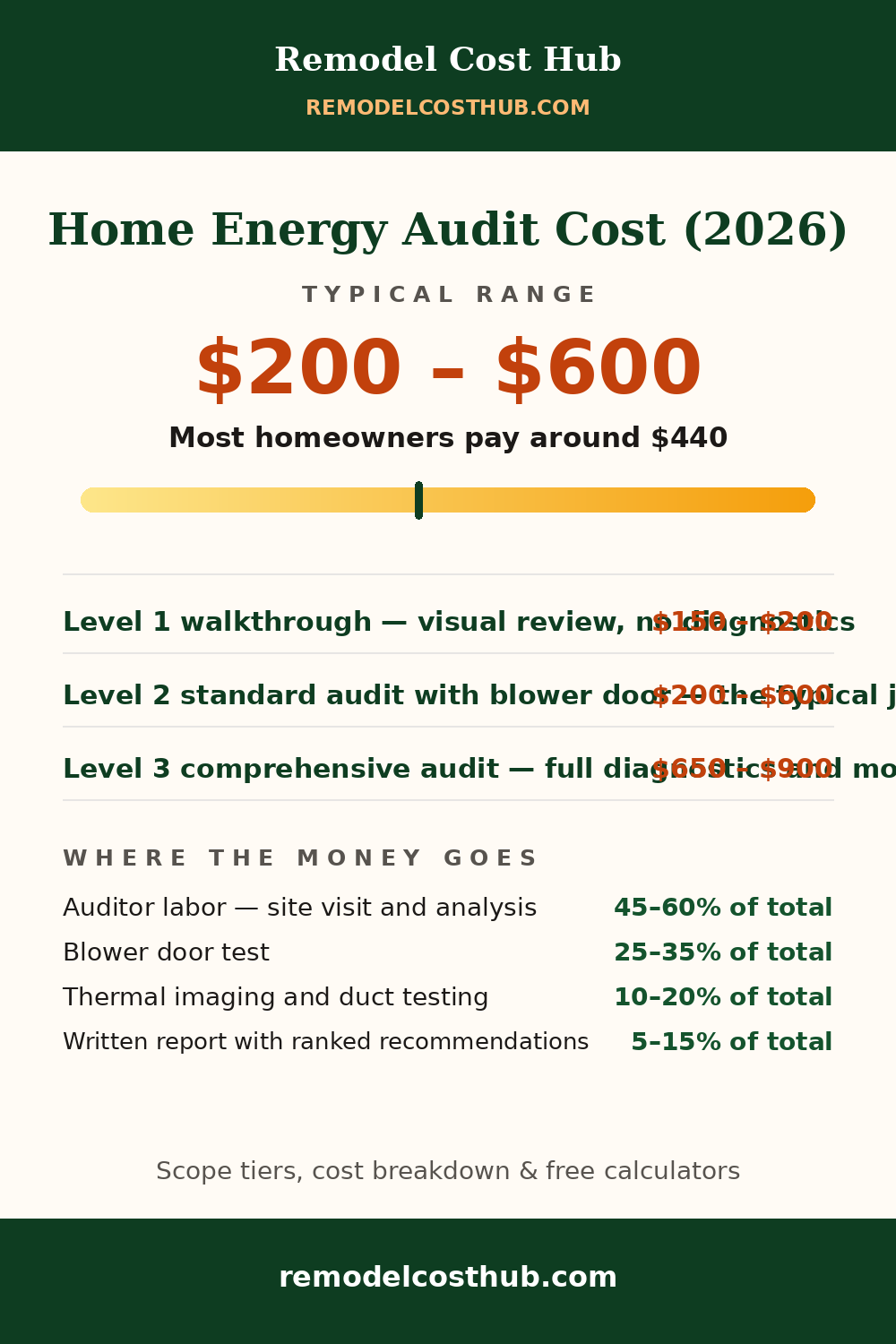
- Typical range: $200 – $600
- Most homeowners pay: around $440
- Prices vary most by: Auditor labor — site visit and analysis (45–60% of the budget)
Cross-checked against two published sources for this project. Sources used for this page: Angi's home energy audit cost guide, updated October 8, 2026 (national average $437 across 817 verified projects, most $212–$698; priced $0.10–$0.40 per square foot; Level 1 walkthrough $150–$200, Level 2 detailed survey $200–$650, Level 3 in-depth audit $650–$900; auditor labor $75–$150 per hour; energy-company audits $0–$150), HomeGuide's home energy audit cost guide (national average $400, average range $200–$600, minimum $99, maximum $2,300+; $0.10–$0.50 per square foot; blower door test $200–$450; duct testing $100–$700; thermographic imaging $200–$500; written report $50–$100) and Angi's blower door test cost guide, updated October 26, 2026 (national average $325, most $200–$450 for a single-family home; thermal imaging add-on $150–$400). The page's typical band is HomeGuide's average range against Angi's most-pay band at $200–$600, and its $440 most-pay figure sits near Angi's published average. Sources last checked: October 2026 — HomeGuide, Angi. How we calculate these costs
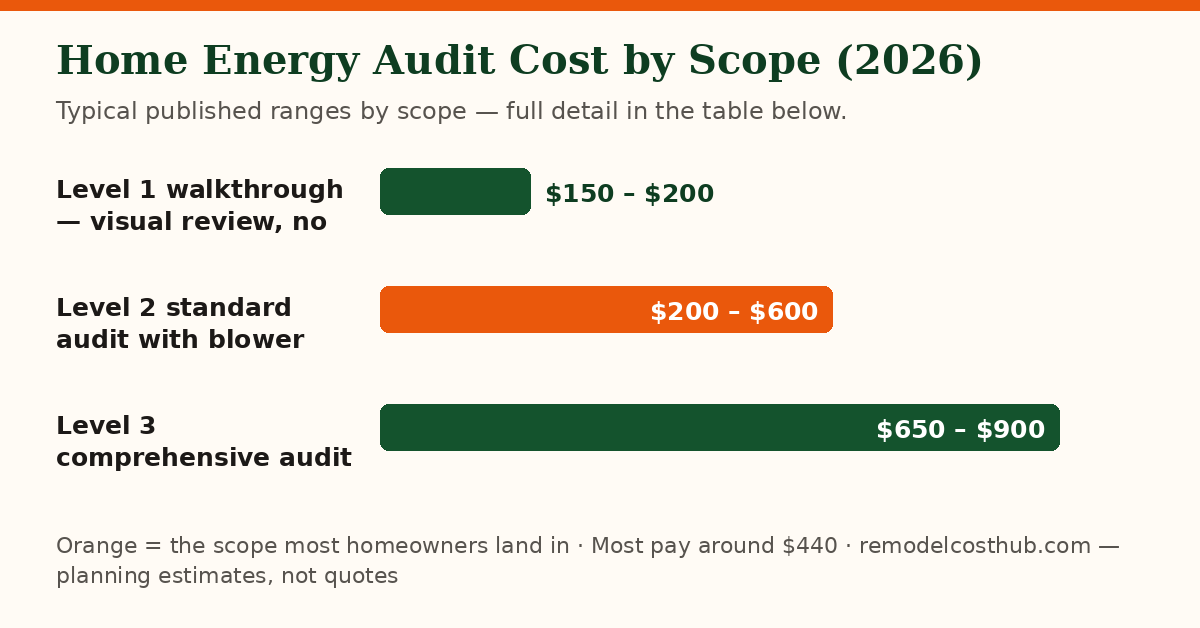
Cost by scope
| Scope | Typical cost | What it includes |
|---|---|---|
| Level 1 walkthrough — visual review, no diagnostics | $150 – $200 | The cheap end: Angi prices a Level 1 baseline walkthrough at $150–$200 — a visual review and utility-bill check, with no blower door and no thermal camera |
| Level 2 standard audit with blower door — the typical job | $200 – $600 | The shared band: HomeGuide's $200–$600 average range against Angi's $212–$698 most-pay band — blower door test, insulation check and a written, ranked report |
| Level 3 comprehensive audit — full diagnostics and modelling | $650 – $900 | The expensive end: Angi prices a Level 3 audit at $650–$900 — detailed testing, room-by-room modelling and renovation recommendations; HomeGuide's range runs to $2,300+ for very large or commercial buildings |
Where the money goes
| Part of the job | Share | Note |
|---|---|---|
| Auditor labor — site visit and analysis | 45–60% of total | Angi prices auditor labor at $75–$150 an hour or a flat fee, and many audits price at $0.10–$0.40 a square foot — home size sets the hours |
| Blower door test | 25–35% of total | Angi prices a blower door test at $200–$450 standalone with a $325 average, and HomeGuide at $200–$450 — the diagnostic core of a Level 2 audit |
| Thermal imaging and duct testing | 10–20% of total | HomeGuide prices thermographic imaging at $200–$500 and duct testing at $100–$700 — the add-ons that find what the eye misses |
| Written report with ranked recommendations | 5–15% of total | HomeGuide prices a written report with recommendations at $50–$100 as a blower-door add-on; on a full audit the ranked report is the deliverable |
What moves the price most
Audit level is first: Angi prices the ASHRAE levels at $150–$200 for Level 1, $200–$650 for Level 2 and $650–$900 for Level 3 — the level, not the house, is the biggest price step. Home size is second: Angi prices audits at $0.10–$0.40 a square foot and HomeGuide at $0.10–$0.50, so a 1,000 sq ft home lands at $100–$400 in Angi's size table while a large home costs proportionally more. Diagnostics are third: a blower door test runs $200–$450 in both Angi's and HomeGuide's guides, thermal imaging adds $150–$400 in Angi, and duct testing adds $100–$700 in HomeGuide — a quote without a test list is not comparable. Utility programs are fourth: Angi prices energy-company audits at $0–$150, and its local guides note a federal credit of up to $150 toward an audit — check the utility offer first, since a subsidized audit covers part of the same ground. For what an audit usually finds first, see our attic insulation guide and our spray foam insulation guide.
Worked example: how a typical home energy audit budget breaks down
Take the typical job — a 2,000 sq ft home, Level 2 audit: walkthrough, blower door test, thermal scan of the main rooms, insulation and HVAC review, written ranked report. Here is a realistic $440 version of that invoice, near Angi's $437 average: The budget below totals $440 — the "most homeowners pay around" figure from the top of this page — split using this page's own cost breakdown. It shows how a real quote at that level is usually composed; every line is built from the ranges on this page, and it is an illustration, not a quote for your project.
| Line item | Example budget |
|---|---|
| Auditor labor (visit, analysis, report) | $220 |
| Blower door test | $130 |
| Thermal imaging scan | $55 |
| Written report with ranked recommendations | $35 |
| Total | $440 |
What most people get wrong
- Buying a Level 1 walkthrough and expecting diagnostics — Angi prices Level 1 at $150–$200 with no blower door and no thermal camera, so a walkthrough cannot rank air leaks it never measured.
- Comparing quotes without a test list — a $200 quote without a blower door and a $600 quote with blower door, thermal imaging and duct testing are different audits, and only the test list makes them comparable.
- Hiring an auditor who sells the upgrades — a certified auditor through the Building Performance Institute or RESNET sells advice, not installations, and a report that recommends one product is a sales document, not an audit.
- Skipping the utility-bill history — twelve months of gas and electric bills let the auditor compare actual use against similar homes and size the opportunity honestly, and a quote without them is guessing at the payback.
Costs in your city
Home energy audits are auditor-labor pricing around diagnostic equipment: the same Level 2 audit quotes near the bottom of the band where auditor rates are low and toward the top in a high-cost metro, while the blower door and camera travel with the auditor. Climate travels with the city — cold markets weight heating losses and hot markets weight cooling, and older housing stock leaks more and benefits more from the same audit. Utility programs travel too: Angi prices energy-company audits at $0–$150, so check the utility offer before paying full price. Ask each bidder for the audit level, the test list, and whether they sell installations.
Frequently asked questions
How much does a home energy audit cost?
Angi's 2026 national average is $437, with most homeowners paying $212–$698, and HomeGuide's national average is $400 inside a $200–$600 average range. This page's typical band is $200–$600, with about $440 the figure most standard audits land near.
What is included in a home energy audit?
A room-by-room review of insulation, heating, cooling and appliances, a blower door test that measures air leakage, a thermal scan where specified, and a written report ranking the findings with estimated costs and savings — the report, not a sales pitch, is the deliverable.
How much does a blower door test cost on its own?
Angi's 2026 average for a blower door test is $325, with most homeowners paying $200–$450, and HomeGuide prices it at $200–$450 for a single-family home. Inside a Level 2 audit the test is part of the audit price, not a separate line.
Do energy audits save money?
Angi, citing the U.S. Department of Energy, puts savings from energy-efficient upgrades at 5–30% on home energy costs over time. The audit itself saves nothing — it ranks where the upgrade money goes first, which is what makes the savings real.
Are free energy audits worth it?
Sometimes, as a first step: Angi prices energy-company audits at $0–$150, and they cover part of the same ground as a paid audit. A free walkthrough is not a Level 2 diagnostic — if it recommends a specific product rather than a ranked list, get the paid audit before committing.