Radon Mitigation cost at a glance
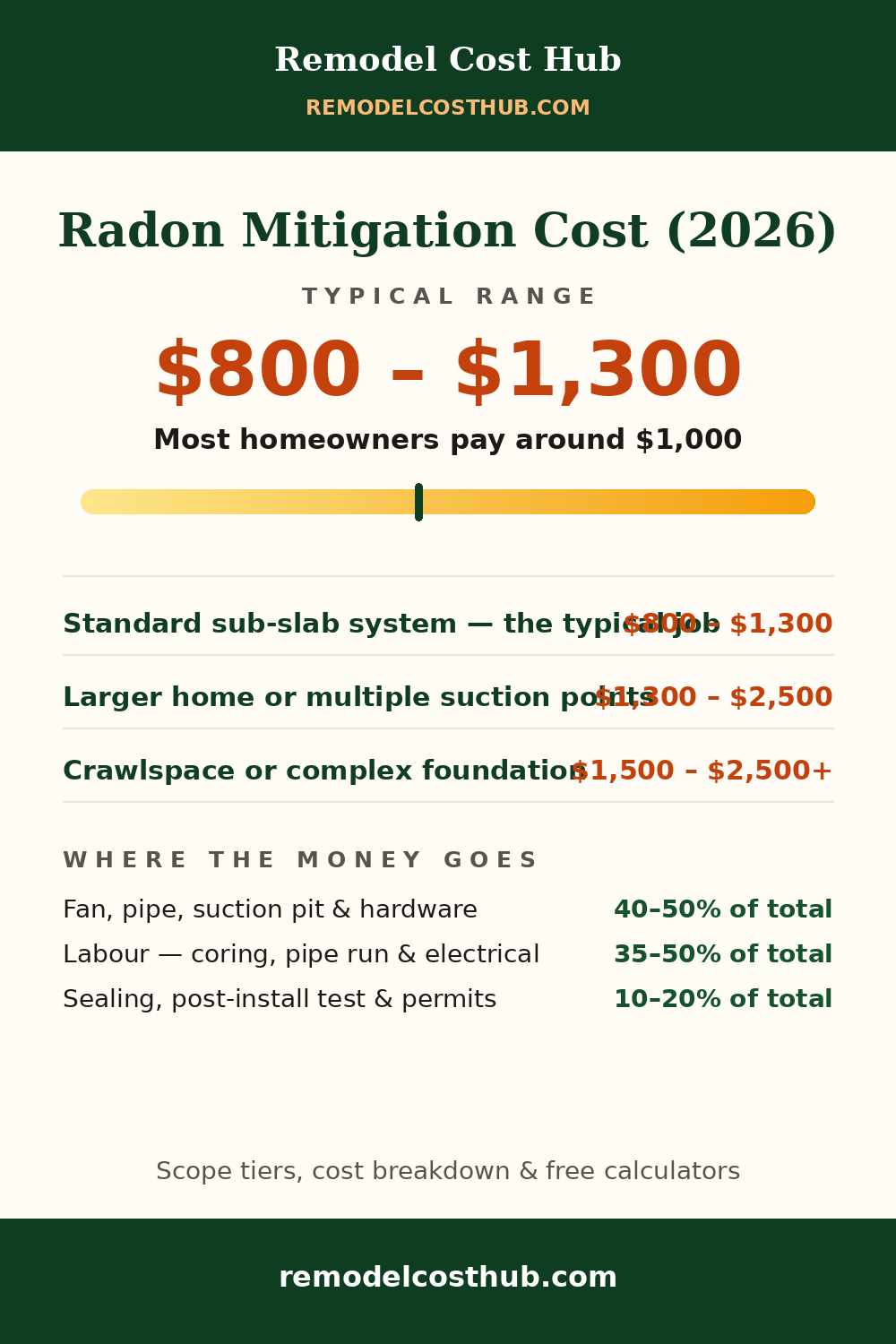
- Typical range: $800 – $1,300
- Most homeowners pay: around $1,000
- Prices vary most by: Fan, pipe, suction pit & hardware (40–50% of the budget)
Cross-checked against three published sources for this project. Sources used for this page: the Angi radon mitigation cost guide, HomeGuide's radon mitigation cost guide and the EPA's Consumer's Guide to Radon Reduction. Sources last checked: October 2026 — HomeGuide, Angi, EPA. How we calculate these costs
Cost by scope
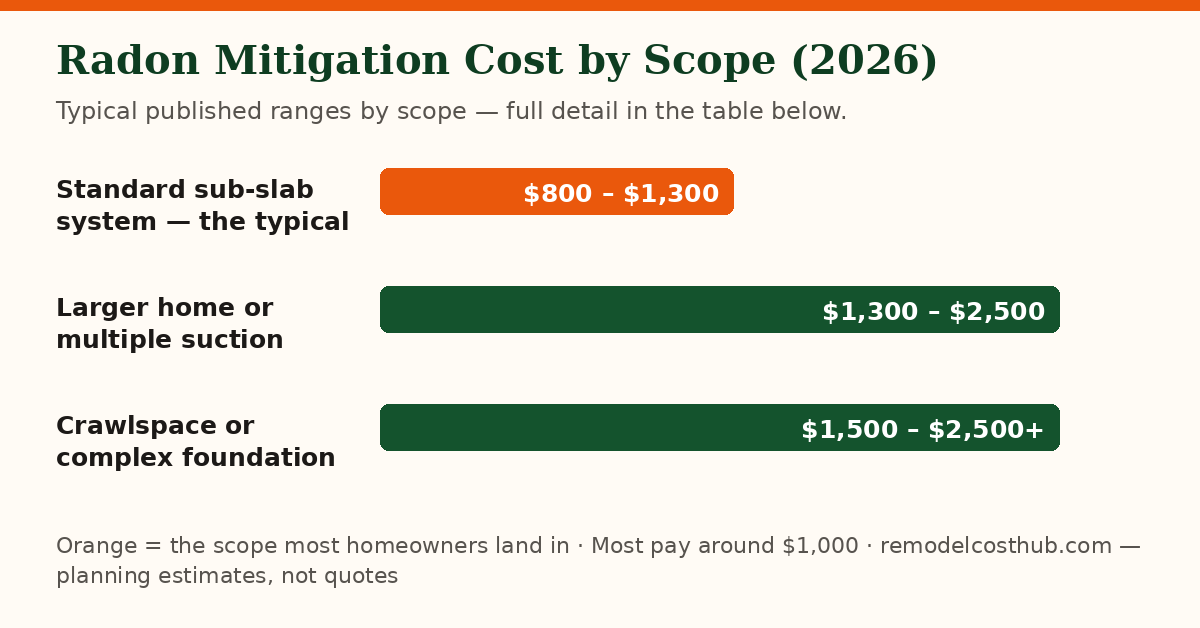
| Scope | Typical cost | What it includes |
|---|---|---|
| Standard sub-slab system — the typical job | $800 – $1,300 | Angi's September 2026 data prices the standard system at $805–$1,326 across 1,184 verified projects, and its second radon guide prices remediation at $800–$1,300 — a suction point through the slab, PVC to a fan, exhaust above the roofline, and a post-install test. |
| Larger home or multiple suction points | $1,300 – $2,500 | Angi's high end reaches $1,795–$2,500; the EPA's Consumer's Guide frames typical systems at $800–$2,500. Additions, multiple foundation types and long pipe runs push a home above the standard band. |
| Crawlspace or complex foundation | $1,500 – $2,500+ | Sub-membrane systems with sealed barriers price above standard sub-slab work — membrane and labour driven — and complex or multi-zone foundations land at the top of the EPA's band and above it. |
Where the money goes
| Part of the job | Share | Note |
|---|---|---|
| Fan, pipe, suction pit & hardware | 40–50% of total | The radon fan, sealed PVC run, suction-point pit and the manometer warning device — the parts half of the invoice on a standard sub-slab job |
| Labour — coring, pipe run & electrical | 35–50% of total | Cutting the suction point through the slab, running pipe to the fan in unconditioned space, sealing slab cracks and the sump lid so the fan holds its vacuum, and the electrical connection done to code |
| Sealing, post-install test & permits | 10–20% of total | Slab-crack and sump-lid sealing, the post-install test that proves the reading came down, and the $25–$150 permit where the municipality requires one |
What moves the price most
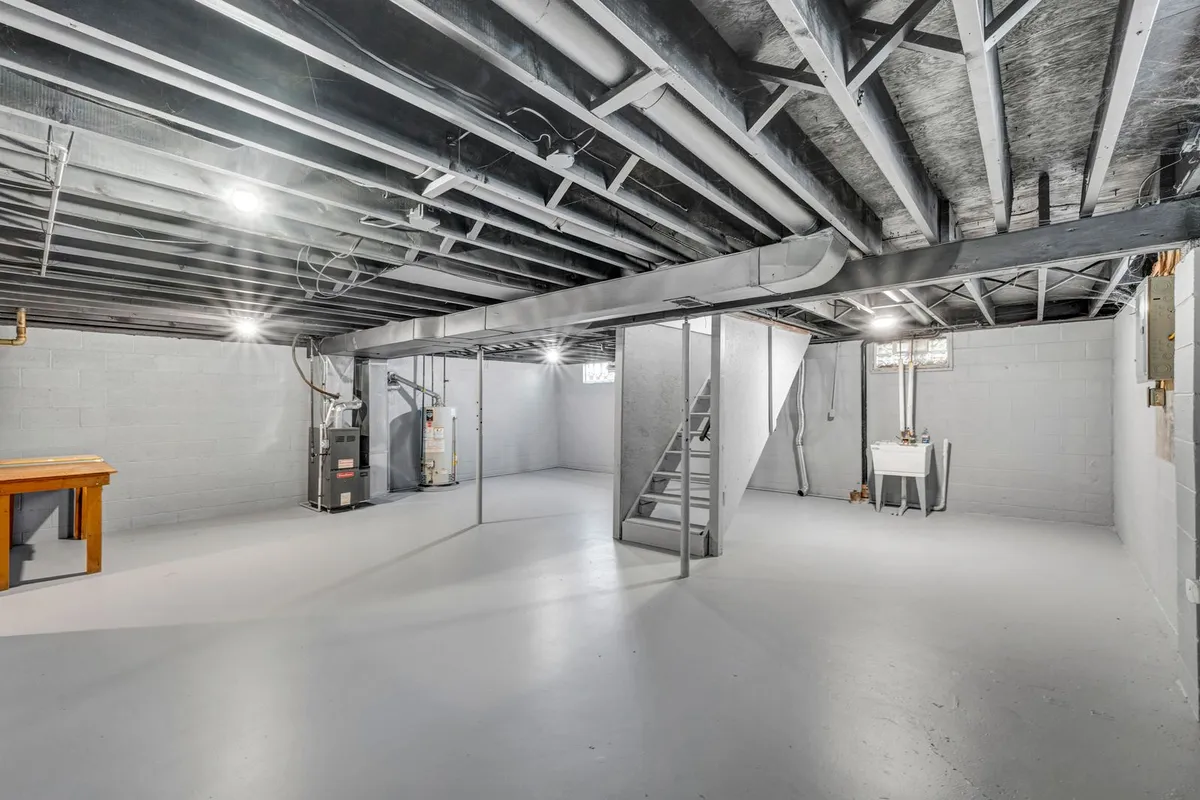
Foundation type decides the system. Basements get sub-slab depressurization — the standard, cheapest version — while crawlspaces need a sub-membrane system with sealed barriers, priced higher because the membrane and labour drive it. Suction-point count is the second lever: one point under a simple slab is the typical job; additions, multiple foundation types and long pipe runs multiply the work. The radon level itself matters less than people expect — the hardware is similar either way — but a high reading raises the stakes on the post-install test. Permits run $25–$150 in Angi where required, and contractor certification and the written guarantee separate real bids from guesses: a guarantee stated as a number, not "we will get it down."
Worked example: how a typical radon mitigation budget breaks down
Take the typical job — a standard basement home: one suction point cut through the slab, sealed PVC run to a fan in the garage attic, exhaust above the roofline, slab cracks and the sump lid sealed, and a post-install test confirming the number came down. Here is a realistic $1,000 version of that invoice, at the $1,000–$1,043 average the guides publish: The budget below totals $1,000 — the "most homeowners pay around" figure from the top of this page — split using this page's own cost breakdown. It shows how a real quote at that level is usually composed; every line is built from the ranges on this page, and it is an illustration, not a quote for your project.
| Line item | Example budget |
|---|---|
| Fan, pipe, suction pit & hardware | $450 |
| Labour — coring, pipe run & electrical | $400 |
| Sealing, post-install test & permits | $150 |
| Total | $1,000 |
What most people get wrong
- Comparing quotes that hide the test. A bid without the post-install test is not a cheaper deal — it is an unfinished job. Get in writing who pays for retesting if the reading stays above 4 pCi/L.
- Pricing from the floor plan alone. Radon is not priced per square foot, and no guide sizes it that way — foundation type and suction-point count decide the number, not the room count.
- Assuming the permit is nobody's job. Permits run $25–$150 in Angi where required; confirm who pulls it before work starts, not after the inspector asks.
- Choosing on price without the guarantee in writing. A real bid states the guaranteed result as a number. "We will get it down" is not a guarantee — it is a sentence.
Costs in your city
Radon is local geology: Zone 1 counties with high radon potential support more certified contractors and more competitive standard-system pricing near Angi's $800–$1,300 band, while fringe areas see fewer bidders and higher minimums. The foundation mix writes the second line — basement-heavy suburbs mitigate cheaply with standard sub-slab systems, crawlspace and slab-on-grade areas pay the membrane premium. Permits at $25–$150 add a third local variable where the municipality requires one. Ask for the suction-point count, the fan model and warranty, and whether the post-install test is included, and any city's quotes become comparable.
How we got these numbers
Cross-checked against the Angi radon mitigation cost guide — September 2026 data read in full this run ($805–$1,326, average $1,043 across 1,184 verified projects; testing $150–$700; permits $25–$150) and its second radon guide (systems $800–$1,300, average $1,000, standard low $400, complex homes to $2,500), the EPA's Consumer's Guide to Radon Reduction — read in full this run (sub-slab suction $800–$2,500; the guide's figures date to 1991 but remain the federal benchmark newer guides cite) and HomeGuide's radon mitigation cost guide — read in full this run (average $1,600, range $1,200–$2,000; professional testing $125–$400; crawlspace encapsulation $3,000–$15,000). The typical band $800–$1,300 is Angi's verified-project range; HomeGuide's member-reported average runs genuinely higher at $1,600 — the two methodologies do not fully overlap, so this page tiers the $1,200–$2,000 band separately rather than blending it. The $1,000 most-pay figure is the average Angi's two guides publish. Breakdown shares are derived from the system parts and labour split on a standard sub-slab job and are labelled as derived on the page.
Frequently asked questions
How much does radon testing cost?
Angi prices radon testing at $150–$700. Test first — mitigation without a reading is a guess — and budget the post-install test too: a bid that skips the verification test is not a cheaper deal, it is an unfinished job.
What does a radon mitigation system actually do?
It is a fan-powered pipe that draws radon from beneath the slab and vents it above the roof. The fan holds a slight vacuum under the house so the gas is pulled from the soil and exhausted outside instead of seeping into the living space — the active soil-depressurization method the EPA's guidance describes.
Where does the radon pipe go?
From the suction point through unconditioned space — an attic, a garage attic or out on the exterior wall — with the exhaust ending above the roof surface, at least 10 feet up and 10 feet away from windows and doors, the way the EPA requires. The fan sits in unconditioned space, and a manometer on the pipe shows at a glance whether the system is running.
How long does a radon fan last?
Plan on replacing the fan every 5 to 10 years at a few hundred dollars — it is a wear item, not a lifetime part. That running cost is small, but it belongs in the long view: a system that has been quietly dead for two years is a decoration, so check the manometer when you check the smoke detectors.
Can I install a radon mitigation system myself?
The EPA's guidance points homeowners toward qualified, certified contractors for mitigation. A certified pro prices the suction-point count, pulls the permit, routes the exhaust to code and tests afterward — and puts the guaranteed result in writing as a number. DIY kits exist, but the test that proves the number came down does not grade on effort.