Luxury Vinyl Flooring cost at a glance
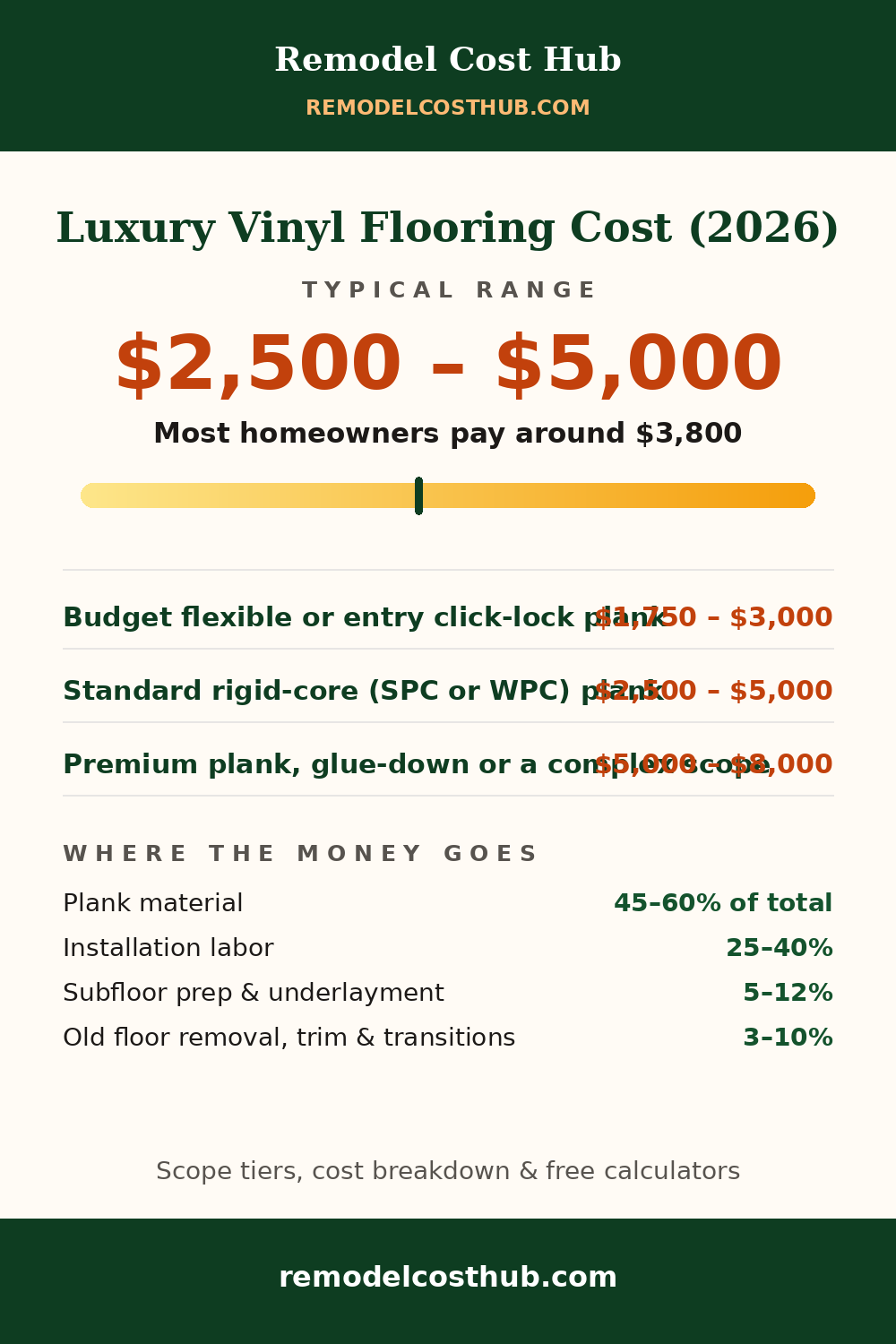
- Typical range: $2,500 – $5,000
- Most homeowners pay: around $3,800
- Per square foot: $5 – $10 per sq ft
- Prices vary most by: Plank material (45–60% of the budget)
Cross-checked against three published sources for this project. Sources used for this page: the Angi luxury vinyl plank (LVP) flooring cost guide, HomeGuide's luxury vinyl flooring cost guide and This Old House's vinyl plank flooring installation cost guide. Sources last checked: October 2026 — This Old House, HomeGuide, Angi. Last updated October 2026 · How we calculate these costs
Cost by scope
| Scope | Typical cost | What it includes |
|---|---|---|
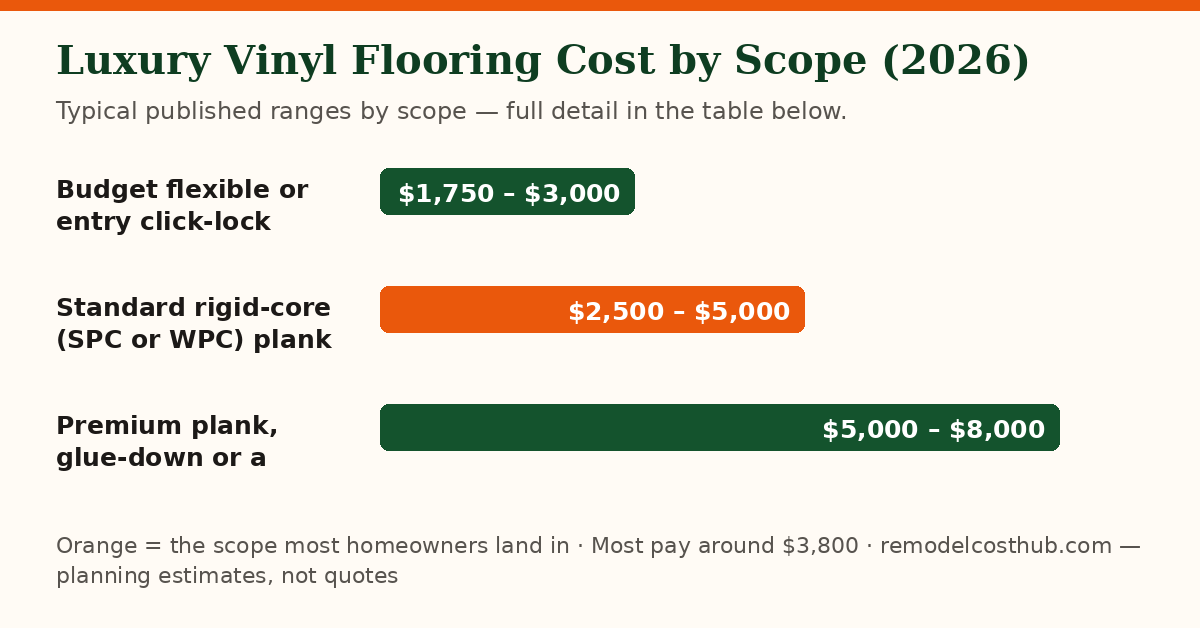
| Budget flexible or entry click-lock plank | $1,750 – $3,000 | Thinner flexible-core plank over about 500 sq ft of flat, sound floor — at $3.50–$6 per sq ft installed, the low end of the Angi and HomeGuide bands |
| Standard rigid-core (SPC or WPC) plank | $2,500 – $5,000 | Where most whole-room projects land: a midrange rigid-core plank with a genuine wear layer at $5–$10 per sq ft installed over about 500 sq ft, including standard prep and transitions |
| Premium plank, glue-down or a complex scope | $5,000 – $8,000 | Thick rigid-core or premium-brand plank, glue-down installation, stairs, a herringbone lay or heavy subfloor prep over about 500 sq ft — toward the $10–$16 per sq ft top of HomeGuide's installed band |
Where the money goes
| Part of the job | Share | Note |
|---|---|---|
| Plank material | 45–60% of total | The largest share in every published breakdown: HomeGuide puts luxury vinyl material at $2–$10 per sq ft, and core type (flexible, WPC or stone-plastic SPC) plus wear-layer thickness are what move a plank through that span |
| Installation labor | 25–40% | HomeGuide puts installation labor and job supplies at $2–$6 per sq ft; click-lock floating installs sit at the fast end of that span, glue-down and patterned lays at the slow end |
| Subfloor prep & underlayment | 5–12% | Levelling and patching — a rigid plank telegraphs subfloor bumps straight through, so prep is quoted more often than the brochures suggest; many planks carry a pre-attached pad instead of a separate underlayment |
| Old floor removal, trim & transitions | 3–10% | Removal and disposal of the old floor, undercutting door casings, and the baseboards, thresholds and stair nosing that finish the edges |
What moves the price most
Core and wear layer are the price. HomeGuide splits luxury vinyl into material at $2–$10 per sq ft and labor at $2–$6, for $4–$16 installed overall; Angi puts LVP at $3–$10 per sq ft, and This Old House puts a 1,000 sq ft project at $5,000–$17,000 all-in. Inside those bands, the plank itself decides: a thin flexible plank with a minimal wear layer is the budget tier, while a thick stone-plastic (SPC) core with a 20-mil wear layer is the premium tier — the wear layer is the part you actually walk on, and its thickness is the honest predictor of how the floor looks in ten years. Installation method is the second lever — click-lock floating floors install fastest and can come back up; glue-down costs more labor and stays put. The subfloor is the third: vinyl is thin and rigid-core plank in particular shows every dip and ridge beneath it, so levelling compound and patching are common quote lines. And scope details — stairs priced per step, herringbone lays, and rooms chopped up with closets and angles — all add cutting time that a per-square-foot average assumes away.
Costs in your city
Labor is the biggest variable in any remodel, and labor is local — the same bathroom can price very differently in Houston than in Boston. We are adding city editions metro by metro, each with its own labor index, permit notes and climate factors, written for that city rather than copied from this page. Wave 1: Houston, Dallas–Fort Worth, Phoenix, Atlanta, Miami–South Florida, Orlando, Tampa, Charlotte, Austin and San Antonio. Until your city's page is live, use the national range here and weight it the way contractors do: Sun Belt labor often prices near or below the national middle, while coastal California and the Northeast metros often price well above it.
Frequently asked questions
How much does luxury vinyl plank flooring cost per square foot installed?
About $5–$10 per sq ft installed for a standard rigid-core plank is the typical overlap: HomeGuide puts the full installed range at $4–$16, Angi puts LVP at $3–$10, and This Old House's worked totals for standard plank work out in the same middle band. Budget flexible plank sits below it and premium rigid-core above it.
How much does LVP flooring cost for 500 sq ft?
About $2,500–$5,000 installed for a standard rigid-core floor is the typical band on this page, with most projects landing around $3,800. Entry click-lock plank can come in near $1,750, and premium plank, glue-down work or heavy subfloor prep runs $5,000–$8,000 for the same area.
Is luxury vinyl flooring really waterproof?
The plank itself is: the core does not swell or soften with water the way laminate's fibreboard core or hardwood does, which is why the guides recommend it for kitchens, bathrooms and basements. Standing water can still find seams and the subfloor beneath, so 'waterproof plank' is not the same promise as a waterproofed room — spills wiped up reasonably promptly are the use it is built for.
LVP or laminate — which should I choose?
Choose by room and by feel. LVP is waterproof, quieter and softer underfoot, and is the guides' pick for wet rooms and basements. Laminate is often cheaper at the entry tier, feels harder and more wood-like underfoot, and resists surface scratching well in dry living spaces. In a dry bedroom or living room the two overlap on price; in a kitchen or bath, vinyl is the safer spend.
Can I install luxury vinyl plank flooring myself?
Click-lock LVP is one of the most DIY-friendly floors sold — planks score and snap or saw cleanly, float over many existing floors, and need no adhesive. The failures are preparation failures: an unflat subfloor telegraphing through, no expansion gap, and planks not acclimated. Glue-down installation and stairs are where most owners hand the job to a pro.