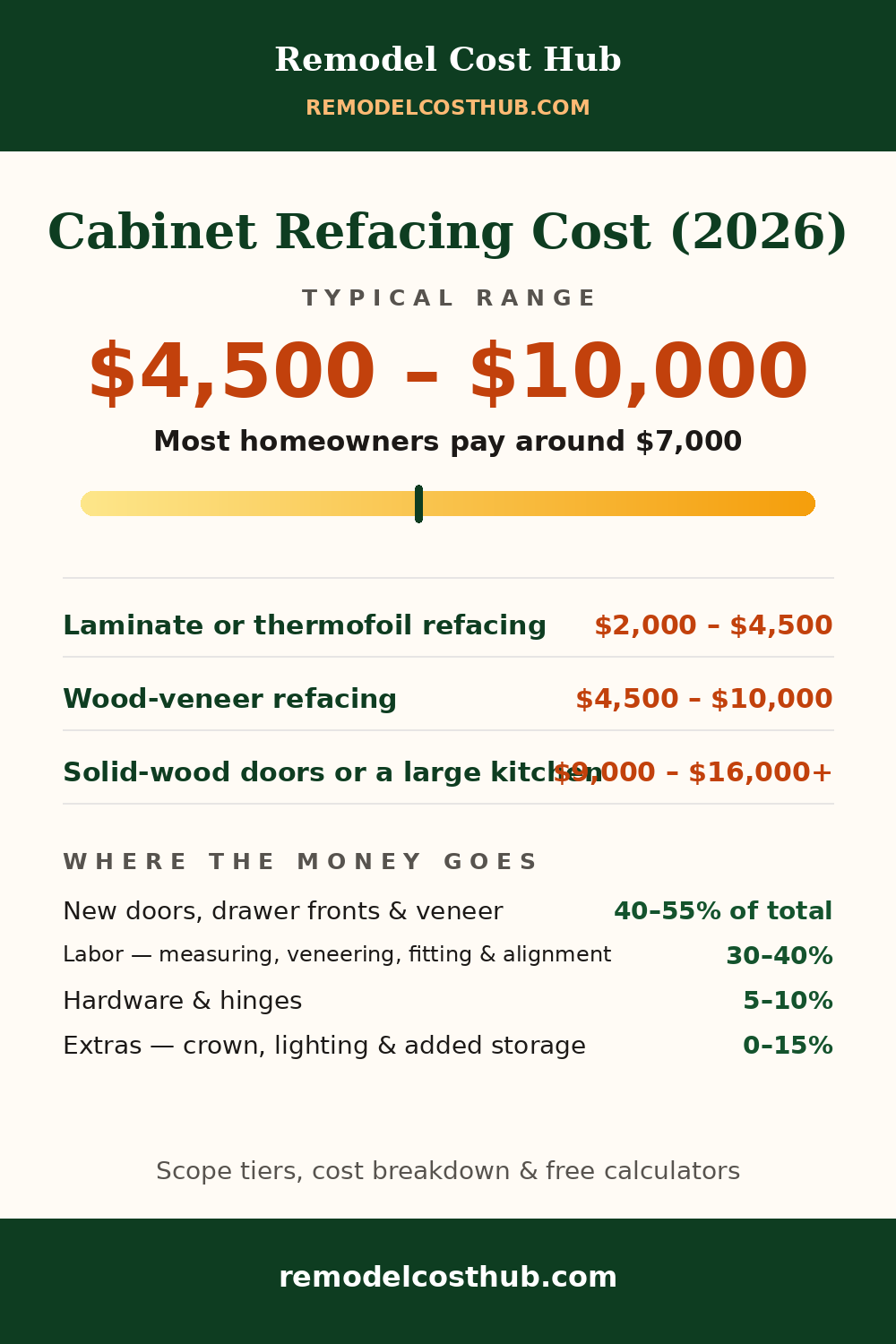
Cabinet Refacing cost at a glance
- Typical range: $4,500 – $10,000
- Most homeowners pay: around $7,000
- Prices vary most by: New doors, drawer fronts & veneer (40–55% of the budget)
Cross-checked against three published sources for this project. Sources used for this page: the Angi cabinet refacing cost guide, HomeGuide's cabinet refacing cost guide and Fixr's cabinet refacing cost guide. Sources last checked: October 2026 — HomeGuide, Fixr, Angi. Last updated October 2026 · How we calculate these costs
Cost by scope
| Scope | Typical cost | What it includes |
|---|---|---|
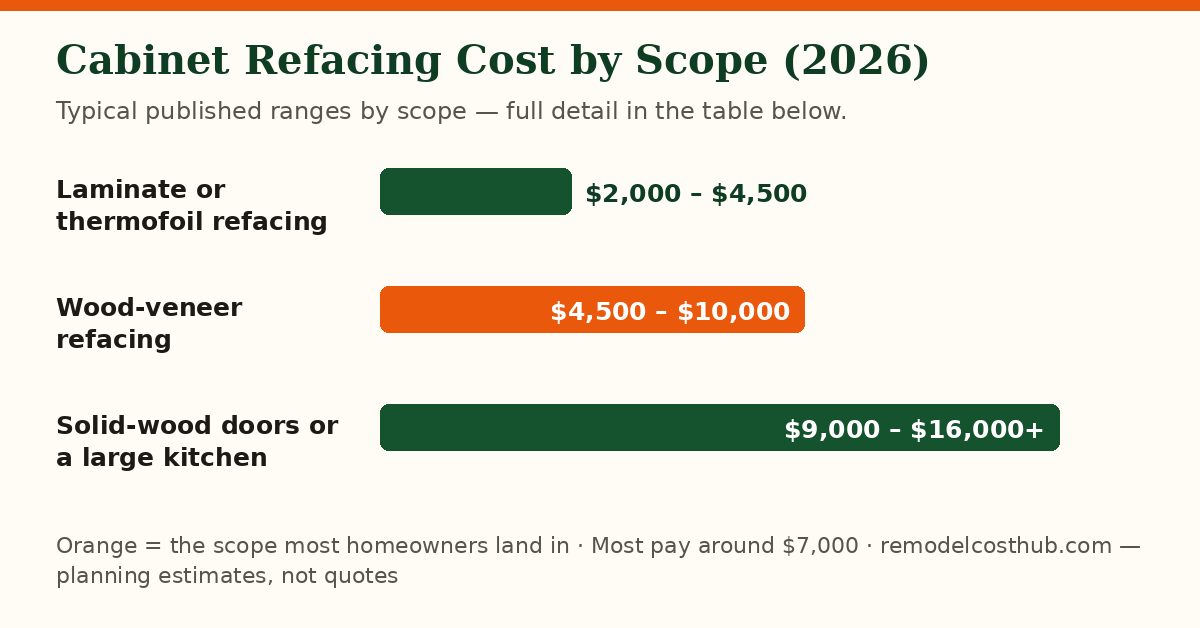
| Laminate or thermofoil refacing | $2,000 – $4,500 | New laminate or rigid-thermofoil doors and drawer fronts with matching veneer applied to the existing boxes of an average kitchen — HomeGuide prices this material class at $80–$125 per linear foot |
| Wood-veneer refacing | $4,500 – $10,000 | Where most refacing projects land: real-wood veneer on the boxes with new wood or veneered doors and drawer fronts — HomeGuide prices wood veneer at $100–$250 per linear foot; Angi's average refacing band is $4,235–$10,230 and Fixr's average project sits near $8,250 |
| Solid-wood doors or a large kitchen | $9,000 – $16,000+ | Solid-wood doors and drawer fronts (HomeGuide: $200–$500 per linear foot), a large door and drawer count, or extras on top — added cabinets, crown moulding, glass fronts or pull-out storage |
Where the money goes
| Part of the job | Share | Note |
|---|---|---|
| New doors, drawer fronts & veneer | 40–55% of total | The visible material is most of the bill: door style and material class (thermofoil, wood veneer or solid wood) set it, and Fixr's per-door average of about $435 shows how quickly a door count adds up |
| Labor — measuring, veneering, fitting & alignment | 30–40% | Refacing is skilled, sequential work: measuring every opening, applying veneer to all exposed box surfaces, then hanging and aligning every door and drawer front — typically several days in the kitchen |
| Hardware & hinges | 5–10% | New pulls and knobs and the soft-close hinges most refacing quotes include as standard; reusing sound existing hardware is one of the few easy savings on this project |
| Extras — crown, lighting & added storage | 0–15% | Near zero on a like-for-like reface; crown moulding, under-cabinet lighting, pull-out shelves or an added cabinet are real lines of their own when the scope grows beyond the existing boxes |
What moves the price most
The boxes decide whether refacing is even an option. Refacing keeps your existing cabinet boxes and layout and replaces everything visible — doors, drawer fronts, veneer on the box exteriors, hardware. Every guide makes the same condition: boxes that are structurally sound, dry and square. Warped, water-damaged or badly built boxes, or a layout you want to change, end the refacing conversation and start a replacement one. Material class is the biggest price lever that remains: HomeGuide's per-linear-foot ladder runs from laminate and thermofoil at $80–$125, through wood veneer at $100–$250, to solid wood at $200–$500 — the same kitchen can legitimately price at two or three times itself across that ladder. Kitchen size and door count come next, because the work is priced per opening as much as per foot. Finally, the comparison that frames the whole project: Angi puts refacing at roughly 30–50% of replacement cost and states the working rule plainly — if a refacing quote passes about half the cost of replacing the cabinets, replacement is usually the better buy, because it also buys new boxes and a layout change.
Costs in your city
Labor is the biggest variable in any remodel, and labor is local — the same bathroom can price very differently in Houston than in Boston. We are adding city editions metro by metro, each with its own labor index, permit notes and climate factors, written for that city rather than copied from this page. Wave 1: Houston, Dallas–Fort Worth, Phoenix, Atlanta, Miami–South Florida, Orlando, Tampa, Charlotte, Austin and San Antonio. Until your city's page is live, use the national range here and weight it the way contractors do: Sun Belt labor often prices near or below the national middle, while coastal California and the Northeast metros often price well above it.
Frequently asked questions
How much does it cost to reface kitchen cabinets?
For an average kitchen, about $4,500–$10,000 with wood veneer is the typical band on this page, with most projects landing around $7,000. Laminate and thermofoil refacing runs $2,000–$4,500, and solid-wood doors or a large kitchen run $9,000–$16,000 or more. HomeGuide puts the average kitchen at $5,000–$13,000 overall, and Fixr's average project is about $8,250.
Is refacing cheaper than replacing cabinets?
Yes, when the boxes are worth keeping: the guides put refacing at roughly 30–50% of replacement — this site's kitchen cabinets guide puts new cabinets at $4,500–$11,000 for the cabinets alone, before the counters, plumbing and extra labor a full replacement drags with it. The working rule from Angi: if refacing would cost more than about half of replacement, replace instead.
How long does cabinet refacing take, and how long does it last?
The in-kitchen work is typically a few days — far shorter than the weeks a full cabinet replacement takes, and the kitchen stays usable for much of it. Done with sound boxes and decent materials, the guides put a refaced kitchen's service life at 10–20 years or more; the doors and veneer are new surfaces with a normal finish lifespan.
What does refacing not fix?
Everything inside the boxes and everything about the layout. Refacing does not repair water damage, sagging or warped boxes, worn drawer boxes and slides (unless they are replaced as extras), and it cannot move a sink, add an island or change where cabinets sit. It is a new skin and new doors on the kitchen you already have — which is exactly right when the layout already works.
Can I reface cabinets myself?
The doors and drawer fronts are a realistic DIY swap; the veneer work on the boxes is the part that separates a professional result from a visible one — it has to be cut, glued and trimmed flush on every exposed surface, and mistakes show permanently. Most owners who DIY buy the doors and hardware and fit those, and the guides are consistent that full veneering is the step to hire out unless you have done it before.