Hydro Jetting cost at a glance
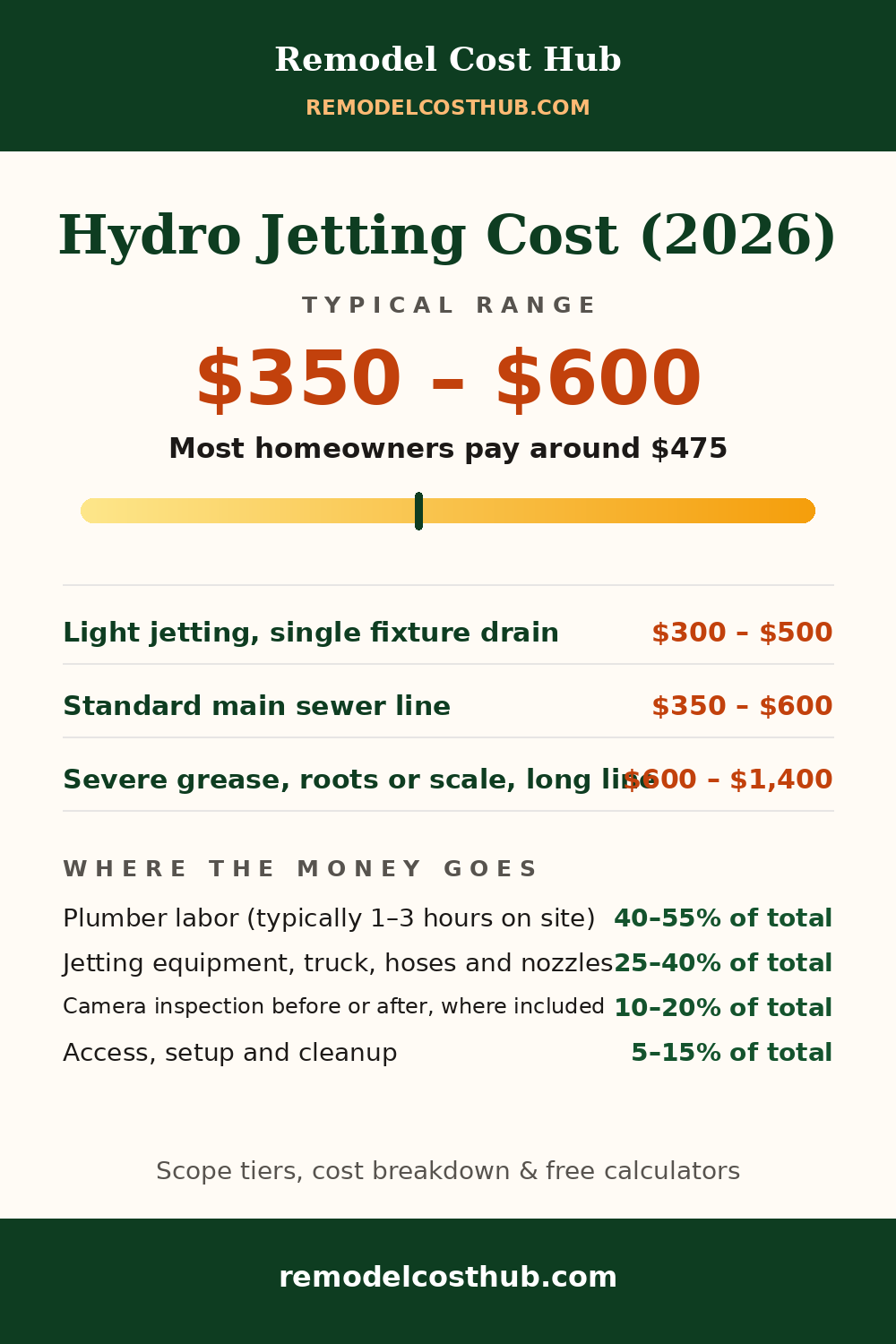
- Typical range: $350 – $600
- Most homeowners pay: around $475
- Prices vary most by: Plumber labor (typically 1–3 hours on site) (40–55% of the budget)
Cross-checked against three published sources for this project. Sources used for this page: Angi's hydro jetting cost guide, updated October 23, 2026 (national average $475, most $350–$600, full range $100–$2,000; severe and complex blockages to $2,000; plumbers $45–$200 an hour; dedicated root removal $100–$600 extra; snaking a sewer main $100–$400), HomeGuide's hydro jetting cost guide (national average $1,000, average range $600–$1,400, minimum $300, maximum $3,000; snaking $150–$275 for a sink and $200–$500 for a sewer line; camera inspection $125–$500; results lasting 2–3 years for most homes) and Thumbtack's hydro jetting cost data as reported on this site's drain-cleaning page ($350–$600). Synthesized typical = Angi's band, matched by Thumbtack; HomeGuide's band is published as the severe tier, not averaged away. Checked November 2026.. Sources last checked: October 2026 — HomeGuide, Angi, Thumbtack. How we calculate these costs
Cost by scope
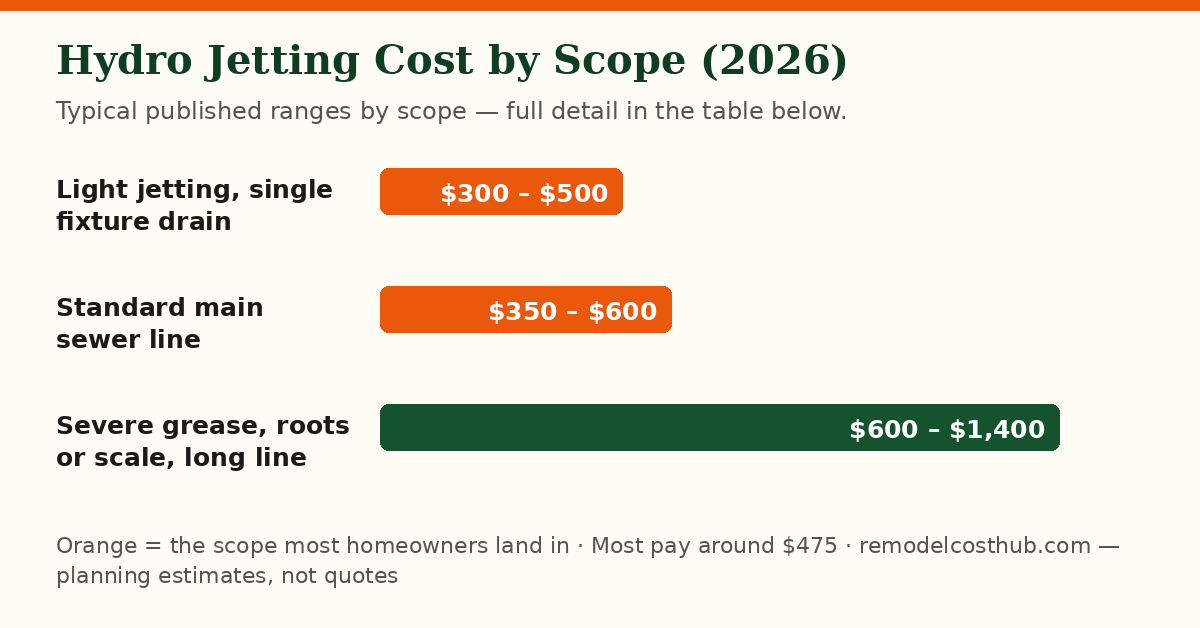
| Scope | Typical cost | What it includes |
|---|---|---|
| Light jetting, single fixture drain | $300 – $500 | A single sink, tub or toilet line jetted where access is easy. HomeGuide notes sink jetting costs less than a sewer line, and published fixture comparisons put the fixture band at $300–$800 — the low end is the honest tier for one accessible drain. |
| Standard main sewer line | $350 – $600 | The typical project on this page. Angi's most-pay band is $350–$600 with a $475 average, and Thumbtack's hydro jetting band matches it at $350–$600. |
| Severe grease, roots or scale, long line | $600 – $1,400 | HomeGuide's band, averaging about $1,000. Severe blockages, long runs, root cutting at $100–$600 extra in Angi, and a camera inspection at $125–$500 in HomeGuide are what push a job into this tier. |
Where the money goes
| Part of the job | Share | Note |
|---|---|---|
| Plumber labor (typically 1–3 hours on site) | 40–55% of total | Angi prices plumbers at $45–$200 an hour; a jetting visit runs longer than a snaking visit because the whole line is flushed, not just the clog |
| Jetting equipment, truck, hoses and nozzles | 25–40% of total | Truck-mounted high-pressure equipment, typically 1,500–4,000 PSI for residential work in the published guides; the rig, not the water, is what the snake-only visit does not carry |
| Camera inspection before or after, where included | 10–20% of total | HomeGuide prices a standalone camera inspection at $125–$500; on older lines it is the step that separates a blockage from a broken pipe before the jet goes in |
| Access, setup and cleanup | 5–15% of total | Finding and opening the cleanout, running the hose, protecting floors and flushing debris clear; a line with no cleanout costs more because access has to be created first |
What moves the price most
Method is the first choice: snaking at $150–$275 for a sink or $200–$500 for a main line in HomeGuide punches through a clog, while jetting at $350–$600 in Angi scours the full pipe wall — for a one-off soft clog the snake is the right spend, for recurring clogs, grease or roots the jet lasts longer, with HomeGuide putting results at 2–3 years. What is in the pipe is second: grease, scale and roots each take more passes and pressure than a soft blockage, and Angi prices dedicated root removal at $100–$600 on top of the jetting. Access is third: an outdoor cleanout at grade is the cheapest start, while a line reached only by pulling a toilet or opening a trap adds the reset to the bill. Pipe condition is fourth: jetting can damage already-deteriorated pipes, so a camera inspection first is the honest step on an older main line, not an upsell. For a simple clog cleared by cable, see our drain cleaning guide, for the camera step itself, see our sewer camera inspection guide, and for a line that turns out to be broken, see our sewer line replacement guide.
Costs in your city
Labor is the biggest variable in any remodel, and labor is local — the same bathroom can price very differently in Houston than in Boston. We are adding city editions metro by metro, each with its own labor index, permit notes and climate factors, written for that city rather than copied from this page. Wave 1: Houston, Dallas–Fort Worth, Phoenix, Atlanta, Miami–South Florida, Orlando, Tampa, Charlotte, Austin and San Antonio. Until your city's page is live, use the national range here and weight it the way contractors do: Sun Belt labor often prices near or below the national middle, while coastal California and the Northeast metros often price well above it.
Frequently asked questions
How much does hydro jetting cost?
A standard visit runs $350–$600 with $475 typical — Angi's most-pay band and average, matched by Thumbtack's $350–$600 band. HomeGuide's $600–$1,400 band, averaging about $1,000, is the severe-blockage tier, not the standard visit.
Is hydro jetting better than snaking?
For a one-off hair or food clog, no — snaking at $150–$275 for a sink or $200–$500 for a main line in HomeGuide clears it for less. For recurring clogs, grease buildup or roots, jetting cleans the full pipe wall instead of boring a hole through the blockage, and HomeGuide puts the result at 2–3 years between visits.
How long does hydro jetting take?
Published comparisons put a residential visit at 1–3 hours depending on line length and what is in the pipe. A camera inspection before or after adds time, and a line with no cleanout adds access time before the jetting starts.
Can hydro jetting damage pipes?
Yes, on pipes that are already deteriorated — which is why the guides put a camera inspection first on older lines. Sound modern pipe handles residential jetting pressure; cracked, corroded or offset pipe is a repair job, and jetting it first can make it worse.
Does hydro jetting remove tree roots?
It cuts roots back and flushes them out, but Angi prices dedicated root removal at $100–$600 on top of the jetting, and roots grow back through the same joints. A line with recurring root intrusion needs the joint or section repaired, not just re-jetted.
What pressure does hydro jetting use?
Residential guides put the working range at about 1,500–4,000 PSI, with the nozzle and the pipe condition deciding the setting. Higher pressure is not better by default — it is matched to the blockage and the pipe, and the operator's judgment is part of what the visit buys.