Termite Inspection cost at a glance
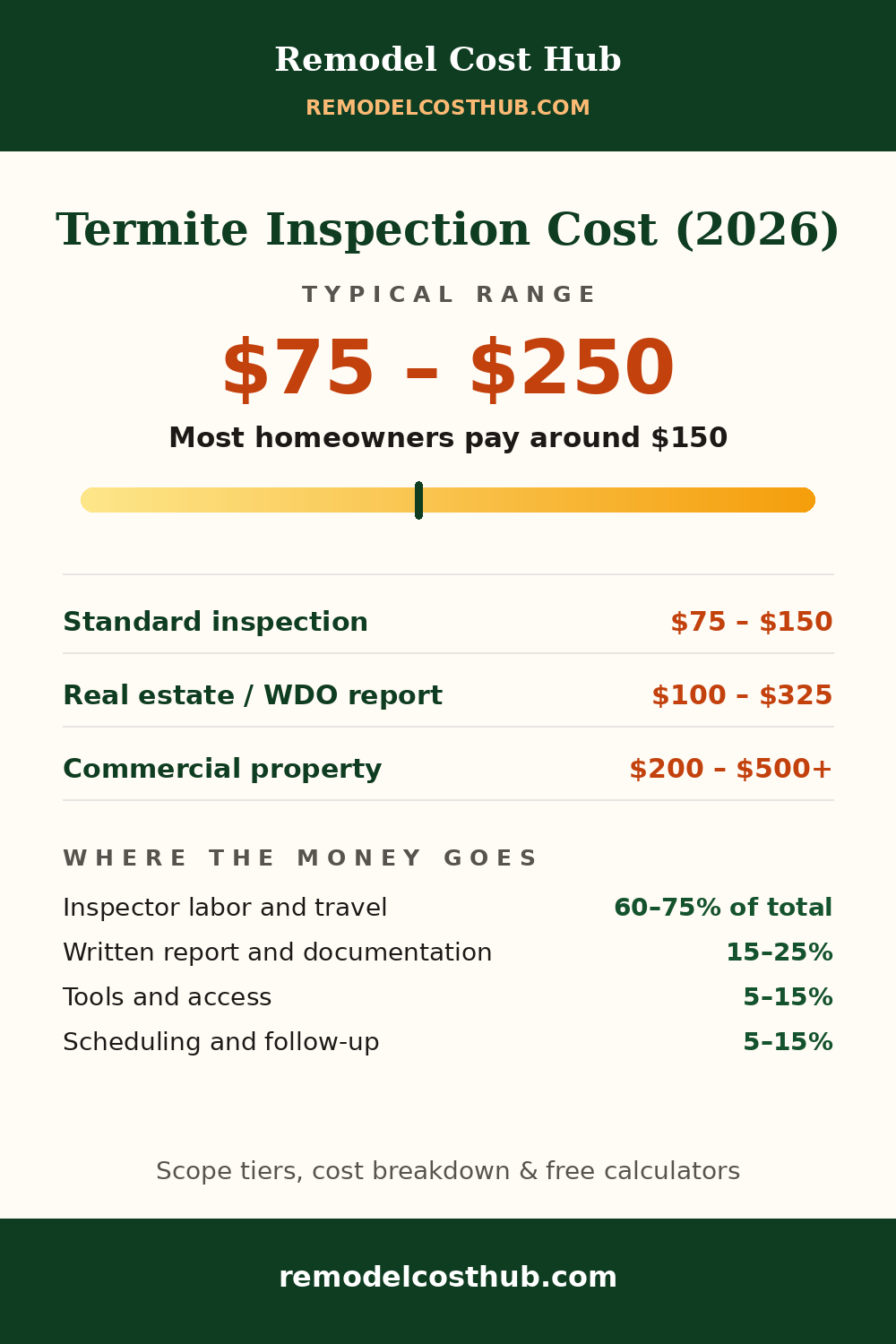
- Typical range: $75 – $250
- Most homeowners pay: around $150
- Prices vary most by: Inspector labor and travel (60–75% of the budget)
Cross-checked against two published sources for this project. Sources used for this page: Angi's termite inspection cost guide, updated September 17, 2026 (national average $100, most $75–$325; home sale $165, follow-up $75–$150, clearance letter $100–$200, termite bond $500–$2,000; spot treatment $230–$970), HomeGuide's termite inspection cost guide (standard $0–$250, routine $100–$250, real estate $100–$325, loan-required $50–$200, WDO $150–$300, commercial $200–$500+, home-inspection bundle $300–$600, follow-up $75–$150, bond $500–$2,000, annual protection plan $200–$900) and Clever Real Estate's inspector-quote analysis (401 licensed-inspector quotes, average $133, typical $110–$156). The page's typical band is the Angi–HomeGuide standard overlap; the $150 most-pay figure sits on HomeGuide's WDO figure and near Angi's $165 home-sale average; free inspections are published as the waived-with-treatment note, not as the typical price. Checked November 2026.. Sources last checked: October 2026 — HomeGuide, Angi. How we calculate these costs
Cost by scope
| Scope | Typical cost | What it includes |
|---|---|---|
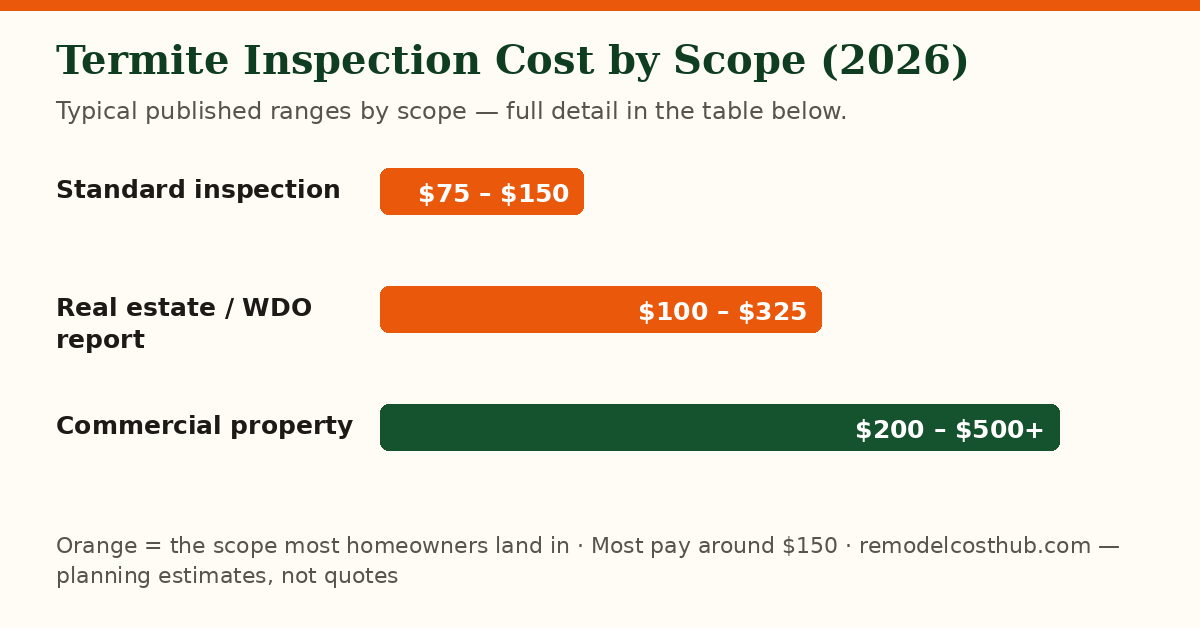
| Standard inspection | $75 – $150 | Routine visual check for a homeowner, with no lender form attached |
| Real estate / WDO report | $100 – $325 | Formal wood-destroying-organism report for a sale or loan, with documentation a lender accepts |
| Commercial property | $200 – $500+ | Larger buildings and multiple structures, priced by area and access |
Where the money goes
| Part of the job | Share | Note |
|---|---|---|
| Inspector labor and travel | 60–75% of total | The walk-through itself — interior, exterior, attic and crawl space where accessible |
| Written report and documentation | 15–25% | The report, and any clearance letter at $100–$200 in Angi's tables |
| Tools and access | 5–15% | Probe, moisture meter and ladder work for attics and crawl spaces |
| Scheduling and follow-up | 5–15% | Booking, and the follow-up visit at $75–$150 if treatment follows |
What moves the price most
Inspection type and report are first: Angi's type table runs a home-sale inspection at $165, a follow-up at $75–$150, a clearance letter at $100–$200 and a termite bond at $500–$2,000 — a lender form is a different product from a routine look-over, and it prices higher. Home size and access are second: iBuyer's tables put a 1,000 sq ft condo at $75–$100 and a 3,000 sq ft home with a crawl space at $175–$250, since attics, basements and detached garages each add inspection time. Lender requirement is third: HomeGuide prices loan-required inspections at $50–$200, and VA and FHA loans commonly require a signed report in termite-active areas. Bond and protection plans are fourth: a bond runs $500–$2,000 in both Angi's and HomeGuide's tables, and annual protection plans $200–$900 in HomeGuide's — neither is inside the inspection fee. For the treatment an inspection may lead to, see our termite treatment guide, for general pest work, see our pest control guide, and for the whole-home check that often bundles a termite look, see our home inspection guide.
Worked example: how a typical termite inspection budget breaks down
Take the typical job — a standard inspection of a single-family home, accessible interior, exterior, attic and crawl space, written report included. Here is a realistic $150 version of that invoice: The budget below totals $150 — the "most homeowners pay around" figure from the top of this page — split using this page's own cost breakdown. It shows how a real quote at that level is usually composed; every line is built from the ranges on this page, and it is an illustration, not a quote for your project.
| Line item | Example budget |
|---|---|
| Inspector labor and travel | $98 |
| Written report and documentation | $30 |
| Tools and access | $12 |
| Scheduling and follow-up | $10 |
| Total | $150 |
What most people get wrong
- Treating a free inspection as a paid report — a waived fee tied to a treatment quote is not a lender-accepted WDO report, and only the same document is comparable.
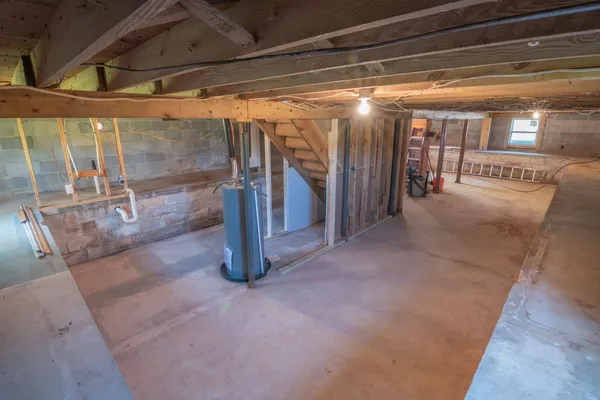
- Skipping the attic and crawl space — hidden colonies live where the inspector cannot walk comfortably, and a slab-only walkthrough is not a full inspection.
- Confusing inspection with treatment — the $150 on this page buys the finding, and treatment at $230–$970 in Angi’s spot-treatment tables is a separate invoice.
- Ignoring the bond question at a sale — a lender may require a $500–$2,000 bond before closing, and discovering it late delays the sale.
Costs in your city
Termite inspection is inspector-labor pricing around an area: the same standard inspection quotes near the bottom of the band where inspector rates are low and toward the top in a high-cost metro, while the report form travels with the loan. Termite pressure travels with the city — warm, humid regions inspect annually as routine, and cooler regions inspect mostly at a sale, which changes both the visit count and whether a bond is in play. Ask each bidder for the inspection type, whether the report is lender-accepted, and whether a follow-up visit is inside the fee.
Frequently asked questions
How much does a termite inspection cost?
Most standard inspections land between $75 and $250, with $150 typical. Angi averages $100 inside a $75–$325 band, HomeGuide puts standard inspections at $0–$250, and Clever's analysis of 401 inspector quotes averages $133 — the band on this page is the standard-scope overlap.
Why do some companies offer a free termite inspection?
Because the inspection is often a lead-in to treatment: HomeGuide puts standard inspections at $0–$250 and notes that many companies waive the fee when you buy treatment from them. A free inspection tied to a treatment quote is not the same product as a paid, lender-accepted report.
What does a termite inspector look for?
Mud tubes, discarded wings, damaged wood and droppings, plus the moisture and wood-to-soil contact that invite termites — across accessible interior, exterior, attic and crawl-space areas. Hidden colonies inside walls are exactly what an inspection can miss, which is why access matters to the price.
What happens if termites are found?
The inspector's report sets the treatment scope: Angi prices spot treatment at $230–$970, HomeGuide prices tenting at $2,000–$8,000 for an average home, and a termite bond at $500–$2,000 may be required by a lender before a sale closes.
How often should a termite inspection be done?
Annually is the standard recommendation in Angi's guidance, since treatments weaken over time and new colonies establish silently. Homes in warm, humid regions and homes with prior termite history are the ones that should not skip a year.