Engineered Hardwood Flooring cost at a glance
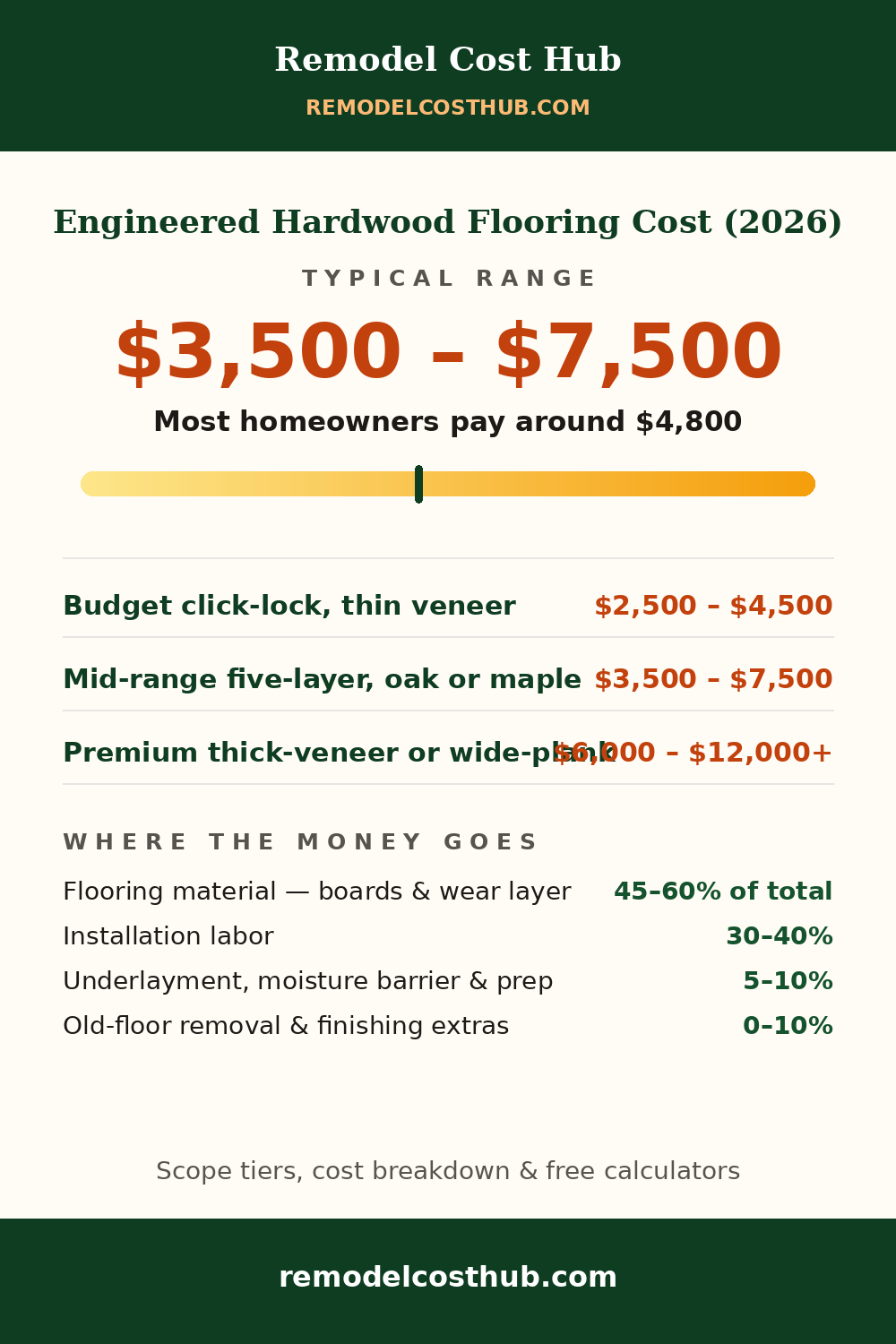
- Typical range: $3,500 – $7,500
- Most homeowners pay: around $4,800
- Per square foot: $7 – $15 per sq ft
- Prices vary most by: Flooring material — boards & wear layer (45–60% of the budget)
Cross-checked against three published sources for this project. Sources used for this page: the Angi engineered hardwood flooring installation cost guide, HomeGuide's engineered hardwood flooring cost guide and Modernize's engineered hardwood flooring cost guide. Sources last checked: October 2026 — HomeGuide, Modernize, Angi. Last updated October 2026 · How we calculate these costs
Cost by scope
| Scope | Typical cost | What it includes |
|---|---|---|
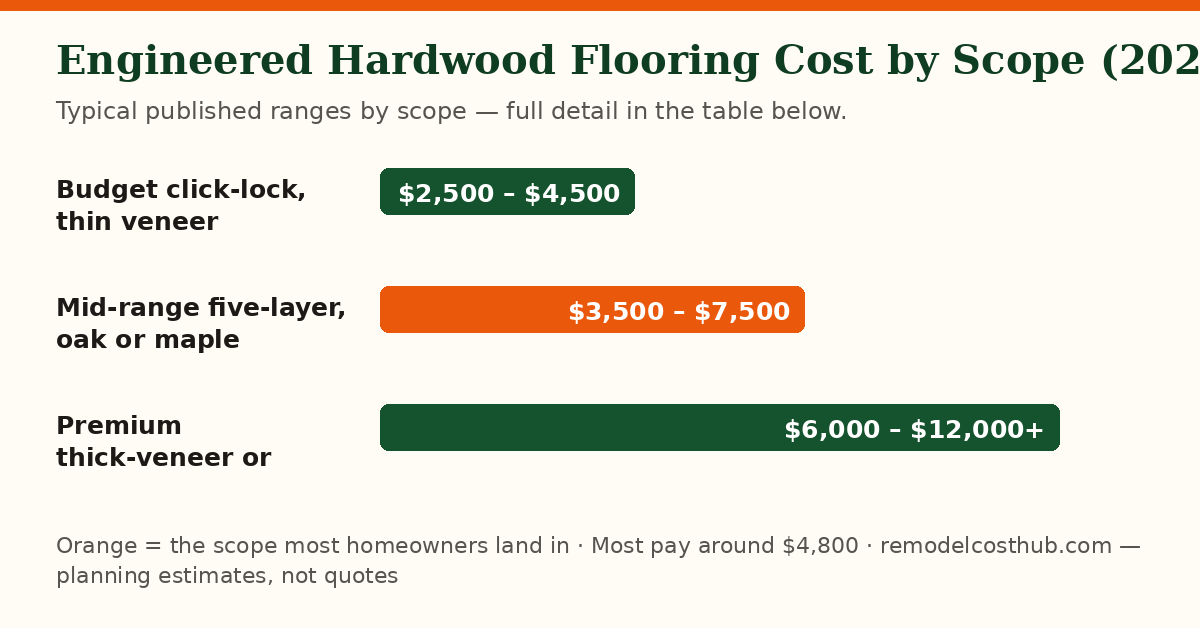
| Budget click-lock, thin veneer | $2,500 – $4,500 | Three-layer boards with a thin wear layer, floated over about 500 sq ft — HomeGuide prices budget engineered at $5–$17 per sq ft installed and Angi's basic grade at $5–$9; standard rooms in common species sit at the low end of those spans |
| Mid-range five-layer, oak or maple | $3,500 – $7,500 | Where most engineered projects land: a five-layer core with a real oak or maple veneer, floated, glued or nailed over about 500 sq ft — HomeGuide puts mid-range engineered at $9–$20 per sq ft installed, Modernize at $6–$16, and Angi's average complete project is about $4,750 |
| Premium thick-veneer or wide-plank | $6,000 – $12,000+ | Seven-plus layers, a thick wear layer that can be refinished, wide planks or premium species over about 500 sq ft — HomeGuide prices high-end engineered at $12–$24+ per sq ft installed |
Where the money goes
| Part of the job | Share | Note |
|---|---|---|
| Flooring material — boards & wear layer | 45–60% of total | The boards are most of the bill: HomeGuide puts mid-range material at $6–$12 per sq ft against $3–$8 of labor, and species and wear-layer thickness move that line more than anything else on the page |
| Installation labor | 30–40% | Floating and click-lock installs are the fastest version of the job; glue-down over concrete and nail-down over plywood take longer, which is why the same boards price differently by method |
| Underlayment, moisture barrier & prep | 5–10% | Floating floors need underlayment (HomeGuide: about $0.50–$1.00 per sq ft where required), and concrete subfloors need moisture testing and often a barrier before any board goes down |
| Old-floor removal & finishing extras | 0–10% | Near zero on a clean subfloor over an existing sound floor; removing old flooring, repairing subfloor and adding transitions and trim are real lines of their own when the room needs them |
What moves the price most
The wear layer is the honest spec on an engineered floor. Underneath, every guide prices the same ladder: HomeGuide splits engineered into budget three-layer boards at $5–$17 per sq ft installed, mid-range five-layer at $9–$20 and high-end seven-plus-layer at $12–$24+; Angi grades the same market at $5–$9 basic, $6–$12 mid-grade and $13–$20 high-end, with a $7–$20 overall band and an average project near $4,750; Modernize puts the average installed cost at $6–$16. The overlap for a standard mid-range floor — roughly $7–$15 per sq ft — is the typical band on this page. Species comes next: red oak, bamboo and heart pine sit at the low end of Angi's $3–$16 material span, while teak, mahogany and cherry sit at the top. Installation method is the third lever, because it sets the labor: floating click-lock is fastest, glue-down over concrete adds adhesive and moisture work, and nail-down needs a plywood subfloor. Finally, where the floor is going is the reason engineered exists at all — its layered core tolerates concrete, below-grade rooms and radiant heat that solid hardwood cannot, so part of what you are buying is permission to put real wood where solid boards would fail.
Costs in your city
Labor is the biggest variable in any remodel, and labor is local — the same bathroom can price very differently in Houston than in Boston. We are adding city editions metro by metro, each with its own labor index, permit notes and climate factors, written for that city rather than copied from this page. Wave 1: Houston, Dallas–Fort Worth, Phoenix, Atlanta, Miami–South Florida, Orlando, Tampa, Charlotte, Austin and San Antonio. Until your city's page is live, use the national range here and weight it the way contractors do: Sun Belt labor often prices near or below the national middle, while coastal California and the Northeast metros often price well above it.
Frequently asked questions
How much does engineered hardwood flooring cost for 500 sq ft?
About $3,500–$7,500 installed is the typical band on this page for a mid-range product, with most projects landing around $4,800 — Angi's average complete engineered project is about $4,750. Budget click-lock floors run $2,500–$4,500 for the same area, and premium thick-veneer or wide-plank floors run $6,000–$12,000 or more.
Is engineered hardwood cheaper than solid hardwood?
Usually, yes. HomeGuide prices engineered at $9–$20 per sq ft installed against $11–$25 for solid, and Modernize puts engineered at $6–$16 against $8–$25 for solid. The saving comes from the thin real-wood wear layer over a layered core — you buy far less of the expensive species per board — and from faster installation methods.
Can engineered hardwood be refinished?
Only as far as the wear layer allows. Thick wear layers (around 4–6 mm) can usually be sanded and refinished once or twice; thin budget veneers may not survive a single sanding. Every guide makes the same point: if refinishing matters to you, buy the wear-layer thickness now, because it cannot be added later.
Where can engineered hardwood go that solid hardwood cannot?
Over concrete slabs, in finished basements and other below-grade rooms, and over most radiant heating systems. The cross-layered core moves far less with humidity than a solid board, which is what makes those locations workable — it is still real wood, though, so standing water and full bathrooms remain a poor fit.
Can I install engineered hardwood myself?
Click-lock floating floors are the realistic DIY version, and the guides consistently point experienced DIYers toward them. Glue-down work over concrete, nail-down installs and any job that needs subfloor repair or moisture mitigation are the versions to hire out — a moisture mistake under a glued floor is an expensive one to undo.