Butcher Block Countertop cost at a glance
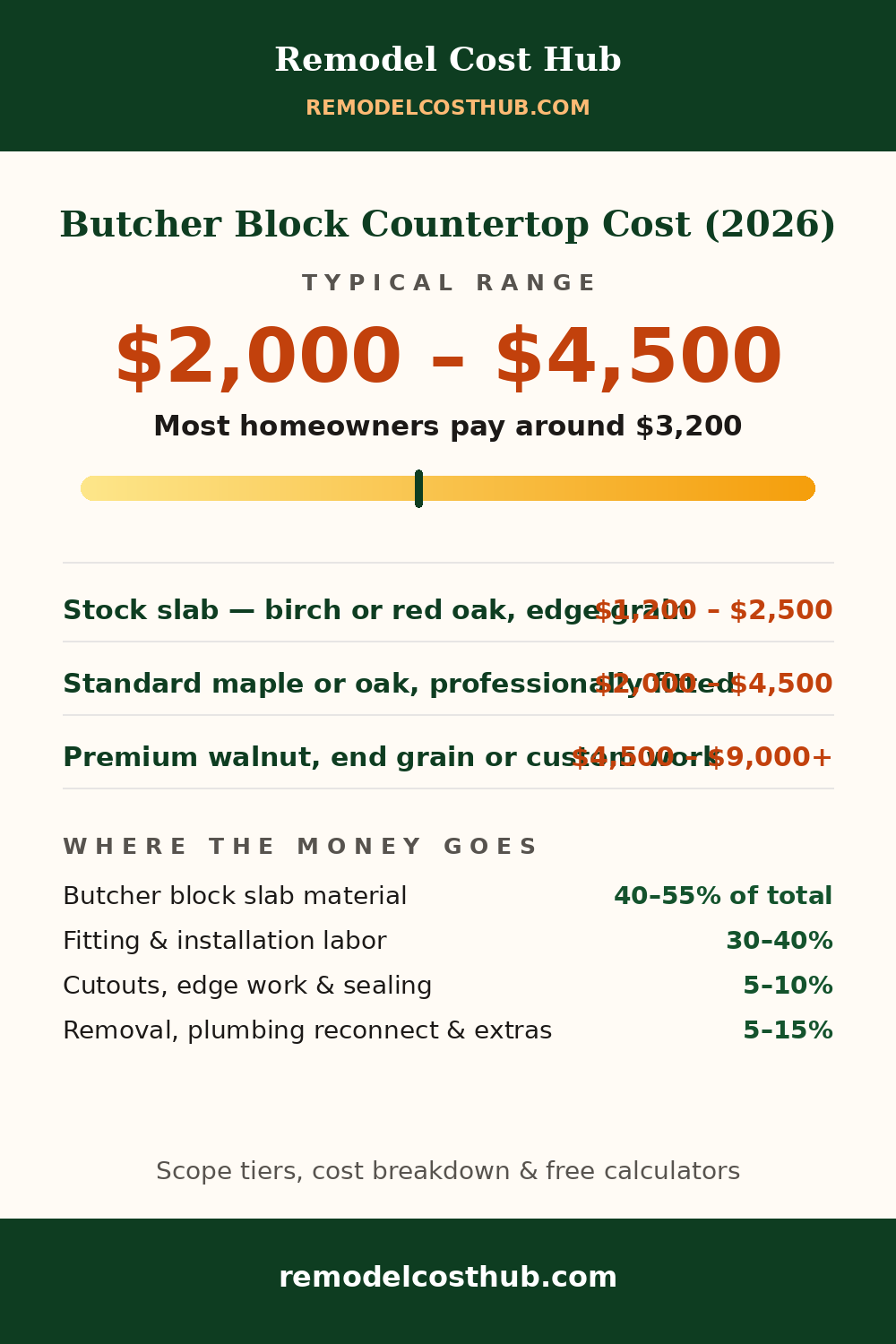
- Typical range: $2,000 – $4,500
- Most homeowners pay: around $3,200
- Per square foot: $50 – $110 per sq ft
- Prices vary most by: Butcher block slab material (40–55% of the budget)
Cross-checked against three published sources for this project. Sources used for this page: the Angi butcher block countertop cost guide, HomeGuide's butcher block countertop cost guide and SlabWise's butcher block countertop cost guide. Sources last checked: October 2026 — HomeGuide, Angi. Last updated October 2026 · How we calculate these costs
Cost by scope
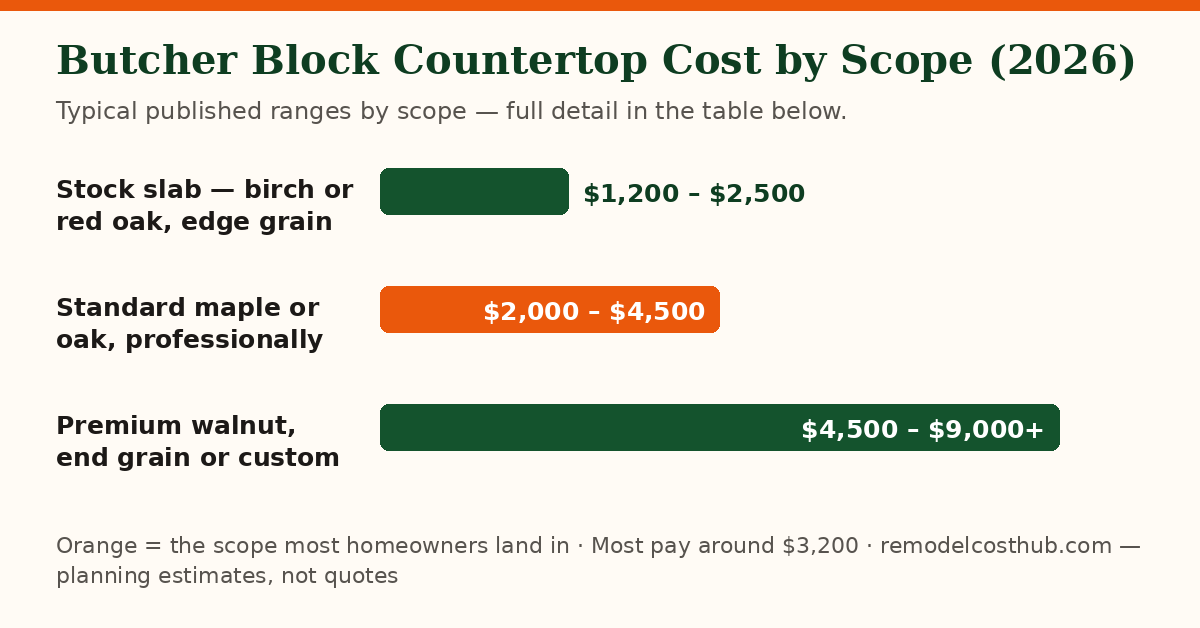
| Scope | Typical cost | What it includes |
|---|---|---|
| Stock slab — birch or red oak, edge grain | $1,200 – $2,500 | A pre-made stock slab in an economical species, standard edge, about 40 sq ft — SlabWise prices birch at $40–$55 per sq ft installed and Angi and HomeGuide both list red oak at $15–$50 per sq ft, the lowest band of any common butcher block wood |
| Standard maple or oak, professionally fitted | $2,000 – $4,500 | Where most butcher block projects land: maple or oak fitted and finished on site over about 40 sq ft — Angi and HomeGuide both put installed butcher block at $50–$150 per sq ft with an average kitchen at $1,500–$6,000, and Angi's average project is about $3,750 |
| Premium walnut, end grain or custom work | $4,500 – $9,000+ | Walnut or cherry, end-grain construction, custom edges and cutouts, or a large kitchen — SlabWise prices walnut at $65–$100 per sq ft installed, Angi prices end grain at $75–$350 per sq ft, and both Angi and HomeGuide put large kitchens at $2,500–$9,000+ |
Where the money goes
| Part of the job | Share | Note |
|---|---|---|
| Butcher block slab material | 40–55% of total | The slab is the largest line: HomeGuide puts the material at $30–$70 per sq ft and SlabWise at $25–$70, and species is what spreads it — maple is the mid-priced standard in both, walnut and exotics price well above it |
| Fitting & installation labor | 30–40% | Templating, cutting, joining, levelling and securing the slab: HomeGuide prices labor and supplies at $20–$80 per sq ft across all jobs, while SlabWise puts standard installation labor at $10–$30 per sq ft for straightforward fits |
| Cutouts, edge work & sealing | 5–10% | Sink and cooktop cutouts (about $100–$200 each in both Angi and HomeGuide), any edge profile beyond a simple eased edge, and the initial sealing or oiling that a wood counter cannot be left without |
| Removal, plumbing reconnect & extras | 5–15% | Removing and disposing of the old counter (about $50–$300 in Angi's data), disconnecting and reconnecting the sink plumbing, and any backsplash added to the job — near zero only when none of that is needed |
What moves the price most
Species and grain decide the slab price before size is even discussed. Angi and HomeGuide agree on the headline band — $50–$150 per sq ft installed, $1,500–$6,000 for an average kitchen — and on the species ladder underneath it: red oak at $15–$50 per sq ft, birch at $25–$75, maple at $40–$80, walnut at $75–$300. SlabWise, pricing standard work more narrowly, puts installed butcher block at $40–$100 per sq ft with maple edge grain at $45–$65 — the standard-species overlap of roughly $50–$110 is the band this page publishes as typical. Grain construction is the second lever: edge grain is the standard counter construction, face grain is cheaper and marks more easily, and end grain — the checkerboard cutting-board construction — is the premium build in every guide. Thickness and finish come third: thicker slabs cost more per foot, and an unfinished slab is cheaper to buy but moves the finishing labor into the install quote. Finally, butcher block is the one counter material with an ongoing line item — regular oiling or resealing, priced by the guides at only about $10–$50 a year in supplies, is not optional maintenance; unsealed wood around a sink is how these counters fail.
Costs in your city
Labor is the biggest variable in any remodel, and labor is local — the same bathroom can price very differently in Houston than in Boston. We are adding city editions metro by metro, each with its own labor index, permit notes and climate factors, written for that city rather than copied from this page. Wave 1: Houston, Dallas–Fort Worth, Phoenix, Atlanta, Miami–South Florida, Orlando, Tampa, Charlotte, Austin and San Antonio. Until your city's page is live, use the national range here and weight it the way contractors do: Sun Belt labor often prices near or below the national middle, while coastal California and the Northeast metros often price well above it.
Frequently asked questions
How much do butcher block countertops cost for an average kitchen?
About $2,000–$4,500 installed is the typical band on this page for about 40 sq ft in a standard species, with most projects landing around $3,200. Angi and HomeGuide both put an average kitchen at $1,500–$6,000 overall, Angi's average project is about $3,750, and SlabWise puts a standard 30 sq ft kitchen at $1,200–$3,000 in common species.
Is butcher block cheaper than granite or quartz?
In standard species, usually yes. HomeGuide notes butcher block at $50–$150 per sq ft installed against granite at $80–$150 and quartz at $50–$200, and SlabWise puts butcher block at $40–$100 against granite at $45–$120 and quartz at $50–$120. Premium walnut or end-grain work closes that gap, and butcher block asks for regular oiling that stone does not.
What is the best wood for a butcher block countertop?
Hard maple is the standard answer in the guides: it is hard, tight-grained, scratch-resistant and mid-priced — $40–$80 per sq ft installed in Angi and HomeGuide, $45–$65 in SlabWise. Birch and red oak are the budget route, walnut is the premium look, and very soft or open-grained woods are the ones to avoid for a working counter.
How long do butcher block countertops last?
The guides put a correctly installed, regularly maintained butcher block at 20 years or more, and because the surface is solid wood it can be sanded and refinished rather than replaced when it is scratched or stained. What shortens that life is water: sealing around the sink and wiping standing water are the maintenance habits the lifespan assumes.
Can I install butcher block countertops myself?
It is one of the more DIY-friendly counter materials — a stock slab, basic carpentry tools and careful measuring cover a straight run. The steps owners most often hire out are the sink cutout, any seam joining two slabs, and the finishing, because a miscut slab is the expensive mistake on this project and wood has to be fitted with room to expand and contract.