Attic Fan Installation cost at a glance
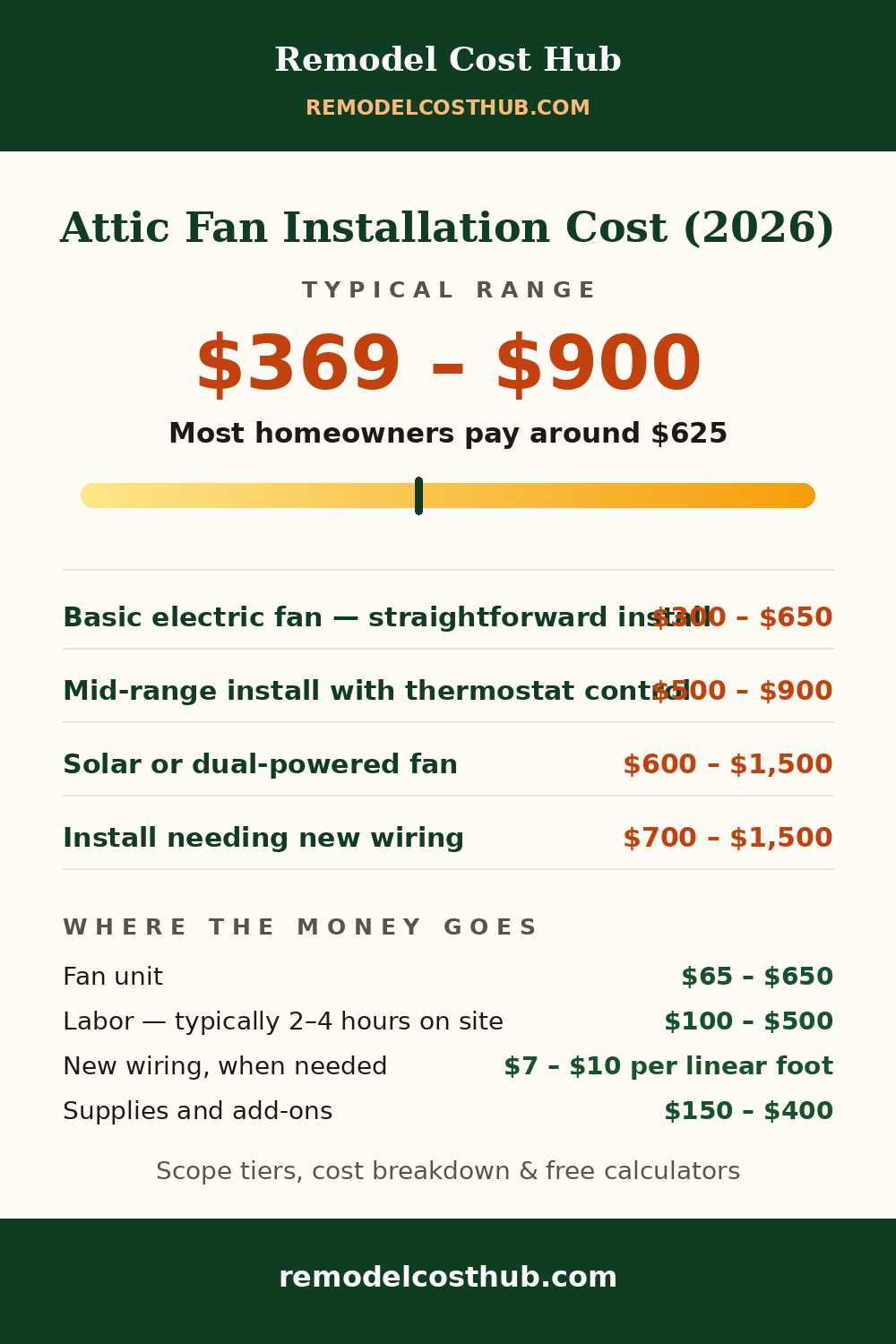
- Typical range: $369 – $900
- Most homeowners pay: around $625
Cross-checked against two published sources for this project. Sources used for this page: the Angi attic fan installation cost guide (September 2026, 2,806 verified projects), Bob Vila's attic fan installation guide (updated August 2026) and Engineer Fix's engineer-authored attic fan cost guide. Sources last checked: October 2026 — Angi, Engineer Fix. How we calculate these costs
Cost by scope
| Scope | Typical cost | What it includes |
|---|---|---|
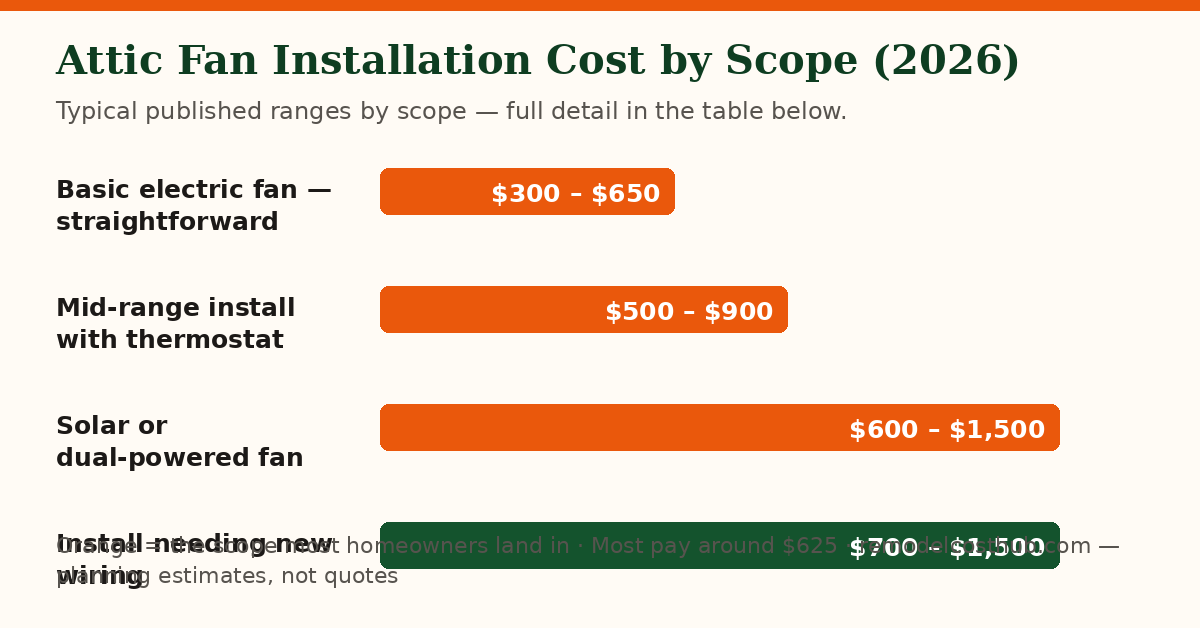
| Basic electric fan — straightforward install | $300 – $650 | The existing-opening, no-new-wiring case — Bob Vila’s typical total starts at $300 and Angi’s most-pay band opens at $369; standard electric fan units run $100–$450 (Angi) |
| Mid-range install with thermostat control | $500 – $900 | Where most homeowners land — Angi’s most-pay band is $369–$914 and Bob Vila’s typical tops out at $900; a thermostat add-on alone runs $150–$400 (Angi) |
| Solar or dual-powered fan | $600 – $1,500 | The premium units — solar fans $200–$850 (Engineer Fix) to $300–$1,000 (Angi) before labor; Engineer Fix’s professional range tops out at $1,500 for complex jobs |
| Install needing new wiring | $700 – $1,500 | The biggest cost driver — a new dedicated circuit runs $7–$10 per linear foot (Engineer Fix), potentially adding hundreds and pushing totals toward the high end |
Where the money goes
| Part of the job | Share | Note |
|---|---|---|
| Fan unit | $65 – $650 | Angi’s largest material line — $100–$450 for standard electric fans, $300–$1,000 for solar or dual-powered |
| Labor — typically 2–4 hours on site | $100 – $500 | Angi’s $45–$85 an hour; Bob Vila’s $100–$500 for more extensive jobs; Engineer Fix’s $100–$700 professional labor — no source publishes a labor-vs-materials percentage split |
| New wiring, when needed | $7 – $10 per linear foot | Engineer Fix’s per-foot rate for a new circuit to the attic — the single biggest labor factor on complex installs |
| Supplies and add-ons | $150 – $400 | Angi’s supplies budget — shingles, vents, flashing; automatic shutters $50–$80, humidistat $50–$100 |
What moves the price most
Fan type and power source is the biggest driver. Passive and turbine vents are cheapest, solar and dual-powered the priciest — every source agrees on the hierarchy (Angi: passive $75–$100, turbine $100–$150, electric $100–$450, solar $300–$1,000). Wiring complexity is the labor driver: a new dedicated circuit at $7–$10 per linear foot can add hundreds (Engineer Fix). Attic size sets the CFM you need — Angi’s sizing rule is attic square footage × ceiling height × 0.7, roughly 700 CFM per 1,000 square feet. Roof access matters: steep or high roofs and tight crawl spaces raise labor, and installing where an opening already exists is cheaper than cutting a new hole. Controls (thermostat, humidistat, automatic shutters) add $50–$400 (Angi). Season helps — scheduling off-season can lower labor rates (Angi). And permits are required in most jurisdictions for new electrical wiring or structural roof changes (Engineer Fix). One honest conflict: Angi says a quality thermostatic electric fan costs very little per year to run, while HomeGuide’s contractor reporting says most pros don’t recommend electric fans because the energy can negate AC savings — both views are published, neither is settled.
Costs in your city
Labor is the biggest variable in any remodel, and labor is local — the same bathroom can price very differently in Houston than in Boston. We are adding city editions metro by metro, each with its own labor index, permit notes and climate factors, written for that city rather than copied from this page. Wave 1: Houston, Dallas–Fort Worth, Phoenix, Atlanta, Miami–South Florida, Orlando, Tampa, Charlotte, Austin and San Antonio. Until your city's page is live, use the national range here and weight it the way contractors do: Sun Belt labor often prices near or below the national middle, while coastal California and the Northeast metros often price well above it.
Frequently asked questions
How much does attic fan installation cost?
Typically $369–$900 — Angi’s 2,806 verified projects (September 2026) average $625 with most homeowners paying $369–$914; Bob Vila’s typical band is $300–$900 and Engineer Fix puts professional installs at $300–$1,500 with a ~$625 average.
How much does an attic fan unit cost?
$100–$450 for a standard electric fan (Angi); $300–$1,000 for solar or dual-powered; $75–$100 for passive vents and $100–$150 for roof turbines — before labor.
How long does attic fan installation take?
A straightforward professional install takes 2–4 hours (Angi); jobs needing new vents or new wiring run longer.
Do I need an electrician to install an attic fan?
Only if new wiring is involved — a roofer handles roof-mounted cutting and sealing, a licensed electrician handles any new circuit, a carpenter handles gable structural framing (Bob Vila). New wiring runs $7–$10 per linear foot (Engineer Fix).
Are electric attic fans worth it?
Genuinely disputed. Angi says a quality thermostatic model costs very little per year to operate; HomeGuide’s reporting says most pros don’t recommend electric fans because the energy use can wipe out AC savings, and notes they are banned in some states. Solar fans cost nothing to run and can qualify for up to a 30% federal tax credit on purchase and installation (Angi).
What size attic fan do I need?
Angi’s published rule: measure attic square footage × ceiling height for cubic footage, then multiply by 0.7 — about 700 CFM per 1,000 square feet of attic floor, adjusted up for dark or steep roofs.