Aluminum Siding Installation cost at a glance
- Typical range: $6,000 – $14,500
- Most homeowners pay: around $11,750
- Per square foot: $6–$10 per sq ft
- Prices vary most by: Aluminum panels (profile and gauge) (35–50% of the budget)
Cross-checked against four published sources for this project. Sources used for this page: Angi's aluminum siding cost guide, updated July 9, 2026 (average about $11,750, overall range $4,500–$19,000; types corrugated $3–$7, longboard $14–$18 per square foot; size table 500 sq ft $1,500–$3,750, 1,000 sq ft $2,250–$5,250, 1,500 sq ft $4,500–$11,000, 2,000 sq ft $6,000–$14,500, 2,500 sq ft $7,500–$19,000), HomeGuide's house siding cost guide (aluminum $6–$10 per square foot installed, $15,000–$25,000 for a 2,500-square-foot house; panel thickness and pre-painted versus raw finish drive the total) and This Old House's siding replacement cost guide, using Homewyse data (aluminum material $4.11, installed $7.32 per square foot, 20–40-year lifespan, average 2,000-square-foot home $14,649; dents easily and can corrode) — HomeGuide's and This Old House's higher totals are published as their larger-house, all-in scope, not averaged away. Sources last checked: October 2026 — This Old House, HomeGuide, Angi, Homewyse. How we calculate these costs
Cost by scope
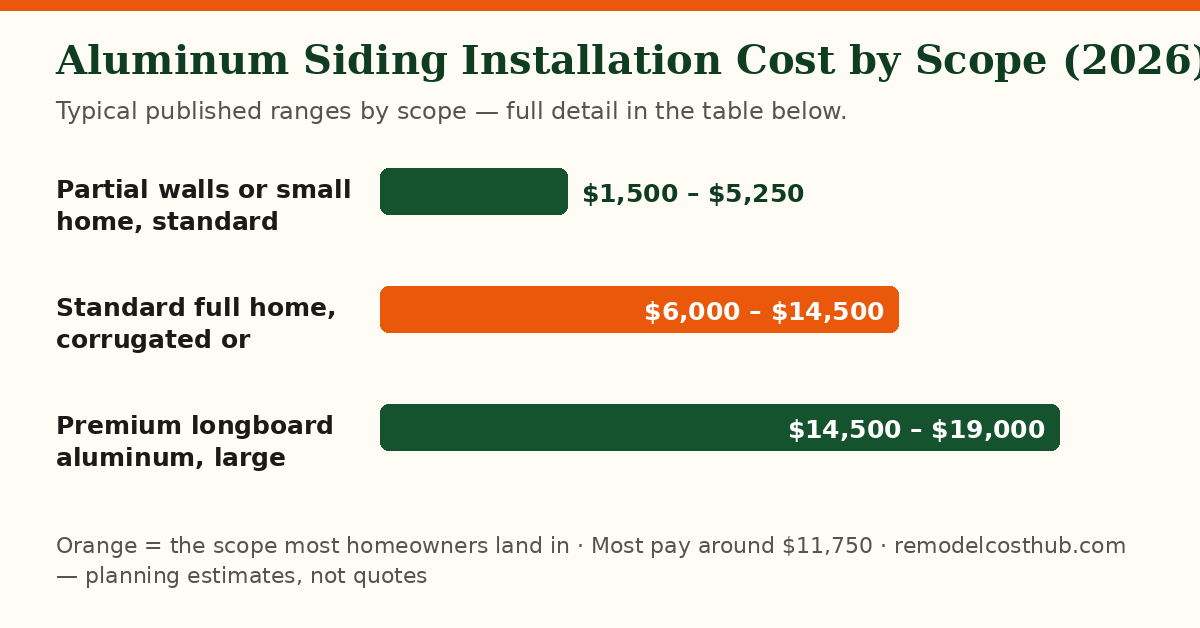
| Scope | Typical cost | What it includes |
|---|---|---|
| Partial walls or small home, standard corrugated | $1,500 – $5,250 | The cheap end: Angi's size table puts a 500-square-foot home at $1,500–$3,750 and a 1,000-square-foot home at $2,250–$5,250, and corrugated aluminum — its cheapest profile at $3–$7 per square foot — is what that end is built from |
| Standard full home, corrugated or horizontal aluminum — the typical job | $6,000 – $14,500 | The shared band itself: Angi's 2,000-square-foot-home band, with HomeGuide's $6–$10 per sq ft and This Old House's $7.32 per sq ft both inside the standard-profile overlap |
| Premium longboard aluminum, large home — the top end | $14,500 – $19,000 | The expensive end: Angi runs its overall range to $19,000 and prices longboard at $14–$18 per square foot, so a full longboard house is a different price class from a standard corrugated job |
Where the money goes
| Part of the job | Share | Note |
|---|---|---|
| Aluminum panels (profile and gauge) | 35–50% of total | The panels: Angi prices corrugated at $3–$7 per square foot and longboard at $14–$18 — profile alone can more than double the material line, and heavier gauges sit at the top of each profile |
| Installation labor (fitting, trimming, detailing) | 30–45% of total | The fitting: Angi's general siding guide puts siding labor at $1–$4 per square foot, and This Old House's material-versus-installed gap ($4.11 against $7.32 per square foot) puts labor at roughly 40% of an aluminum job |
| Trim, house wrap, fasteners and accessories | 10–20% of total | The finish: corner boards, J-channels, starter strips and house wrap are priced with the panels, and longboard's custom trims sit at the top of this line |
| Old siding removal and repainting | 5–15% of total | The extras: removal is a separate per-square-foot line in the guides, and aluminum's chalking and fading are handled by repainting — a recurring finish cost, not a panel replacement |
What moves the price most
Profile is the budget cliff. Corrugated aluminum at $3–$7 per square foot and longboard at $14–$18 are not two grades of the same product — they are different looks, different gauges and different prices, and choosing longboard moves a standard house into the premium tier by itself. Wall area, not living area, is the second driver: the guides price by siding square footage, so a sprawling one-story home can carry more wall than a compact two-story one of the same floor area. Denting is aluminum's named weakness in both Angi and This Old House — hail and hard impacts mark it where vinyl would flex and fiber cement would not — which is why heavier gauges, priced higher, exist at all. Finally, removal and repainting are the quiet lines: old siding has to come off and be hauled away, and a chalked or faded finish is repainted rather than replaced.
Costs in your city
Labor is the biggest variable in any remodel, and labor is local — the same bathroom can price very differently in Houston than in Boston. We are adding city editions metro by metro, each with its own labor index, permit notes and climate factors, written for that city rather than copied from this page. Wave 1: Houston, Dallas–Fort Worth, Phoenix, Atlanta, Miami–South Florida, Orlando, Tampa, Charlotte, Austin and San Antonio. Until your city's page is live, use the national range here and weight it the way contractors do: Sun Belt labor often prices near or below the national middle, while coastal California and the Northeast metros often price well above it.
Frequently asked questions
How long does aluminum siding last?
The siding tables in Angi and This Old House both give aluminum 20–40 years, and Angi's metal siding guide lists a 50-year lifespan for aluminum in its own table — the honest planning figure is 20–40 years with its finish maintained, longer where hail and impacts are rare.
Can aluminum siding be painted?
Yes — painting is a standard part of aluminum's life cycle, and the guides list painting as a cost factor on aluminum jobs. A chalked or faded finish is repainted rather than replaced, which is one reason aluminum's lifetime cost stays below its replacement cost.
Does aluminum siding dent easily?
It is the material's named weakness: both Angi and This Old House list denting (and corrosion where the finish is damaged) as aluminum's main drawback against vinyl, wood and fiber cement. Heavier gauges resist dents better and cost more, which is the trade the premium tier prices.
Is aluminum siding cheaper than vinyl?
Roughly comparable, not clearly cheaper: Angi's general siding table prices aluminum at $3–$6 per square foot installed against vinyl at $3–$12, while HomeGuide prices aluminum at $6–$10 against vinyl at $4–$12 — the two materials overlap, and profile and gauge decide which quote is lower on a given house.