Storm Shelter Installation cost at a glance
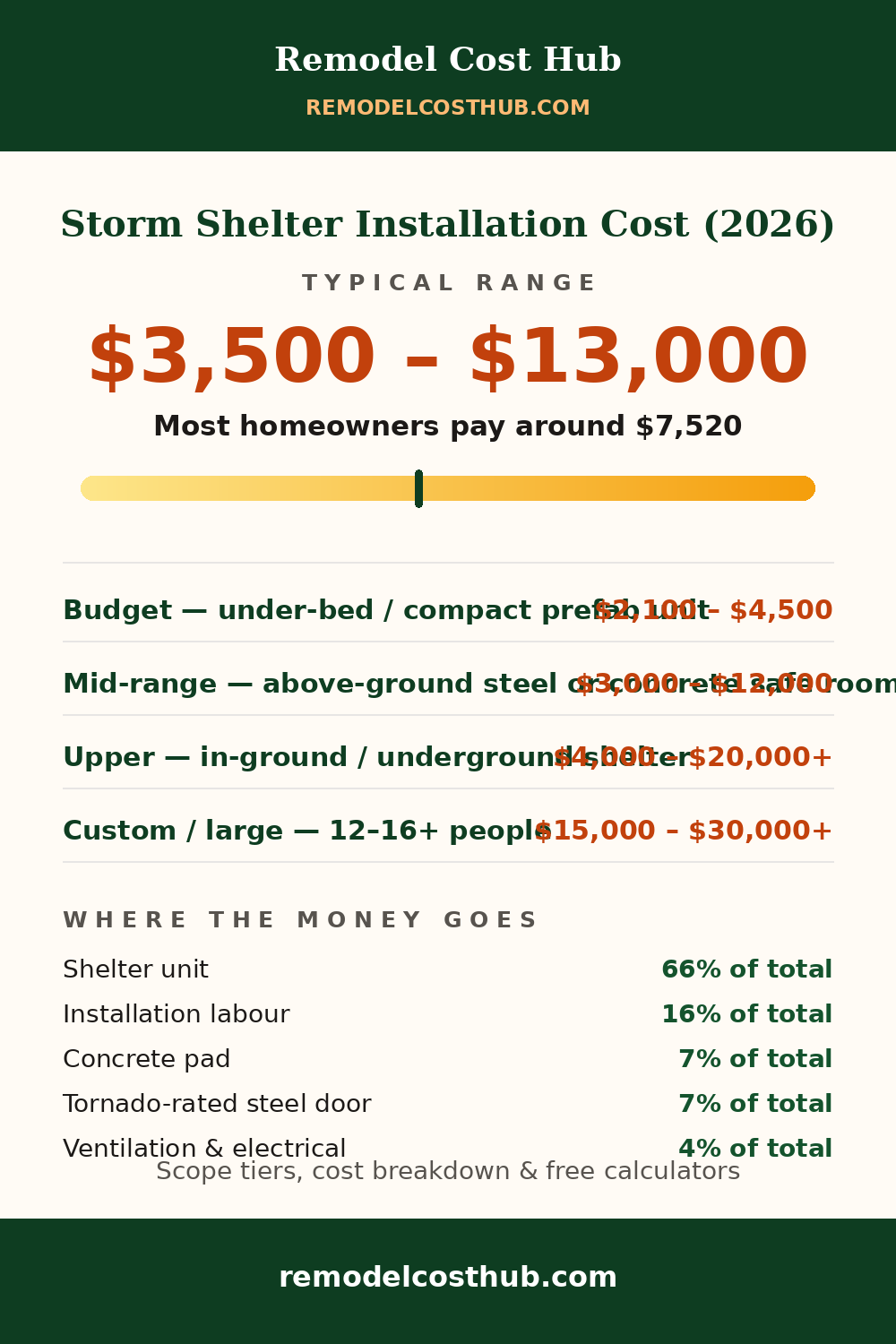
- Typical range: $3,500 – $13,000
- Most homeowners pay: around $7,520
Cross-checked against three published sources for this project. Sources used for this page: Angi, What Is a Storm Shelter? (updated Jul 9, 2026; national average $7,520, up to $30,000 for a 15-person unit; 250 mph wind rating; no typical range of its own — its cost detail is thin), HomeGuide, Tornado & Storm Shelter Costs in 2026 — Build vs. Buy (published May 12, 2023, updated Feb 22, 2024 — the oldest of the three, so its figures are the stalest; typical $3,500–$15,000; by size 2 people $2,800–$4,500 to 16+ people $7,500–$20,000+; concrete $3,700–$7,000+, steel $4,500–$20,000+, fiberglass $4,700–$10,000+; labour $250–$3,000+; concrete pad $5–$10/sq ft; steel door alone $500–$2,500+; permits: most cities do not require one when anchoring to an existing slab, typically required for a new slab or underground build — no dollar fee published), NerdWallet, How Much Does a Storm Shelter Cost in 2026? (updated Jul 28, 2025; its cost figures are explicitly attributed to Angi — $3,000–$13,000 range — so it is corroboration of Angi, not a third dataset; type bands are its own presentation: above-ground ceiling $15,000; interior safe room $3,000–$10,000+), LendEDU, Storm Shelter Cost: What to Expect and Budget (published Dec 22, 2025, updated Apr 1, 2026 — DERIVATIVE: states in its own header that all costs are sourced from contractor estimates via Angi and HomeGuide; per-sq-ft $150–$350, labour typically 10–20% of total, new slab $500–$1,500 extra, insurance discount 5–20%, county rebates $300–$1,500, FEMA grants up to 75% — all single-source via LendEDU). Typical $3,500–$13,000 is the honest overlap of HomeGuide ($3,500–$15,000) and Angi ($3,000–$13,000); $7,520 is Angi's figure alone. No source gives percentage breakdown shares or a permit fee — none is published; shares are derived from the worked example below. Checked November 2026.. Sources last checked: October 2026 — NerdWallet, HomeGuide, Angi. How we calculate these costs
Cost by scope
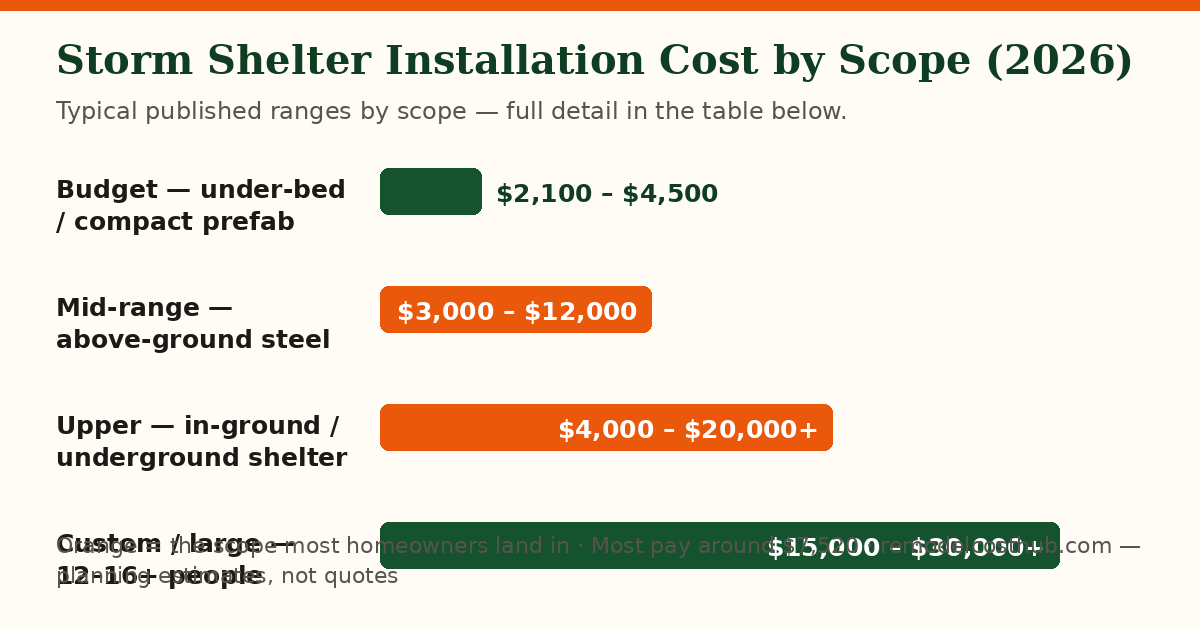
| Scope | Typical cost | What it includes |
|---|---|---|
| Budget — under-bed / compact prefab unit | $2,100 – $4,500 | A compact prefab unit for 2–3 people, typically installed in a garage or closet — the cheapest entry point. All four sources agree on this band (Angi; HomeGuide $2,800–$4,500 for 2 people; NerdWallet and LendEDU $2,100–$4,500). Holds 2–3 people only. |
| Mid-range — above-ground steel or concrete safe room | $3,000 – $12,000 | An above-ground safe room in a garage, basement, closet or freestanding — steel or concrete, anchored to the slab, with a tornado-rated door. This is where the $7,520 most-pay example sits. Grounded in HomeGuide's $3,000–$12,000+ and LendEDU's $3,000–$12,000; NerdWallet puts the ceiling at $15,000. |
| Upper — in-ground / underground shelter | $4,000 – $20,000+ | An in-ground shelter, typically under a garage floor or in the yard — excavation, waterproofing and drainage included. All sources agree on this band. A garage below-floor unit runs $6,000–$15,000 (HomeGuide; LendEDU $10,000–$15,000) and a basement safe-room conversion $6,000–$15,000. |
| Custom / large — 12–16+ people | $15,000 – $30,000+ | A large custom concrete or steel shelter for 12–16+ people, or a walk-in safe room built into the house. Angi prices a 15-person unit at as much as $30,000; LendEDU prices 15+ people at $15,000–$30,000+. HomeGuide's ceiling for 16+ people is lower, at $20,000+ — the spread is a genuine disagreement between the guides. Full underground bunkers run $40,000–$80,000 (HomeGuide, single source) and are a different job. |
Where the money goes
| Part of the job | Share | Note |
|---|---|---|
| Shelter unit | 66% of total | $5,000 for the shelter unit itself — the bulk of the total; see the tiers above. HomeGuide prices concrete units at $3,700–$7,000+, steel at $4,500–$20,000+ and fiberglass at $4,700–$10,000+. Share derived from the worked example below. |
| Installation labour | 16% of total | $1,200 for installation labour. HomeGuide prices labour at $250–$3,000+ ($50–$150 per hour); LendEDU prices $250–$2,000 and says labour is typically 10–20% of the total (single source). Share derived from the worked example below. |
| Concrete pad | 7% of total | $500 for a concrete pad under an above-ground unit. HomeGuide prices a pad at $5–$10 per sq ft; LendEDU at $6–$12 per sq ft; a new slab adds $500–$1,500 (LendEDU, single source). Share derived from the worked example below. |
| Tornado-rated steel door | 7% of total | $500 for the steel door. HomeGuide prices a tornado-rated steel door bought alone at $500–$2,500+ (single source). Share derived from the worked example below. |
| Ventilation & electrical | 4% of total | $320 for ventilation and electrical hookup. An HVAC pro runs $75–$150 per hour and interior wiring $4–$9 per sq ft (HomeGuide); fans and lighting wiring run $500–$2,000+ (LendEDU, single source). No opened source prices a ventilation unit itself. Share derived from the worked example below. |
What moves the price most
What it is: a storm shelter — also called a safe room or tornado shelter; Angi notes that technically there is no difference between the terms — is a reinforced room or structure built to FEMA P-320 (residential safe rooms) and the ICC 500 building-code standard, rated to resist 250 mph winds and wind-borne debris. FEMA does not certify, approve or endorse any shelter or company — it publishes guidance, and units are tested to ICC 500. Do not buy a shelter sold as "FEMA-certified". Range: $3,500–$13,000 is the honest overlap of HomeGuide ($3,500–$15,000, updated Feb 2024) and Angi ($3,000–$13,000, via NerdWallet and LendEDU); $7,520 is Angi's national average alone — HomeGuide gives no average and LendEDU rounds the same Angi figure to $7,500. Per square foot: $150–$350 (LendEDU, single source — no other opened source gives a shelter per-sq-ft rate; HomeGuide's $90–$210 per sq ft is for building a home addition to house a safe room, a different scope). Size: a 2-person unit runs $2,800–$4,500, 4 people $3,500–$7,000, 6 people $3,800–$7,800, 8 people $4,500–$8,500, 10 people $5,000–$9,000 and 12 people $5,500–$15,000 (HomeGuide); LendEDU agrees at 4–6 people (20–30 sq ft) $3,000–$8,000 and 8–12 people (40–60 sq ft) $6,500–$12,000, but prices 15+ people at $15,000–$30,000+ against HomeGuide's $7,500–$20,000+ for 16+ — a genuine disagreement on the large-unit ceiling. FEMA recommends at least 5 sq ft per person for a tornado shelter (10 for a wheelchair user, 30 for someone needing a bed or stretcher); hurricane rooms need more — 7–10 sq ft per person (HomeGuide) and up to 20 (Angi) — because you may stay inside for hours. Material: concrete $3,700–$7,000+ (HomeGuide) or $3,500–$8,000 (LendEDU) — the budget option, 50+ year lifespan, but it can leak or crack over time; steel $4,500–$20,000+ (both agree) — the widest size range, 50+ years; fiberglass $4,700–$10,000+ (both agree) — underground only, about 25 years, and it can crack with ground movement or temperature swings. A wood-frame shelter built to the USDA Forest Products Lab design runs $4,300–$5,000+ in materials only (HomeGuide, single source). Above ground vs underground: above-ground $3,000–$12,000 (HomeGuide; LendEDU agrees; NerdWallet's ceiling is $15,000) against underground $4,000–$20,000+ (all sources agree) — underground adds excavation, waterproofing and drainage. Above-ground also suits flood zones and high water tables and is easier to reach for people with mobility issues; underground offers maximum debris protection and takes no floor space. A garage below-floor unit runs $6,000–$15,000 (HomeGuide) against $10,000–$15,000 (LendEDU), and a basement safe-room conversion $6,000–$15,000 (both agree). Site and soil: rocky or clay soil, a high water table, flooding risk, poor drainage and limited access (narrow gates, slopes, trees) all add cost — a high water table or flood zone can rule out underground entirely. Excavation runs $2.50–$15.00 per cubic yard or $100–$300 per hour (HomeGuide; LendEDU agrees), and a geotechnical or soil report $1,000–$5,000 (both agree). Location: Tornado Alley (Oklahoma, Kansas, Texas) and hurricane coasts have the most demand and stricter codes; city labour rates run higher than small towns (LendEDU). Install time: a prefab above-ground shelter typically goes in within 3–8 hours (HomeGuide; LendEDU agrees); underground installation takes 1–3 days (LendEDU), while a large custom underground shelter can take 2–3+ months from design to completion (HomeGuide) — different scopes, not a contradiction. Timing: building during new construction is 20–30% cheaper than retrofitting an existing home (HomeGuide, single source). Permits: no dollar fee is published anywhere — most cities do not require a permit when you anchor a shelter to an existing concrete slab, but a new slab or an underground build typically does require one (HomeGuide); check with your local building department before work starts. Add-ons: escape hatch $250–$300, security lock $75–$200+, bench $150–$400+, shelving $50–$400+, emergency cot $50–$200+, railing $50–$100+, plumbing $450–$1,800 per fixture, light fixture $70–$300+ (HomeGuide, single source); a separate anchor fee of $200–$350 at some companies (HomeGuide, single source); delivery $2–$10 per mile outside the maker's service area (HomeGuide, single source) and trucking or crane time $1,000–$3,000 if billed separately (LendEDU, single source). Value and help with the cost: in storm-prone areas a shelter adds about 3.5% to home value (FEMA / Federal Alliance for Safe Homes, via HomeGuide, NerdWallet and LendEDU — all three cite the same origin); on a $300,000 home that is roughly $10,500. Some insurers offer a 5–20% premium discount for a FEMA-compliant safe room (LendEDU, single source). FEMA does not pay homeowners directly — its Hazard Mitigation Assistance money flows to states, which run the grants; some states offer a tax credit up to $3,000 (HomeGuide) and county rebates typically run $300–$1,500 (LendEDU, single source), with FEMA grants covering up to 75% in some programs (LendEDU, single source). Worked example at the most-pay figure: a mid-range above-ground steel safe room — shelter unit $5,000 + installation labour $1,200 + concrete pad $500 + steel door $500 + ventilation and electrical $320 = $7,520. For the slab it anchors to, see our concrete driveway guide; for a garage installation, see our garage door replacement guide; for keeping the basement dry around it, see our basement waterproofing guide; and for the room it may be built into, see our home addition guide.
Costs in your city
Labor is the biggest variable in any remodel, and labor is local — the same bathroom can price very differently in Houston than in Boston. We are adding city editions metro by metro, each with its own labor index, permit notes and climate factors, written for that city rather than copied from this page. Wave 1: Houston, Dallas–Fort Worth, Phoenix, Atlanta, Miami–South Florida, Orlando, Tampa, Charlotte, Austin and San Antonio. Until your city's page is live, use the national range here and weight it the way contractors do: Sun Belt labor often prices near or below the national middle, while coastal California and the Northeast metros often price well above it.
Frequently asked questions
How much does a storm shelter cost?
Most residential storm shelters cost $3,500–$13,000 installed — the overlap of HomeGuide's $3,500–$15,000 and Angi's $3,000–$13,000. Angi's national average is $7,520. Small under-bed units start around $2,100; large or custom underground shelters can reach $20,000–$30,000.
Is an above-ground or underground storm shelter cheaper?
Above-ground is cheaper: $3,000–$12,000 (HomeGuide; LendEDU agrees) against $4,000–$20,000+ underground (all sources agree), because underground adds excavation, waterproofing and drainage. Above-ground also suits flood zones and high water tables and is easier to reach for people with mobility issues; underground offers maximum debris protection and takes no floor space.
How big should a storm shelter be?
FEMA recommends at least 5 sq ft per person for a tornado shelter — 10 sq ft for a wheelchair user and 30 for someone needing a bed or stretcher. Hurricane safe rooms need more — 7–10 sq ft per person (HomeGuide) and up to 20 sq ft (Angi) — because you may stay inside for hours. A family of 4–6 typically needs a 20–30 sq ft unit.
Do I need a permit to install a storm shelter?
It depends on your city. Most cities do not require a permit when you anchor a shelter to an existing concrete slab, but a new slab or an underground installation typically does require one (HomeGuide). Check with your local building department before work starts; no permit fee is quoted here because fees vary by city and no opened source gives one.
Will FEMA pay for my storm shelter?
No — FEMA does not pay homeowners directly. It distributes money to states through the Hazard Mitigation Assistance program, and the states run the grants; some states also offer tax credits up to $3,000 (HomeGuide). Contact your State Hazard Mitigation Officer to check what is available where you live.
Does a storm shelter increase home value?
In storm-prone areas, yes — by about 3.5% of the home's value, according to FEMA and the Federal Alliance for Safe Homes (HomeGuide; NerdWallet; LendEDU). On a $300,000 home that is roughly $10,500. Some insurers also offer a 5–20% premium discount for a FEMA-compliant safe room (LendEDU, single source).